
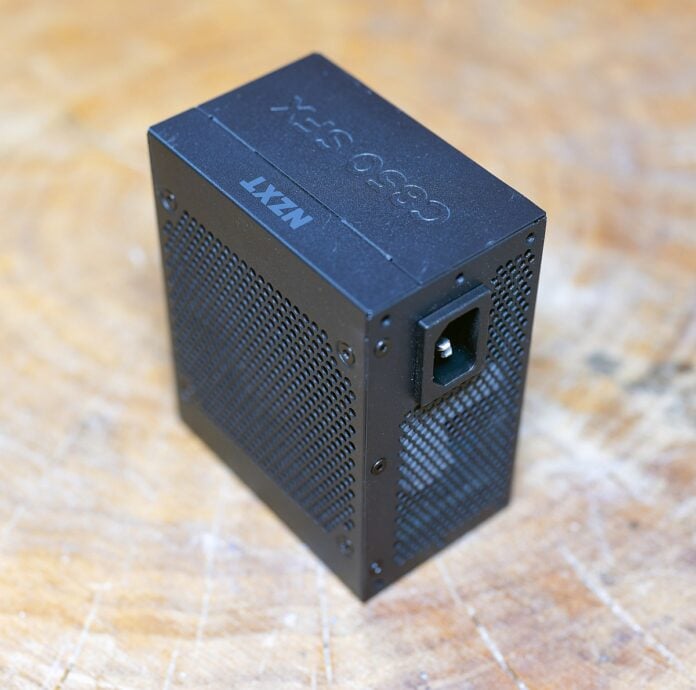
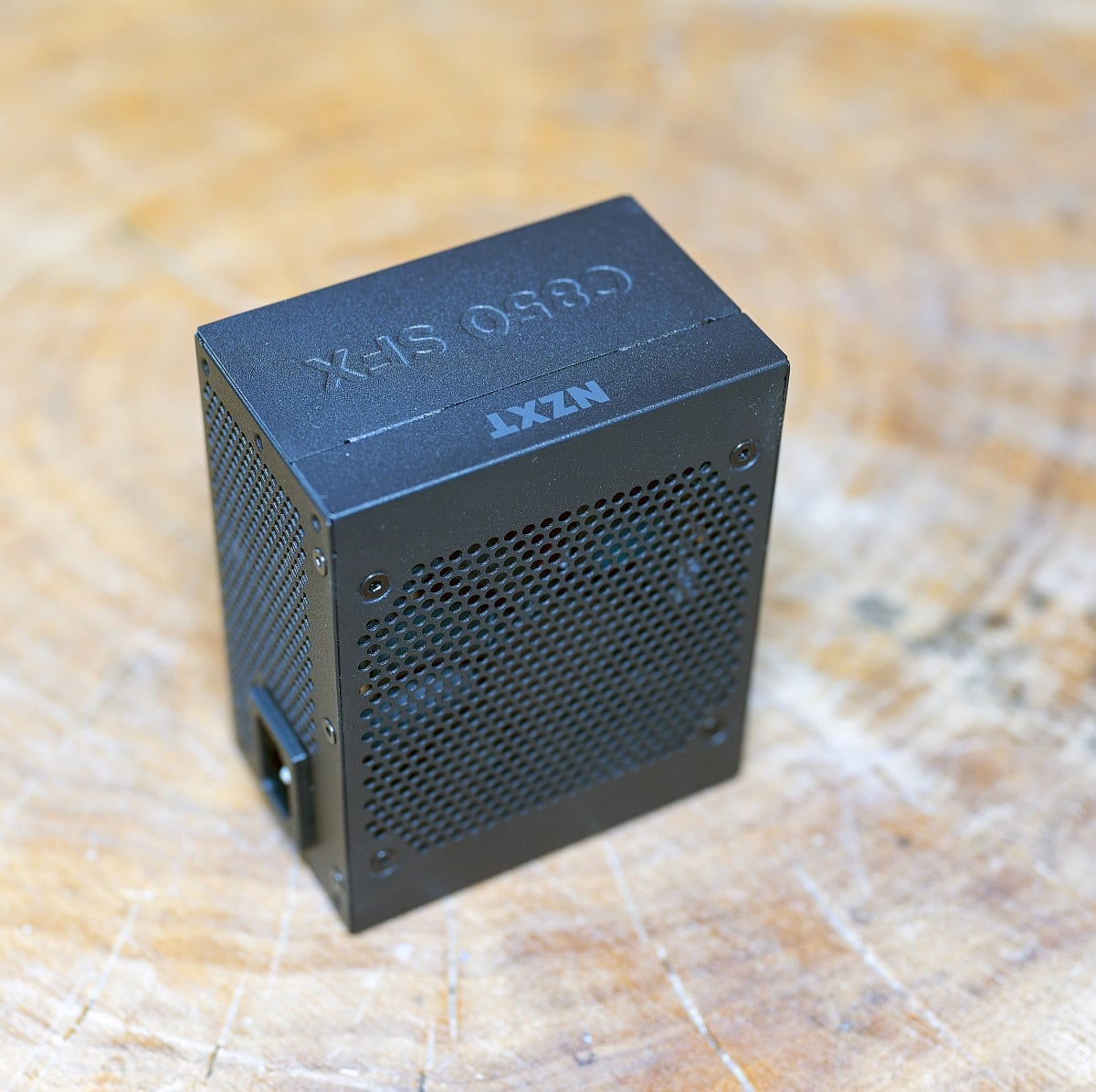
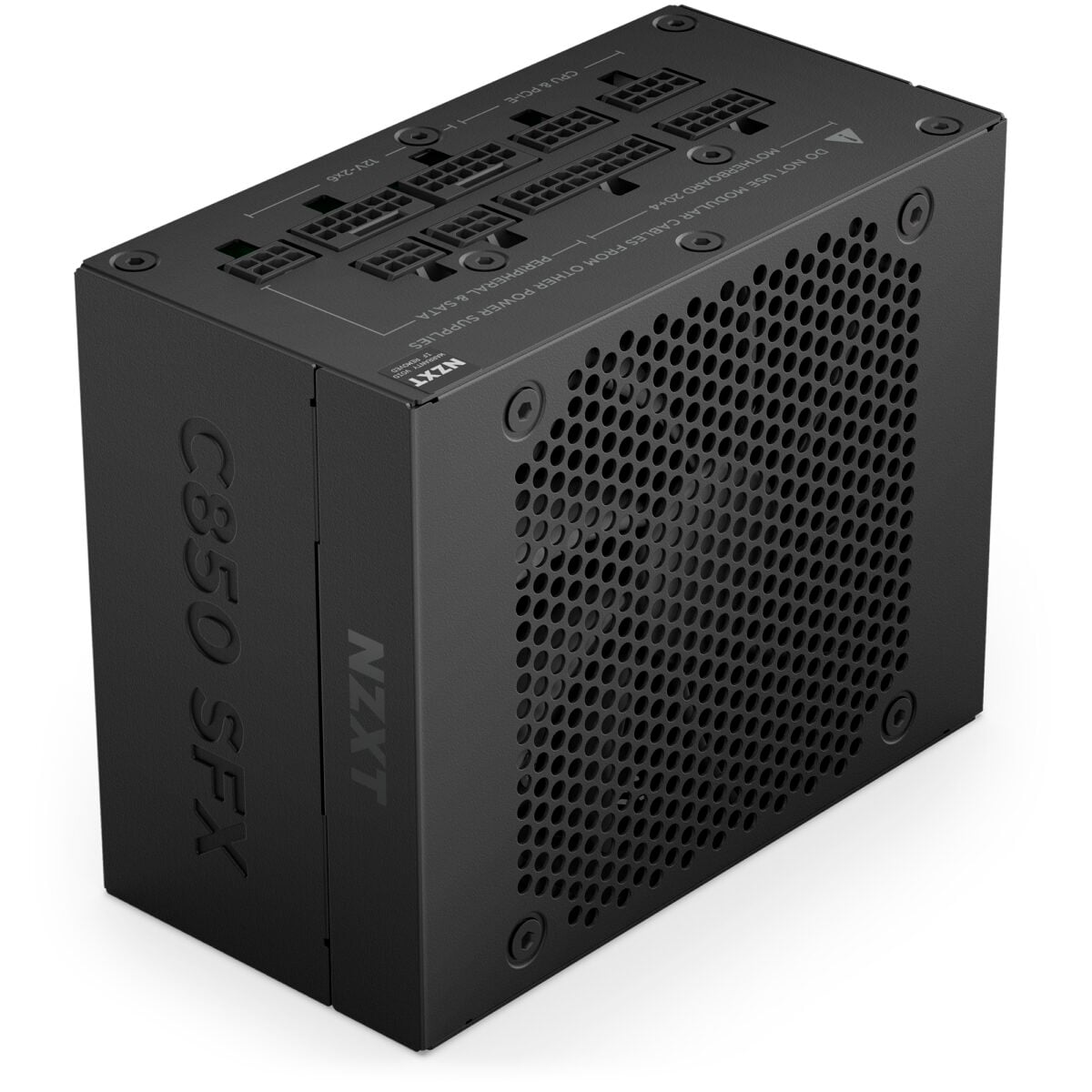
If you are planning a powerful gaming rig in a shoebox‑sized chassis, the power supply is no longer a humble afterthought. To this end, NZXT plans to take the guesswork out of pairing next‑gen graphics cards with small‑form‑factor (SFF) enclosures through the release of the C850 SFX Gold model, which is the firm’s most compact PSU to date. Despite its small, standardised 125 x 63.5 x 100mm footprint, this 850W SFX unit offers full ATX 3.1 compliance, a native 600W 12V‑2×6 PCIe 5.1 connector, and fully modular cabling designed for tight spaces.
The proposition is straightforward: to deliver clean, stable power to GPUs up to GeForce RTX 5080 or Radeon RX 9070 XT while keeping noise and cable clutter in check. With 80 Plus Gold and Cybenetics Platinum efficiency ratings, 100% Japanese 105°C capacitors, a 92mm fluid‑dynamic‑bearing fan with Zero RPM mode, and a 10‑year warranty, NZXT clearly wants this unit to be a long‑term anchor for serious SFF builds. Let me dig in.

NZXT C850 SFX Gold 850W
£139 / €159
Pros
- Reasonable pricing
- Cybenetics Platinum certificate
- Very solid performance for its class
- 10-year warranty
- ATX 3.1/PCIe 5.1 compatibility
Cons
- Only one 8-pin CPU connector
- Lack of power-off button
- Loud operation at over 75% load
Club386 may earn an affiliate commission when you purchase products through links on our site.
How we test and review products.
Specs and features
On paper, the NZXT C850 SFX Gold ticks key modern boxes for a high‑end compact PSU, and I can verify this by looking at the robust specifications.
| Power and platform wattage |
| Throughput: 850W continuous at up to 50°C ambient. |
| Form factor: SFX, ATX12V v3.1, EPS12V v2.92 compliant. |
| Main rails: single 12V rail rated at 70.83A (850W), 3.3V and 5V combined up to 100W, 5VSB at 3A (15W). |
| Power factor correction: active, with PF up to 0.97. |
| Efficiency and acoustics |
| 80 Plus Gold: up to 91.1% at 20% load, 92.1% at 50% load, and 89.2% at full load (115V). |
| Cybenetics efficiency: Platinum‑class average efficiency (≈90–92% depending on input voltage). |
| Cybenetics noise rating: A‑, with average noise roughly in the 25–30 dBA bracket under typical test conditions. |
| Cooling |
| Fan: 92mm PWM fluid dynamic bearing, rated up to 3,500 ±10% rpm, 57cfm and 41 dBA at maximum speed. |
| Zero RPM mode: the fan remains off at low loads, spinning up only as thermal thresholds dictate. |
| Build and protections |
| Capacitors: all 105°C‑rated Japanese electrolytics for primary and secondary stages. |
| Protections: OVP, UVP, OCP, OPP, SCP, OTP. |
| MTBF: 100,000 hours at 25°C. |
| Compliance and warranty |
| Safety and EMC: CE, UKCA, FCC, IC, BSMI, CB, IEC 62368‑1, EN 62368‑1, KC. |
| Warranty: 10 years across all regions. |
Core selling points revolve around next‑gen readiness and build experience. The unit is fully ATX 3.1-certified and ships with a dedicated 600W 12V‑2×6 PCIe 5.1 cable, which matches the latest guidance for high‑transient GPUs and replaces the older 12VHPWR standard. NZXT explicitly supports graphics cards such as the GeForce RTX 5080 and Radeon RX 9070 XT, positioning the 850W as a solid ceiling for single‑GPU, high‑end gaming rigs.
Users looking to put an RTX 5090 into a small-form-factor rig need to look elsewhere, however. NZXT is clear in its guidance that while it may work in concert with this supply, it is not recommended. Neither are heavily overclocked systems, and I see the logic in this line of thinking.
The fully modular, individually embossed cables and shorter lengths aim to make cable management less of an ordeal in compact cases. By allowing builders to connect only the essentials, airflow around the GPU and CPU cooler improves, and the overall aesthetic is cleaner with tempered‑glass panels.
When compared to the competition, pricing is pretty consistent with other models carrying a similar feature set, such as the Corsair SF series or Cooler Master V SFX. Both are for around £160-170, which is a tad more than the £139 NZXT asks. A ten-year warranty period is a good offer in this segment.
Look and feel
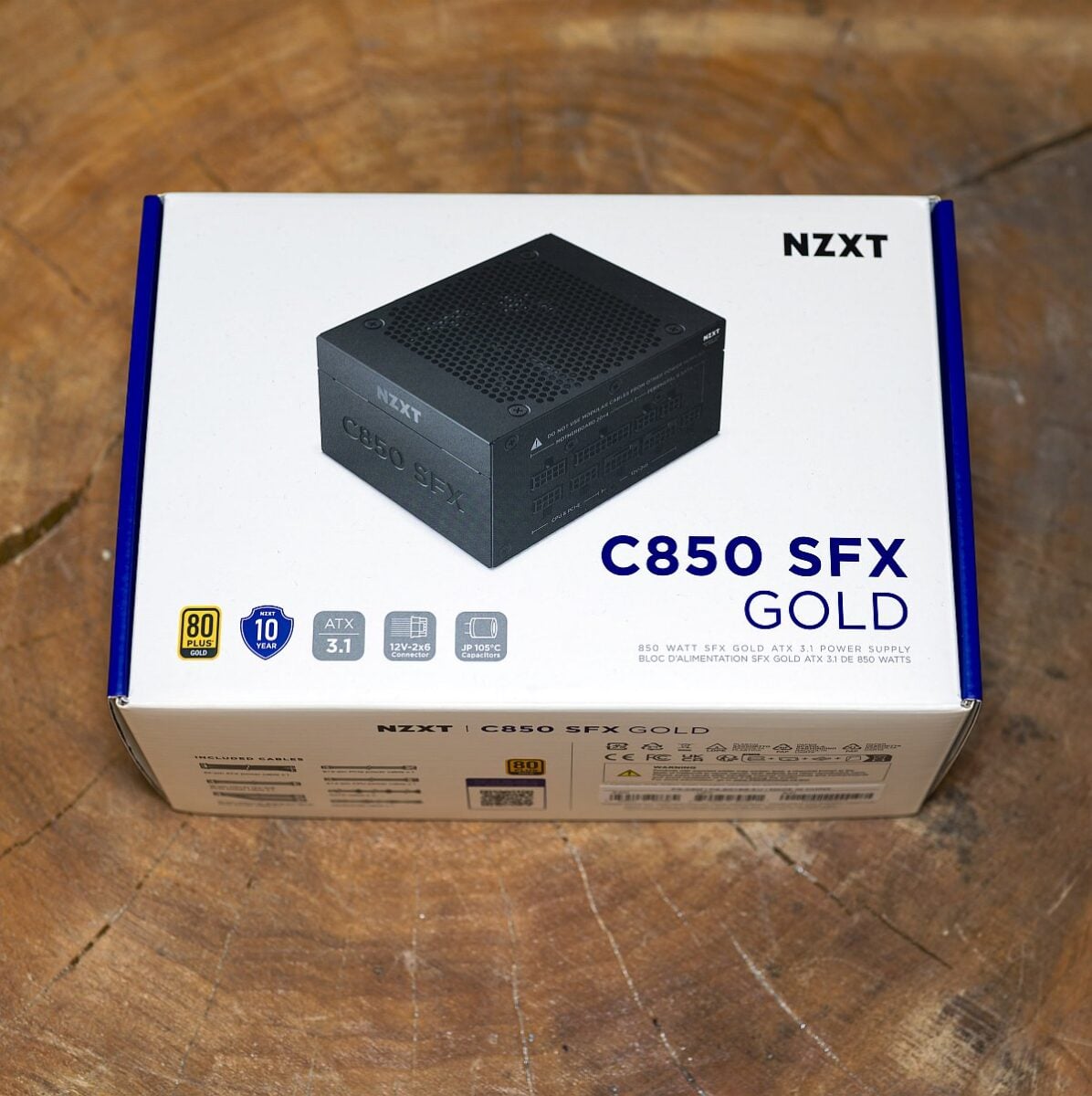
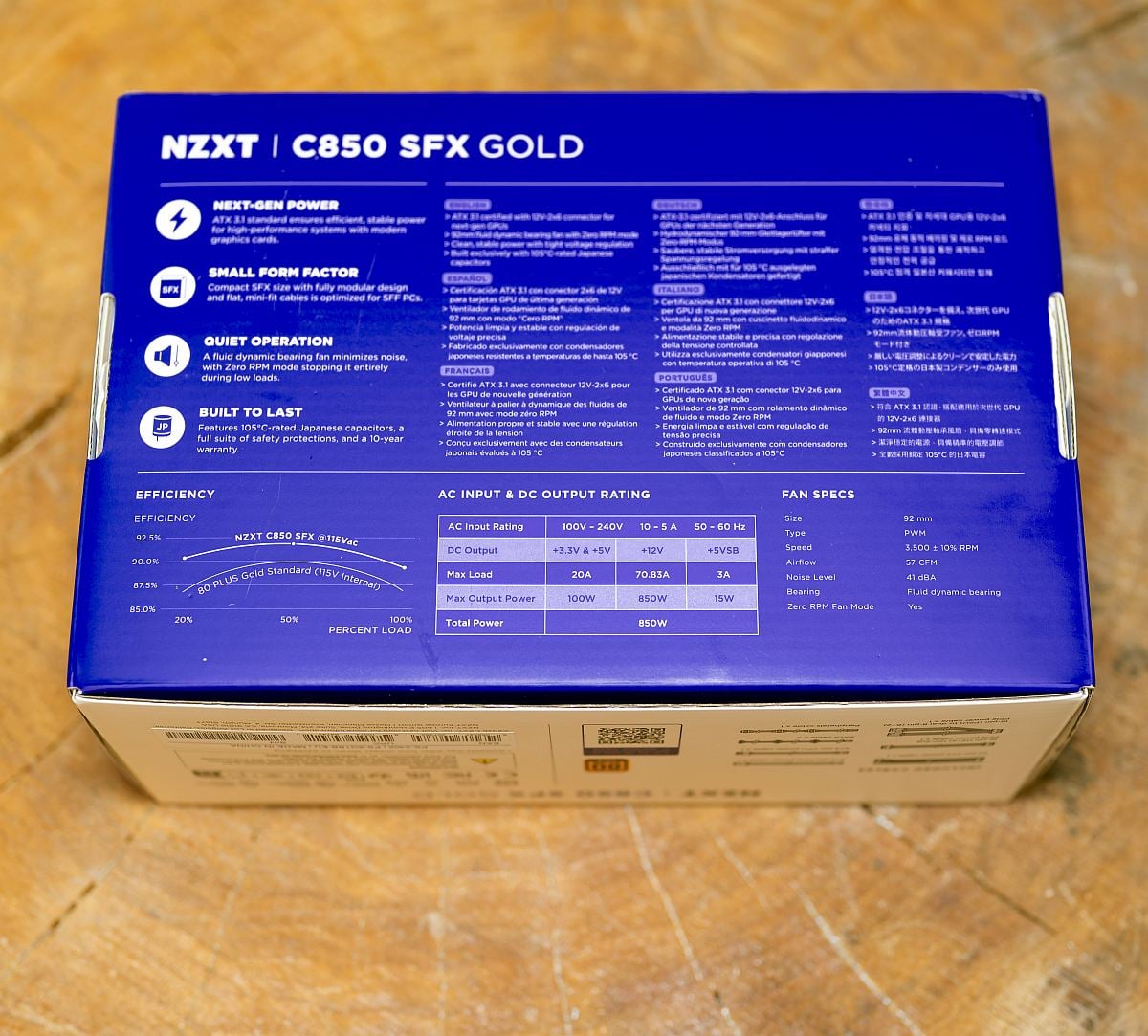
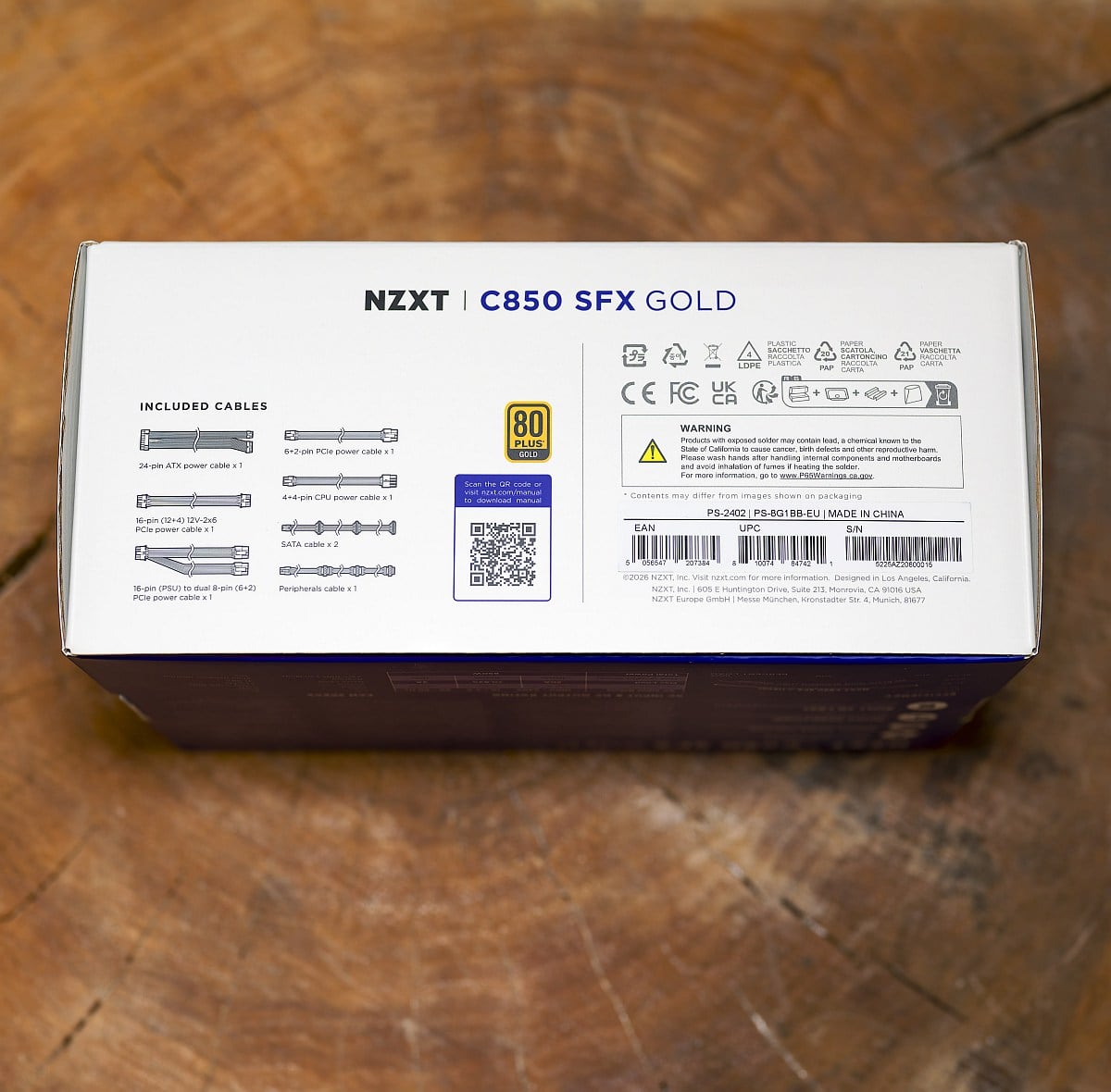
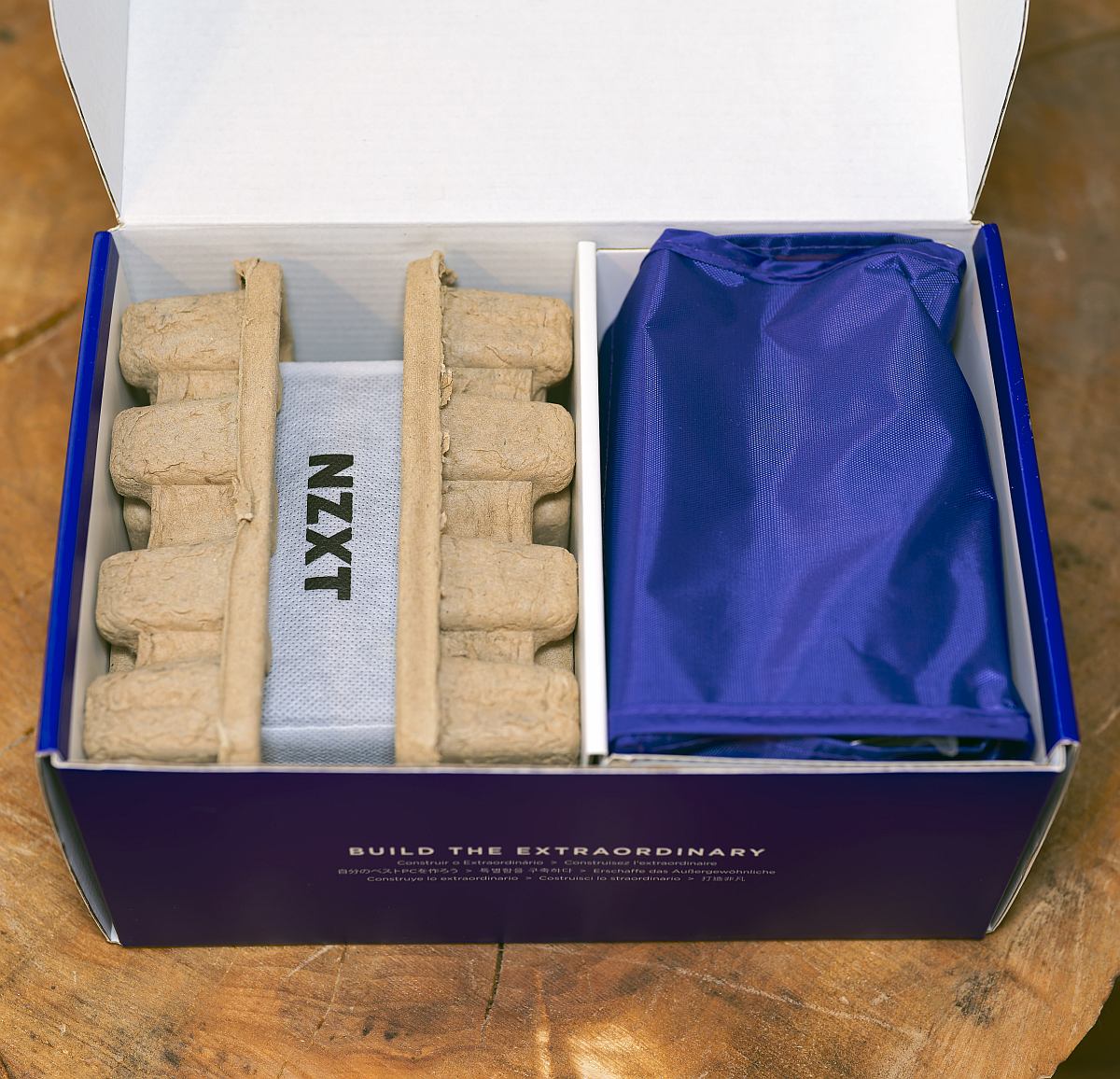
The power supply arrives in a white/purple cardboard box. On the front, you will find information about the model, PSU power, 80 Plus Gold certification – no info about the Cybenetics score – and a PSU image. On the back, there is additional detail about the specification and the provided cables’ details are put on the side of the box.
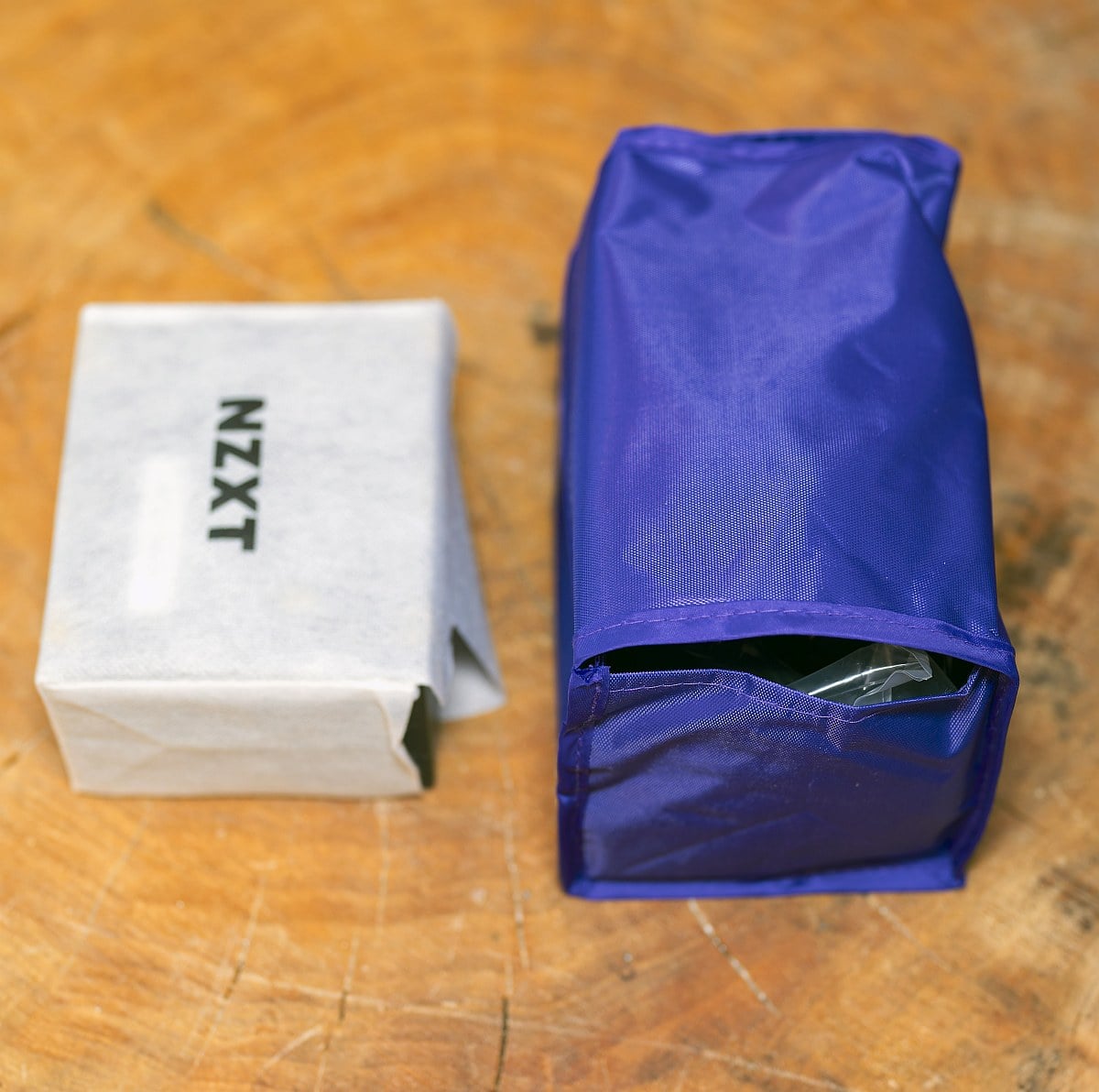
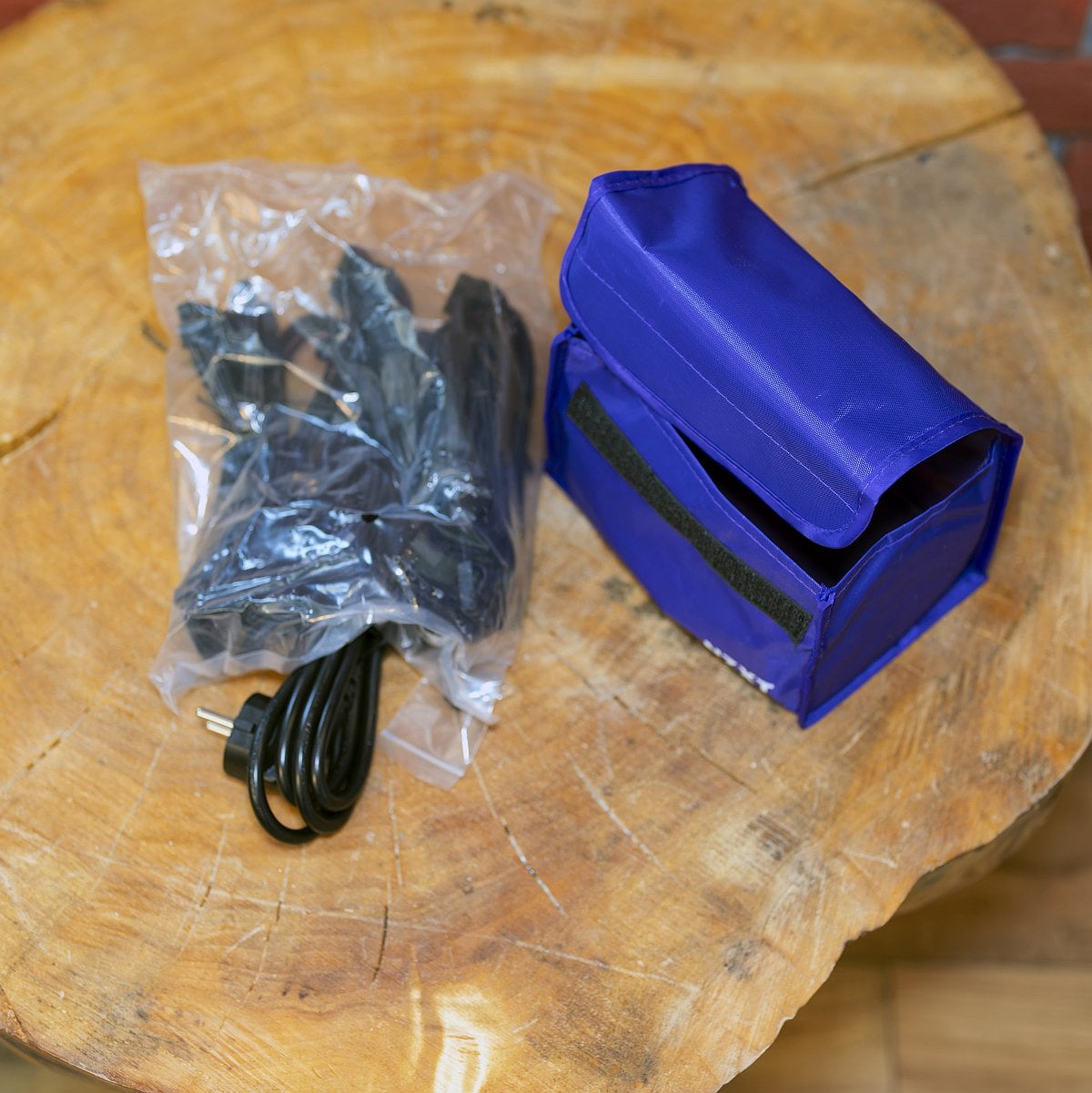
The supply includes the required power cable, mounting screws, and a user manual. There are no zip ties, but the cables are put in the material bag. There’s nothing revolutionary here, but still, it’s a nice package.
The cabling
NZXT places clear emphasis on cabling and modularity. This is a fully modular PSU, and every included cable features individually embossed wires with integrated cable combs. This naturally helps with routing in tight spaces. Importantly, lengths are intentionally short – the 24‑pin ATX cable is 350mm, while the CPU and PCIe cables are 470mm.
NZXT does this to reduce bunching behind motherboard trays in SFF enclosures. That’s a boon in Mini‑ITX cubes or sandwich‑layout cases. On the other side, it will frustrate attempts to repurpose this unit in deep ATX towers, where reaching the EPS connector could be difficult. You can’t please them all, and I believe NZXT makes the right choice in both cabling and lengths, detailed below.
- 24‑pin ATX (350mm).
- 4+4‑pin CPU EPS (470mm).
- 6+2‑pin PCIe (470mm).
- 16‑pin PSU to dual 8‑pin (6+2) PCIe cable (two connectors, 470mm).
- 16‑pin 12V‑2×6 PCIe 5.1 cable rated for 600W, 470mm.
- 2 × SATA cables (each with three connectors, 100 + 100mm spacing, six total SATA connectors).
- Peripheral cable (three 4‑pin connectors, 100 + 100mm spacing).
You’re looking at support for up to three classic 8‑pin PCIe connectors for legacy high‑power cards, or a direct 12V‑2×6 hook‑up for the latest Nvidia and AMD GPUs. Accessory support is serviceable for a gaming‑first SFF system – a handful of SSDs, a pump, and some fans – but storage‑heavy workstations with banks of 3.5in drives are not the target. There is only one 4+4-pin CPU power cable, but again, most smaller boards only feature one such connector of this ilk.
Detailed inspection
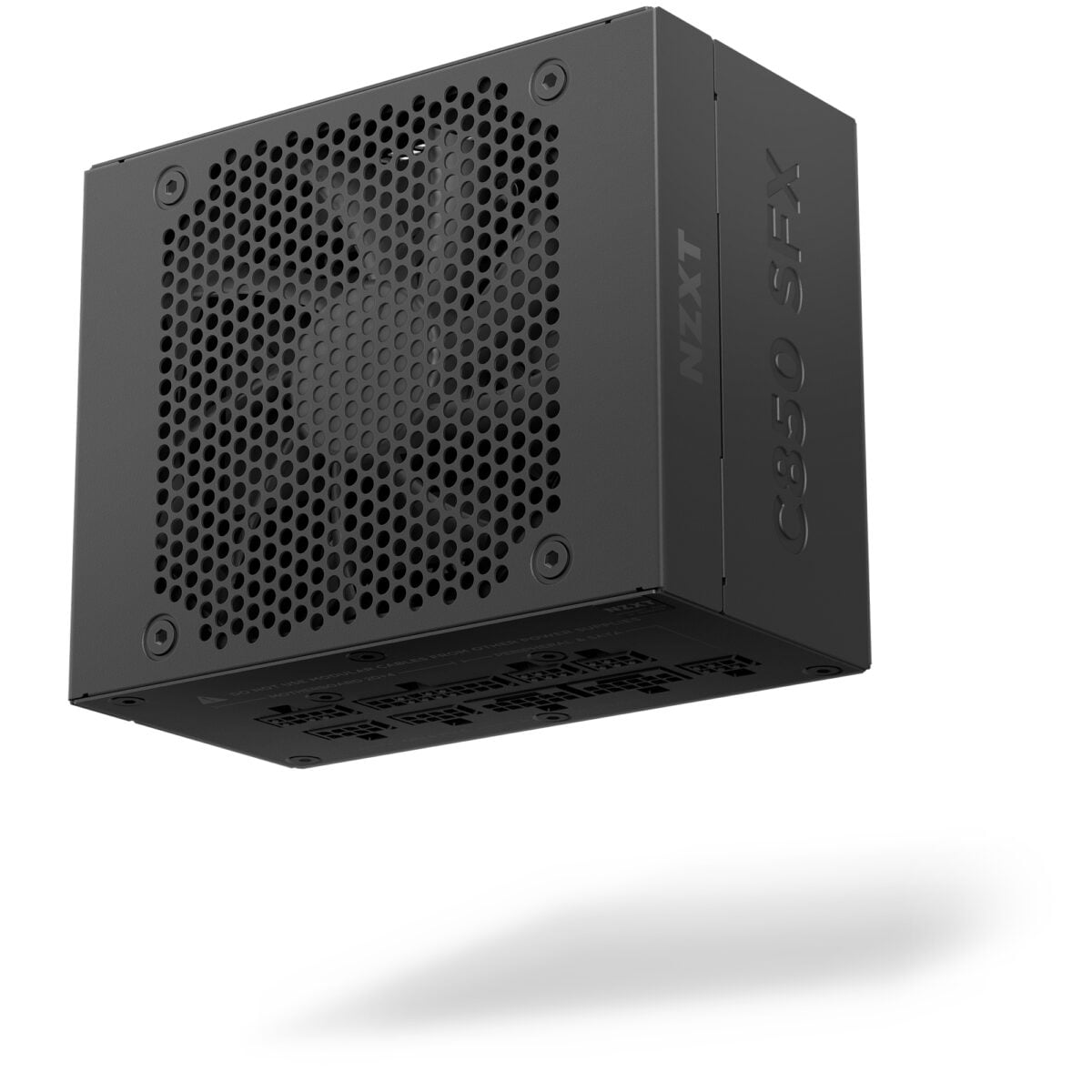
The NZXT C850 SFX Gold makes full use of the SFX form factor by adhering to the accepted specifications. This enables seriously compact cases or extra clearance for front radiators and cabling. The chassis is understated, with a dense vent pattern and a 92mm fan that occupies most of the underside, as you would expect from an SFX design.
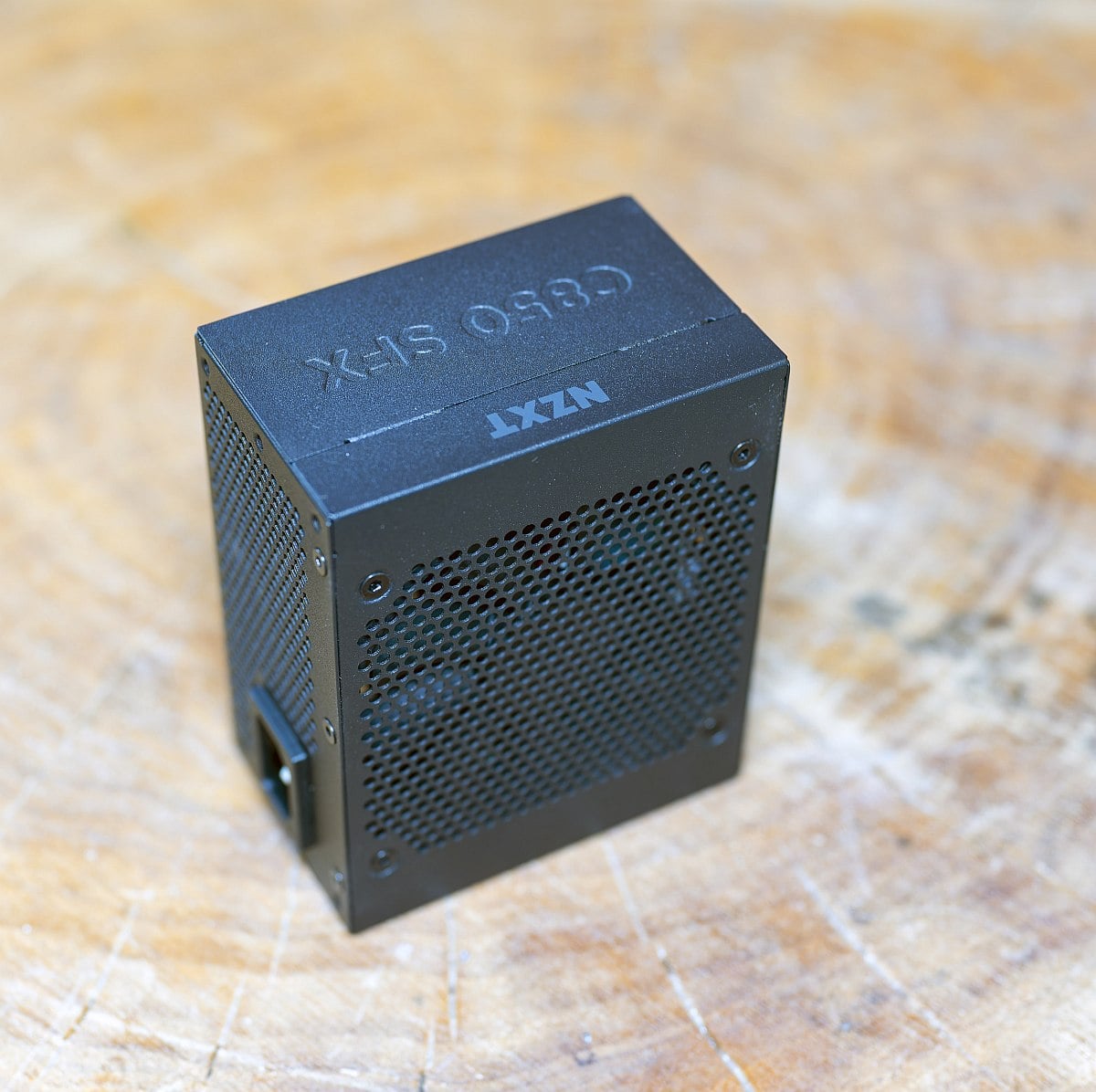
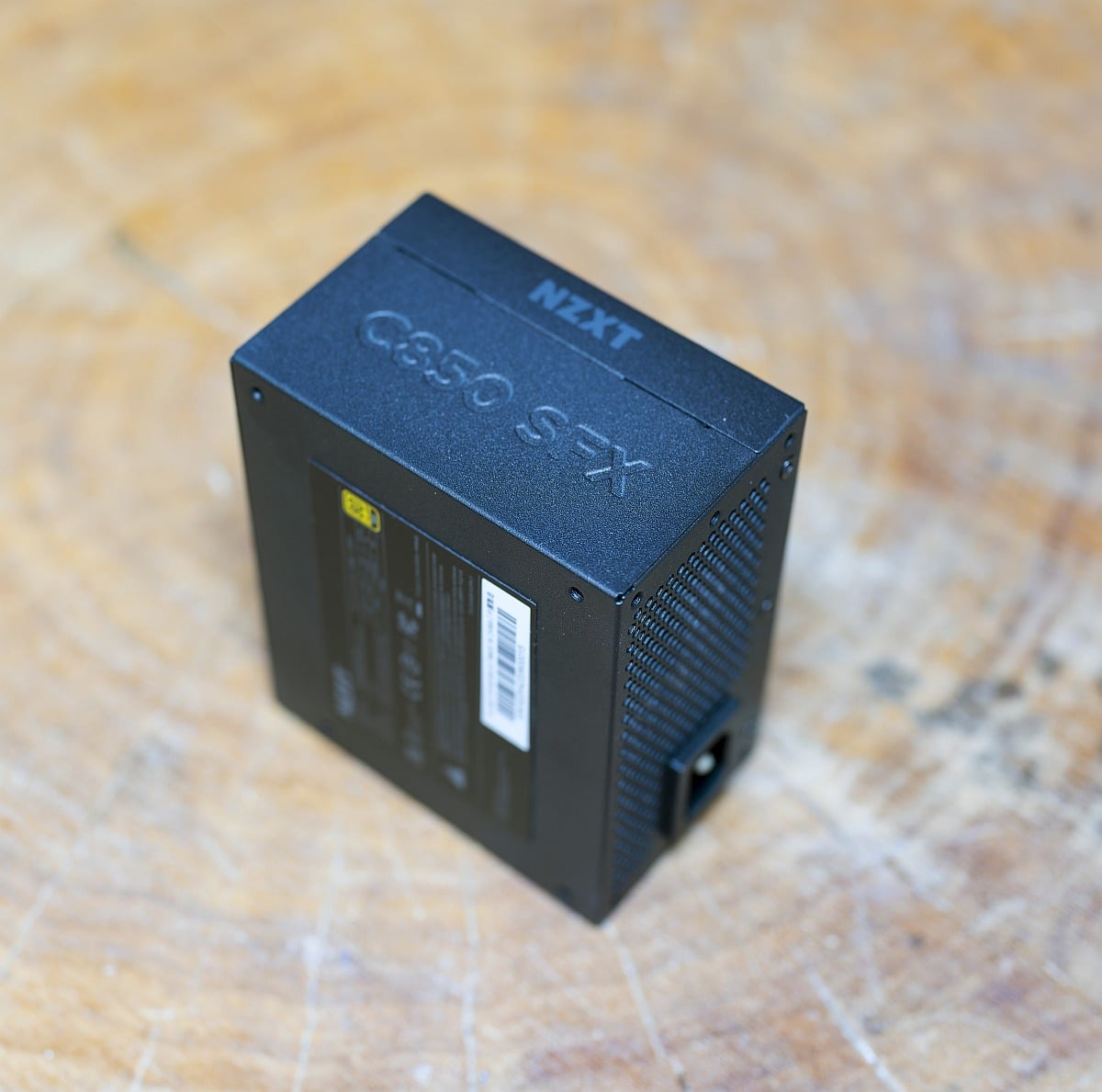
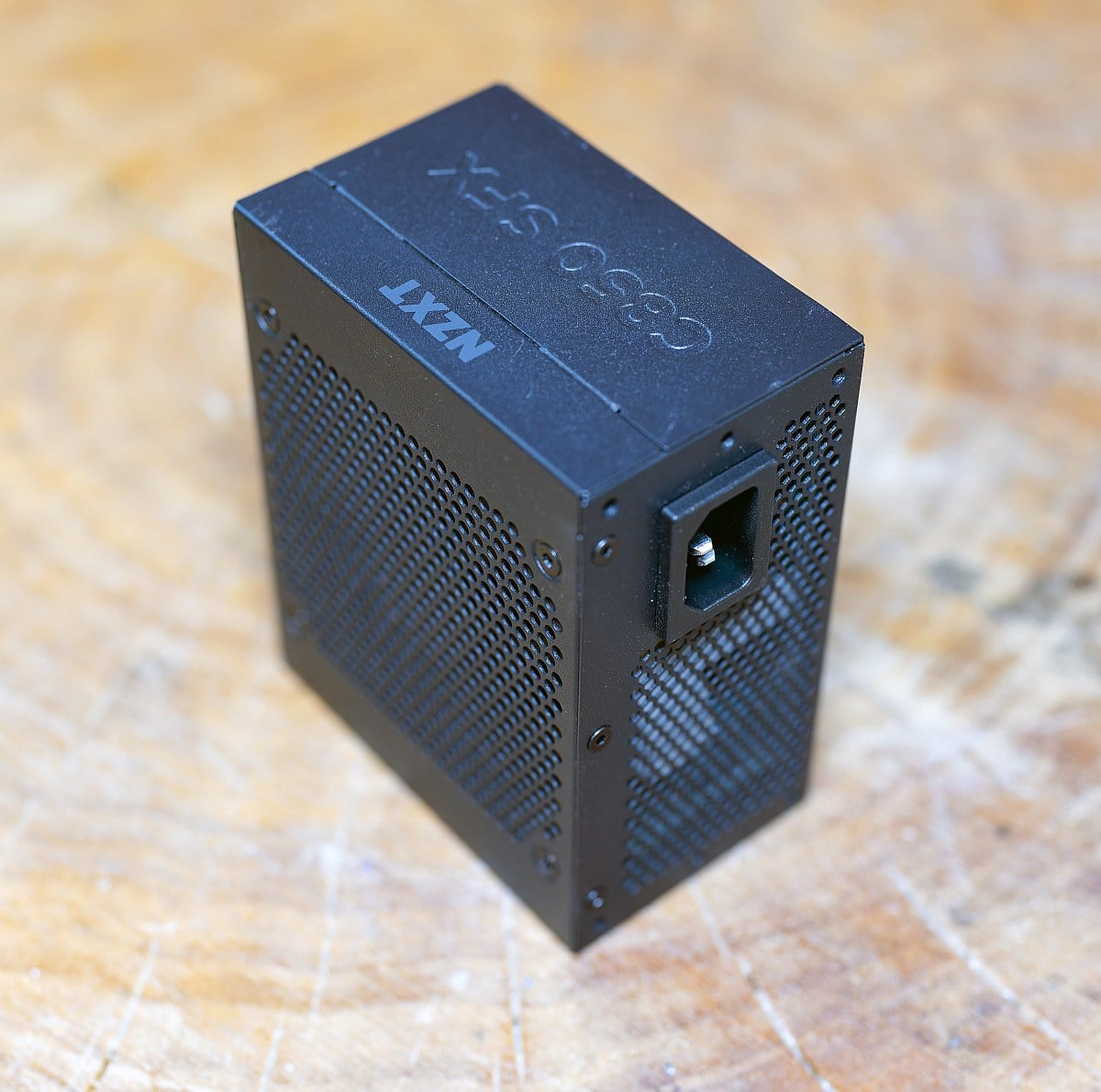
A rear exhaust full of holes promotes smooth airflow out of the chassis, while the intake side is optimised around the fan, featuring a pattern that balances airflow restriction and noise.
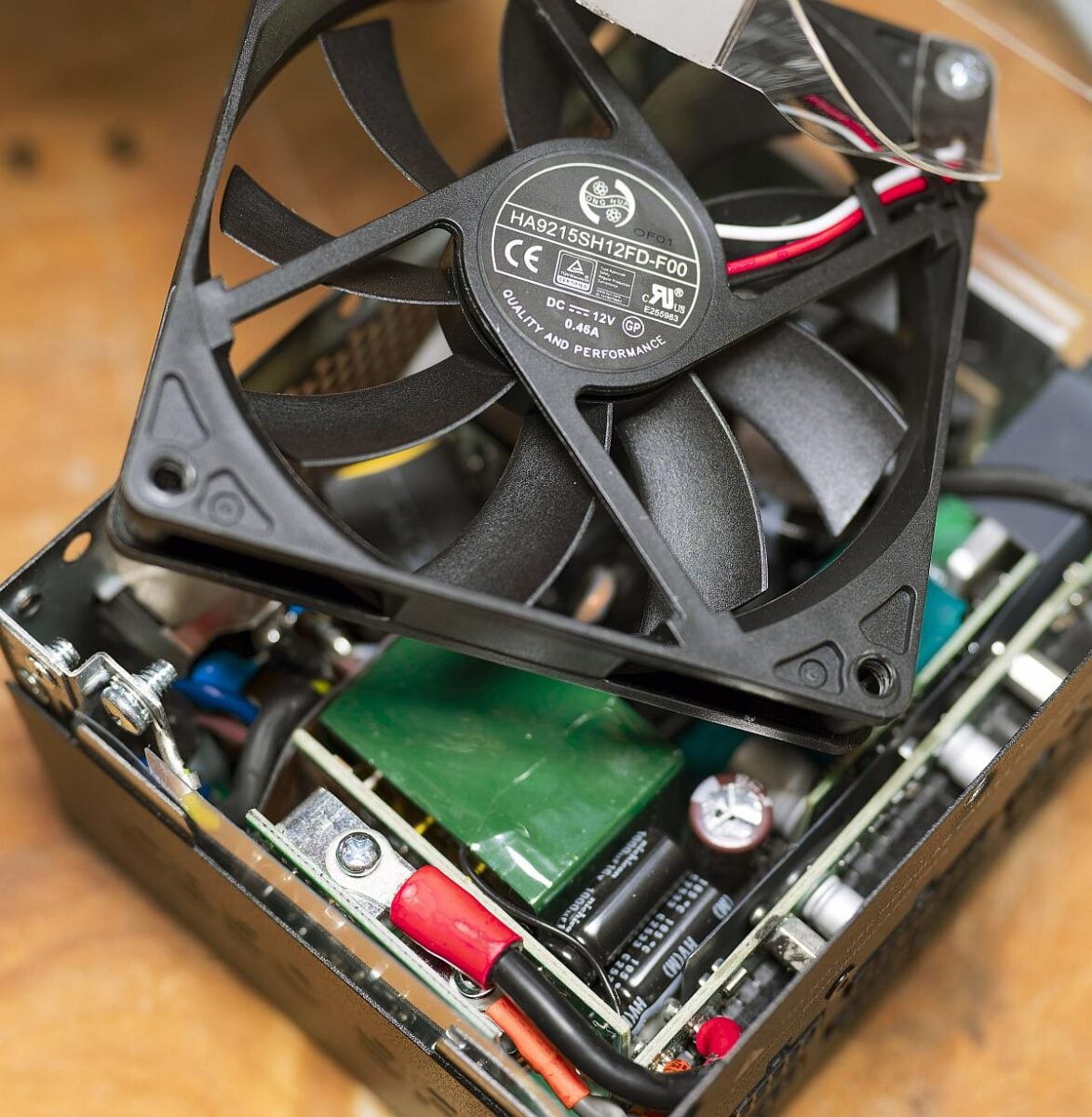
The heart of its cooling system is a Hong Hua HA9215SH12FD-F00 fan. It has a fluid-dynamic bearing and a maximum speed of 3,500rpm.
Protection coverage is comprehensive, too: OVP, UVP, OCP, SCP, OPP, SIP, and OTP are all present and coordinated to guard against over‑voltage, under‑voltage, over‑current, short‑circuit, overpower, surge, and over‑temperature events. You also get a 100,000-hour MTBF rating. I’m especially pleased to see NZXT rates it at the full 850W at an ambient temperature of up to 50°C, hinting at good underlying engineering.
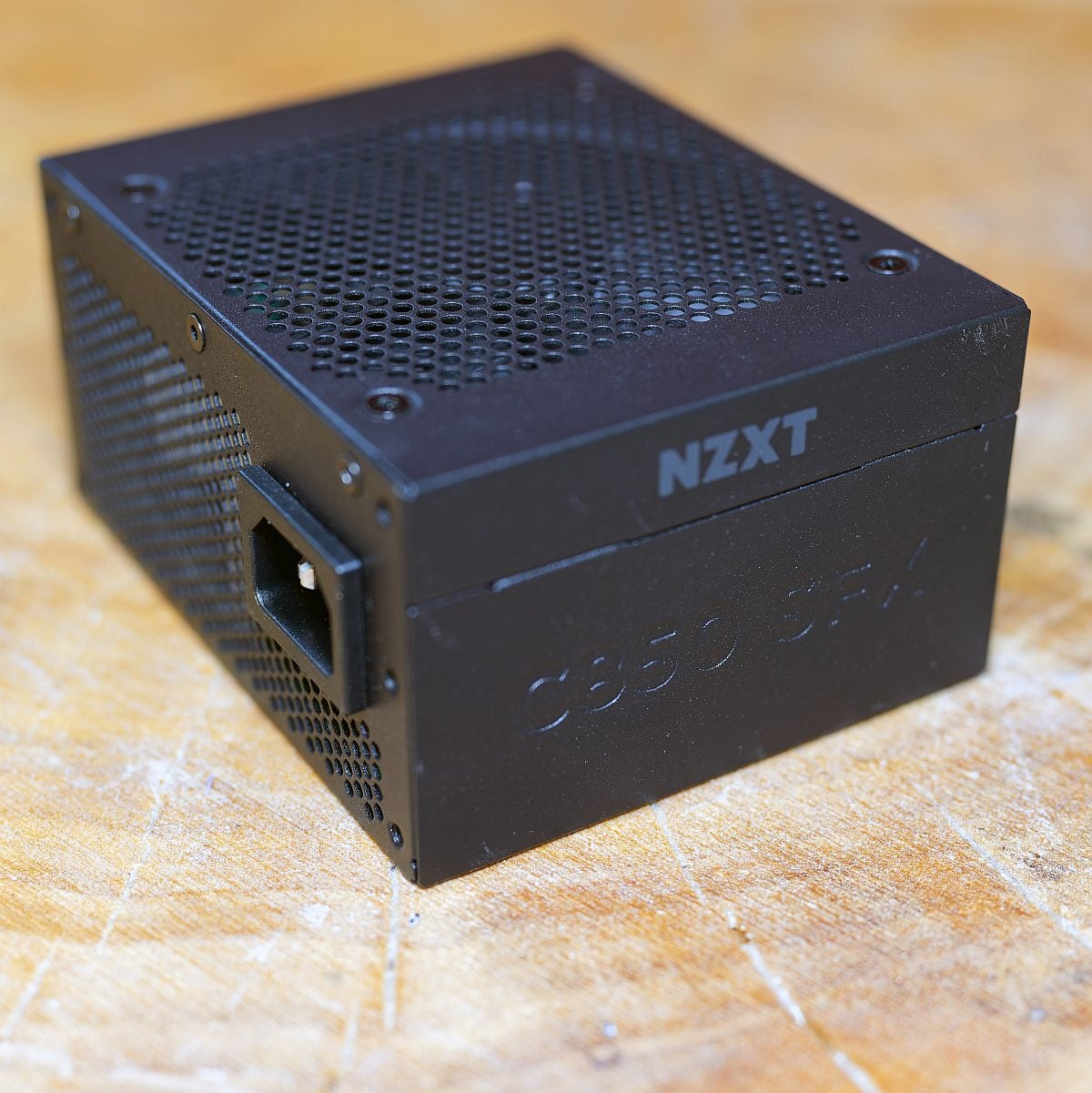
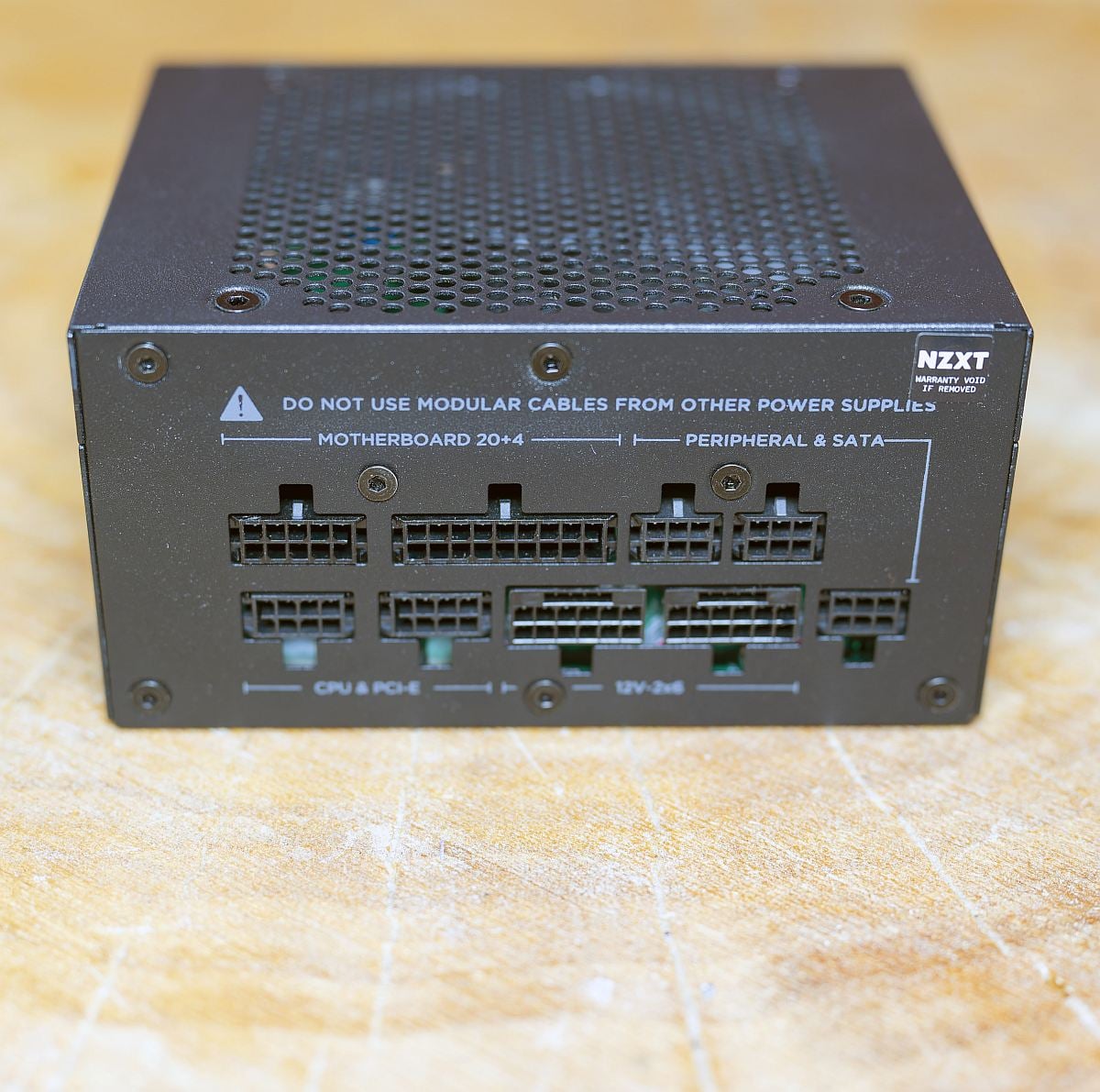
There’s no specific button to toggle semi-passive operation, mind you, but that’s understandable given the budget, but the lack of a power button is conspicuous by its absence.
Internals
A heatsink connects to the parts of the power supply that need the most cooling and dissipates a large portion of the heat. Even though a Cybenetics Platinum efficiency power supply generates relatively little heat, active cooling is required to prevent overheating under high load and toasty ambient conditions.
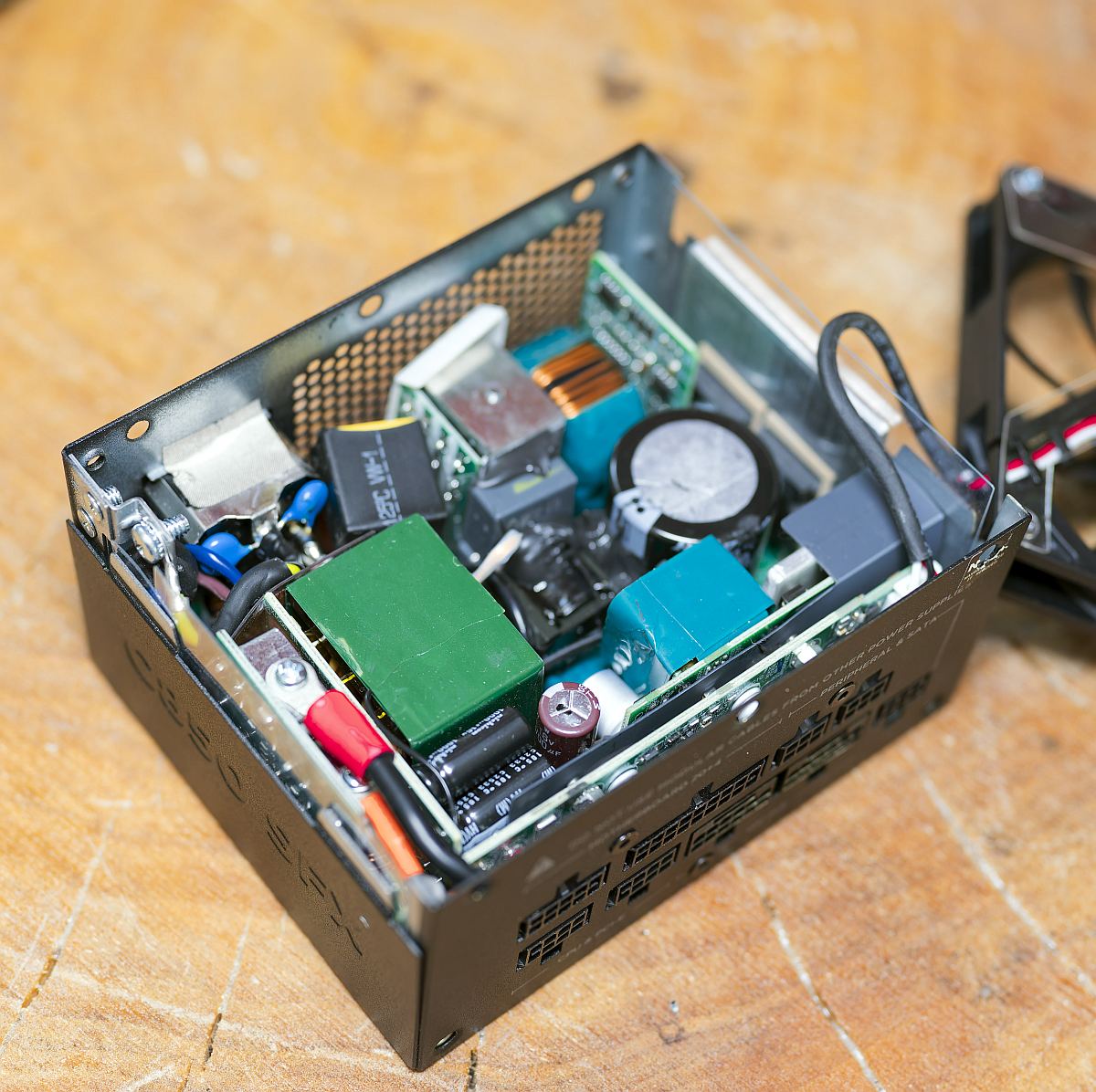
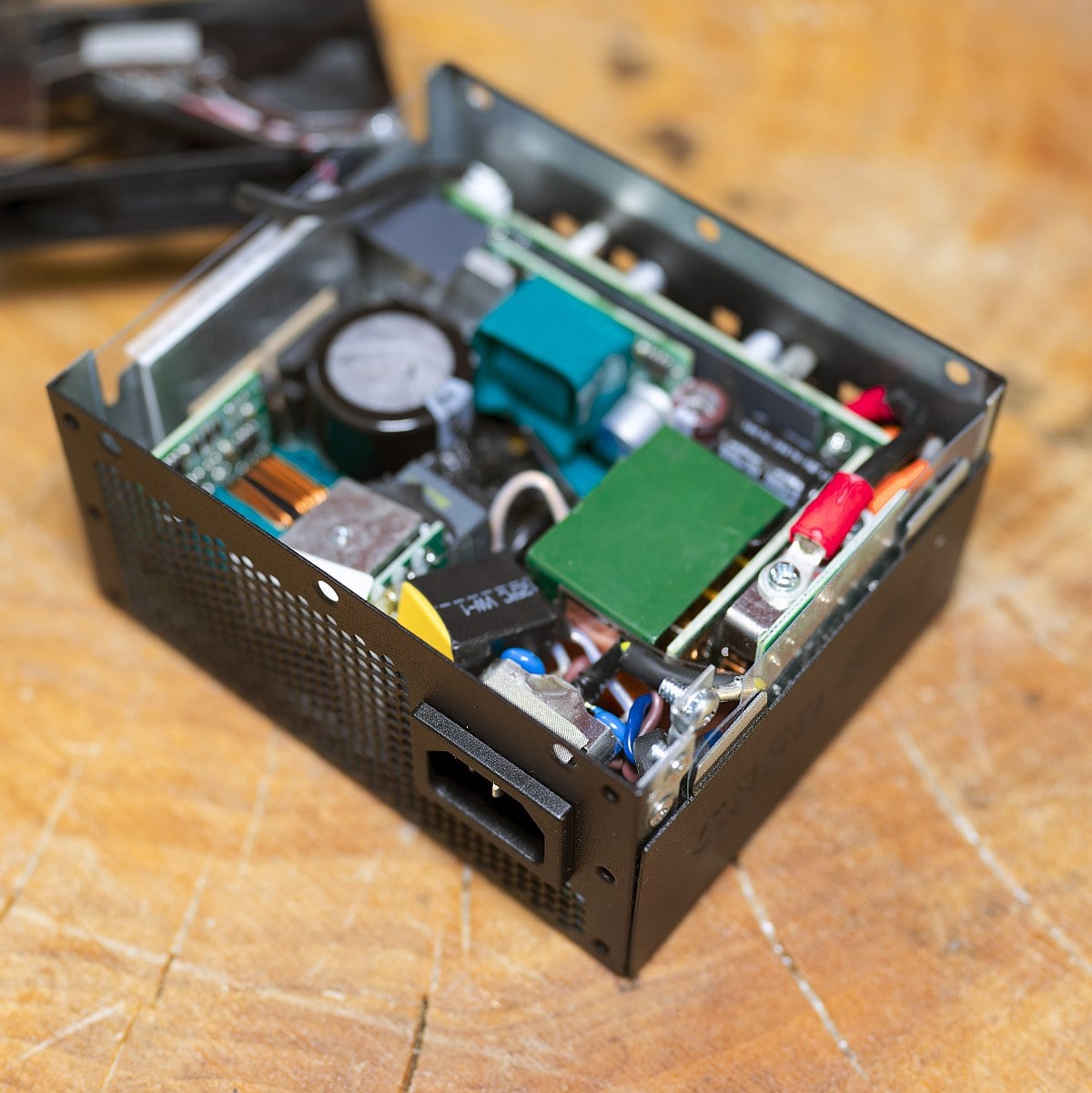
Solder quality on the main board is very good. The OEM for this PSU is HEC. As for the topology, it’s an APFC (Active Power Factor Correction), double forward for the primary side. It features an advanced APFC controller, specifically using Champion CM6500UNX.
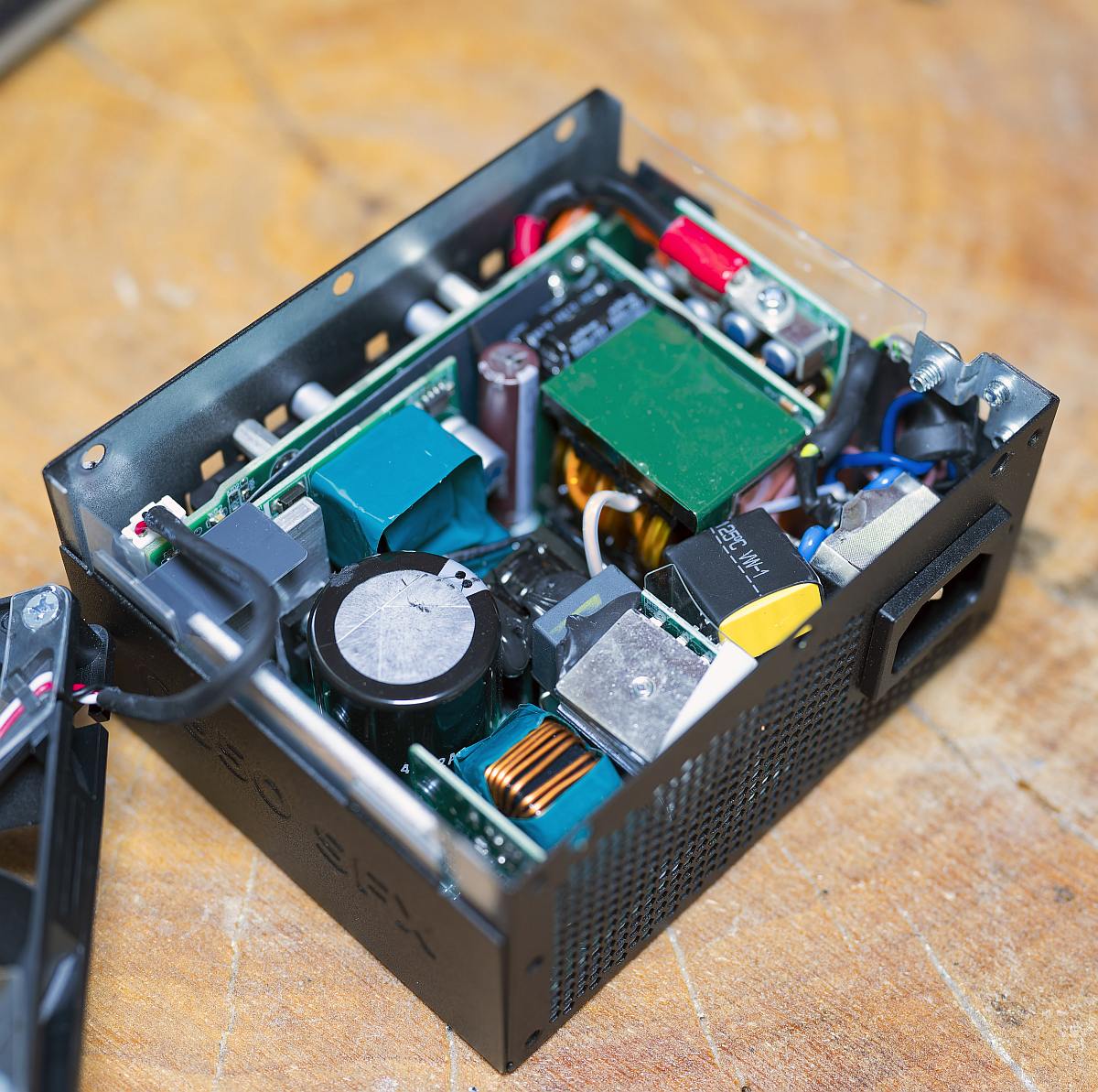
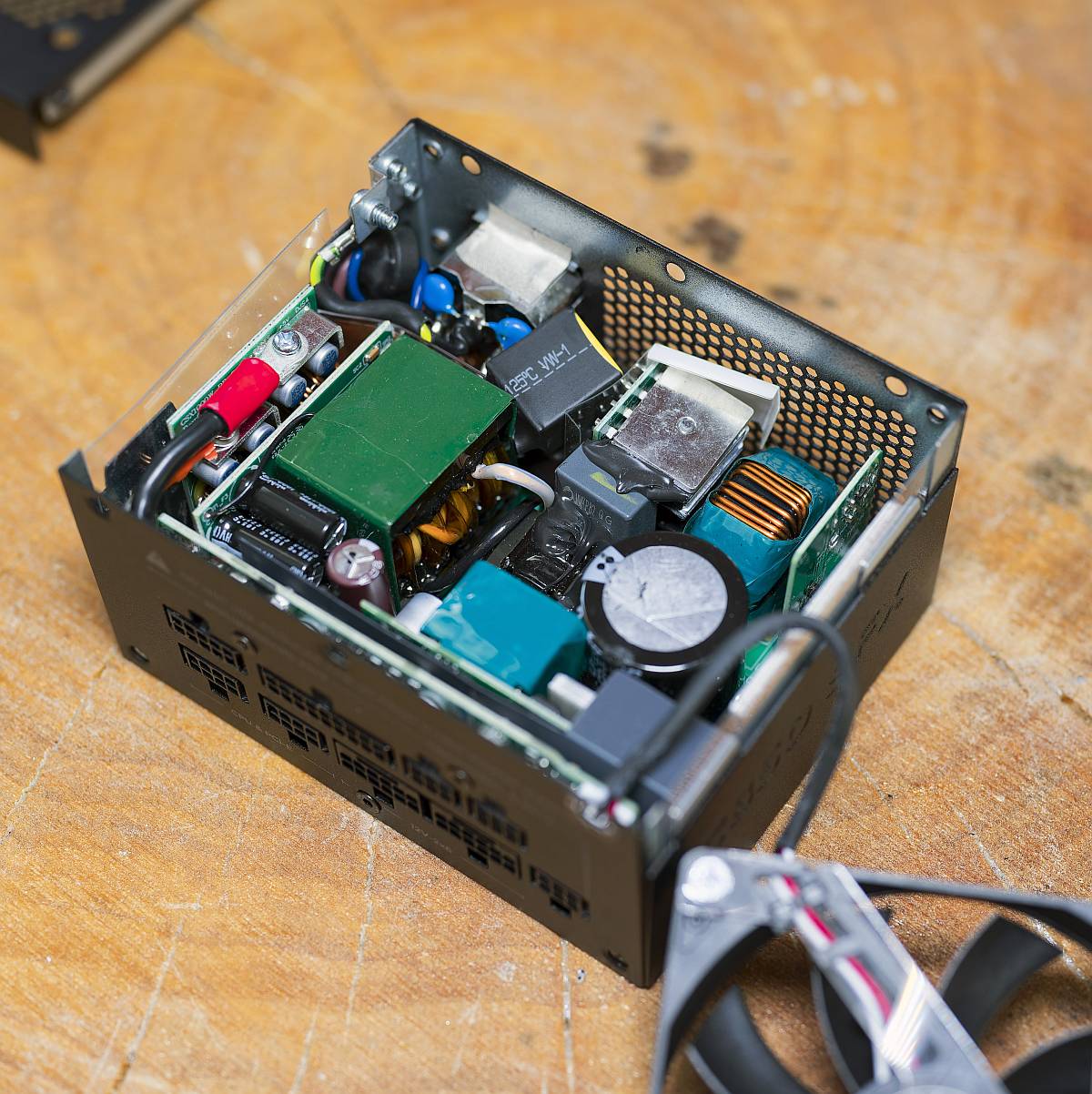
As for the secondary side, you find synchronous rectification. The minor rails tap into DC-DC converters from the 12V. As for the capacitors, they’re all Japanese, so that’s great.
Performance and efficiency
My first basic test is performed using a power supply tester. It draws no more than a couple of watts from the PSU, but it helps verify the PSU’s operation. A self-check indicates whether the voltages are at the proper levels.
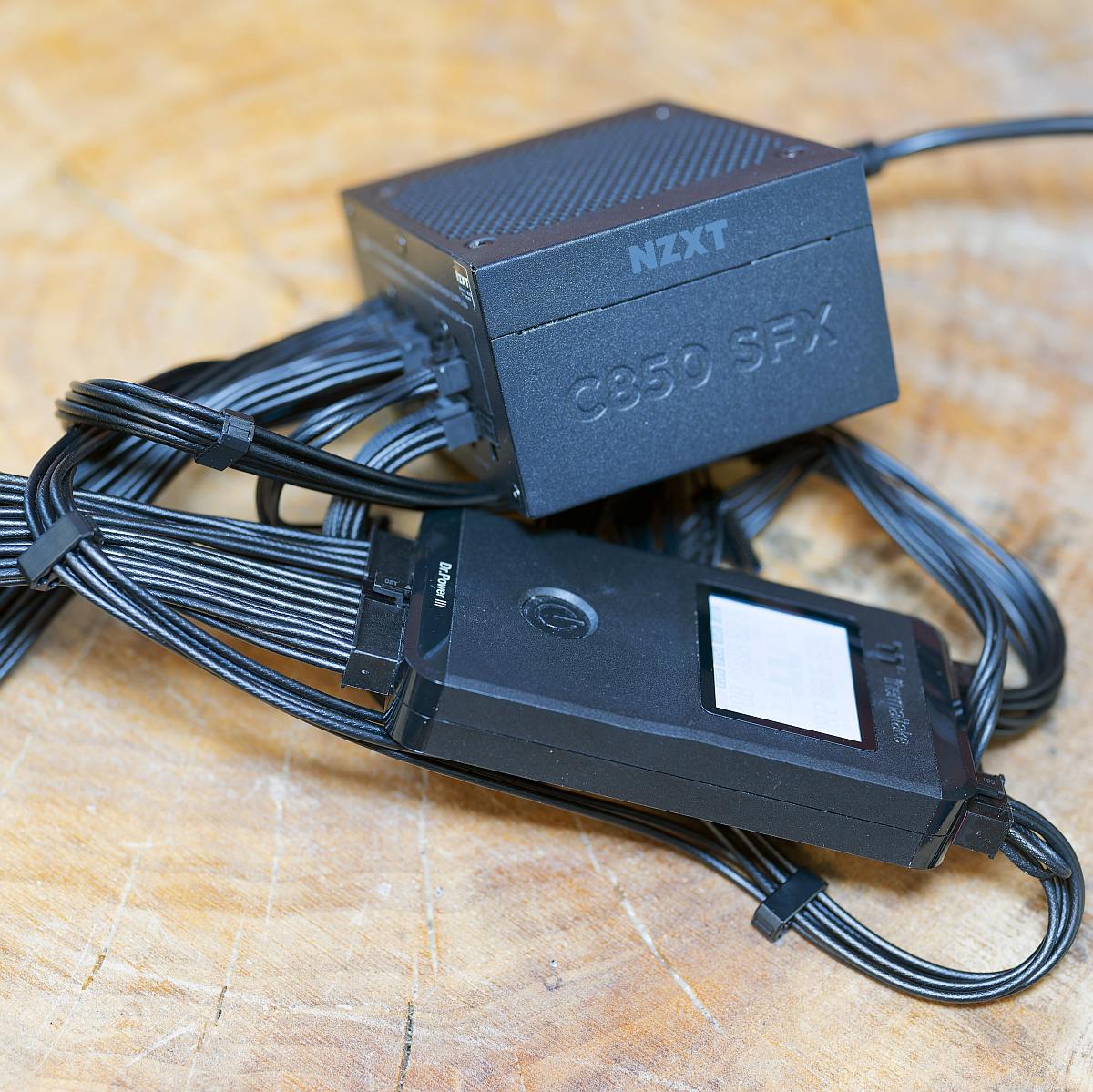
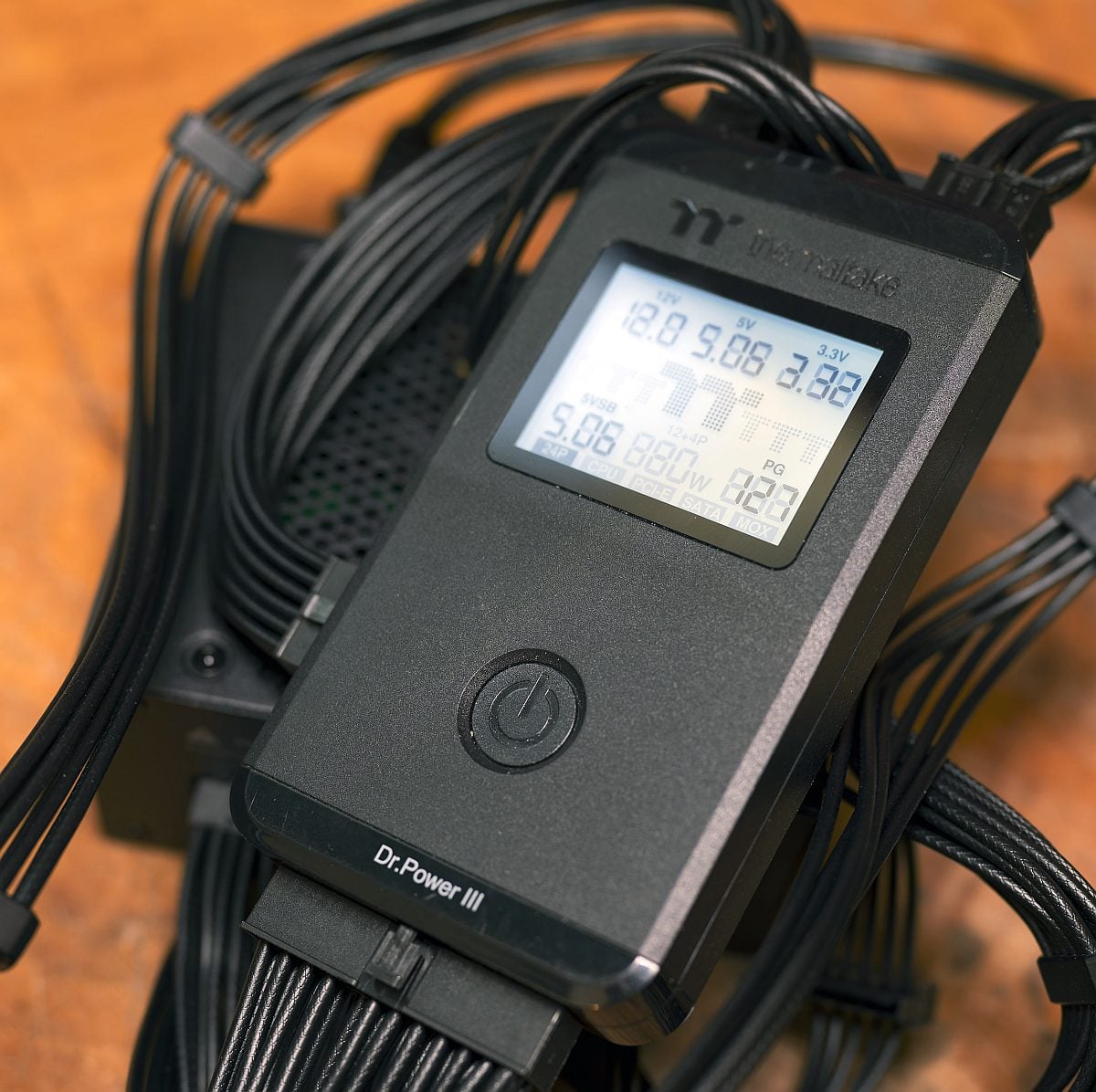
As you can see, there are no issues with the NZXT C850 SFX Gold 850W unit.
The following professional setup is used for the remainder of the testing:
- Voltcraft VC-870 Digital Multimeter – voltage measurement (+ Fluke 97 scope meter)
- Oscilloscope – GW INSTEK GDS 3154
- DC load – original solution
- Fluke 97 Scope meter (a measurement of voltage and ripple),
- Voltcraft SL-451 decibel meter (volume measurement)
- ACUVIM-IIRF is used to measure active power (input from the socket).
- PCE Instruments PCE-DT 50 tachometer – for the measurement of the rotational speed of the fan.
Measurements are taken only using 230V input voltage.
I’ll give you the TLDR first. NZXT C850 SFX Gold exceeds 80 Plus Gold certification, delivering high efficiency that helps keep power loss and heat generation in check. Under typical loads, the PSU consistently maintains good performance. This directly translates into lower electricity bills for users running their systems extensively, as well as a reduced environmental impact.
12V regulation
| Wattage | NZXT C850 SFX Gold |
| 85W (10%) | 12.18V |
| 212.5W (25%) | 12.12V |
| 425W (50%) | 12.07V |
| 637.5W (75%) | 12.04V |
| 850W (100%) | 12.02V |
Voltage remains solid across the load spectrum, with a roughly one percent deviation from highest to lowest, providing stable power to sensitive components even at full load. This stability is crucial because voltage fluctuations can cause system crashes or hardware damage, especially in high-performance components like CPUs and GPUs.
Wide-load efficiency
| Wattage | NZXT C850 SFX Gold |
| 85W (10%) | 88.97 per cent |
| 212.5W (25%) | 91.43 per cent |
| 425W (50%) | 92.12 per cent |
| 637.5W (75%) | 88.31 per cent |
| 850W (100%) | 86.55 per cent |
80 Plus Gold PSUs offer solid everyday performance without hitting the expense and heights of, say, Platinum or Titanium models. NZXT is comfortably over 90% efficient at workloads common on consumer PCs.
Low-load efficiency
| Wattage | NZXT C850 SFX Gold |
| 40W | 81.69 per cent |
| 60W | 86.48 per cent |
| 80W | 88.76 per cent |
Hitting over 80% across low loads is impressive in its own right.
12V ripple suppression
| Wattage | NZXT C850 SFX Gold |
| 85W (10%) | 12.4mV |
| 212.5W (25%) | 14.6mV |
| 425W (50%) | 16.3mV |
| 637.5W (75%) | 18.2mV |
| 850W (100%) | 27.9mV |
Ripple suppression reflects good quality AC-to-DC conversion. The NZXT C850 SFX Gold features consistently low ripple up to 75% of its operating range, and though it then climbs up, the supply still delivers pretty clean power that ensures stable, error-free operation for modern components.
Reduced ripple contributes to better long-term health of your PC parts, too, and it can even lead to slightly improved overclocking headroom because delivered power is consistent and mostly free of electrical noise.
Noise
| Wattage | NZXT C850 SFX Gold |
| 85W (10%) | 30.0 dBA (0rpm) |
| 212.5W (25%) | 30.0 dBA (0rpm) |
| 425W (50%) | 33.7 dBA (1,350rpm) |
| 637.5W (75%) | 37.5 dBA (2,200rpm) |
| 850W (100%) | 41.6 dBA (3,150rpm) |
These are decent results for this class of PSU, especially, again, till around 75%. NZXT C850 SFX Gold has a semi-passive mode that works up to 30% load, but the 92mm fan’s control keeps noise in check, with the PSU practically silent during low-to-medium workloads.
However, under heavy loads, noise output is high, so it’s best to avoid power-hungry components if you prefer quiet PC builds. I definitely notice the fan when running full gallop, so my advice would be to overspec your proposed wattage. Doing so means the fan won’t work as hard at a particular wattage.
Conclusion
NZXT’s C850 SFX Gold is a purpose‑built SFX power supply for enthusiasts who want next‑generation GPU support and long‑term reliability in a genuinely compact form factor. There specifications are solid for a modern PSU, with nothing of note missing from a supply designed for this generation of components as well as next.
This PSU is clearly tuned for the realities of modern gaming workloads rather than peak synthetic numbers alone. The ATX 3.1 specification not only mandates better handling of momentary power excursions – up to roughly twice the PSU’s rated output for brief spikes – but also tightens requirements around timing, protection, and connector design. In practice, when paired with appropriate SFF‑friendly yet chonky GPUs such as the RTX 5070 and 5080, system builders should expect stable operation in heavy gaming and content‑creation scenarios without nuisance shutdowns from pesky transient spikes.
The cabling, too, is enough for a Mini‑ITX system with a high‑end CPU, single near-flagship GPU, several NVMe drives, and perhaps one or two SATA SSDs.
Acoustically, SFX brings necessary trade‑offs. The 92mm FDB fan must spin up to 3,500rpm to move enough air through a compact housing crammed with hot‑running components, resulting in higher noise at full load than some larger 120mm and 140mm ATX models. Nonetheless, the Cybenetics A‑ noise rating indicates that average noise across realistic loads remains in a comfortable mid‑20 dBA band, particularly when typical gaming power draw sits well below the PSU’s 850W ceiling.
If your next project is a compact yet powerful gaming PC built around a modern card like GeForce RTX 5080 or Radeon RX 9070 XT, the NZXT C850 SFX Gold PSU sits squarely in the sweet spot.