
The InWin Shift is a striking, open‑frame, test‑bench‑style chassis that trades panels and dust filters for sculptural aluminium, huge flexibility, and a blank canvas for modders and BTF builds. It is expensive and specialised, but for enthusiasts who want their hardware on full display and love tinkering, it is one of the most distinctive platforms currently available.

InWin Shift
€449.99
Pros
- Beautiful CNC‑machined aluminium frame with sculptural legs and sandblasted finish
- Fully open design with adjustable “wings” for up to nine 120mm fans or three 360mm radiators
- Excellent support for ATX/E‑ATX including selected back‑connector boards
- Ideal test bench with easy access for frequent hardware swaps
- Modular PSU/storage brackets and GPU supports for flexible layouts
Cons
- High price for a bare chassis with no fans or front‑panel I/O beyond the power button
- A completely open frame has no dust filters and requires regular cleaning
- The exposed rear of the power switch and cabling looks out of place on such a premium design
- No fixed cable tie‑downs, relies on bolt‑on brackets for tidy routing
Club386 may earn an affiliate commission when you purchase products through links on our site.
How we test and review products.
When you’ve tested as many cases as I have, trust me, it’s refreshing to see something different, and you can always rely on InWin to do more than add a few slithers of wood. The Taiwanese firm isn’t necessarily a household name among PC builders, but has over 40 years of case manufacturing experience. The company’s manufacturing facilities at a huge new factory in China are impressive to say the least, allowing InWin to continue its legacy of outlandish cases with even more gusto.
Having first spied Shift at CES 2025, I’ve been itching to get my hands on this eye-catching proposition and the time has finally come. Let’s dig in.
Specifications
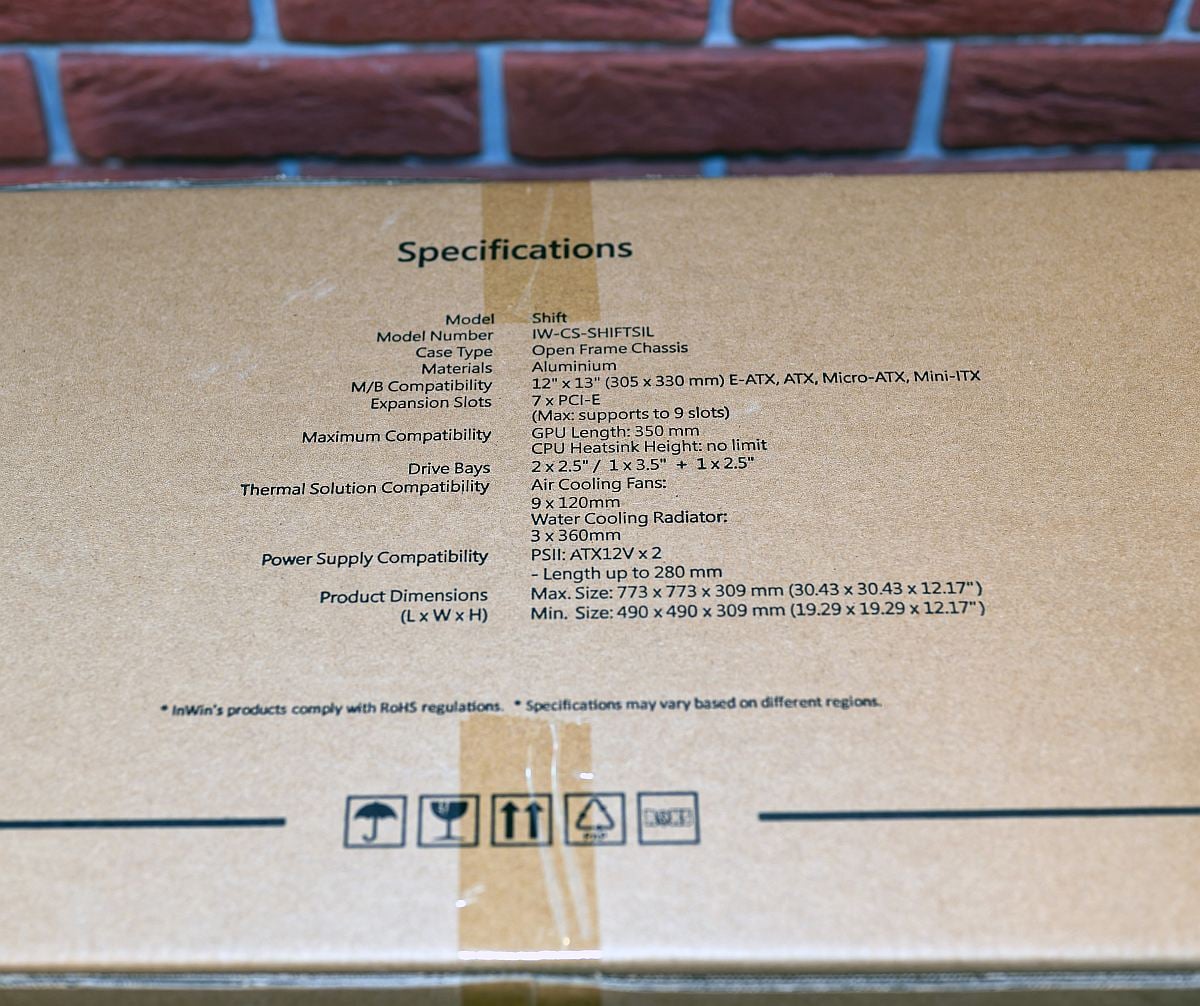
The Shift is an open‑frame, desk‑sized chassis that can contract for a neater footprint or expand dramatically once its wings are spread. Despite its size, the aluminium construction keeps the weight modest while remaining rigid in use.
| Specification | InWin Shift |
| Form factor | Open‑frame chassis/test bench style |
| Dimensions | Min: 490 x 490 x 309mm; Max: 773 x 773 x 309mm |
| Weight | 4.25kg (approx. 9.4lb) |
| Materials | Premium CNC-machined aluminium with sandblasted finish |
| Colour | Silver |
| Motherboard support | Mini‑ITX, Micro‑ATX, ATX, E‑ATX up to 305 x 267mm |
| GPU support | Up to 350mm cards; vertical or horizontal mounting via rotatable 7-slot PCIe bracket |
| CPU cooler height | Effectively unlimited due to open top and sides |
| PSU support | ATX PSUs up to 280mm; up to 2 PSUs possible when using both brackets |
| Storage | Up to 2 x 2.5in, or 1 x 3.5in plus 1 x 2.5in, via modular brackets |
| Fan mounts | Up to 9 x 120mm fans across three articulated “wings” |
| Radiator support | Up to 3 x 360mm radiators (top and the two side wings) |
| Front I/O | Power button only; no USB or audio |
| Included cooling | None |
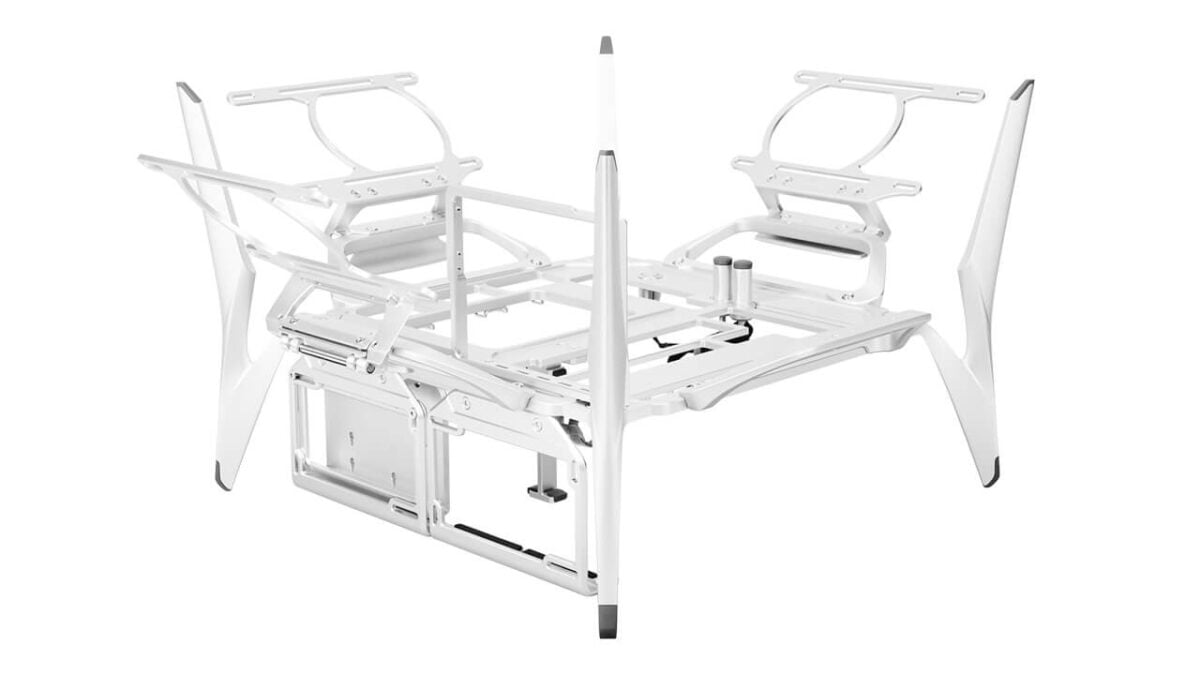
Destined to turn heads, the case (or frame, rather) is made entirely from CNC-machined aluminium with a sandblasted silver finish. It weighs just 4.25kg and can shrink to just 490 x 490 x 309mm in its most compact form. Spread the articulating wings and total footprint extends to 773 x 773 x 309mm, accommodating larger cooling hardware for the most powerful of builds. Motherboard support naturally spans Mini-ITX through E-ATX, and Shift is also compatible with select Asus BTF and MSI Project Zero back-connector boards for a cleaner front-side aesthetic.
GPU clearance is officially 350mm, and PSU support extends up to 280mm ATX units. There is room for two power supplies if the triple 2.5in drive cages are removed. Storage meanwhile is modest, supporting either 2 x 2.5in drives or a 3.5in plus 2.5in combination mounted on modular brackets.
Cooling support is where the bulk of Shift’s generosity lies, allowing up to nine 120mm fans or three 360mm radiators across the central frame and wings. At the same time, CPU cooler height is effectively unrestricted due to the fully open design. The front I/O is intentionally minimal, with only a single illuminated power button. This, along with a whopping €449 price tag, reinforces Shift’s role as a specialised test bench and show frame rather than a mainstream daily-driver chassis.
Unboxing
The Shift arrives in a large but understated cardboard carton, which feels modest given the chassis’s premium nature, but everything inside is especially well packaged.
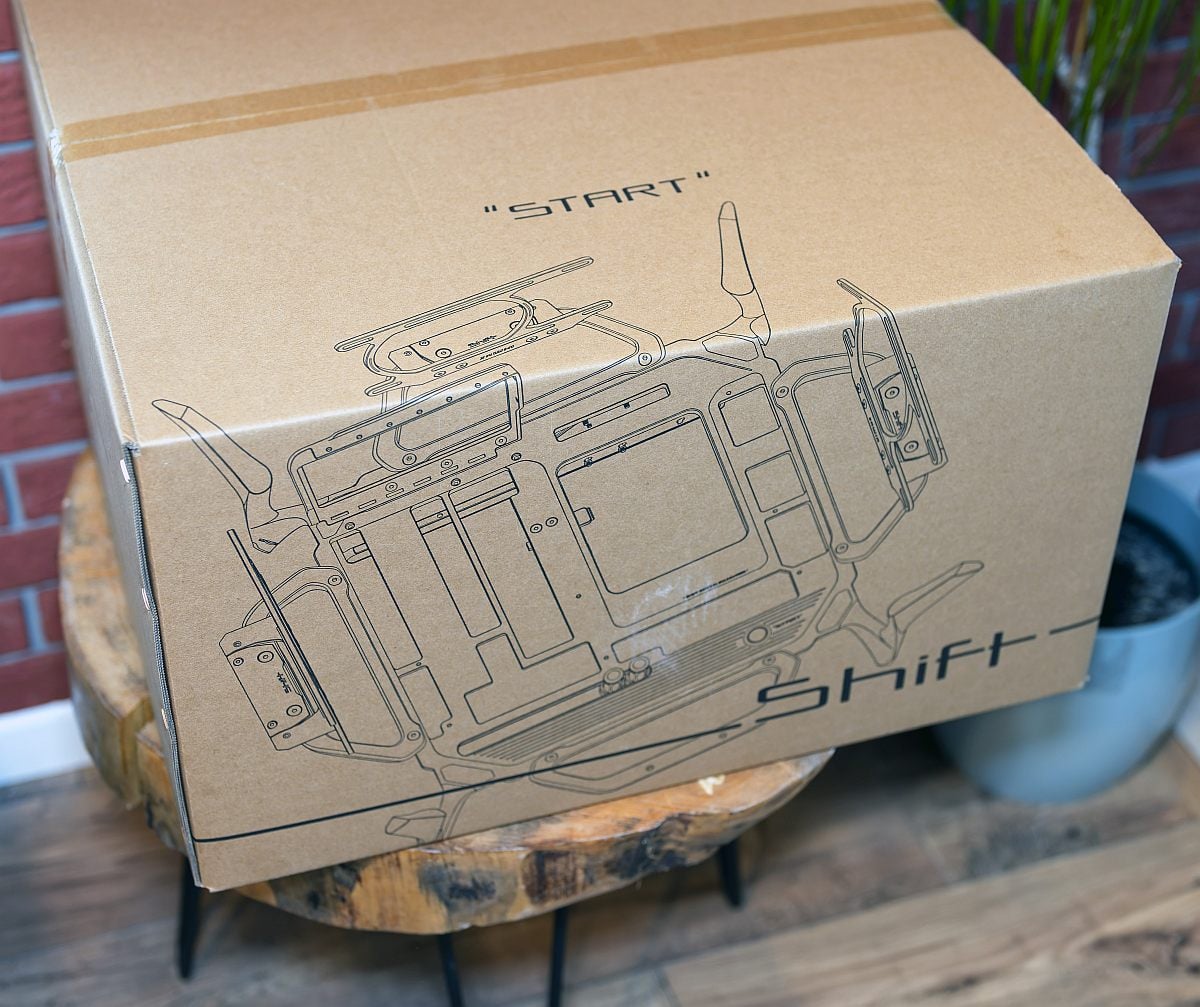
Exterior printing highlights the distinctive silhouette and “Shift Beyond Boundaries” tagline, suggesting its dual role as both a display piece and a functional test bench. Inside, foam blocks and corner boots protect the aluminium legs, while the frame itself is wrapped to prevent scuffs during transit.
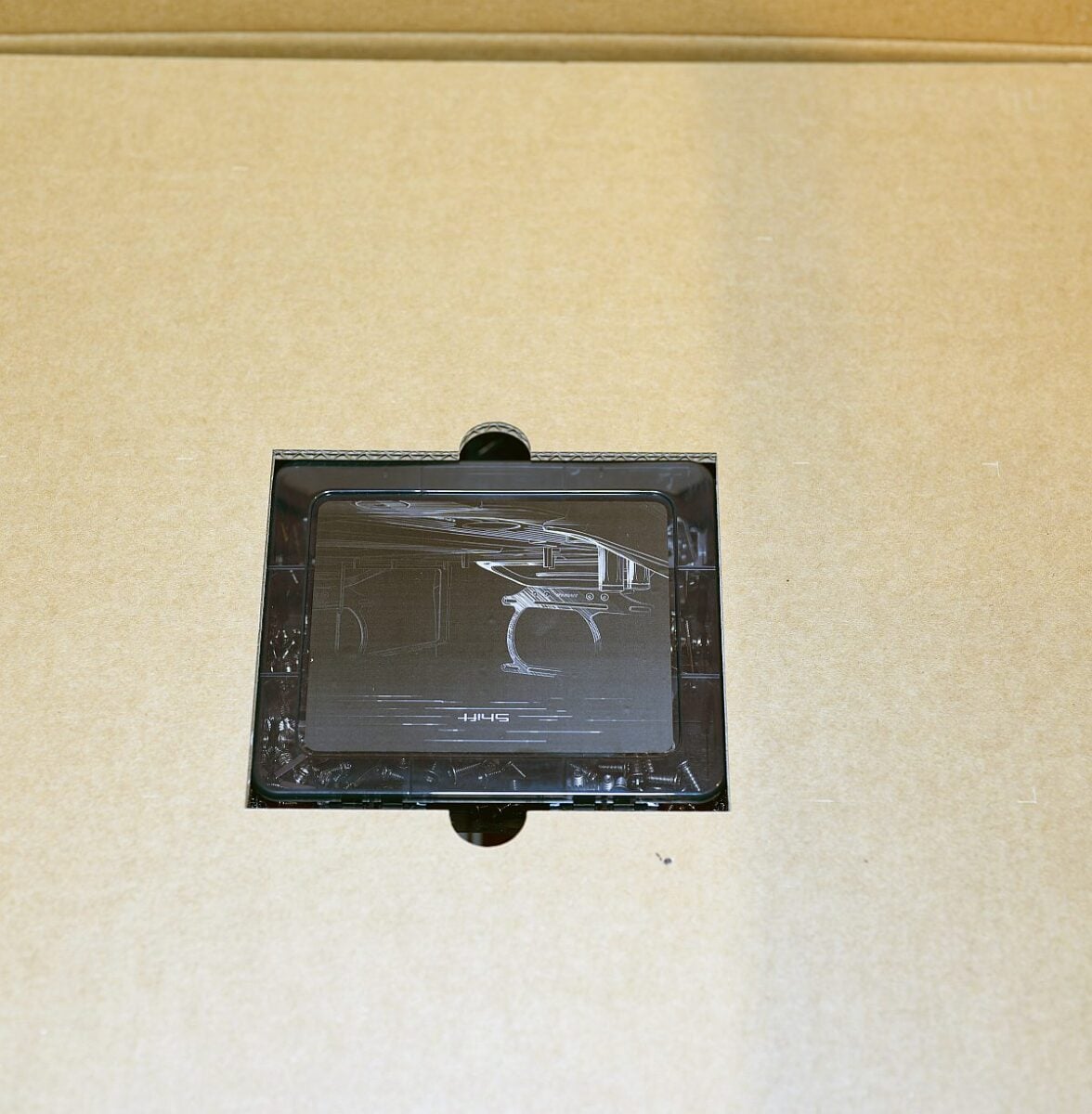
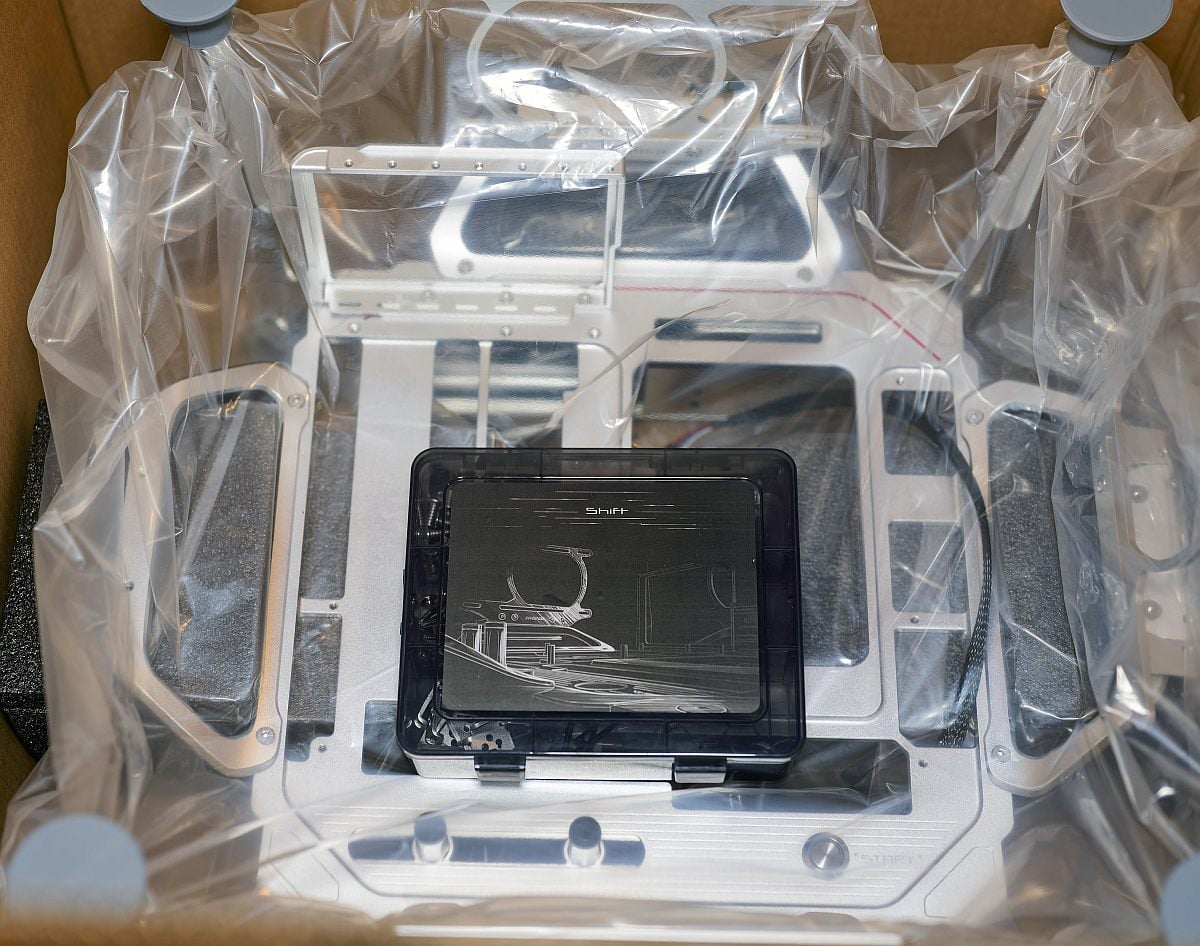
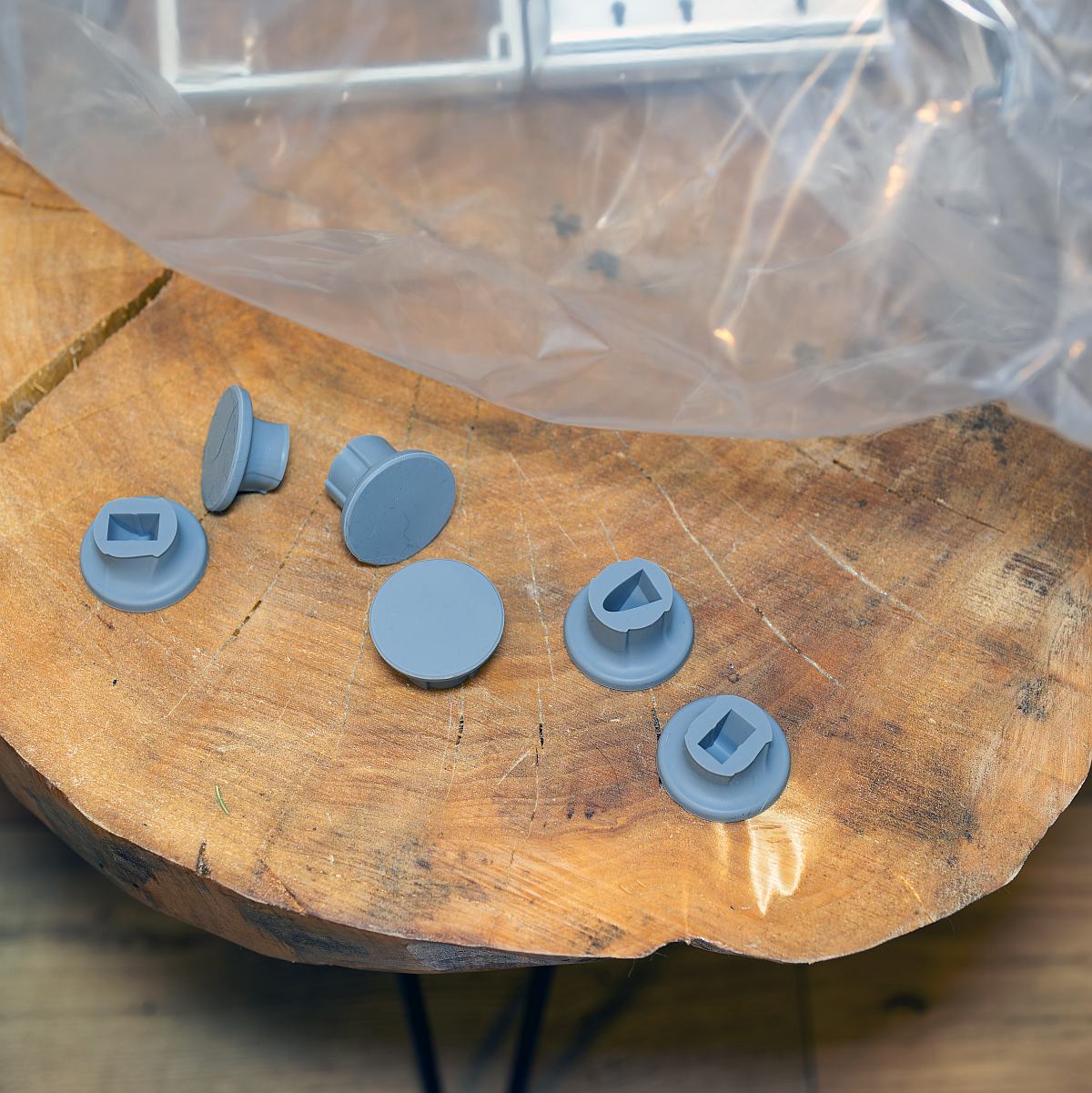
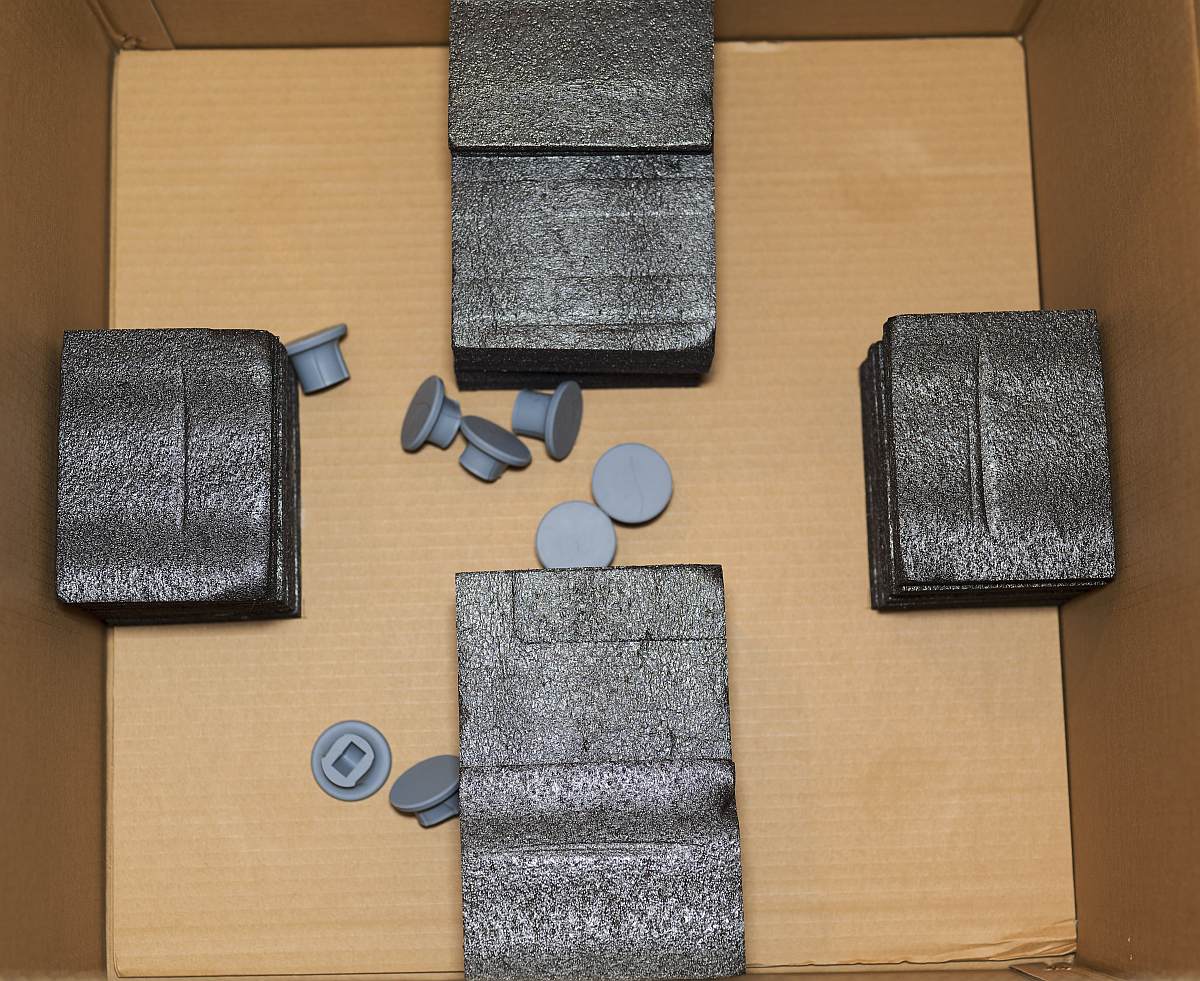
A flat cardboard insert with glued open‑cell foam sandwiches the chassis from above and below. It keeps the open frame from moving within the box.
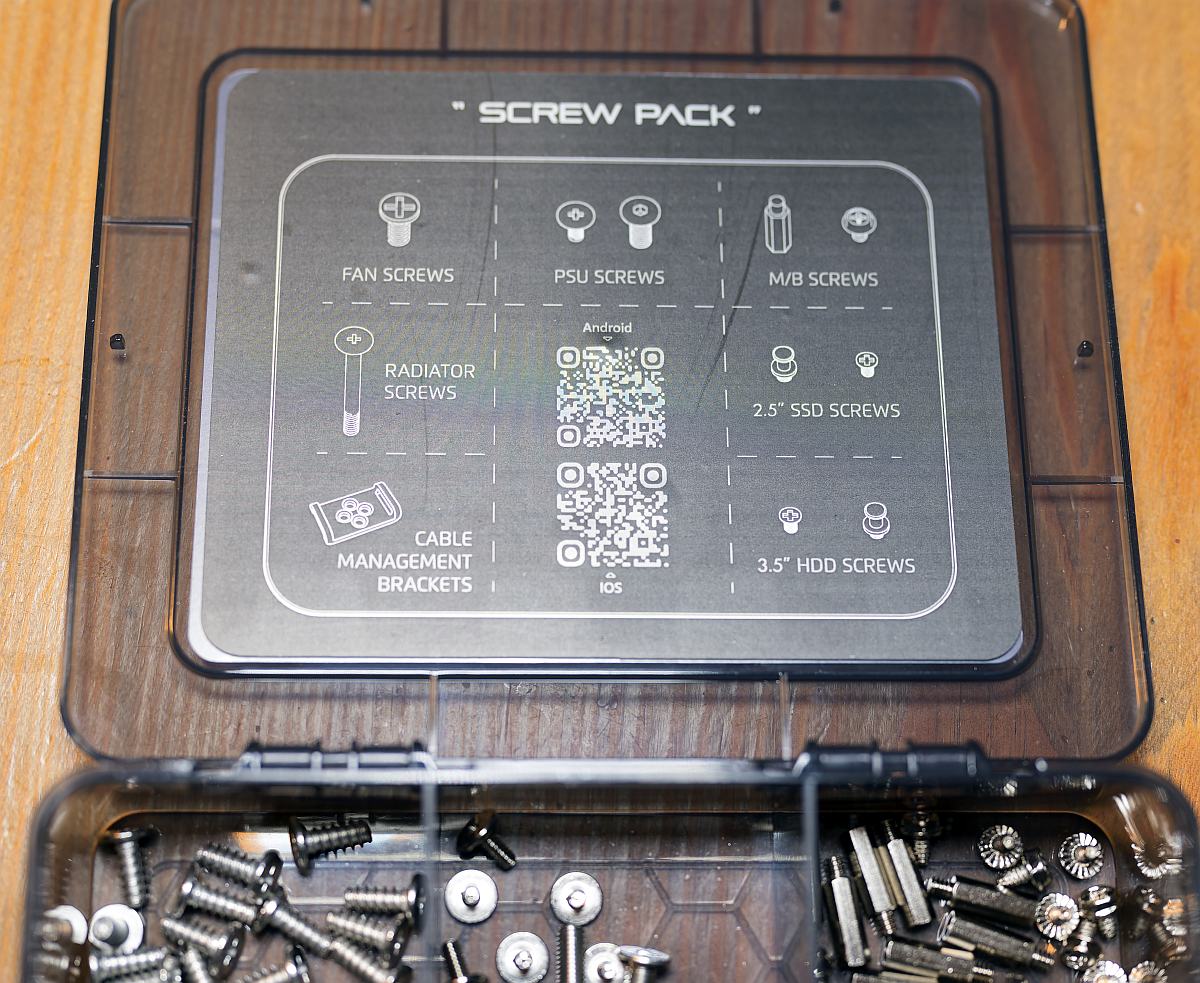
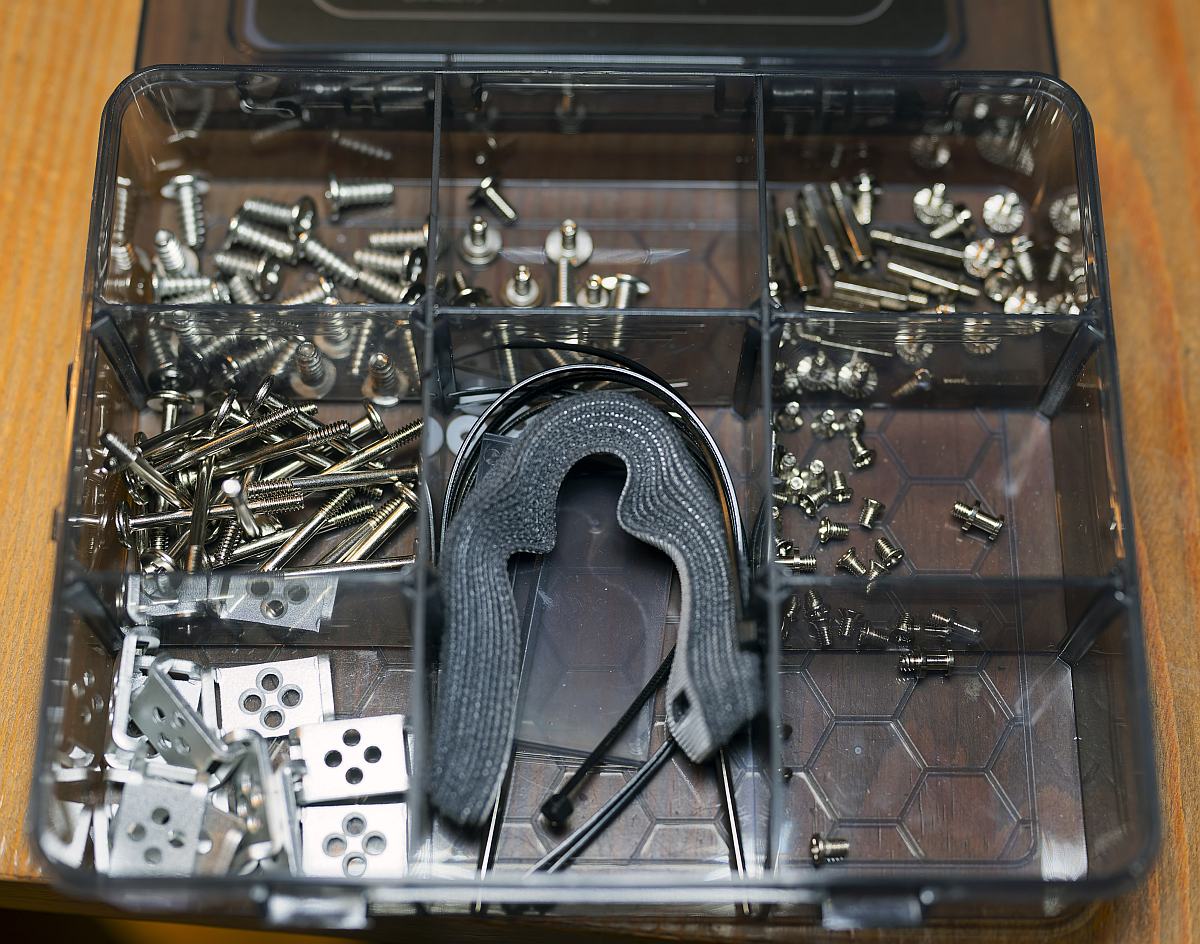
InWin also includes a neatly organised accessory case that holds screws, standoffs, cable ties and the distinctive aluminium cable‑management brackets. These extras reinforce the chassis’s reuse-centric philosophy, encouraging multiple rebuilds and custom layouts over the Shift’s lifetime.
Exterior Tour
When viewed upright, with its “wings” folded in, the Shift immediately stands out as a sculptural piece rather than a conventional PC case. The CNC‑machined aluminium surfaces are smooth and cool to the touch. The sweeping legs give the whole frame a sense of engineered elegance.
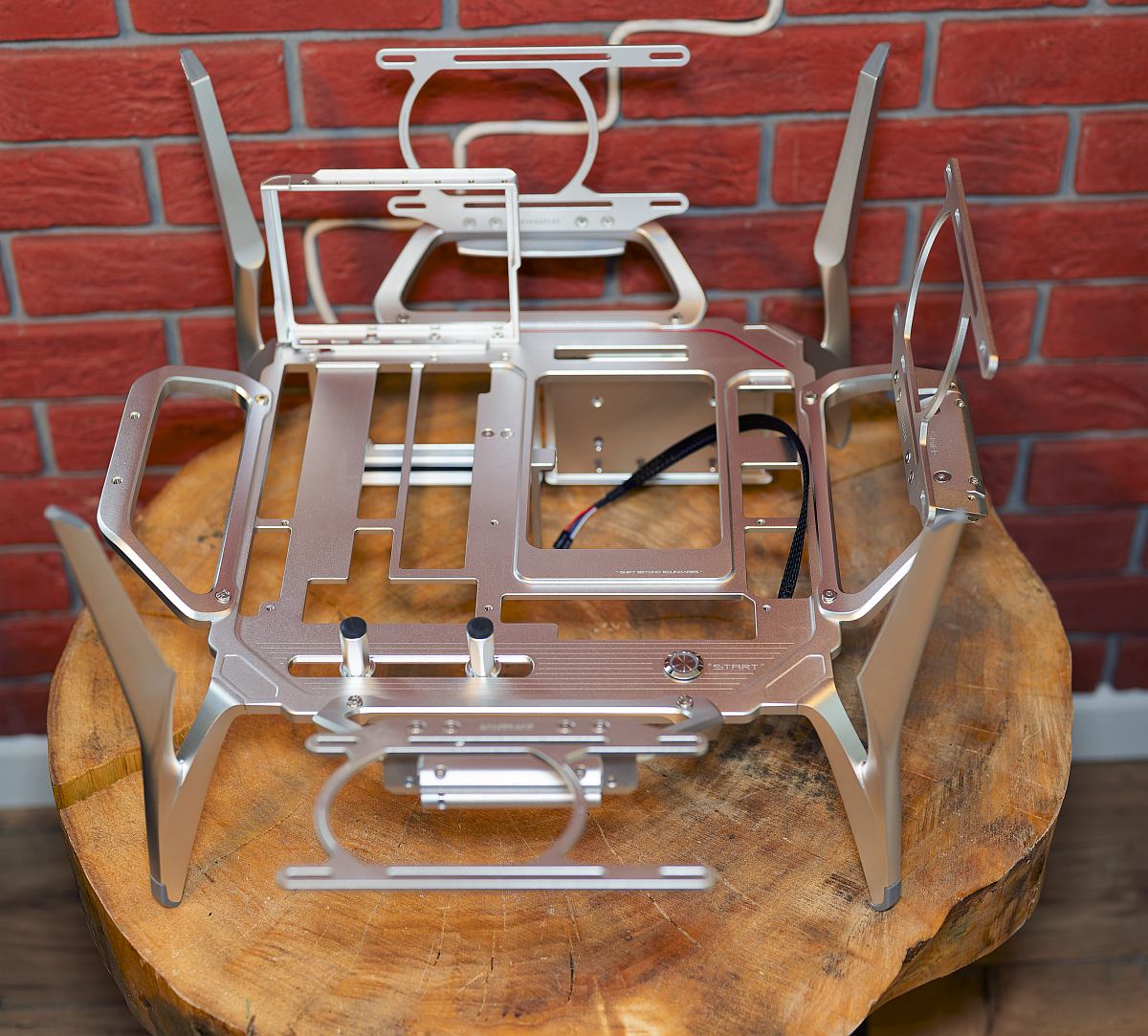
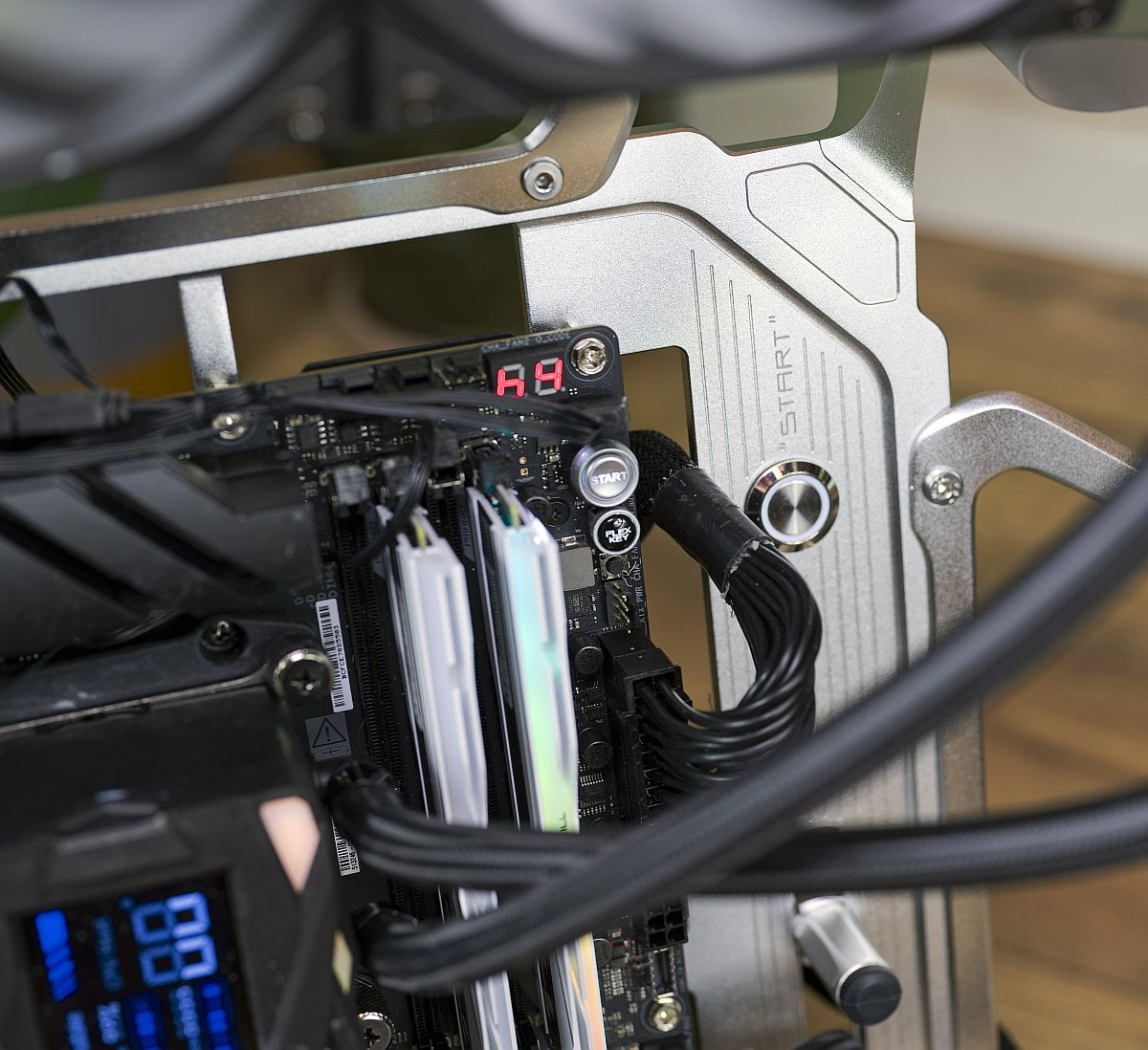
The central tray, slightly reclined when the chassis is used vertically, hosts the motherboard and GPU, with generous cutouts that also accommodate BTF and other back‑connector boards for a cable‑free front view. Subtle red accents along the tray edge, engraved stripes, and laser‑etched “Start” and “Shift Beyond Boundaries” text reinforce the premium, design‑focused feel.
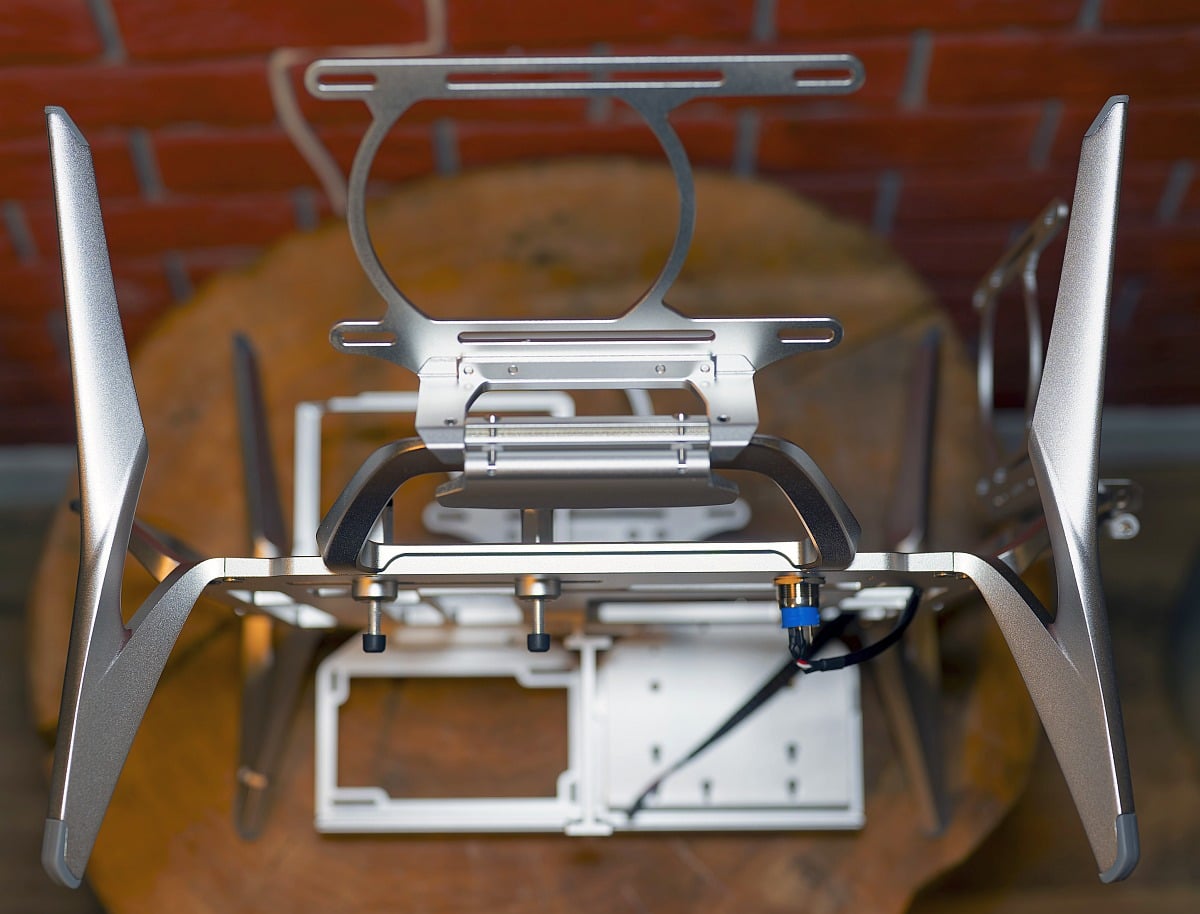
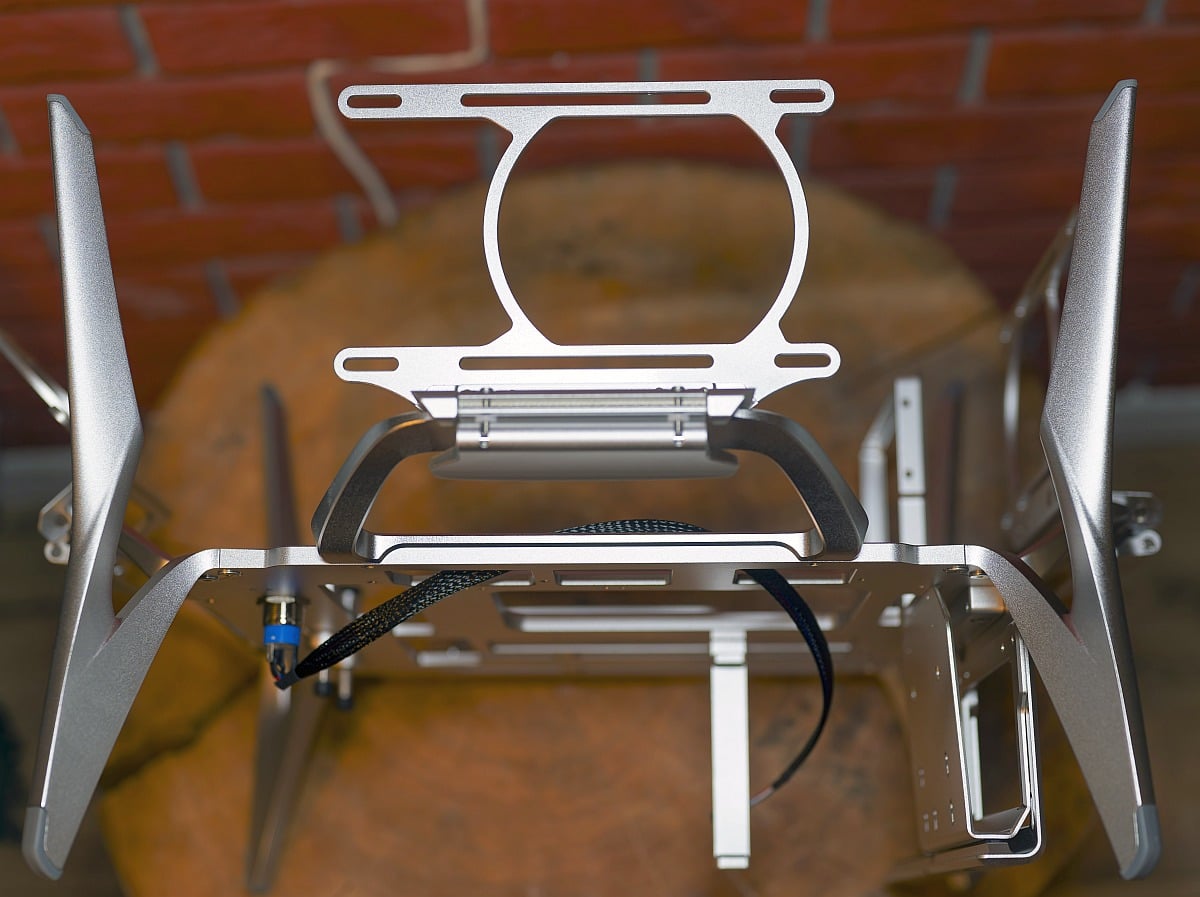
Three articulated “wings” surround the tray – one at the top and one on each side – each drilled with 120mm‑spaced rails to accept fans, radiators, or even relocated PSU and storage brackets. The PCIe area provides seven slots and can be rotated to support either vertical or horizontal GPU installation, with two height‑adjustable, rubber‑tipped GPU support brackets that help hold large cards in place.
At the bottom, four elaborately shaped legs both stabilise the frame and act as design highlights. The rubberised feet prevent vibration while protecting your desk surface. One leg can handily be adjusted when the case is laid flat, allowing you to compensate for uneven surfaces and prevent the chassis from rocking.
Interior Tour
From the rear, the Shift is almost as visually busy as from the front. You can see large apertures around the motherboard tray and modular brackets ready for PSU and storage. InWin reinforces the motherboard standoff areas to withstand frequent hardware swaps, specifically targeting testers such as yours truly and enthusiasts who rebuild often.
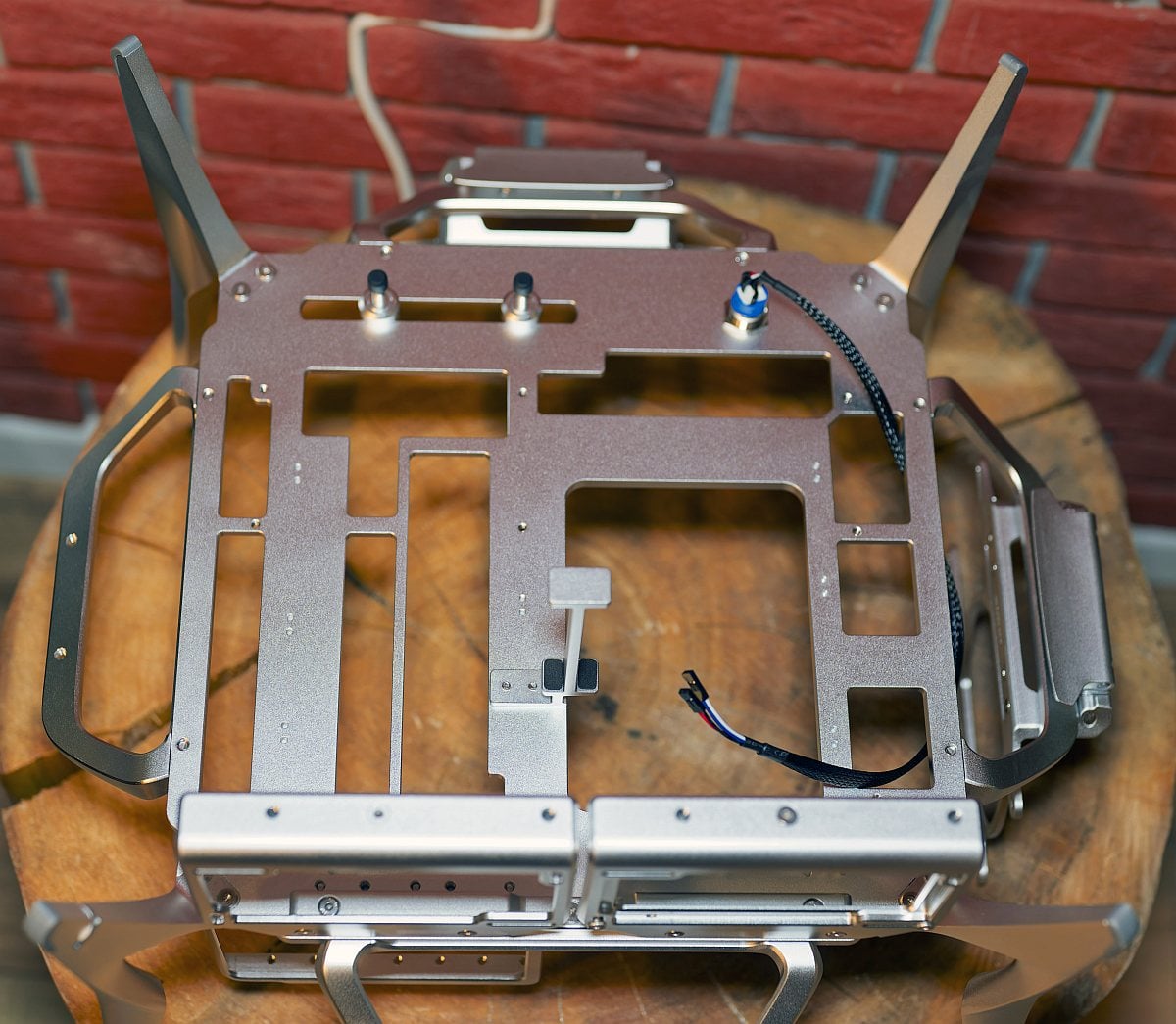
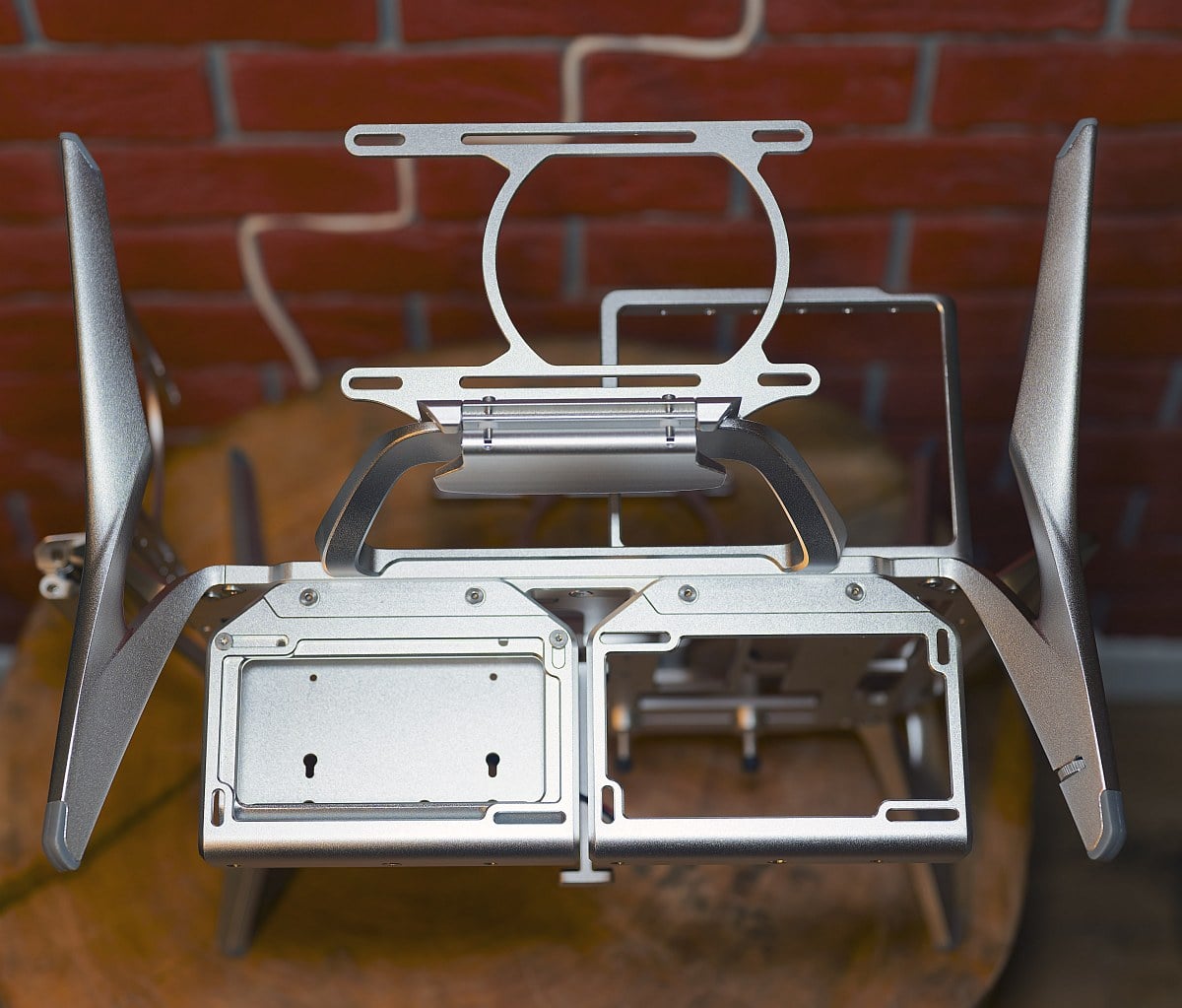
Instead of fixed tie‑down loops, cable management is handled via the included aluminium brackets. They screw into dedicated mounting holes on the back of the tray and are secured with zip ties or Velcro ties. This approach keeps the rear visually clean, but it requires planning to place brackets where cable bundles are expected.
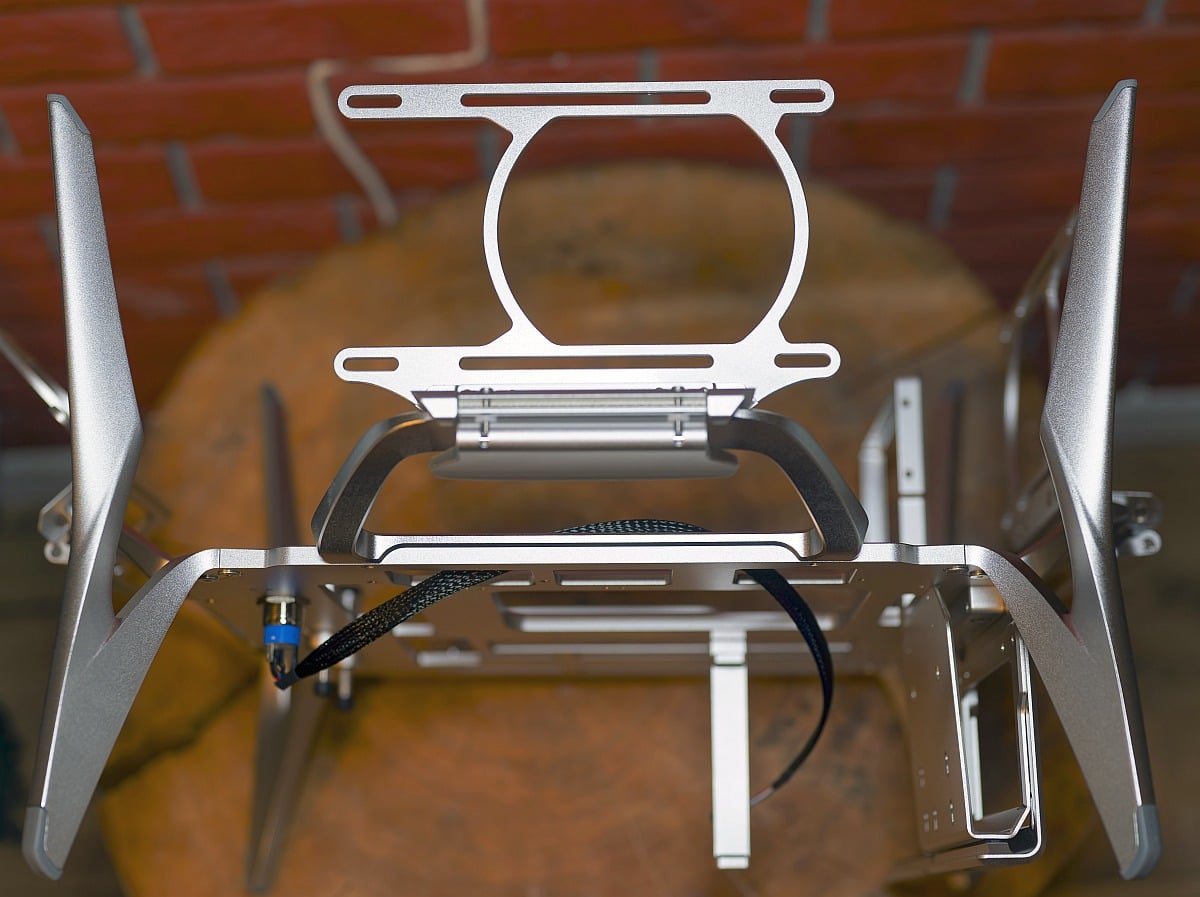
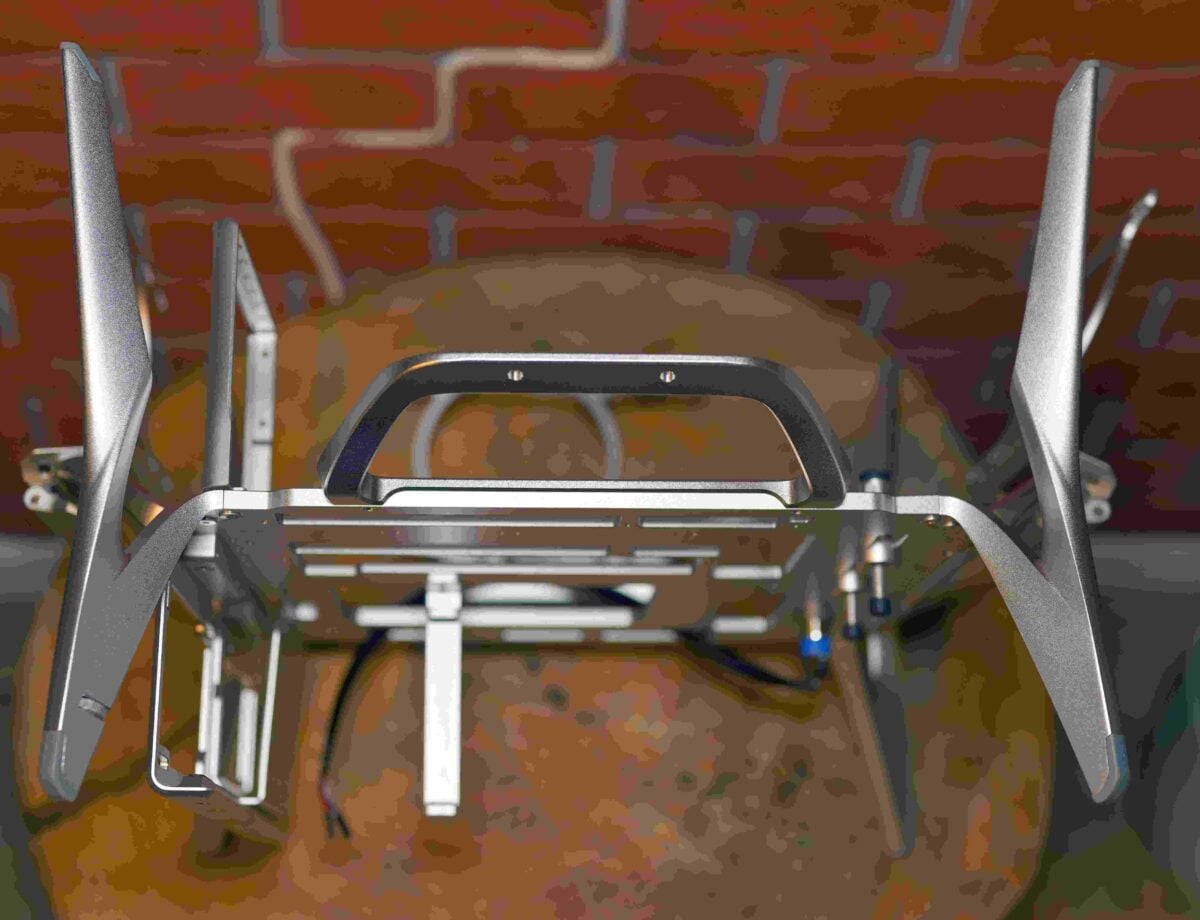
Limitless CPU cooler height is afforded by the open structure, making large dual‑tower air coolers and tall custom water‑cooling components easy to accommodate. GPUs up to 350mm fit without issue before clashing with the right‑hand wing. The modular PSU and storage brackets, meanwhile, can be relocated between rear and side wings to suit a choice of single‑ or dual‑PSU layouts.
The only jarring element on this otherwise cohesive design is the back of the power switch. Its exposed plastic housing and cabling feel slightly out of place given the level of machining elsewhere. With no front‑panel USB or audio headers, the Shift stays true to its minimalist concept. It clearly targets builds where convenience is secondary to aesthetics and flexibility.
Build Process
Here’s the list of parts used for a sample build:
• CPU: AMD Ryzen 9 9950X3D
• CPU cooler: Thermaltake LA360-S ARGB
• RAM: G.Skill TridentZ Neo RGB 2 x 16GB 6,000MHz CL28
• Motherboard: Asus ROG Crosshair X870E Hero
• GPU: Asus TUF Gaming GeForce RTX 3080
• SSD: Lexar NQ790 2TB
• PSU: NZXT C1500 Platinum
Assembly on the Shift is about as straightforward as open‑air building gets. However, there is some preparatory work in installing standoffs and deciding where brackets and wings should be located.
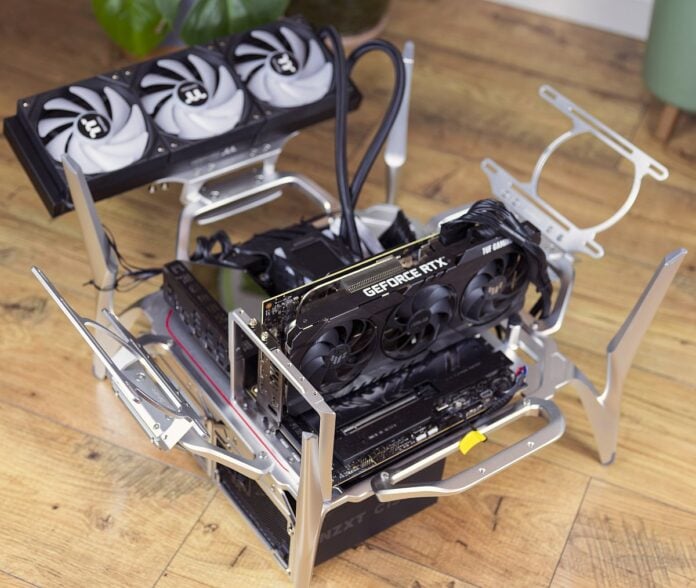
The roomy central tray easily accommodates a high‑end ATX board and a large GPU. There are no obstructions above the CPU area, and there is unhindered access to PCIe slots for riser cards or capture cards. Mounting the 360mm AIO on one of the wings keeps tubing runs short and makes the radiator visually prominent. This is turning the loop into part of the case’s silhouette rather than something hidden away. One minor niggle here is that only long radiator screws are provided in the bundle.
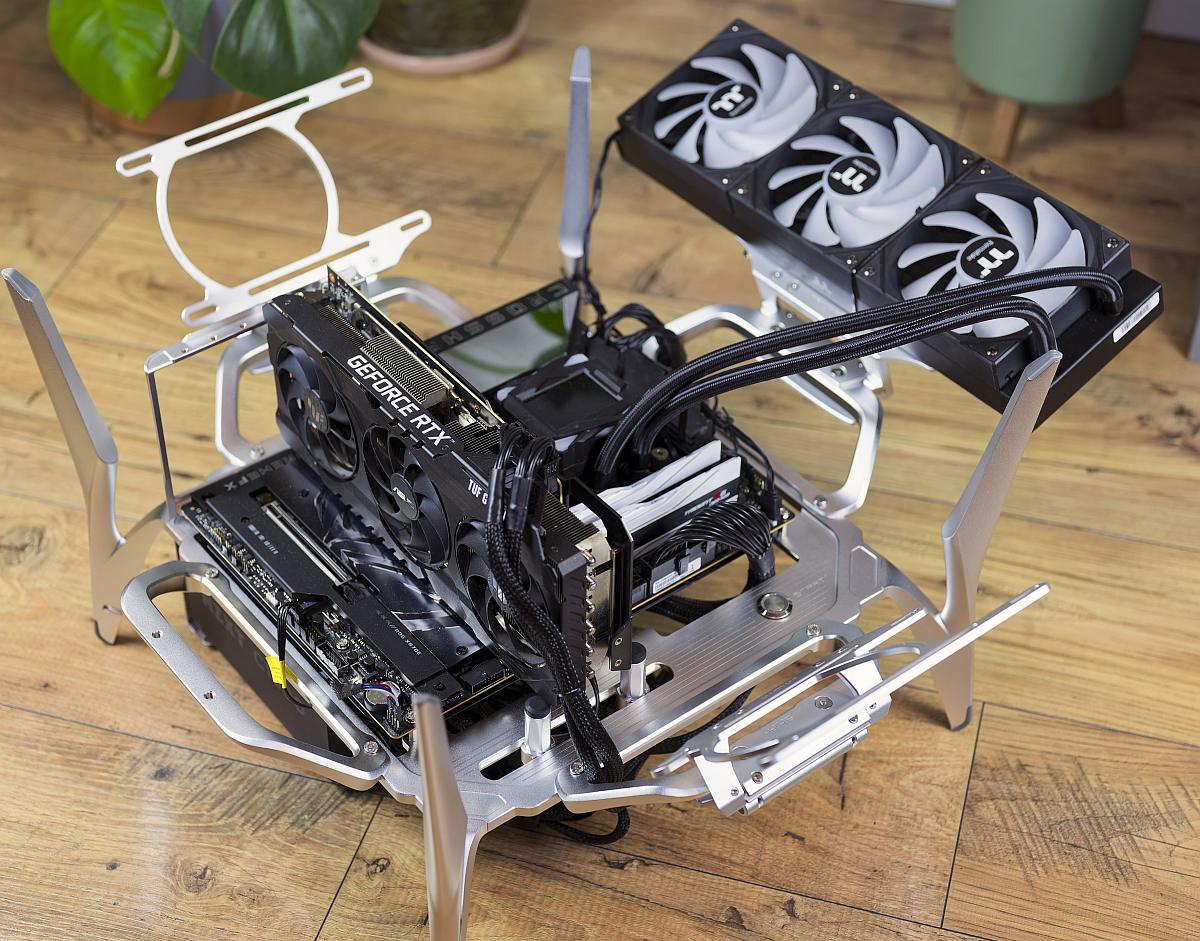
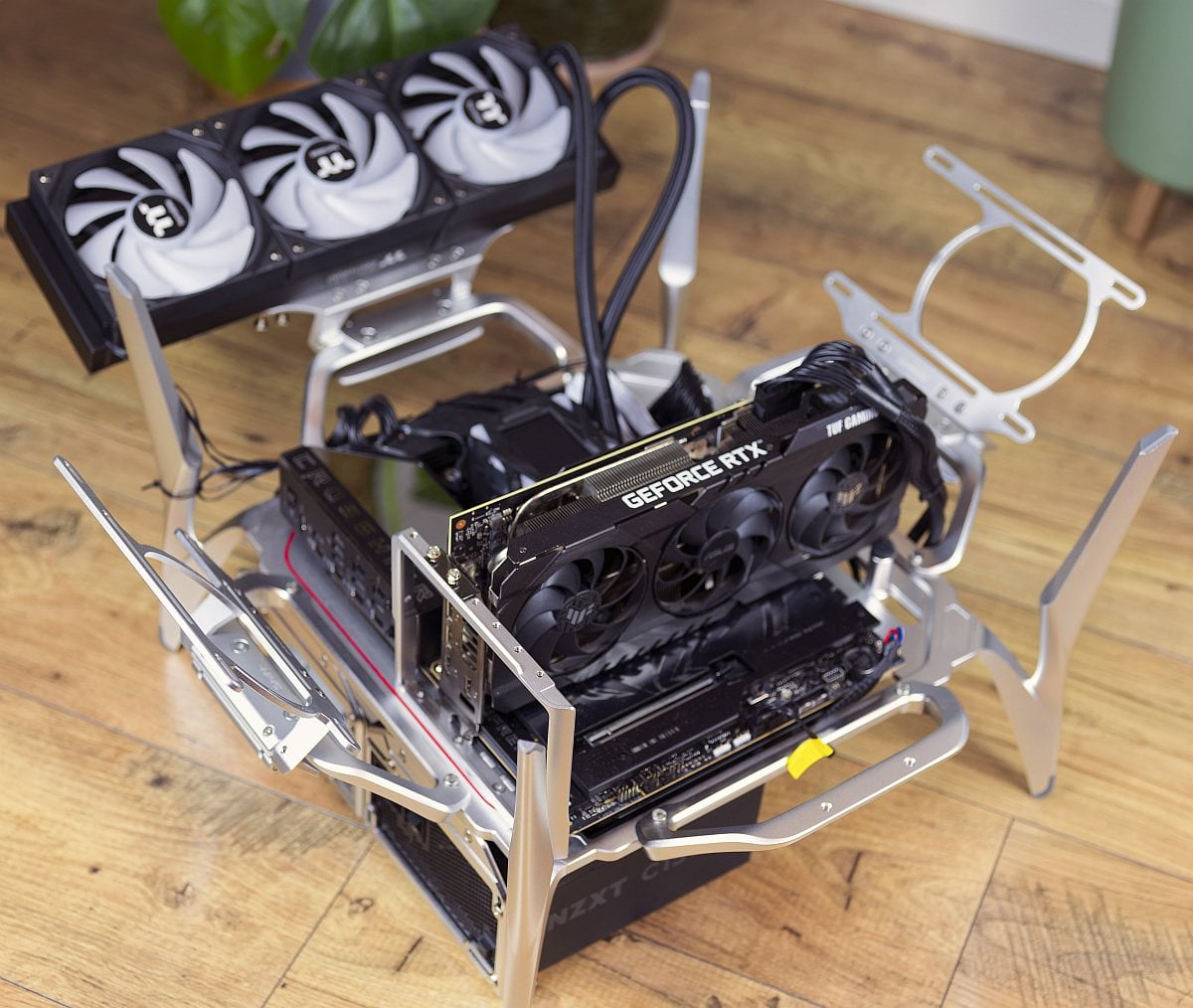
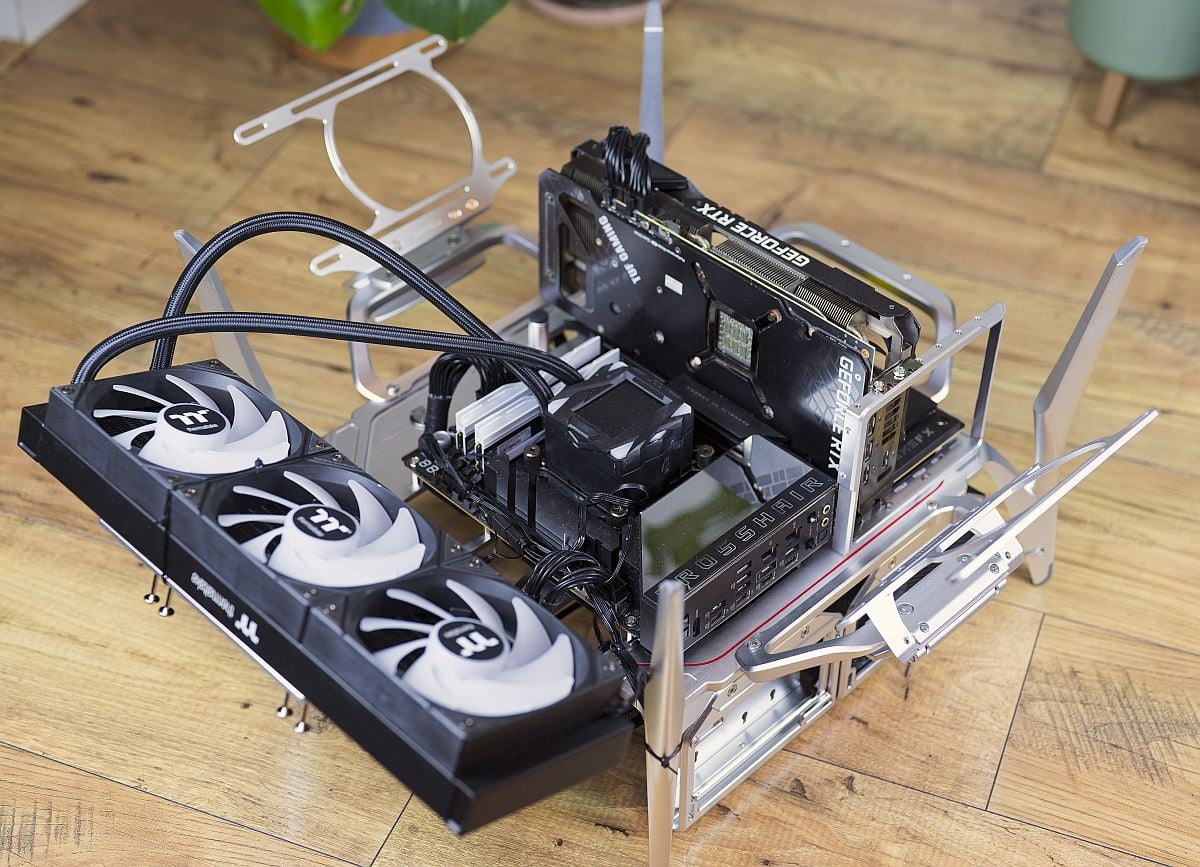
The NZXT C1500 PSU typically requires careful placement due to its length and cable bulk. Here, the movable brackets and numerous cutouts enable routing thick bundles cleanly behind the tray.
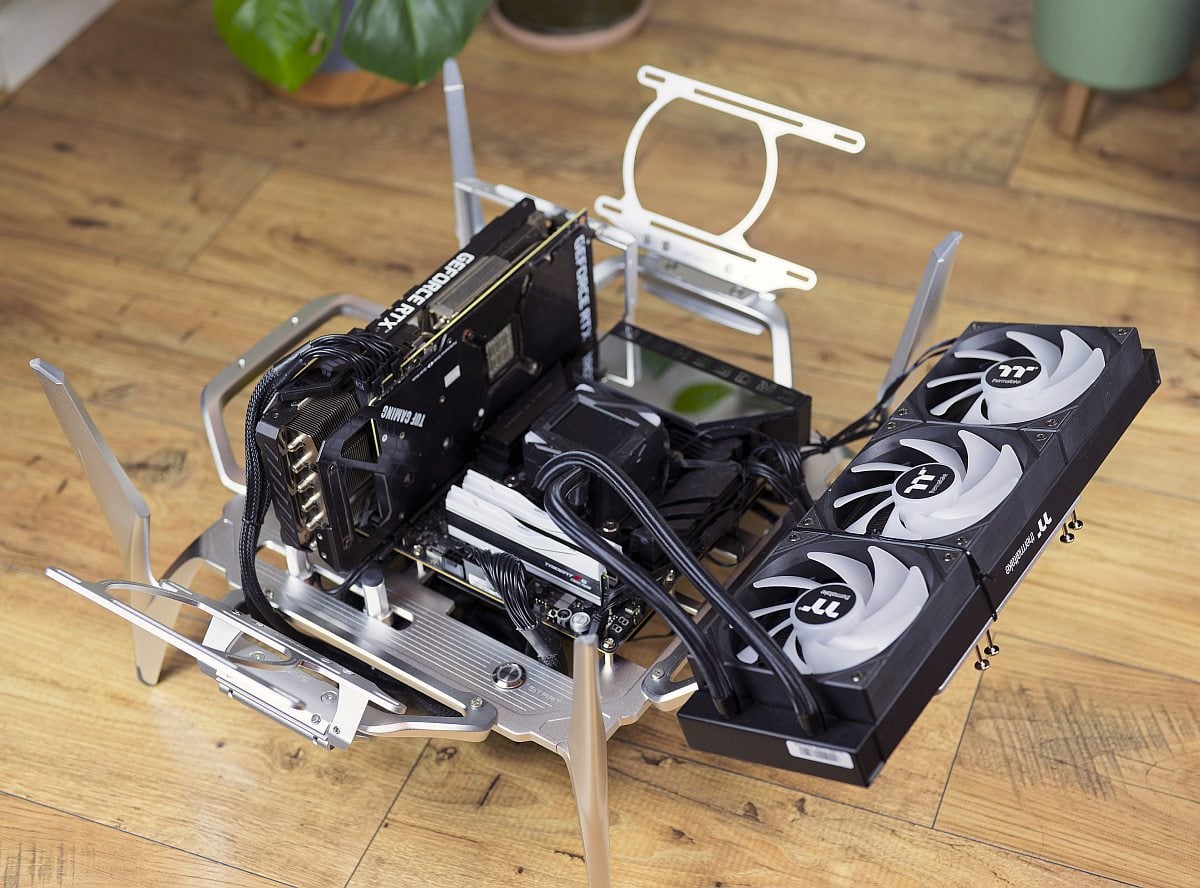
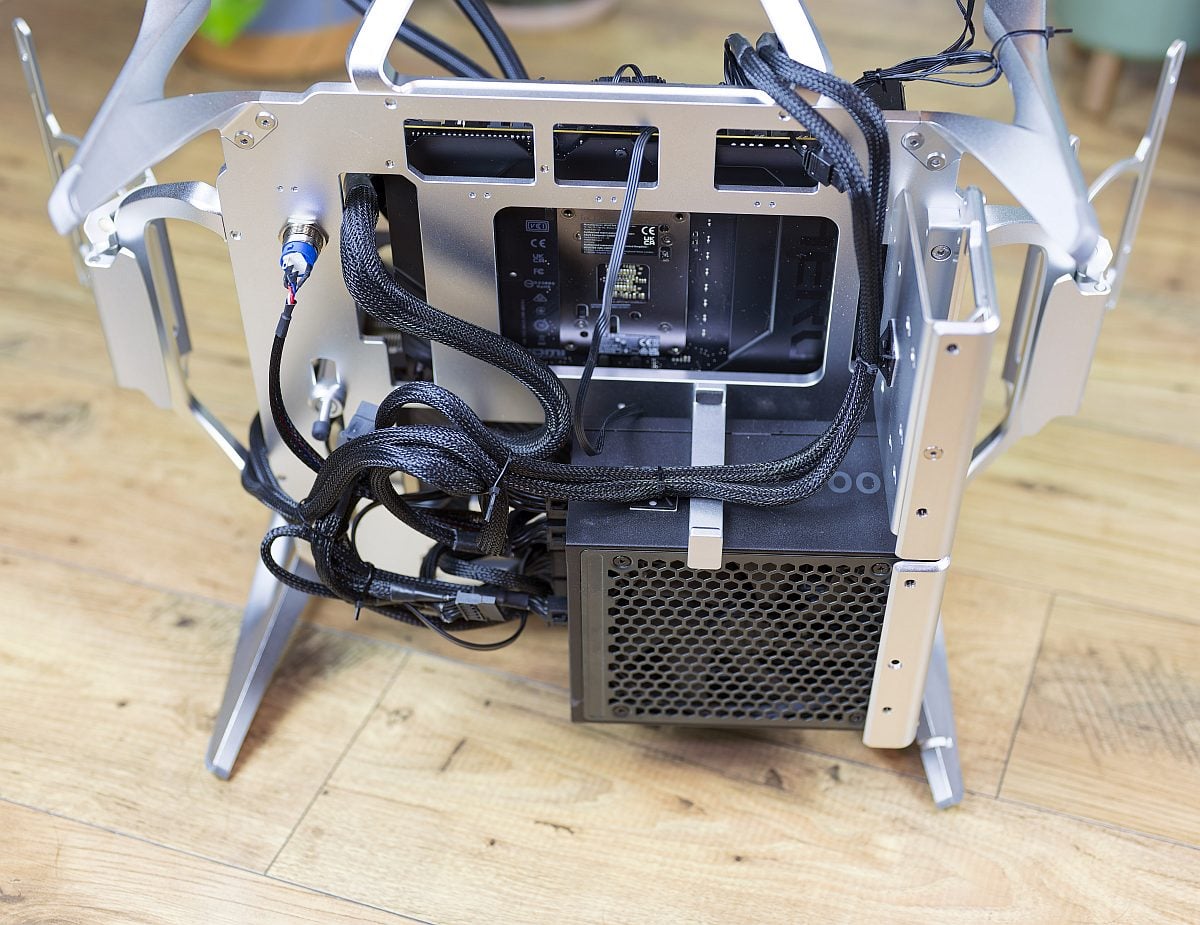
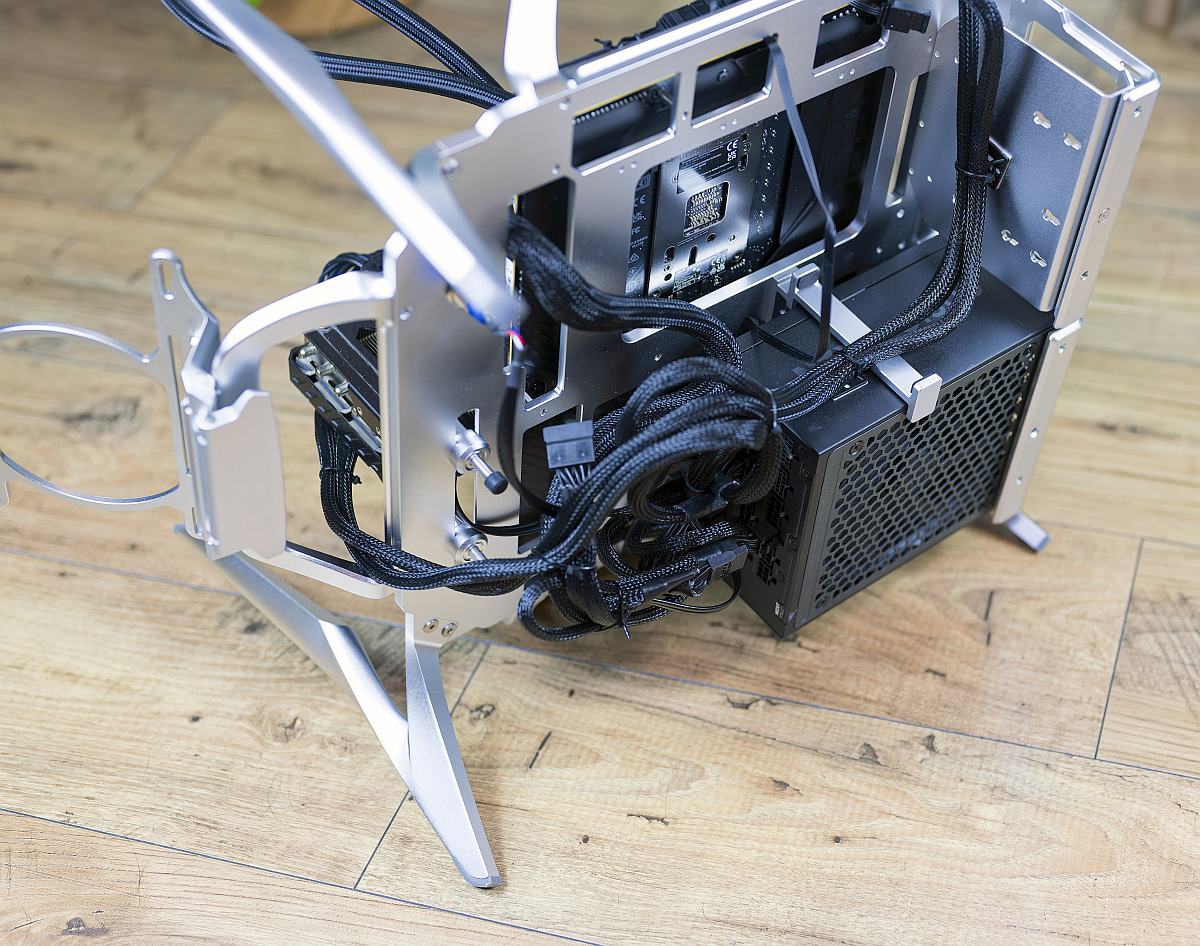
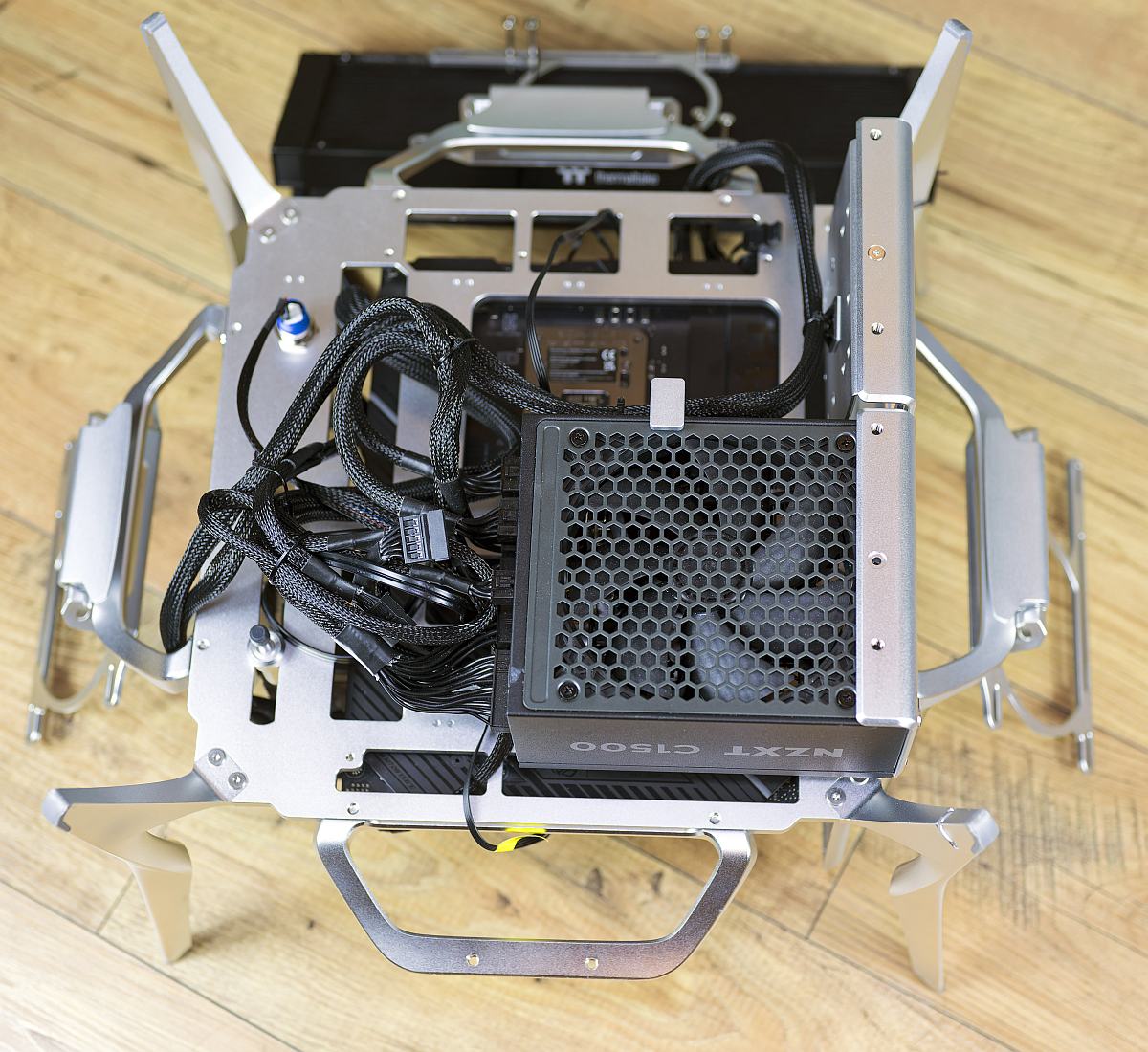
BTF‑style or well‑planned cable sets pay dividends, since there are no panels to hide excess slack or untidy runs on the component side. Supplied aluminium cable‑management clips and a mix of zip and Velcro ties are helpful and it’s not overly difficult to achieve a tidy rear layout.
However, a little extra planning is required compared with a conventional tower. Once assembled, the Shift feels surprisingly rigid given its 4.25kg weight. The angled stance plus wing bracing help it shrug off flex even when loaded with a long GPU and radiators.
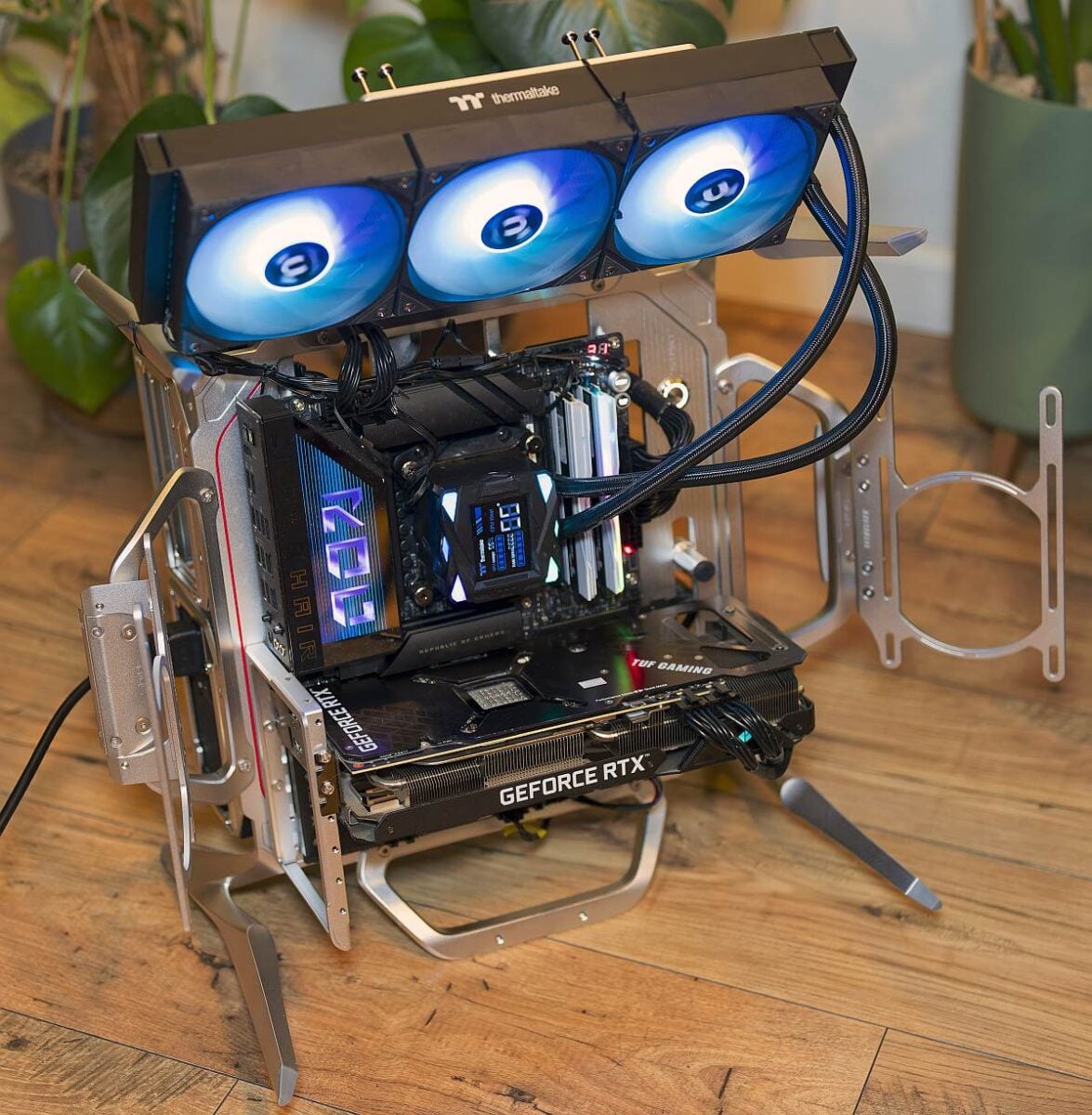
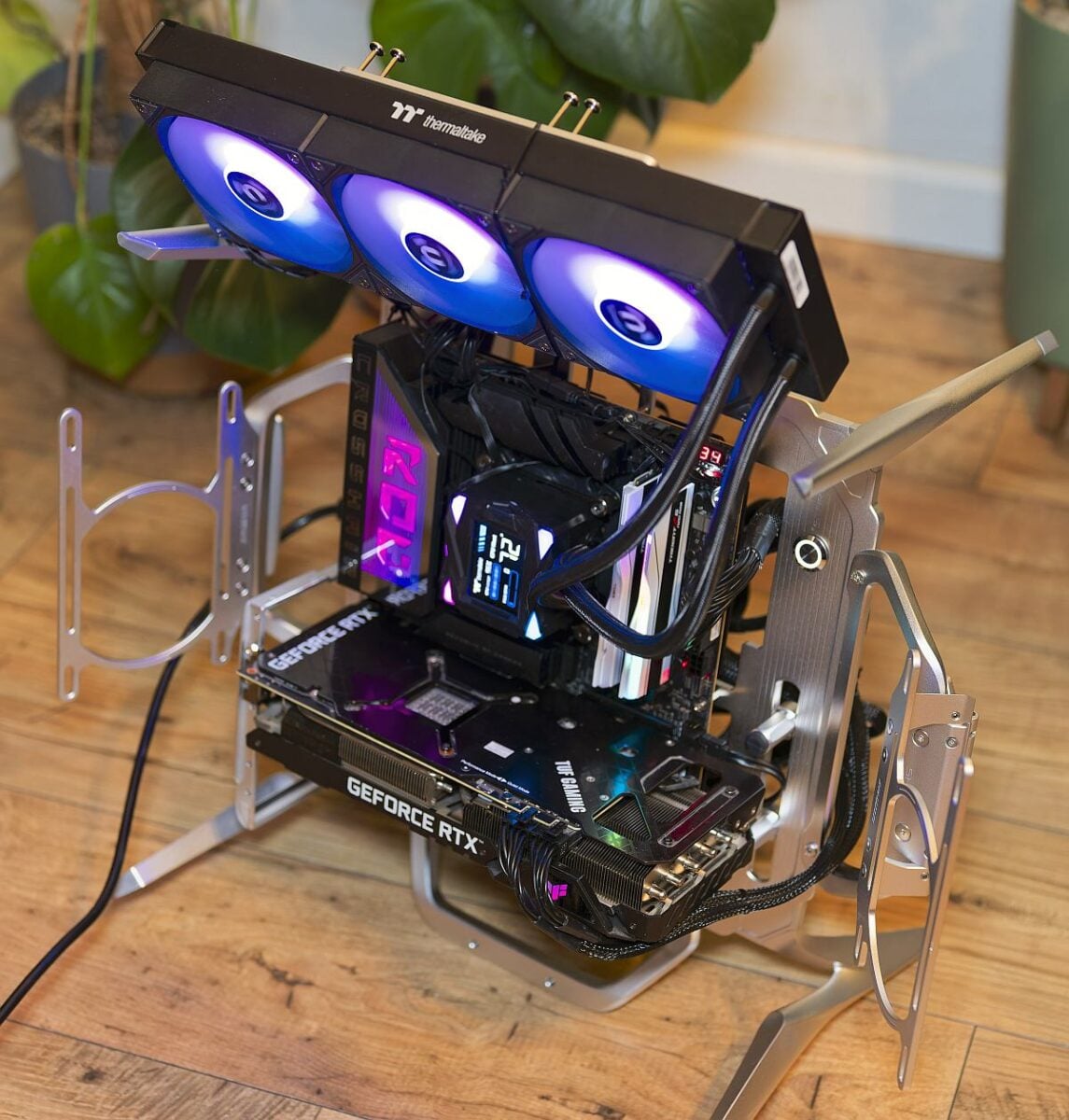
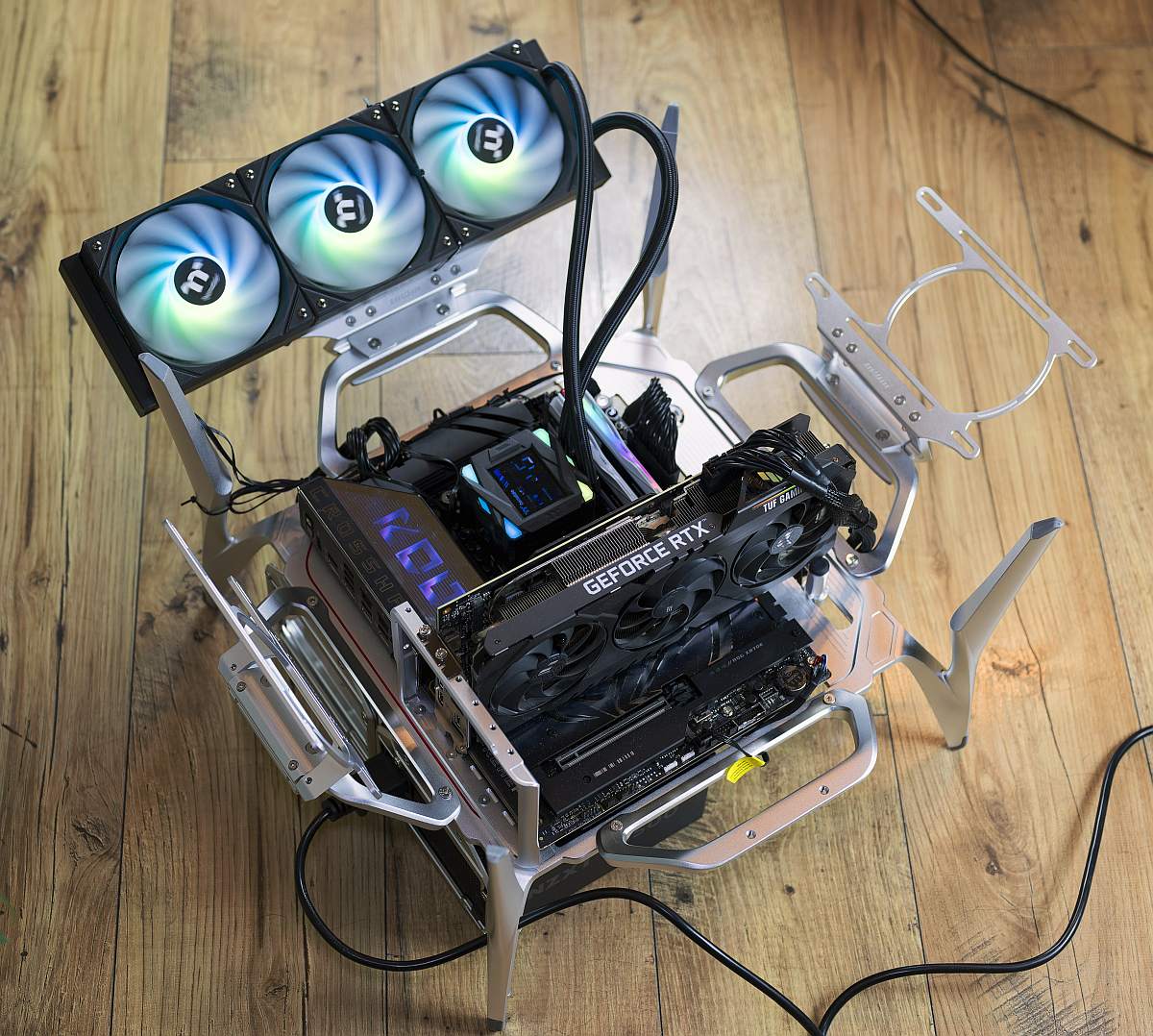
There’s no denying it’s a whole lot of fun to build with, and there’s something about the look of my finished setup that makes me think Johnny 5 is still alive. What you lose in dust filtration and protection from spills, you absolutely make up for in playfulness.
Performance
With no panels or filters to impede airflow, the Shift behaves more like a premium test bench than a conventional chassis. It relies entirely on your chosen coolers and fan curve for thermal performance. In practice, this is beneficial for CPU temperatures when paired with a 360mm radiator and reasonable fan speeds.
High‑core‑count chips operate comfortably within spec, with plenty of headroom left for overclocking or PBO‑style boosts. GPU temperatures are also strong, though not always class‑leading compared to the very best closed cases with focused intake. The open air layout typically implies less directed airflow across the graphics card’s heatsink.
Acoustically, the frame adds almost no additional noise of its own, so perceived sound levels closely track fan and pump tuning rather than being filtered by panels or dampening. For silent‑leaning builds, this can be an advantage. A well‑tuned profile at moderate RPMs keeps the system quiet while still benefiting from unrestricted access to fresh air.
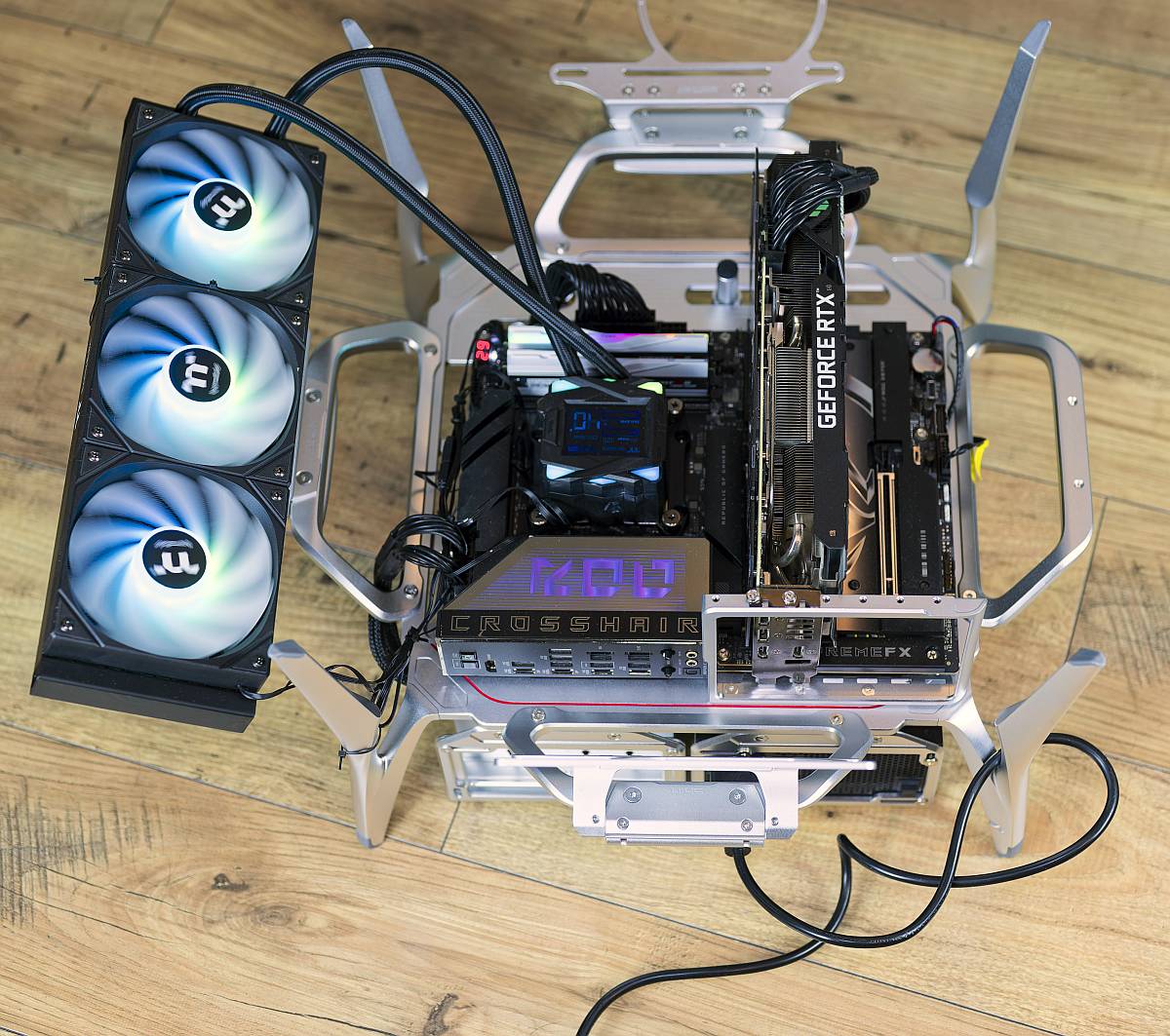
On the flip side, high‑RPM stress testing or aggressive bench work is heard unvarnished, but that’s par for the course with any open‑frame bench table. The real strength lies in consistency: there are no hotspots trapped behind glass or mesh. Any component that runs loud or hot is plainly exposed and easy to address with different cooling.
Though I’ve no direct comparison – none of the chassis I’ve tested recently are anything like this – I have noted temperatures across my test build for your reference. Temperatures were recorded in an idle state and with 2D and 3D loads using Cinebench 2024 and Fortnite, respectively.
Sustained stress testing shows the Shift performing exceptionally on CPU thermals, with my 9950X3D maintaining 78°C after prolonged all-core load, and hitting just 68°C when playing Fortnite. That’s matching or beating many closed cases thanks to its completely unobstructed intake and exhaust paths. Perusing the logs with a 360mm AIO in play, peak CPU temperatures under heavy multi‑hour load remain comfortably below typical thermal limits, and average readings stay tightly grouped, indicating stable behaviour over time.
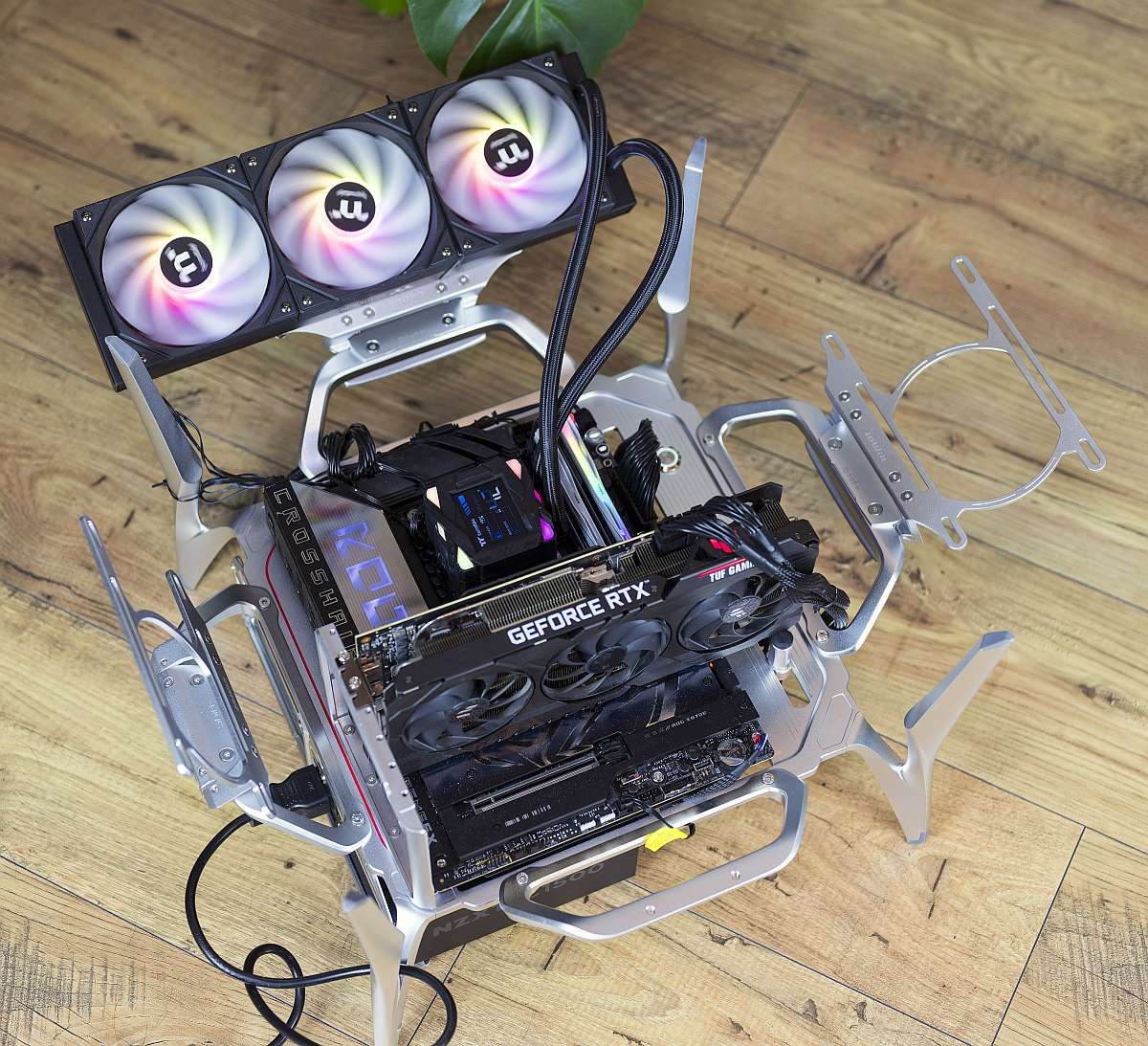
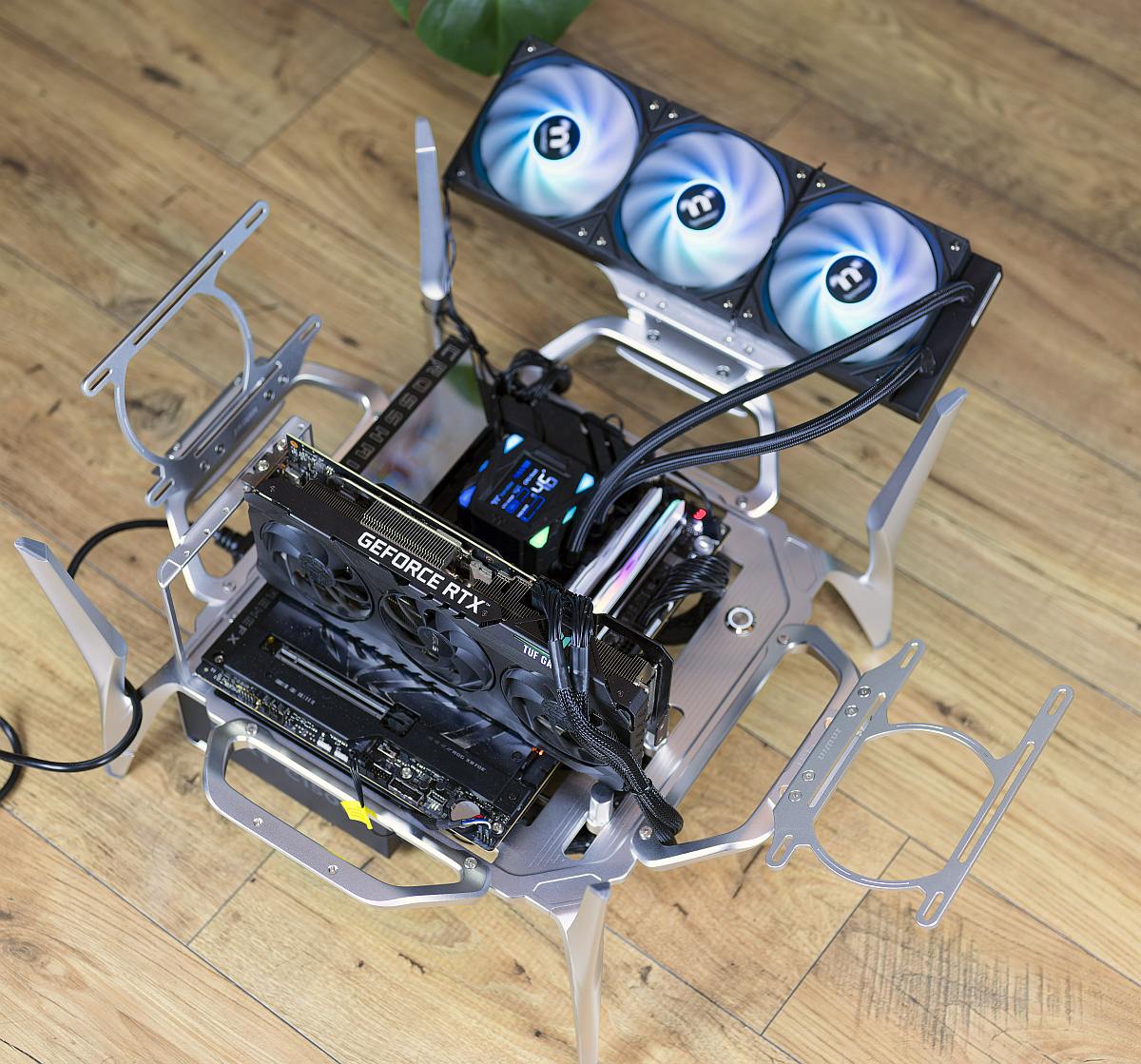
GPU temperatures, meanwhile, are only a few degrees higher than those in the best airflow‑optimised enclosures. This gap can be narrowed by dedicating one wing of fans or the radiator area to direct airflow toward the graphics card.
Noise levels are similarly pliable, ranging from a gentle 32dB hum at idle, to a distracting 43dB whoosh when gaming. Because there are no panels to dampen sound, idle and light‑load noise is dictated almost entirely by your fan and pump profiles, making zero‑RPM or low‑RPM strategies especially effective. Under gaming or rendering loads, the Shift will not hide coil whine or turbulent fan noise. It also avoids panel resonance and vibration that can amplify certain frequencies in closed towers. For testers and tweakers, this transparency is useful, as it makes cooler behaviour and fan tuning easier to evaluate without enclosure variables muddying the picture.
Conclusion
Shift is not a mass‑market mid‑tower; it is a niche tool and showpiece for two main audiences – reviewers and tinkerers who value easy access, and enthusiasts or modders seeking a dramatic aluminium canvas for custom loops and wild designs.
For those users, InWin’s mix of build quality, versatility, and BTF‑ready layout makes a compelling case despite the high price and lack of convenience features. Its strengths lie in build quality, modularity, and ease of access. CNC‑machined aluminium, adjustable wings, BTF support, and thoughtful extras such as aluminium cable brackets make it a compelling canvas for ambitious builds and frequent hardware swaps. At the same time, the price tag, lack of dust filters, and absence of front I/O make it ill‑suited for users who want a quiet, low‑maintenance gaming PC under the desk.
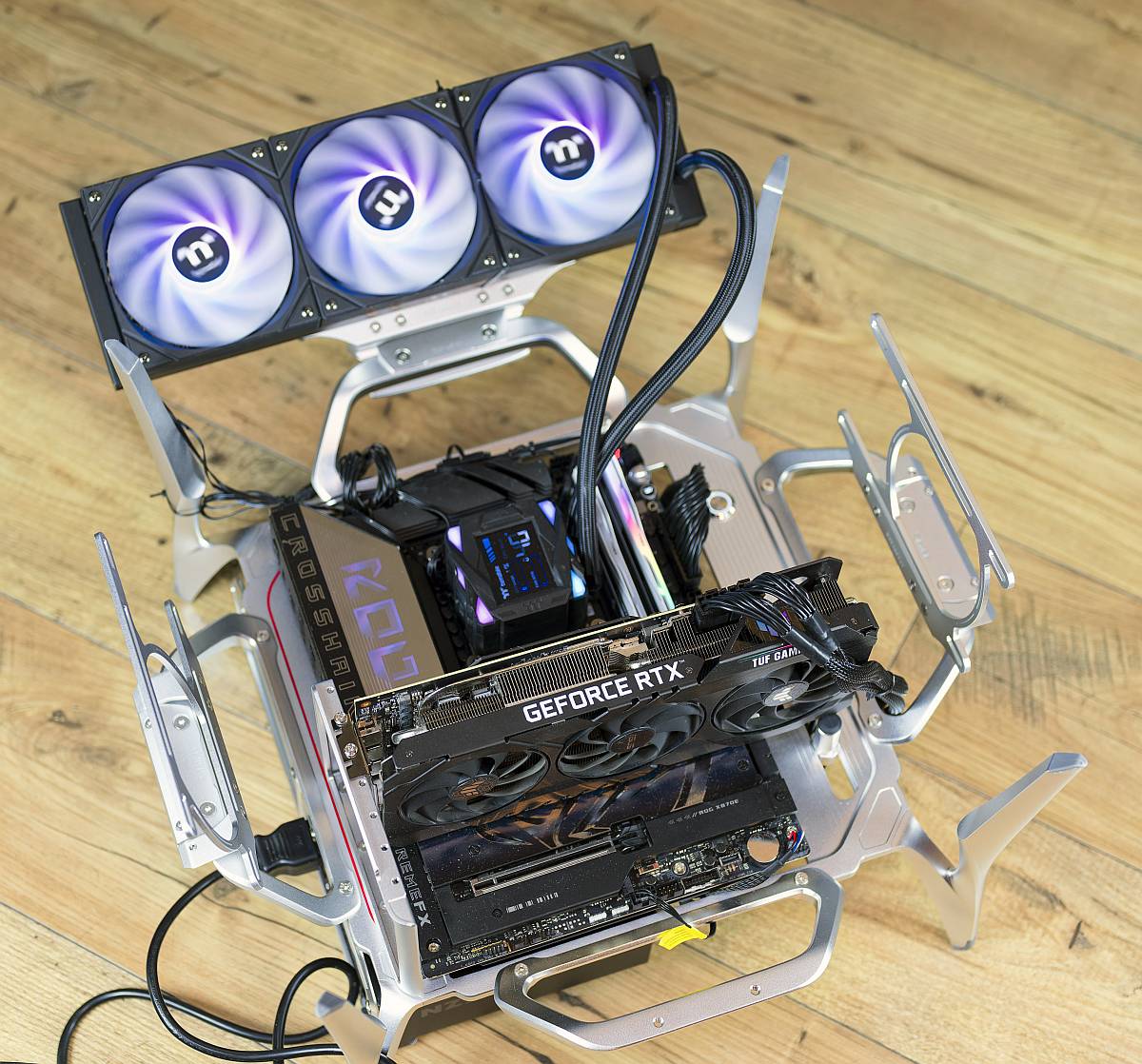
For many, the compromises will likely outweigh the benefits. But there will always be those who want their PC to look like a piece of industrial art on the desk, and if you take pleasure in the build process, the InWin Shift stands out as one of the most distinctive and flexible open‑frame chassis options available.
If you see your PC as a living project – one that’s rebuilt often, shown off proudly, and perhaps water‑cooled in painstaking detail – the InWin Shift delivers a distinctive foundation that encourages creativity and will likely outlast several generations of components.