
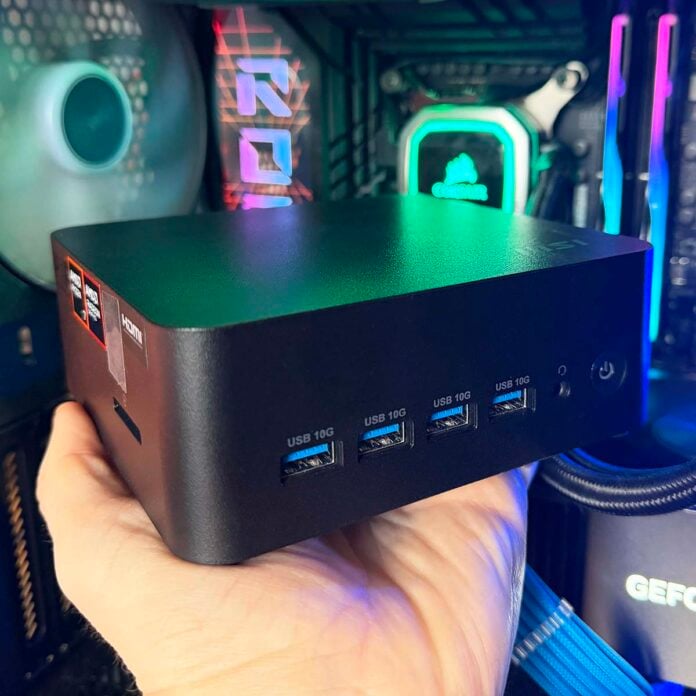
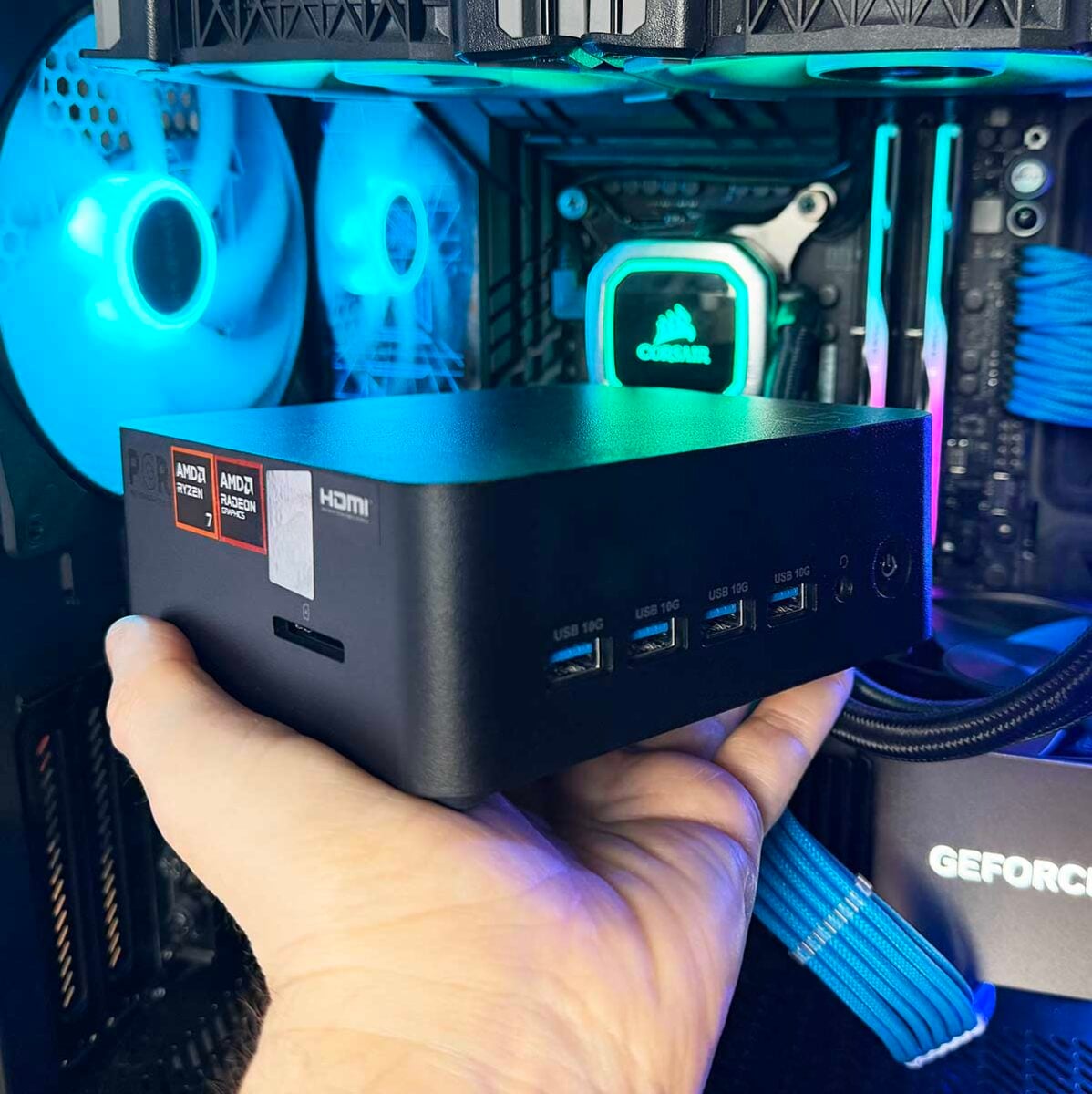
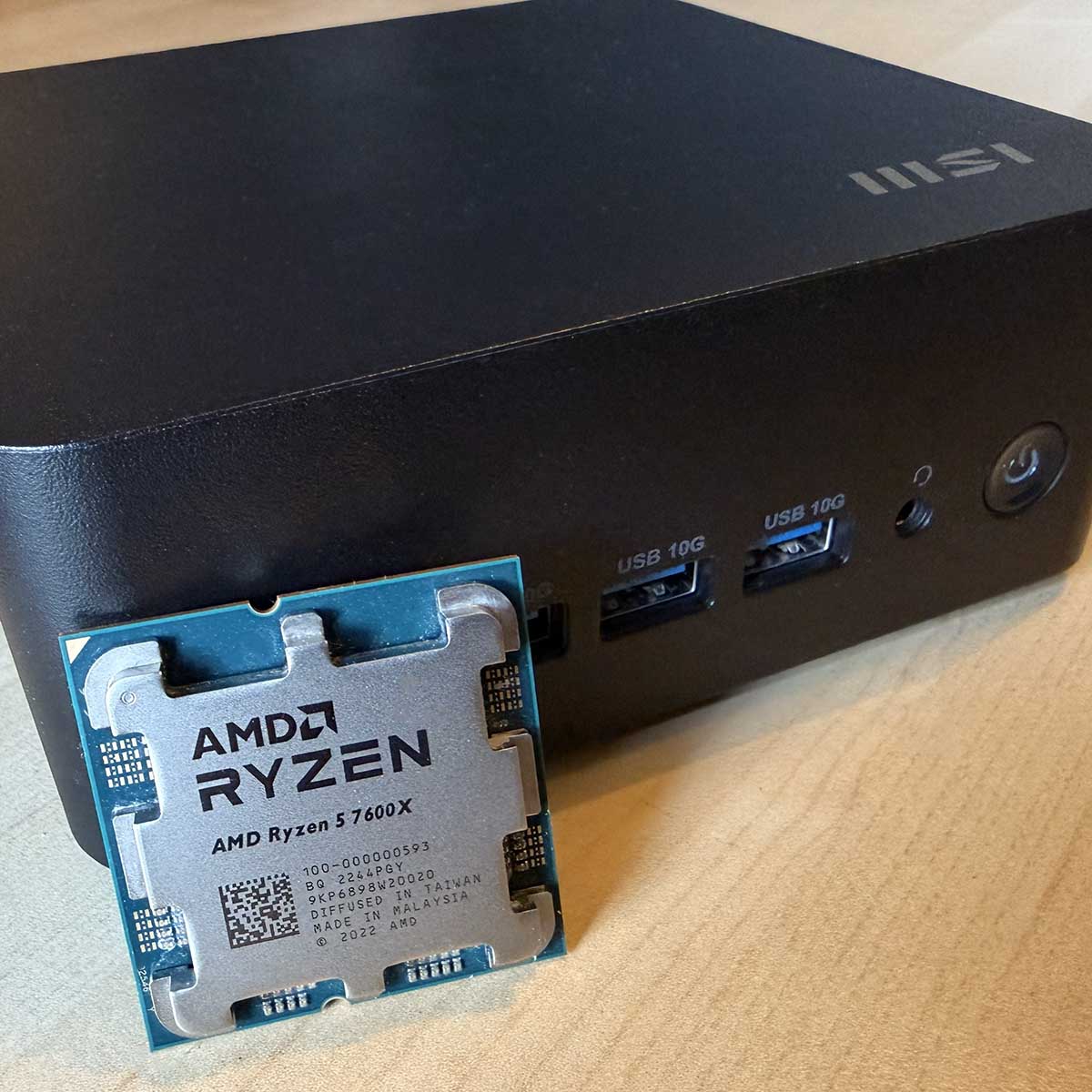
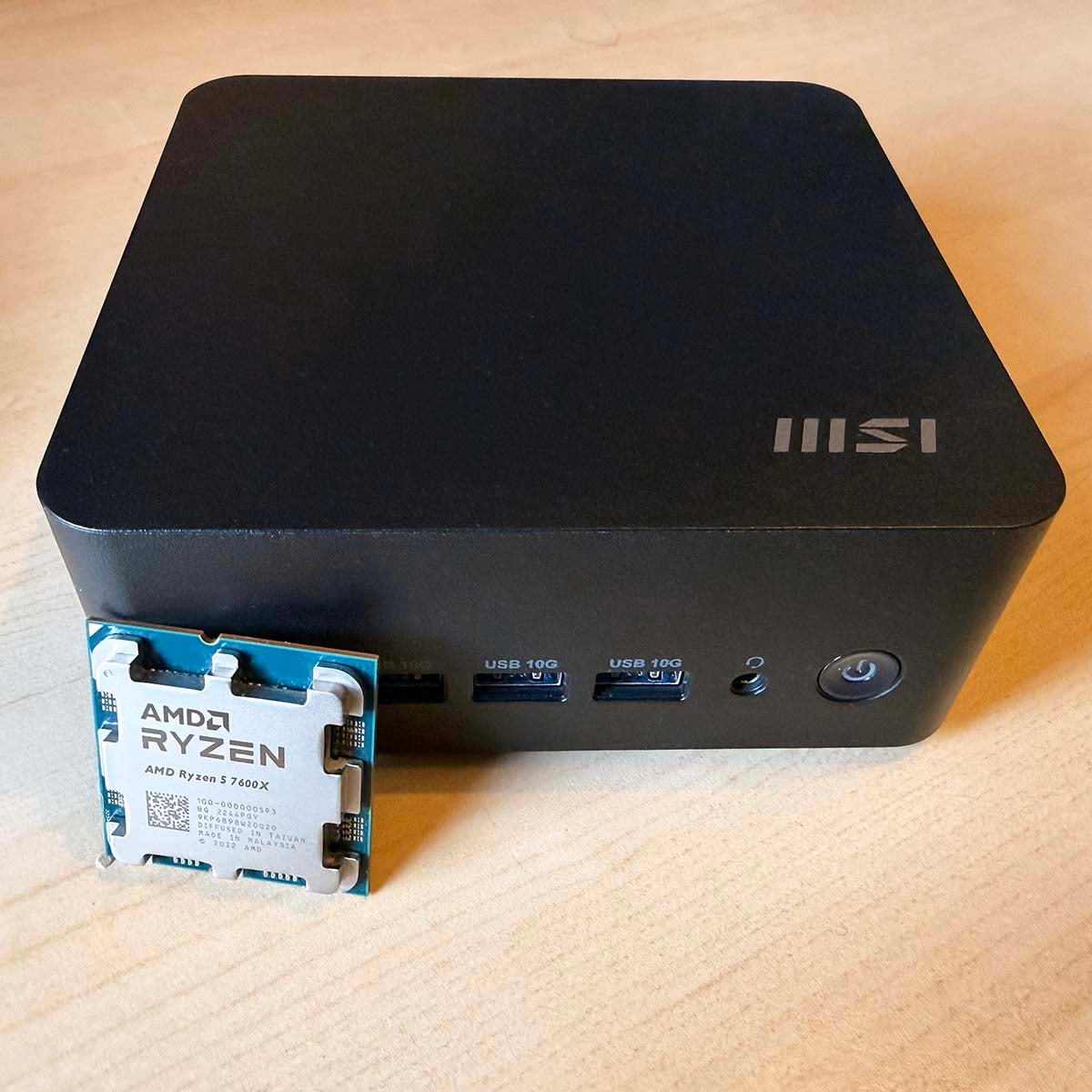
You quickly notice a ridiculous disparity in size when you sit MSI’s tiny Cubi Z AI 8M right next to my desktop tower. It’s almost like lining up a Matchbox car by the real thing. In fact, my desktop PSU alone is over twice the size of this little box of magic. Yet, despite the size difference, the Cubi is still remarkably powerful. This got me thinking. What do you really lose by going for a mini PC instead of a full-size desktop?
There are a few obvious advantages of the big, towering desktop, of course, not least the fact that it can take a full-size graphics card, plus you can also swap out the CPU and motherboard. But what if you have no need for the latest gaming tech? With an 8-core AMD Ryzen 7 CPU, and even a respectable integrated GPU under the hood, can a mini PC like the Cubi really cover all your software bases? I decided to run it through our usual CPU test suite to find out.
It’s almost like lining up a Matchbox car next to the real thing.
The first thing I’ll say is that, if you just want a PC that can handle office duties, such as word processing, spreadsheets, email, and web browsing, a tiny PC like the Cubi is absolutely perfect. I had no trouble at all using it as a daily work driver for my work at Club386, where I used it for general office duties, browsing with Chrome, and even photo-editing with Photoshop. Having 32GB of memory would have helped, but it still basically did the job with the 16GB of DDR5 RAM fitted in my review sample.
But what happens if you really push the CPU? Do you lose anything if you don’t have a full desktop chip with an AIO cooler attached to it, or will this tiny PC really serve all your needs? Let’s take a look.
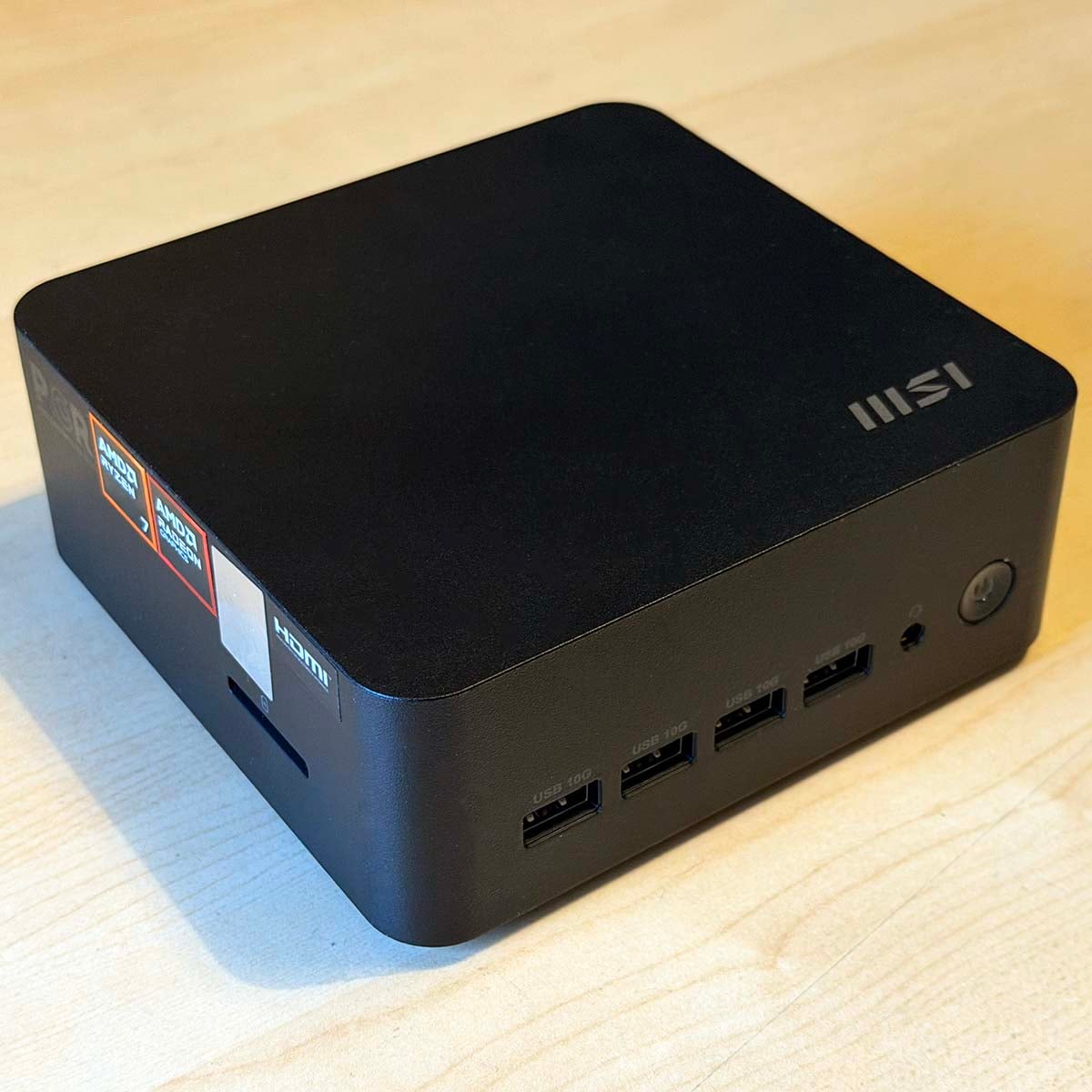

MSI Cubi Z AI 8M
From £429
Pros
- Solid CPU performance
- Quiet operation
- Low power draw
- Loads of ports
- Reasonable price
Cons
- Comparatively tall
- Basic BIOS
- Only one M.2 2280 SSD slot
- NPU doesn’t meet Copilot+ spec
Club386 may earn an affiliate commission when you purchase products through links on our site.
How we test and review products.
Benchmarks
Before we start discussing the data here, there is an important caveat to add. All the comparison benchmarks for other CPUs were conducted on our high-end test rig. This setup includes a massive 64GB of Kingston Fury Beast 6,000MT/s DDR5 memory, rather than the 16GB of 5,600MT/s RAM in our MSI Cubi sample. It also has a dedicated discrete GPU and all the other benefits of a full-size desktop rig.
As such, this isn’t a like-for-like set of benchmarks. You can’t use these results to compare the performance AMD’s Ryzen 7 8845HS CPU to other desktop CPUs, but they do give you a sense of how this mini PC compares to a full-size system. Given that this mini PC costs £429.99, and only has an 8-core Zen 4 CPU, we’re not comparing it to Intel and AMD’s latest 16-core and 24-core CPUs. Instead, we want to see how it compares to CPUs you might put in a budget or mid-range all-purpose desktop rig.
Rendering
Blender
Let’s kick off with some hardcore rendering and push those eight CPU cores to their limit. The MSI Cubi Z AI 8M churns out 211.1 samples per minute in this test. That puts it in front of AMD’s new 6-core Ryzen 5 7500X3D desktop chip in our test rig, and very slightly ahead of the Ryzen 5 7600X CPU as well. This mini PC can’t catch our desktop with an 8-core CPU, but it offers a similar level of power to a 6-core Zen 4 desktop chip.

Cinebench
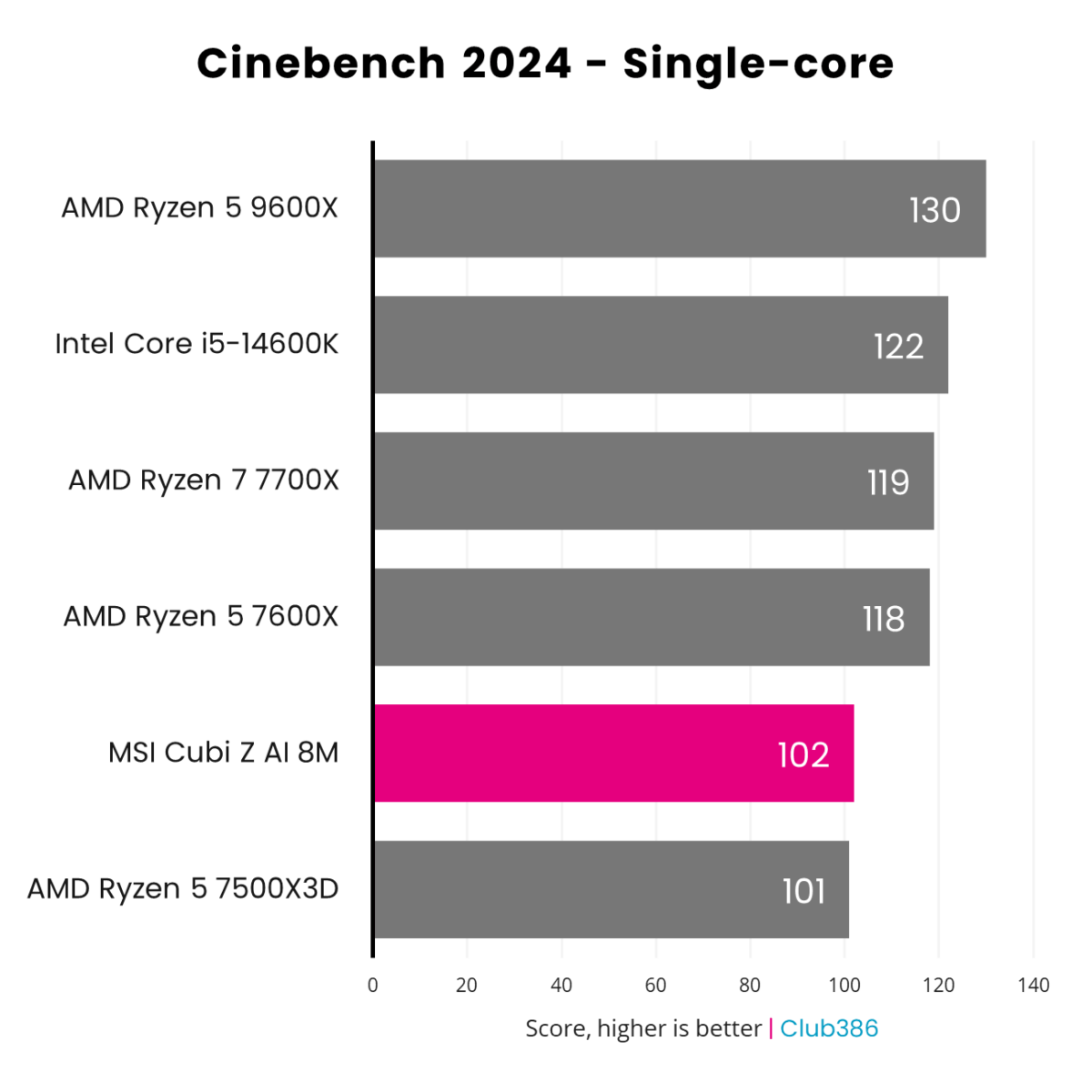
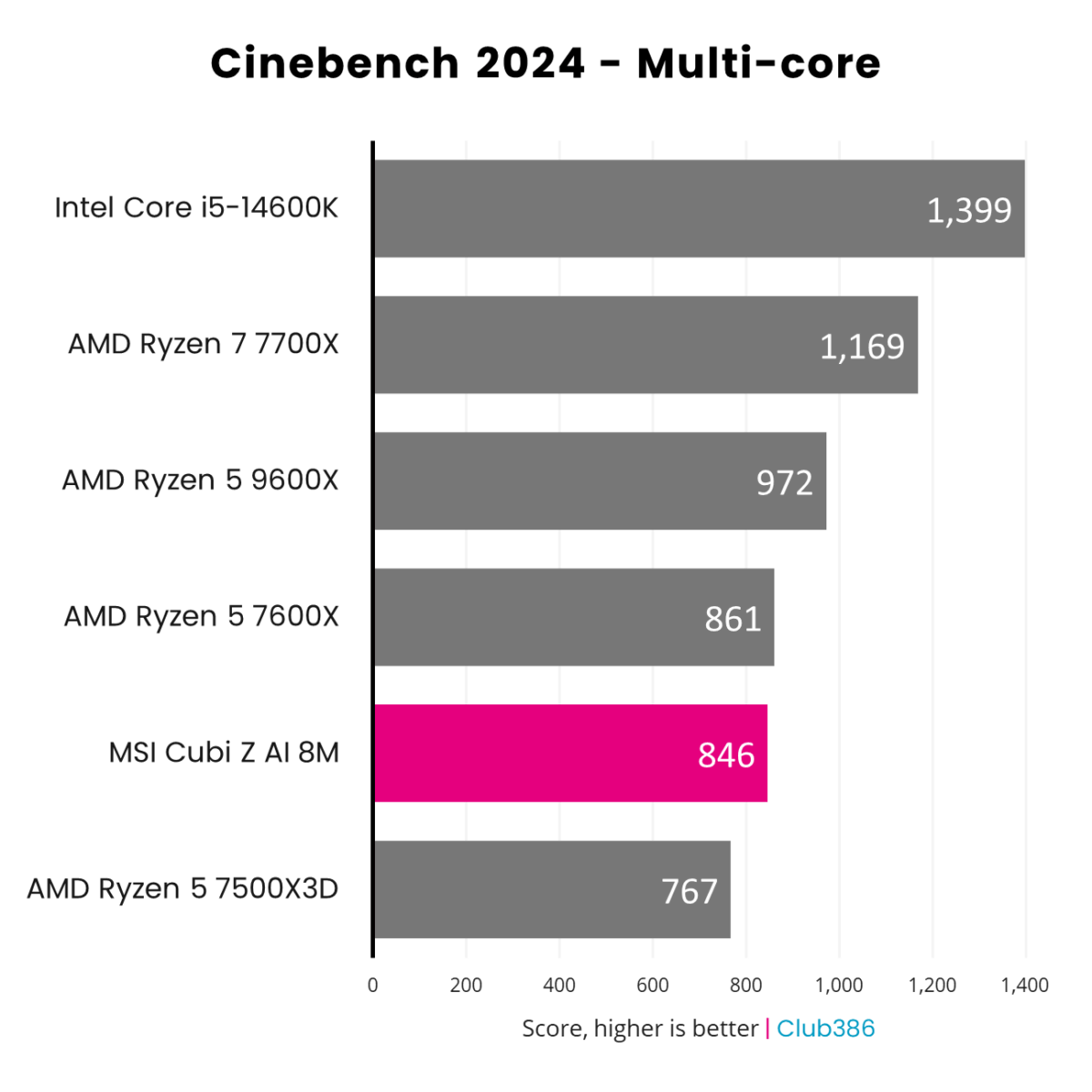
We see similar results in Cinebench R24, where the MSI Cubi Z AI 8M is again ahead of the 6-core Ryzen 5 7500X3D in the multi-core test, and this time behind AMD’s 7600X. However, we’re only looking at a score of 846 vs 861 here – the 7600X and Cubi CPUs are again pretty evenly matched. There’s a marked drop in performance when we get to single-threaded performance, however. The Cubi is still ahead of the 7500X3D here, but it falls well behind the 7600X.
Corona 10
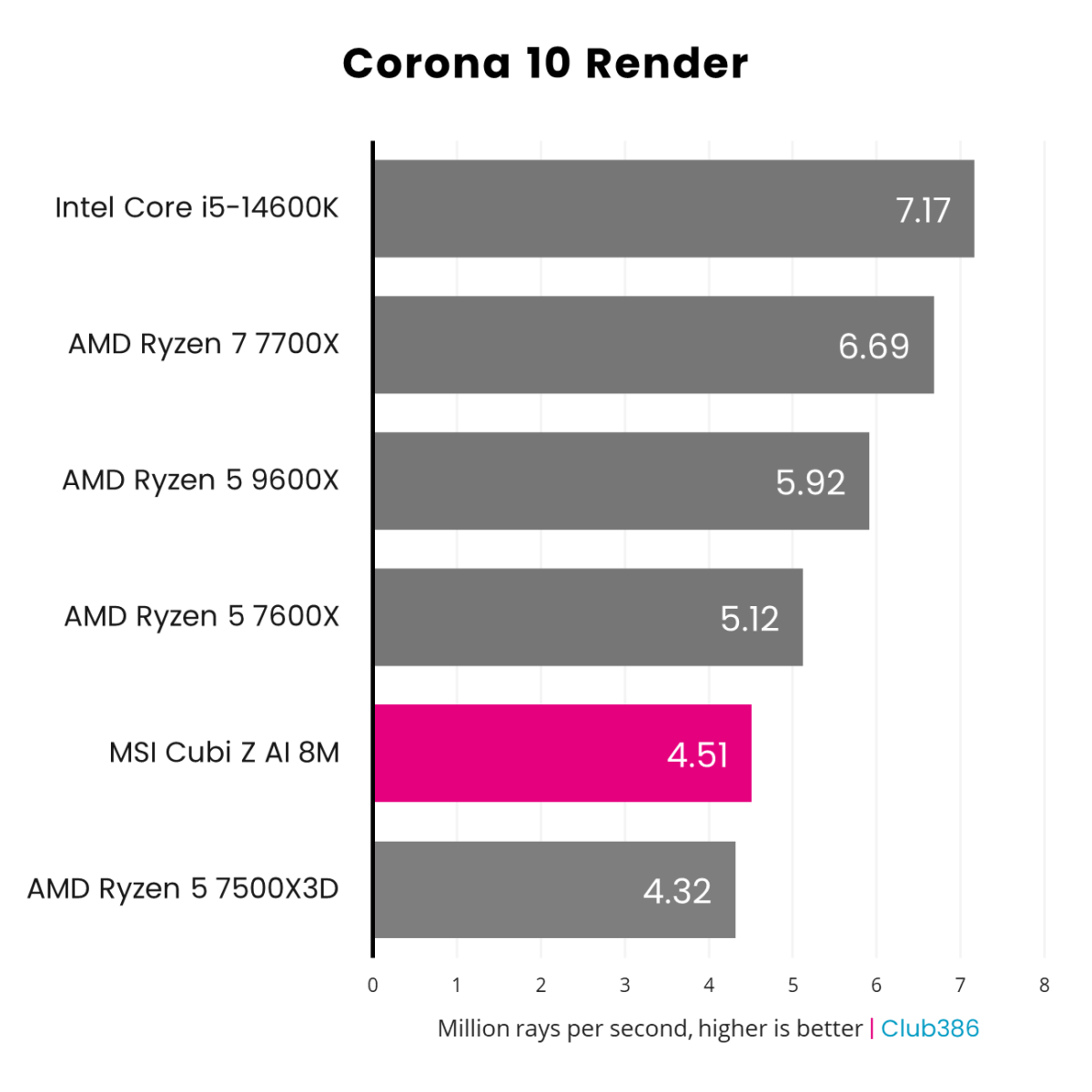
Finally, in our Corona 10 benchmark, the Cubi again sits between AMD’s Ryzen 5 7500X3D and 7600X in our test rig, outputting 4.51 million rays per second. The Ryzen 5 7600X has a larger lead than in the other multi-threaded tests here, showing that core count isn’t everything when it comes to rendering performance.
Productivity
7-Zip compression
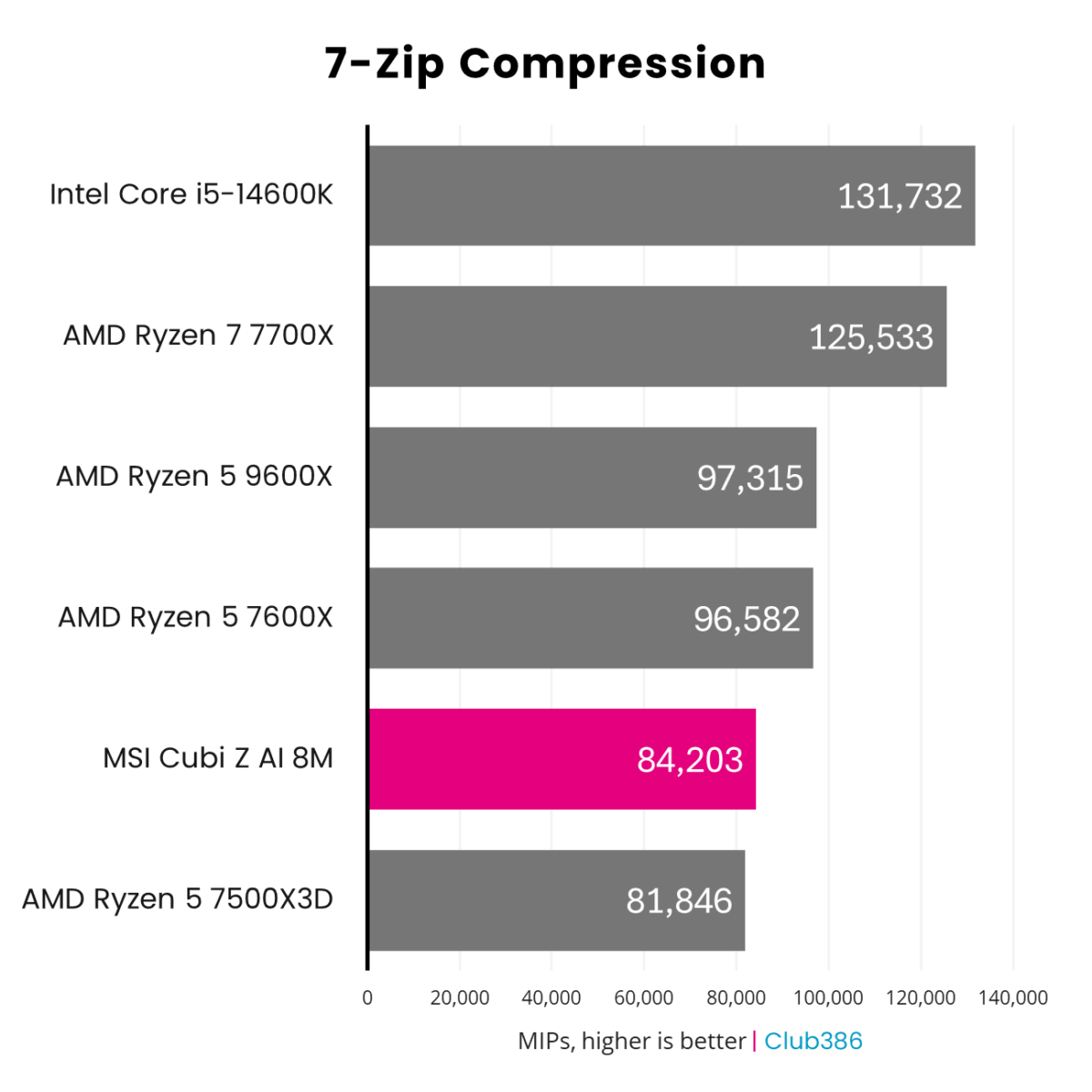
Running 7-Zip’s built-in benchmark, this tiny PC again beats the AMD Ryzen 5 7500X3D in our full-size desktop rig, clocking up 84,203 MIPS. It can’t catch the other chips in our desktop comparison system, but its performance is still fine.
Geekbench 6
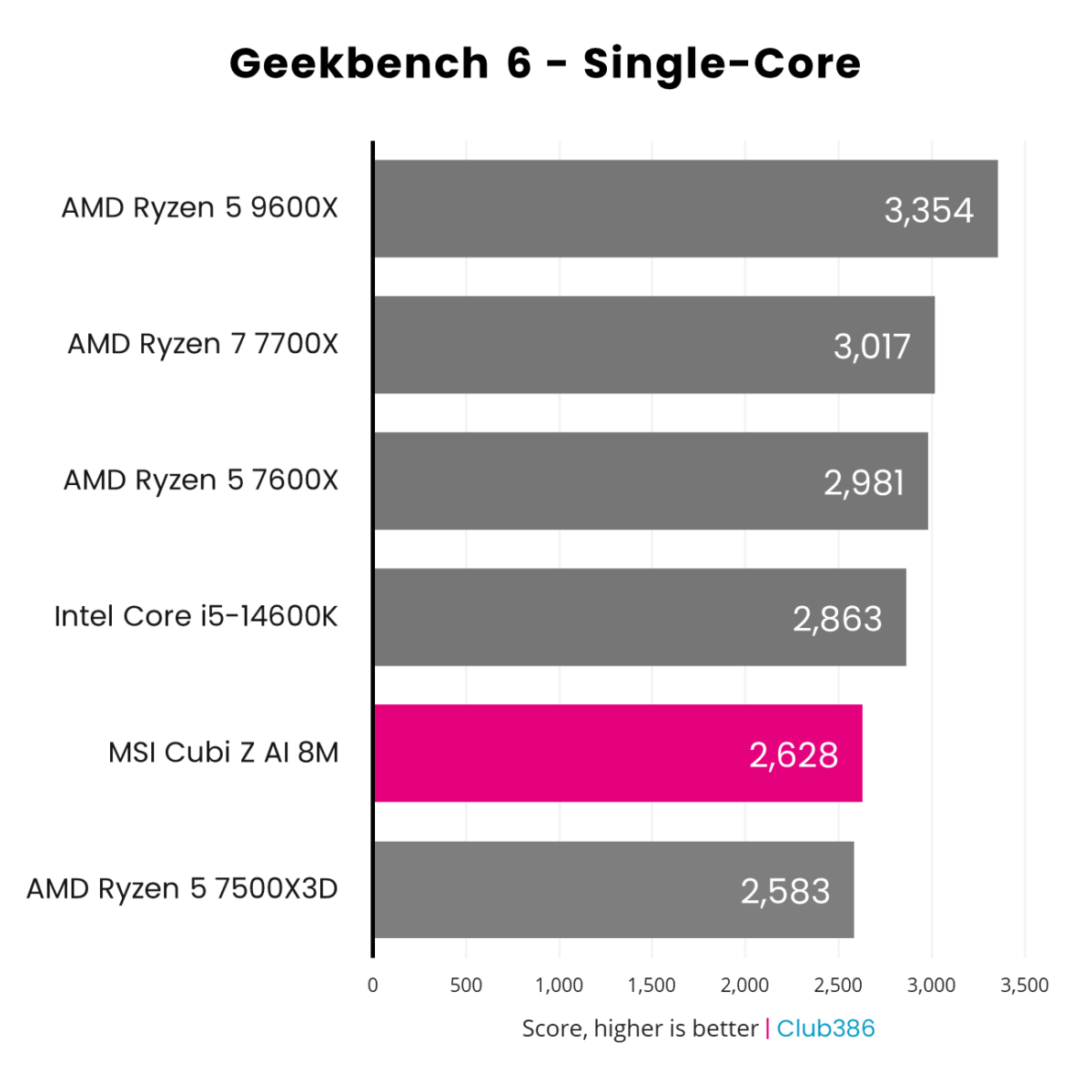
Likewise, Geekbench’s single-core test again shows the Cubi beating AMD’s Ryzen 5 7500X3D in our test rig. The Cubi might only have a modest PSU and cooling system, but its CPU is clearly regularly boosting beyond the 7500X3D’s maximum 4.5GHz boost clock.
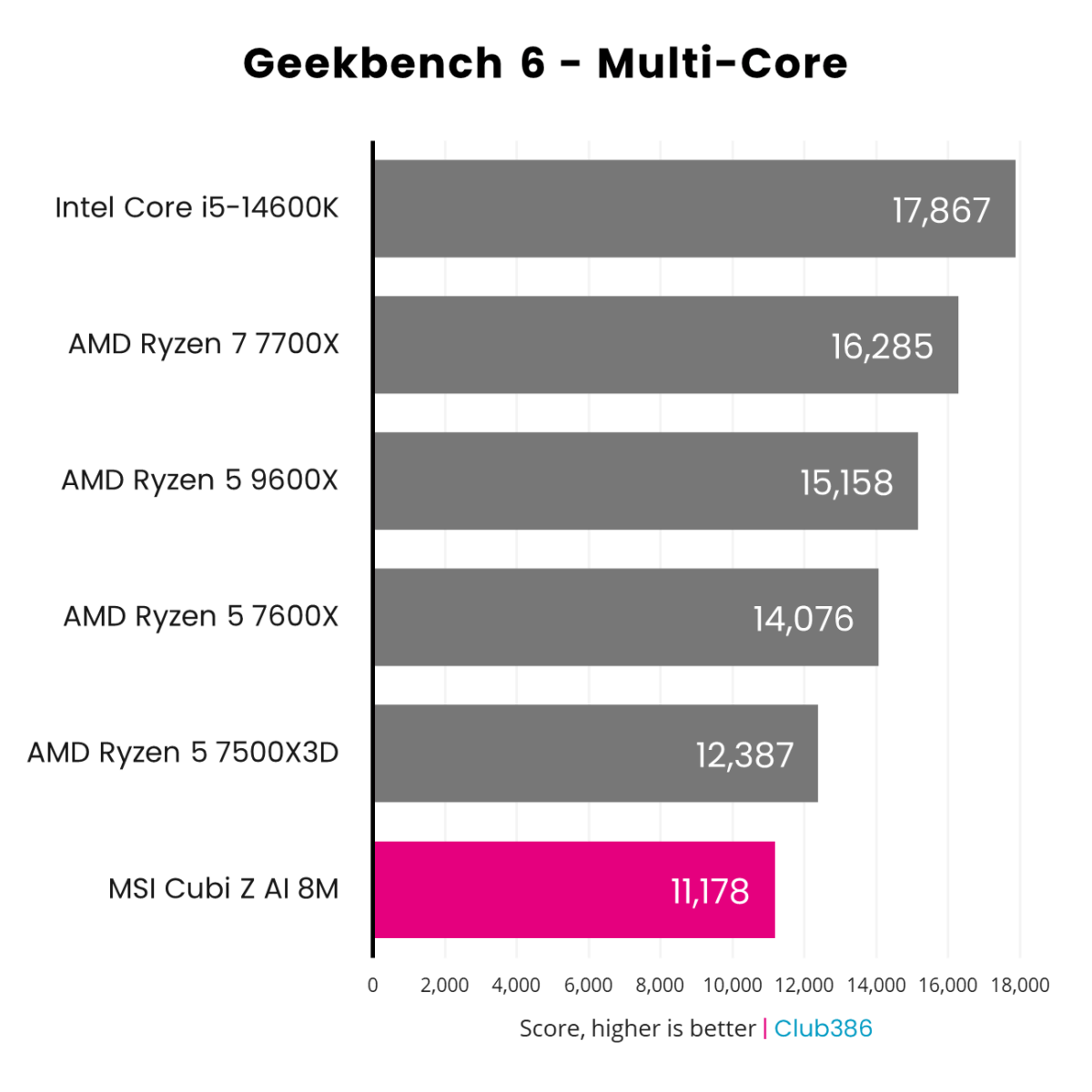
Sadly, Geekbench’s multi-core test didn’t paint the Cubi in such a good light. Its 11,178 score here drops behind all the other chips in our desktop rig. However, it’s worth bearing in mind the disparity in specs between these two systems elsewhere too.
Analysis
While the Cubi generally sits toward the bottom of our graphs in these tests, I need to reiterate that it’s a genuinely tiny PC, and that it also only costs £429.98 for the case, motherboard, CPU, and PSU all together. The fact that it’s even in the same league as these desktop systems is remarkable in itself.
It’s often not far off the performance of AMD’s Ryzen 5 7600X, and it’s regularly ahead of lower-clocked desktop CPUs such as the 7500X3D as well. With this machine, you’re getting a different balance than a full-size desktop PC, and the main limits are power and thermals.
It’s regularly ahead of lower-clocked desktop CPUs such as the 7500X3D.
The Cubi only needs an external power brick, and its cooling system is minuscule compared to the huge AIO coolers and fan arrays in a desktop. As such, it can’t maintain the same boost clocks as its 8-core desktop counterparts, which is why it falls behind them. Even at peak load, the Cubi never drew more than 80W from the mains in our tests, which is a great result when you consider the power on offer.
Its eight cores were generally boosting to 4.25GHz in multi-threaded workloads, which is why it can’t catch the 7700X in these tests. However, the fact there are eight cores gives it enough power to sail past the 6-core 7500X3D.
Conclusion
So, on to the all important question – what do you gain and lose by going for a mini PC like the Cubi over a full-size desktop? One gain is obvious. With its modest dimensions, the Cubi only has a total volume of 0.9 litres, compared to over 50 litres for a standard ATX case such as the Fractal Design Meshify 2. Even a small mini-ITX case like the Fractal Era 2 is 19x the size of the Cubi in terms of volume.
This mini PC is tiny, and if you use its VESA mount you can stick it on the back of your monitor without having to worry about desk space. Pricing is also good value for what you get, albeit with the added ridiculous cost of RAM at the moment.
A standard Ryzen 7700X ATX desktop system is 5,000% bigger than the Cubi, but only 32% faster.
You do definitely lose some processing power in this shrinking exercise, but nowhere near as much as you might expect. You’re generally getting the oomph of a 6-core Zen 4 desktop CPU in this compact rig. Taking Blender as an example, the Cubi’s result of 211.1 puts it ahead of AMD’s 6-core Zen 4 CPUs, while the 8-core Ryzen 7 7700X is 32% faster, and the 14-core Intel Core i5-14600K is 47% quicker. It goes without saying that Core i7 and Ryzen 9 chips will be substantially faster again in this test.
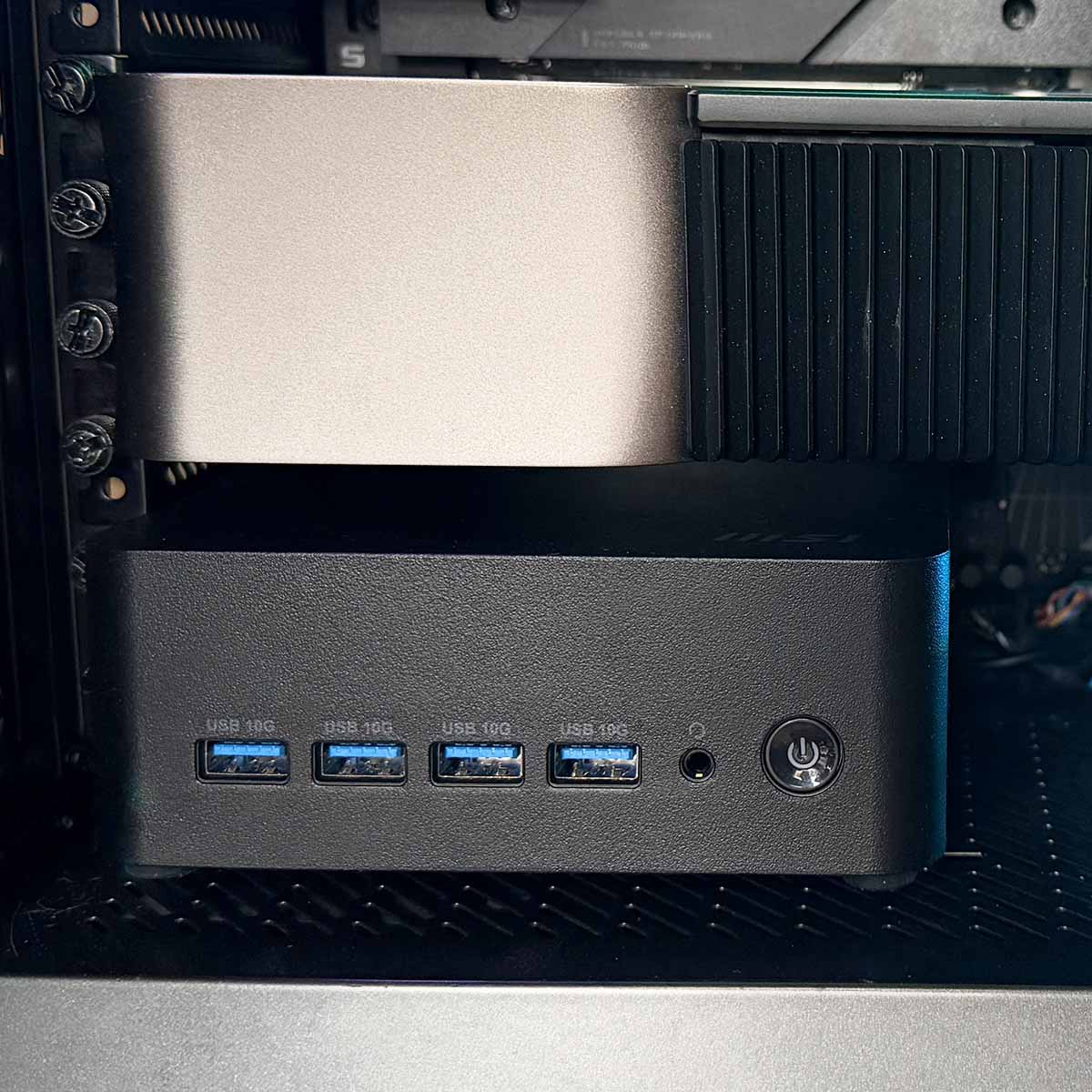
However, our test rig draws 260W from the mains with the 14600K installed, and it’s several times the size. Look at it this way – a standard 14600K ATX desktop system is 5,000% bigger than the Cubi, and draws 225% more power, but it’s only 47% faster.
That’s the tradeoff you’re making here. Yes, a mini PC like the Cubi will be slower than an 8-core full-size desktop. However, the performance difference is much smaller than its diminutive size suggests.
Those wanting the fastest CPU performance possible, perhaps for 3D rendering and video encoding, as well as gaming, will naturally be better off buying a full-size desktop rig. However, if space is at a premium, and you want a PC that can handle standard office duties, and also take on demanding tasks when needed, this 8-core mini PC is more than up to the job.