

Valve has published its latest hardware survey report, quantifying the hardware and software preferences of Steam users as of November 2025. This new report shows that Linux adoption is continuing its steady growth to the detriment of Windows, and in particular Windows 10, which has lost 2% of its users in the last month alone.
Linux has seen adoption by Steam users increase by 0.15%, reaching an all time high of 3.2%. Yes, this remains distant to Windows’ overall 94.79% share, but it is on the up and has surpassed macOS at 2.02%. For reference, Linux sat below 1% for the longest time, only starting to gain sustained traction after the release of the Steam Deck in late February 2022. What’s clear is that gamers are starting to give Linux a shot, be it due to their hardware choices (SteamOS handhelds) or just out of curiosity.
Coinciding with the increase in Linux users, Windows 10’s end of life caused its share to drop to 29% as gamers migrated to Windows 11, which now accounts for 65%. Not surprising considering the seamless upgrade path and wide hardware/software compatibility of Windows 11. That said, it seems that a small portion of the users who ditched Windows 10 have moved to some kind of Linux distro, with a preference for Mint, Devian, and Bazzite.
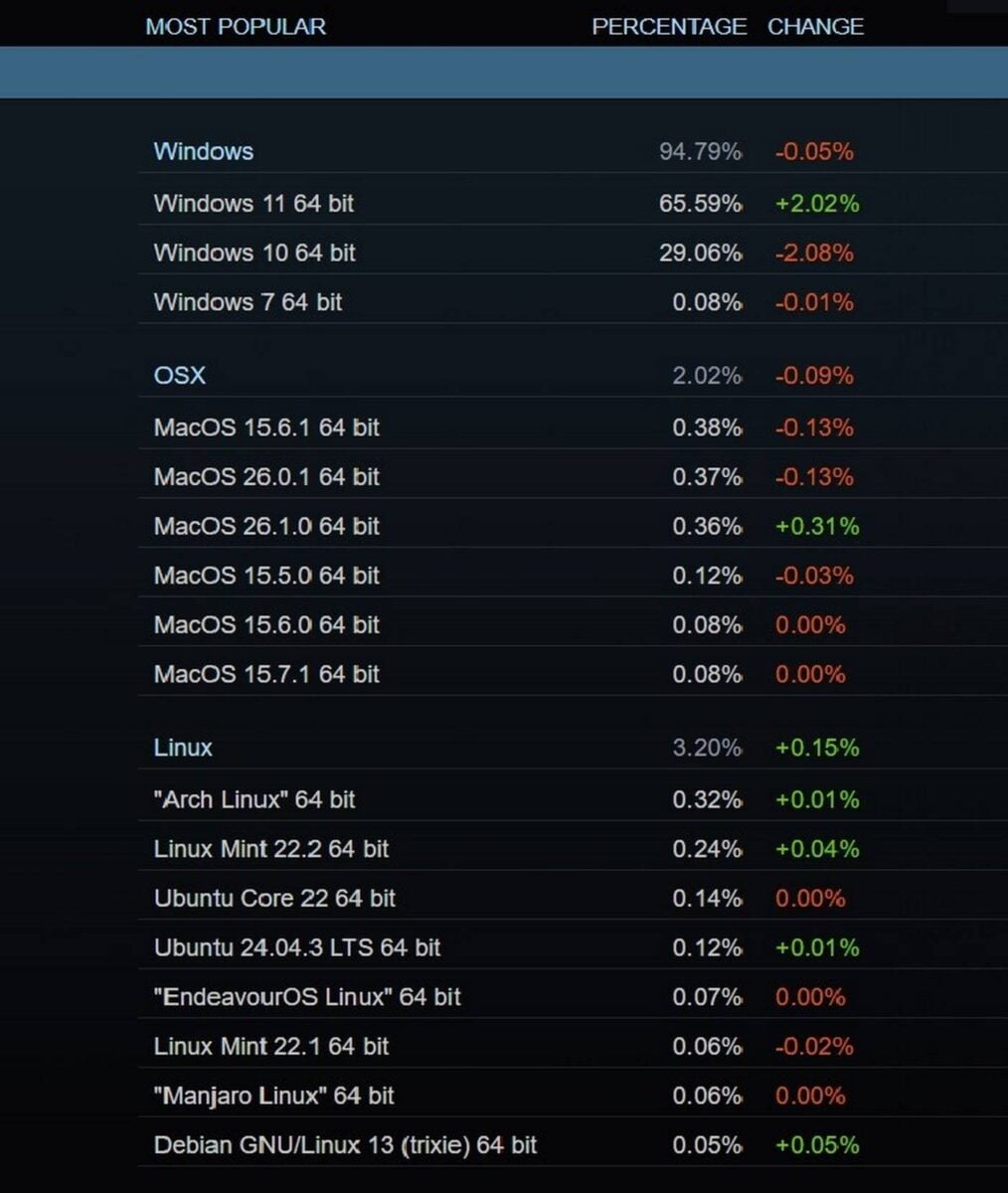
Similar to how the Steam Deck boosted Linux’s presence, you can bet on another massive surge in adoption the month following Valve’s Steam Machine release. Today, SteamOS represents 26.42% of Steam’s Linux user base. It is by far the most popular version of Linux, despite suffering from a decline this month. Understandably, Microsoft is keen to stave off the Linux threat, with the company striving to regain interest in Windows gaming with the launch of Xbox handhelds.
On the subject of hardware, AMD is also recording its highest-ever CPU share, with 43.56%, though Intel remains ahead at 56.44%. For GPUs, Nvidia’s 60-class cards are still among the most popular, even among laptop gamers.
Overall, not a bad showing by Linux, especially considering that it’s still far from perfect for gaming. While it manages to beat Windows in some instances, the convenience and familiarity of the latter remains a massive attraction. Only a minority of users are willing to fight through the incompatibilities that come with many games on Linux, so while it’s unlikely to replace Windows anytime soon, the upward trajectory shows no signs of slowing.