

Maxon has just launched Cinebench 2026, overhauling the benchmark with a new engine and wider support for contemporary hardware. This version also introduces a new CPU test, better accommodating Simultaneous multithreading (SMT) without having to engage multiple cores.
Cinebench 2026 marks a move to Redshift, the default rendering engine for Maxon’s Cinema 4D application suite. This, in turn, should provide performance metrics more relevant to those seeking to understand how their hardware will perform using the software. However, this also means it’s impossible to draw meaningful comparisons between Cinebench 2024 and 2026 scores.
Maxon claims the rendering effort placed on a CPU in Cinebench 2026 relative to R23 is “sixfold”, reflecting processor performance improvements since the latter version’s release, as well as the demands of modern artists. The company also recommends running the application on systems with a minimum of 16GB of RAM, as memory usage can run up to 8.5GB.
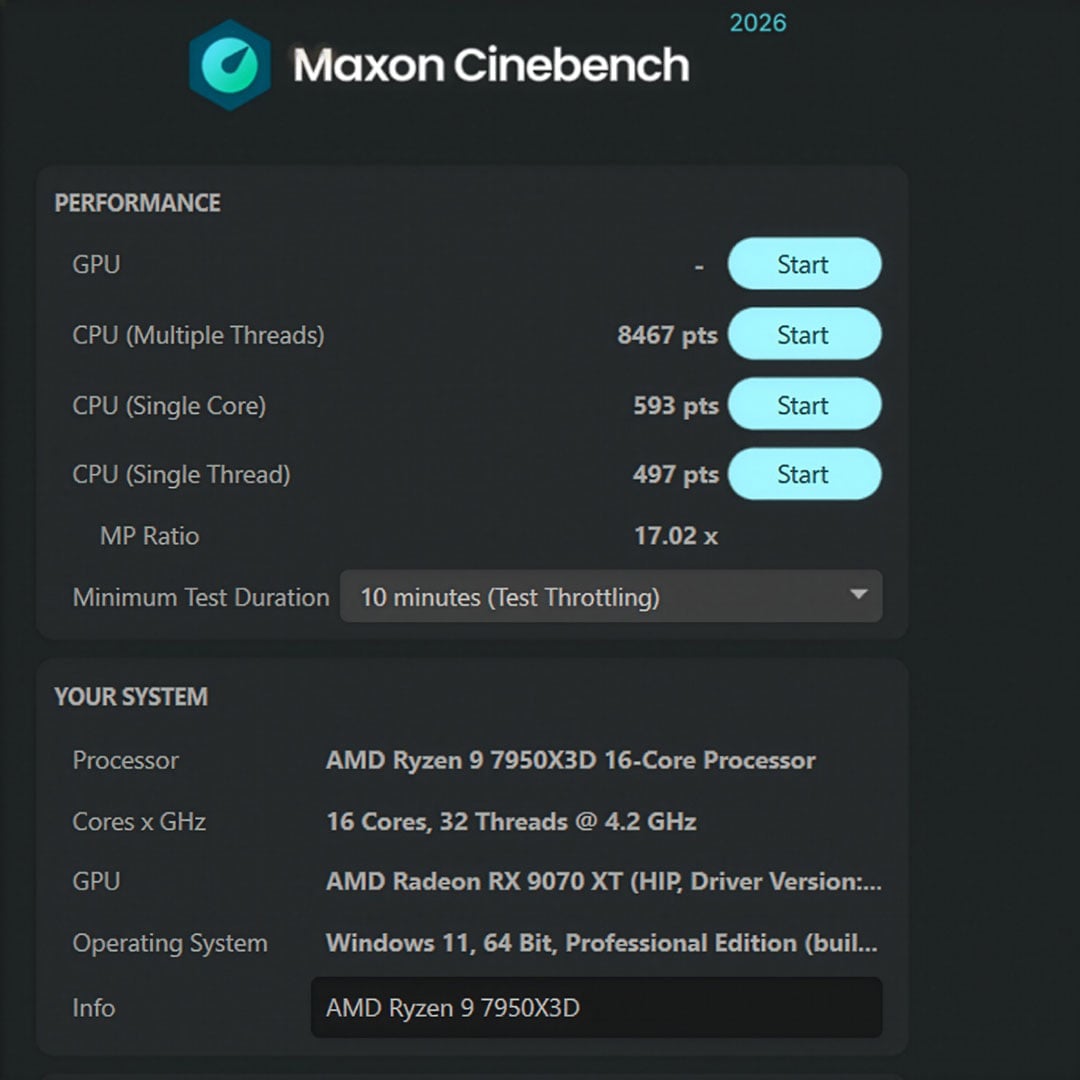
New to this version of Cinebench is the introduction of a ‘CPU (Single Core)’ test, which exists alongside the longstanding ‘CPU (Single Thread)’ benchmark. This addition provides a means to evaluate an individual core’s SMT performance, while the standard single-thread benchmark remains unchanged as a test for single-threaded chops.
To help illustrate this difference, we’ve run Cinebench 2026 on both an AMD Ryzen 9 7950X3D (from our 2024 test platform) and an Apple M4 Pro (from Tarinder’s MacBook). The desktop processor supports simultaneous multithreading, with each core boasting two threads. Meanwhile, the laptop CPU has no SMT support, netting a 1:1 ratio of cores and threads.
| AMD Ryzen 9 7950X3D | Apple M4 Pro | |
|---|---|---|
| CPU (MT) | 8,467pts | 6,251pts |
| CPU (ST) | 497pts | 652pts |
| CPU (SC) | 593pts | N/A |
Based on these first test results, I’m curious to see how single-thread and single-core performance stacks up on other processors. You can expect to see Cinebench 2026 appear in future Club386 CPU benchmarks, but it’ll take some time for us to build a database of results comparable to our Cinebench 2024 stack.
You may also see Maxon’s latest benchmark appear in our GPU coverage moving forward, as this update adds official support for Nvidia GeForce RTX 50 and AMD Radeon RX 9000 series graphics cards. For those lucky enough to have an M3 Mac or newer, you also now have access to Metal RT ray tracing support in this test.
Cinebench 2026 is available to download now, for free, direct from Maxon. Expect to see your system achieve higher scores than on ’24, but remember the results aren’t comparable.
If we’re lucky, we’ll see some new CPUs at CES 2026 flaunting some Cinebench 2026 scores. Perhaps the Ryzen 9 9950X3D2 or Ryzen 7 9850X3D? We can all live in hope.
Until then, please consider adding Club386 to your Google Preferred Sources, and drop us a follow on Google News so you don’t miss a beat.