

Intel Arrow Lake Refresh CPUs appear to be popping up in early Geekbench tests as the rumoured release date approaches. The latest result puts the new Core Ultra 290K Plus in the spotlight, and it appears to deliver a respectable boost for a mere refreshed design.
According to a new Geekbench 6 test entry, the Intel Core Ultra 290K Plus scores 3,535 single-core points and 25,106 multi-core points, which represents about a 10% uplift over the Core Ultra 9 285K. The test was run on an Asus ROG Strix Z890-E Gaming Wi-Fi motherboard paired with 64GB of 6,800MT/s DDR5 memory, indicating that these gains aren’t relying on high-end memory kits.
Even so, the 290K Plus sits at the top of Geekbench’s Intel processor benchmarks charts. While this rumoured new CPU is expected to succeed the Core Ultra 9 285K, Intel may end up releasing a faster 295K Plus version later down the line, akin to the i9-14900KS. As always with rumours, though, we must take the above with a pinch of salt, as real-world performance tends to be less exciting, especially when other hardware bottlenecks come into action. There’s also no indication of gaming performance here, which was notably disappointing on Intel’s original Arrow Lake chips.
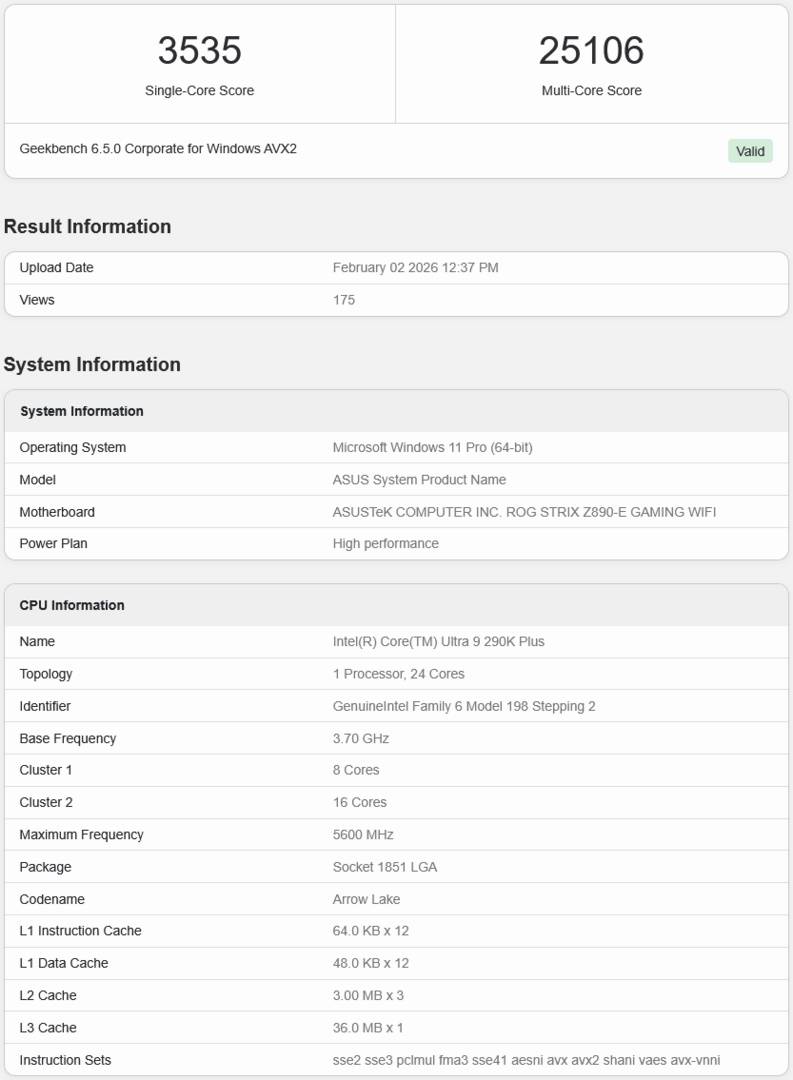
Benchmarking aside, the Core Ultra 290K Plus is expected to pack the same 24-core layout as the 285K, split into eight P-cores and 16 E-cores. TDP is also said to be identical, limited to 125W PL1 and 250W PL2. Aside from any architectural improvements yet to be disclosed, the main change seems to be slightly higher boost frequencies, which have been reportedly pushed up by 100MHz on the P-cores and 200MHz on the E-cores. As a result, the 290K Plus looks set to be clocked at a 3.7GHz base and 5.6GHz boost on the P-cores, with the E-cores having 3.2GHz base and 4.8GHz boost frequencies.
Overall, these gains seem to correlate with previous Arrow Lake refresh leaks regarding the mid-range Core Ultra 7 270K Plus, which also appeared to show about a 10% improvement over the existing 265K. Short of being a completely new generation, at least Arrow Lake Refresh gives those already invested in Intel’s LGA1851 platform another upgrade option. If rumours are correct, we can expect to see these chips hit the market sometime in March or April 2026.