
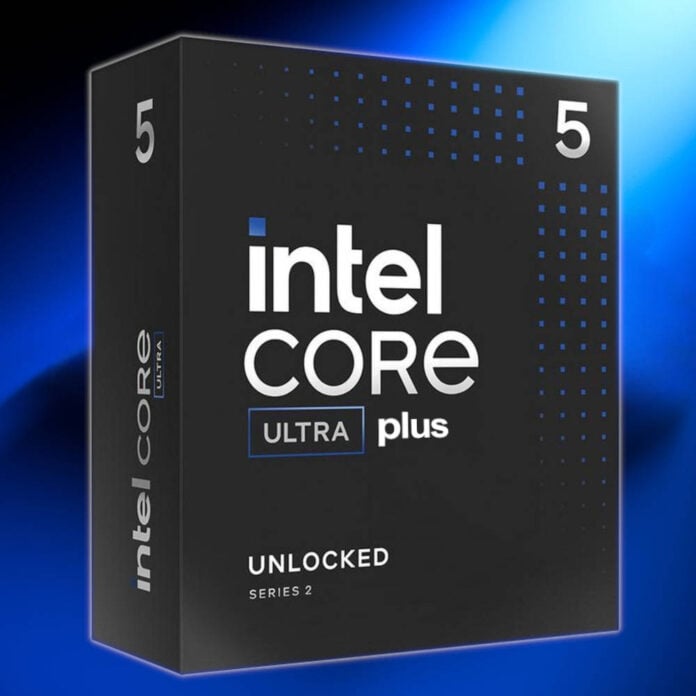
Upcoming Intel Core Ultra Series 2 Plus processors have started showing up at online retailers, confirming rumoured specs while giving us a hint at their potential price targets. From the looks of it, these are set to replace their predecessors, offering a slight performance uplift for a similar cost.
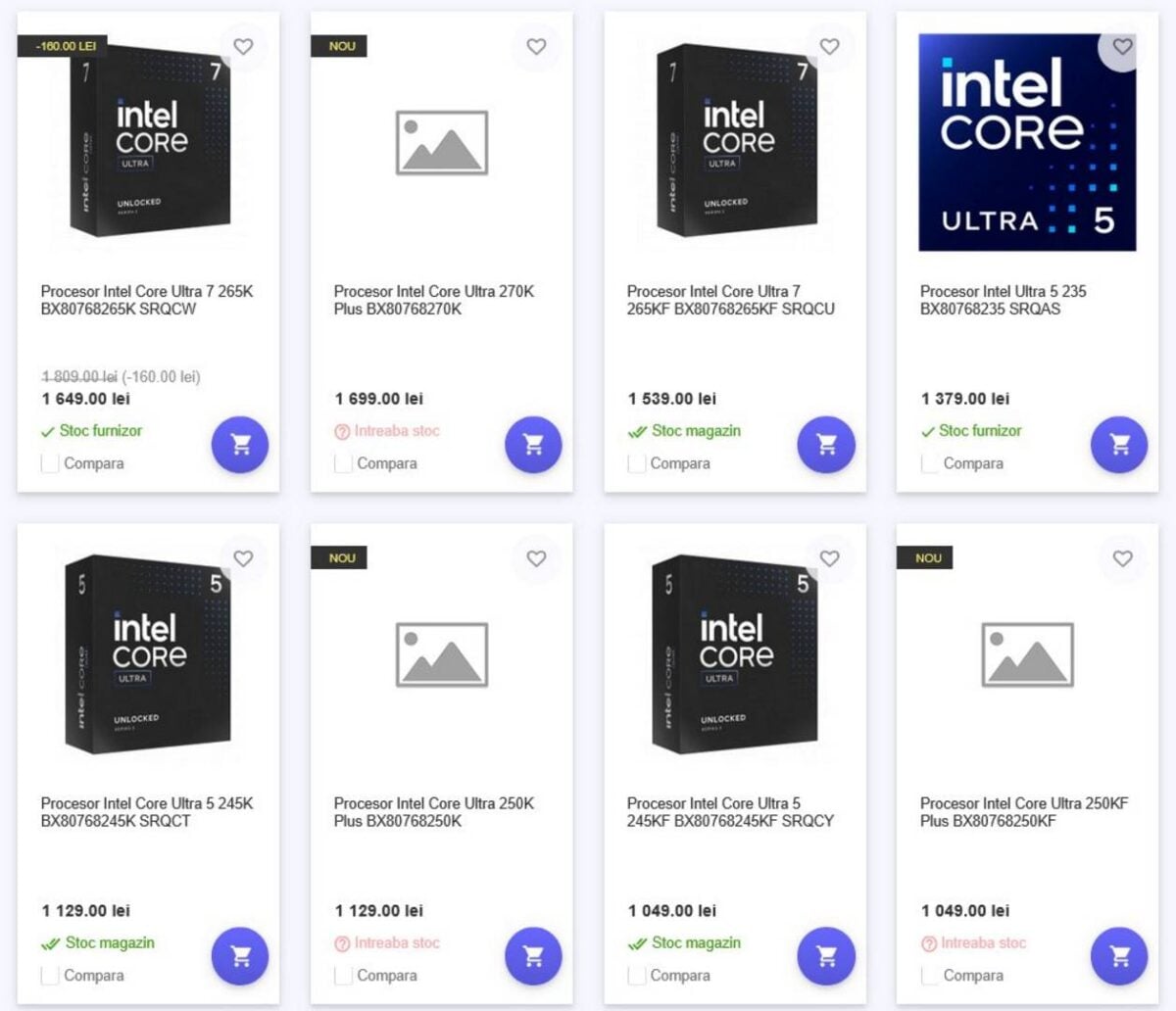
Spotted by @momomo_us on X, three Arrow Lake Refresh chips have been listed on a Romanian store, including the Core Ultra 270K Plus, Core Ultra 250K Plus, and Core Ultra 250KF Plus. These are respectively positioned at 1,699 lei (£289), 1,129 lei (£192), and 1,049 lei (£178), which is roughly what their supposed predecessors, the Core Ultra 265K, 245K, and 245KF go for. Understandably, none of the Plus models is currently in stock since Intel has yet to officially launch them.
The most notable model is undoubtedly the Core Ultra 250KF Plus, which trades integrated graphics for a slightly lower price. This CPU is expected to pack 18 cores, split into 6 P-cores and 12 E-cores – four more than the 245KF. This should give it enough horsepower to run games at high frame rates while reallocating background tasks to the efficient cores. In other words, this will likely be a favourite among budget-oriented gamers.
That said, don’t expect any outstanding uplifts from these CPUs since Arrow Lake Refresh isn’t a brand-new architecture. If recent leaks are accurate, we may hope to see about a 10% performance increase over regular Arrow Lake, which would be acceptable, but then there is the platform longevity question.
As a reminder, Intel’s LGA-1851 socket will likely be replaced by LGA-1954 later this year or early 2027, marking an end for the current platform. This means no further upgrade paths, unlike AMD’s AM5, which is already awaiting Zen 6 and potentially Zen 7, too. Intel could surprise us with an unexpected extension to the LGA-1851 platform, but I wouldn’t hold my breath.
We should get more information soon, as Intel is expected to release its Arrow Lake Refresh lineup sometime in March or April 2026. From what we gathered, these Series 2 Plus chips will likely appeal to OEMs and users upgrading from low-tier Intel CPUs.