
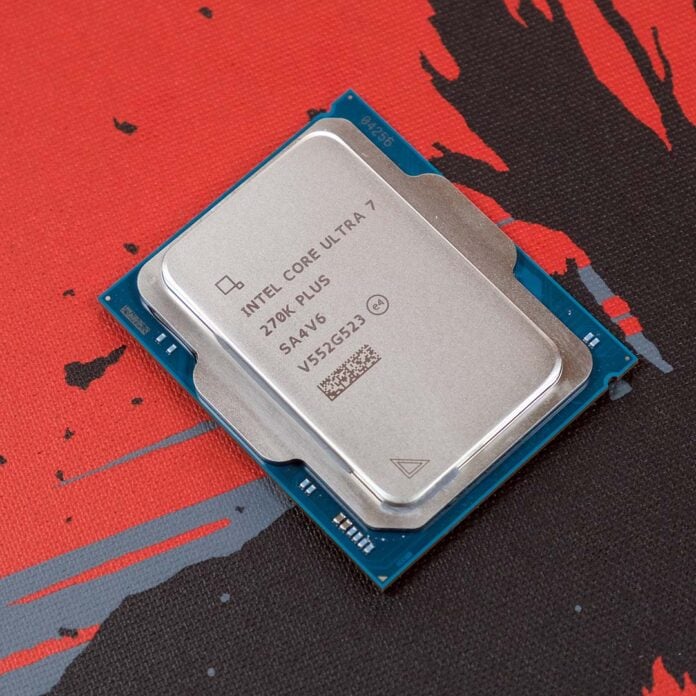
The Core Ultra 7 270K Plus leads the charge for Intel’s Arrow Lake Refresh, bringing a host of surprising and welcome improvements to the table. Without getting ahead of myself too much, this is a processor you’ll want to pay attention to, as the chip puts the blue team back on firm footing within the processor market and then some.
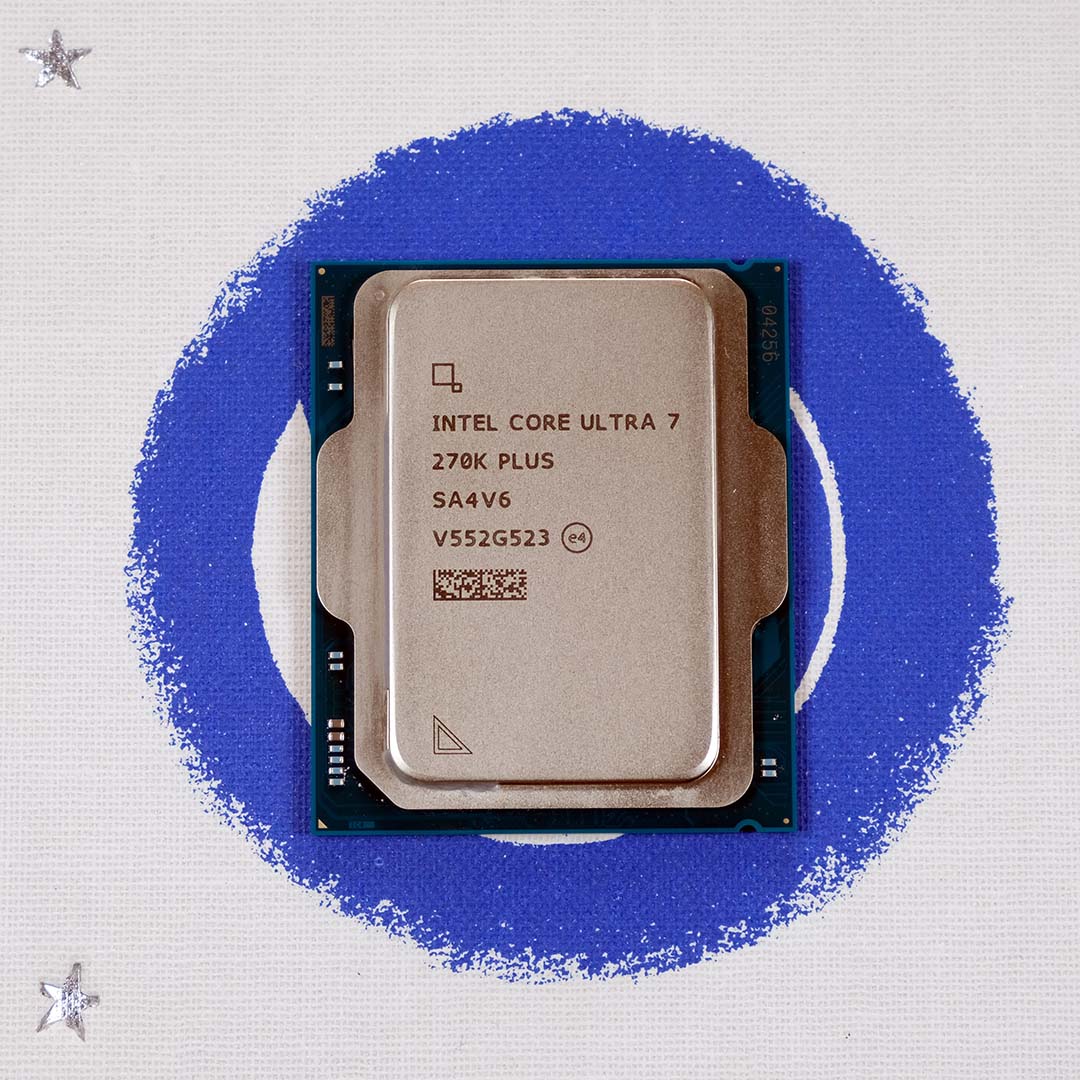

Intel Core Ultra 270K Plus
$299 / £299
Pros
- Excellent multi-core chops
- Solid gaming performance
- Great power efficiency
- High value all-rounder
- Binary Optimisation compatible
Cons
- Relatively high temperatures
- Limits Gen 5 SSD speeds
Club386 may earn an affiliate commission when you purchase products through links on our site.
How we test and review products.
Launching at $299, the 270K Plus replaces the Core Ultra 7 265K which will remain available at promotional pricing while stocks last. The Core Ultra 5 250K Plus rounds out the roster at $199, replacing the Core Ultra 5 245K. Intel isn’t shy about gunning for the Ryzen 7 9700X and Ryzen 5 9600X with these chips, which occupy similar if not the same price points.
Specifications

Glancing at the Club386 Table of DoomTM below, the Core Ultra 7 270K Plus has so much in common with existing Core Ultra 9 285K one would think it’s the same chip rebranded and repositioned at a much lower price point. That isn’t too far from the truth, however Intel has made several notable changes below the surface and introduced new software to further improve its Arrow Lake CPU architecture.
I’ll discuss several of these tweaks in this review, but I recommend reading Ben’s announcement coverage for further insight on the changes that characterise Arrow Lake Refresh.
| Model | Cores / Threads | Boost clock (P/E core) | TDP PL2 | Cache (L2+L3) | Memory support | Launch MSRP |
|---|---|---|---|---|---|---|
| Ultra 200 Plus (2026) | ||||||
| Ultra 7 270K Plus | 24 (8+16) / 24 | 5.5 / 4.7GHz | 250W | 76MB | DDR5-7200 | $299 |
| Ultra 5 250K Plus | 18 (6+12) / 18 | 5.3 / 4.7GHz | 159W | 60MB | DDR5-7200 | $199 |
| Ultra 200 (2024) | ||||||
| Ultra 9 285K | 24 (8+16) / 24 | 5.7 / 4.6GHz | 250W | 76MB | DDR5-6400 | $589 |
| Ultra 7 265K | 20 (8+12) / 20 | 5.5 / 4.6GHz | 250W | 66MB | DDR5-6400 | $394 |
| Ultra 5 245K | 14 (6+8) / 14 | 5.2 / 4.6GHz | 159W | 50MB | DDR5-6400 | $309 |
| 14th Gen (2023) | ||||||
| i9 14900K | 24 (8+16) / 32 | 6.0 / 4.4GHz | 253W | 68MB | DDR5-5600 | $589 |
| i7 14700K | 20 (8+12) / 28 | 5.6 / 4.3GHz | 253W | 61MB | DDR5-5600 | $409 |
| i5 14600K | 14 (6+8) / 20 | 5.3 / 4.0GHz | 181W | 44MB | DDR5-5600 | $319 |
| 13th Gen (2022) | ||||||
| i9 13900K | 24 (8+16) / 32 | 5.8 / 4.3GHz | 253W | 68MB | DDR5-5600 | $589 |
| i7 13700K | 16 (8+8) / 24 | 5.4 / 4.2GHz | 253W | 54MB | DDR5-5600 | $409 |
| i5 13600K | 14 (6+8) / 20 | 5.1 / 3.9GHz | 181W | 44MB | DDR5-5600 | $319 |
Much like the 285K, Intel’s new 270K Plus arrives with a full complement of 16 Skymont E-Cores, now capable of running up to 4.7GHz out of the box, a 100MHz improvement over prior models. This maintains a total core and thread count of 24 apiece, as Intel continues to forgo support for hyper-threading, as well as another 10MB of cache.
However, maximum boost clock remains at 5.5GHz, 200MHz short of the aforementioned 285K. This is a curious frequency deficit considering the 270K Plus boasts otherwise identical specs, but other underlying upgrades go some distance in plugging this gap.

Key among them is a 900MHz boost for the die-to-die interconnect. This greatly improves the speed at which the individual tiles (Compute, SoC, etc.) can communicate with one another, reducing latency and boosting performance in the process.
However, this change sadly hasn’t remedied the bottleneck caused by Arrow Lake’s IOE (I/O Extender) Tile. Gen 5 SSDs still can’t run at their maximum speeds on these new processors, falling short by as much as 2,800MB/s in sequential read speeds in our testing. While not a massive drawback, it’s a shame to see this problem persist.
Memory remains a sore subject given current prices, but if you already have high-end sticks, Intel’s done you a favour. The Internal Memory Controller has received a 400MHz boost, providing more memory overclocking headroom. By default, the 270K Plus supports heady JEDEC speeds up to 7,200MT/s, with room to reach 8,000MT/s via Core 200S Boost.
For those with luck enough to own CUDIMM memory, Arrow Lake Refresh also arrives with support for four-rank modules. This unlocks the possibility of running 128GB per stick, providing the capacity of a four-DIMM array in a dual-channel configuration without compromising on speed or latency. It’s ultimately a future-looking specification, especially in this economy, but credit to Intel for pushing the boat out with an industry first.

As well as hardware improvements, Intel is also looking to build on its software enhancements to further push performance. Both the 270K Plus and 250K Plus are compatible with Binary Optimisation, an evolution of the brand’s Application Optimisation profiles.
In short, Binary Optimisation improves instructions per cycle (IPC) through more efficient use of core architecture and code execution. Intel has launched a handful of profiles for games and Geekbench 6, with intent to develop more as time passes.
You’ll need to download and manually enable Binary Optimisation to see any benefits from the tech. As much as I would prefer a blanket approach, doing so isn’t currently possible and would lead to complications with anti-cheat software. Regardless, I’m thankful for any free performance boosts as and when they’re available.
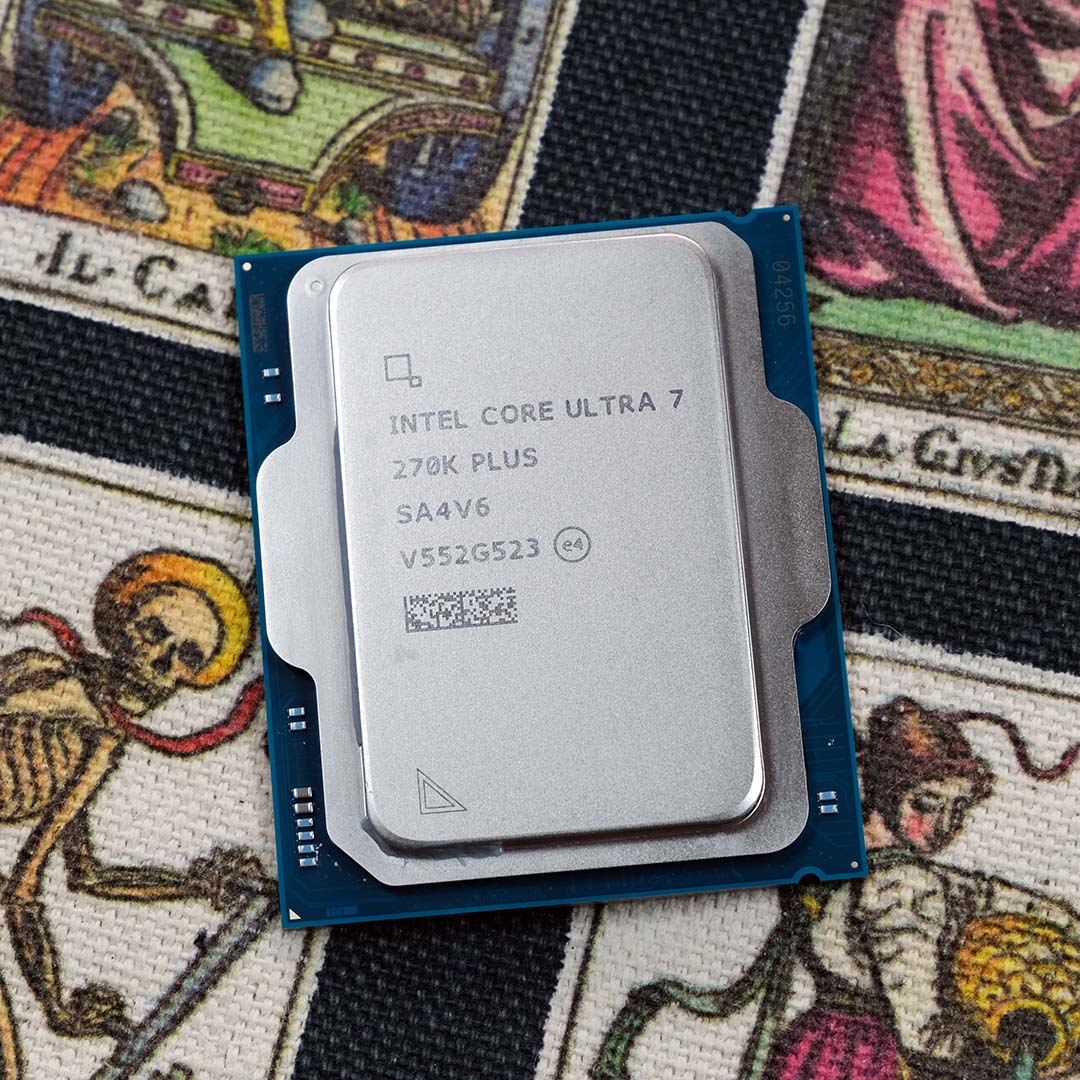
Manufacturers are releasing new motherboards to coincide with this launch, but you can install the 270K Plus in any existing LGA1851 platform. You don’t even have to apply a BIOS update to get up and running, much as Intel (and I) recommend applying the latest firmware.
While Intel’s platform was pricey in 2024, the cost of motherboards has dropped significantly since then. In fact, Z890 boards are broadly comparable in price with AMD’s X870E offerings, starting at around £200. There’s also B860 and H810 alternatives to consider, and while you lose overclocking support, Intel’s aggressive pricing for these new chips is such that I can see users adopting low-cost platforms to go with.
With the above in mind, the $299 270K Plus price tag makes for a properly competitive offering relative to the closest AMD equivalent, the Ryzen 7 9700X. Of course, cost is one thing, but it’s performance that determines value, so let’s see what exactly this Intel CPU can do.
Test Methodology
To put the Core Ultra 7 270K Plus and comparable processors through their paces, I’ve refreshed our CPU test suite with new additions and methodology. The latter changes particularly concern gaming performance, where I’ve captured frame rates at 1080p using ‘High’ in-game presets sans upscaling where possible.
Across games and productivity benchmarks, I’ve paired the CPU with our Nvidia GeForce RTX 5090 Founders Edition. While pairing a $300 chip with a $2,000 graphics card may seem a touch absurd, the monster pixel pusher removes any potential GPU bottlenecks so the processor has all the room it could wish for to demonstrate its capabilities.
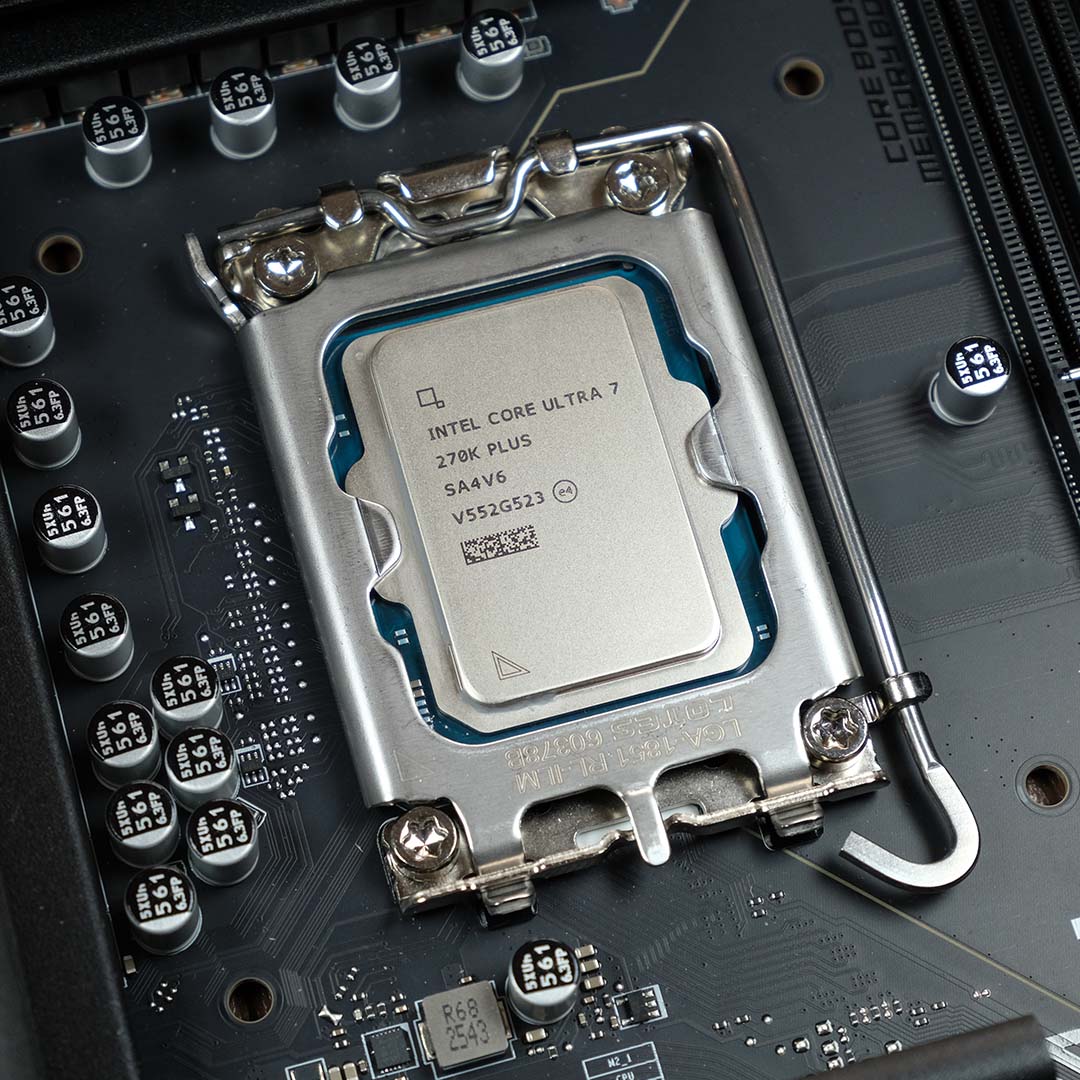
Core Ultra 7 270K Plus test PC
Club386 carefully chooses each component in a test bench to best suit the review at hand. When you view our benchmarks, you’re not just getting an opinion, but the results of rigorous testing carried out using hardware we trust.
Shop Club386 test platform components:
CPU: Intel Core Ultra 7 270K Plus
Cooler: Arctic Liquid Freezer III Pro 420 A-RGB
Motherboard: MSI MAG Z890 Tomahawk WiFi II
GPU: Nvidia GeForce RTX 5090 Founders Edition
Memory: 32GB DDR5-7200 G.Skill Trident Z5 RGB
Storage: 2TB WD_Black SN8100 NVMe SSD
PSU: 1,200W be quiet! Dark Power 14
Chassis: be quiet! Light Base 900 FX
An MSI MAG Z890 Tomahawk WiFi II forms the base of our LGA1851 test platform, complete with 32GB of DDR5-7200 CL34 G.Skill Trident Z5 RGB RAM. In the opposing corner, an MEG X870E Ace Max and 32GB of DDR5-6000 CL32 G.Skill Trident Z5 Neo RGB serve as the main pillars for our AM5 bench. Chassis, cooler, GPU, SSD, and PSU are consistent across both systems.
Finally, I’m using Intel Application Optimisation (APO) profiles where available, as well as Binary Optimisation on the 200K Plus for applicable programs. I’ll note and highlight any performance differences the latter provides relative to APO as and when they apply.
App Performance
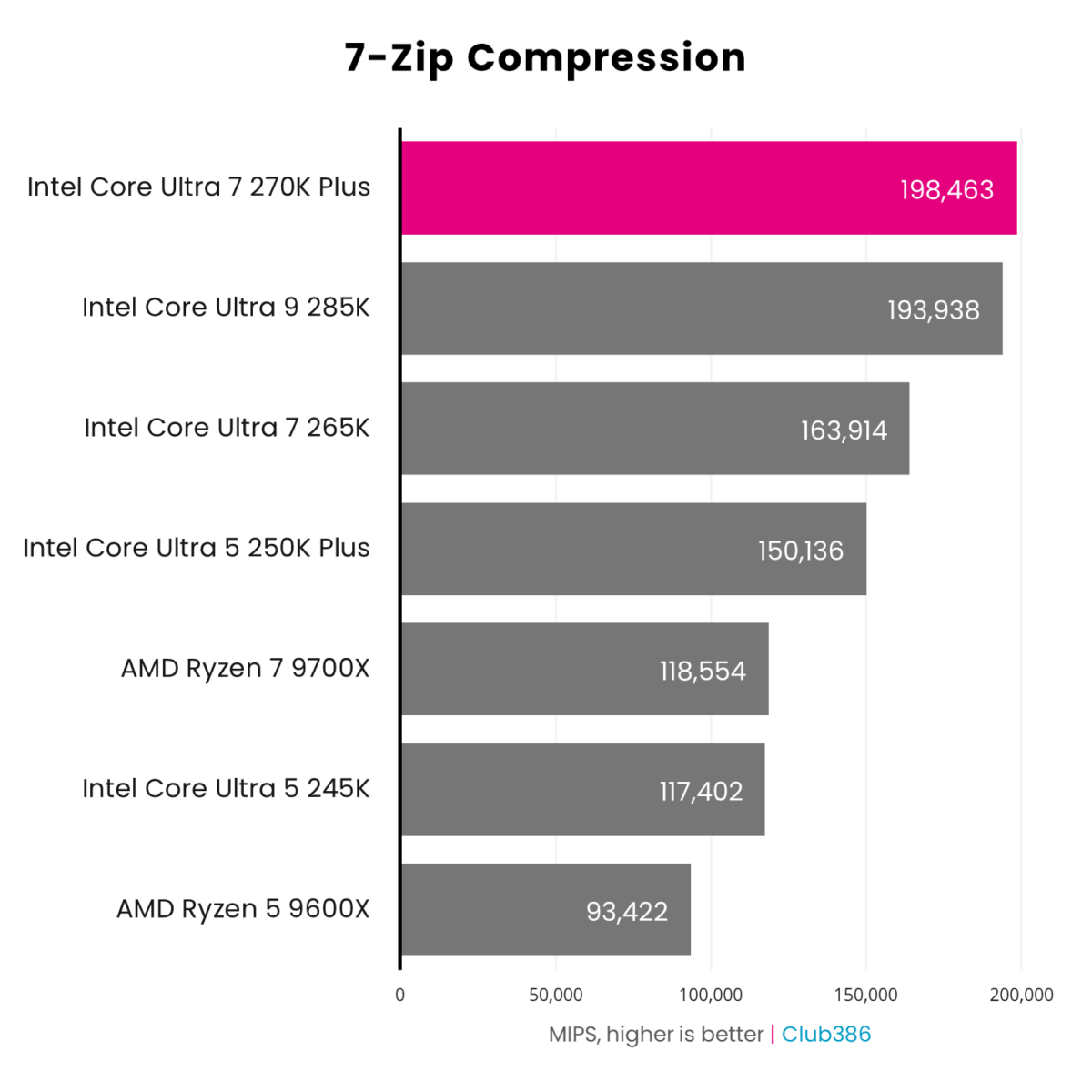
More threads beget greater 7-Zip Compression performance, which gives the Core Ultra 7 270K Plus plenty of room to shine. Intel’s new chip even manages to claw past its fellow 24-thread sibling, the Core Ultra 9 285K, with a 2% lead. More impressive, however, is the 21% performance improvement the 270K Plus offers relative to the Core Ultra 7 265K, which it undercuts on price.
Thread count comparisons between the $359 Ryzen 7 9700X (16) and $299 270K Plus (24) are stark to say the least. Intel’s 50% uptick in threads return a massive 67% advantage over AMD’s contender in this multi-threaded test.
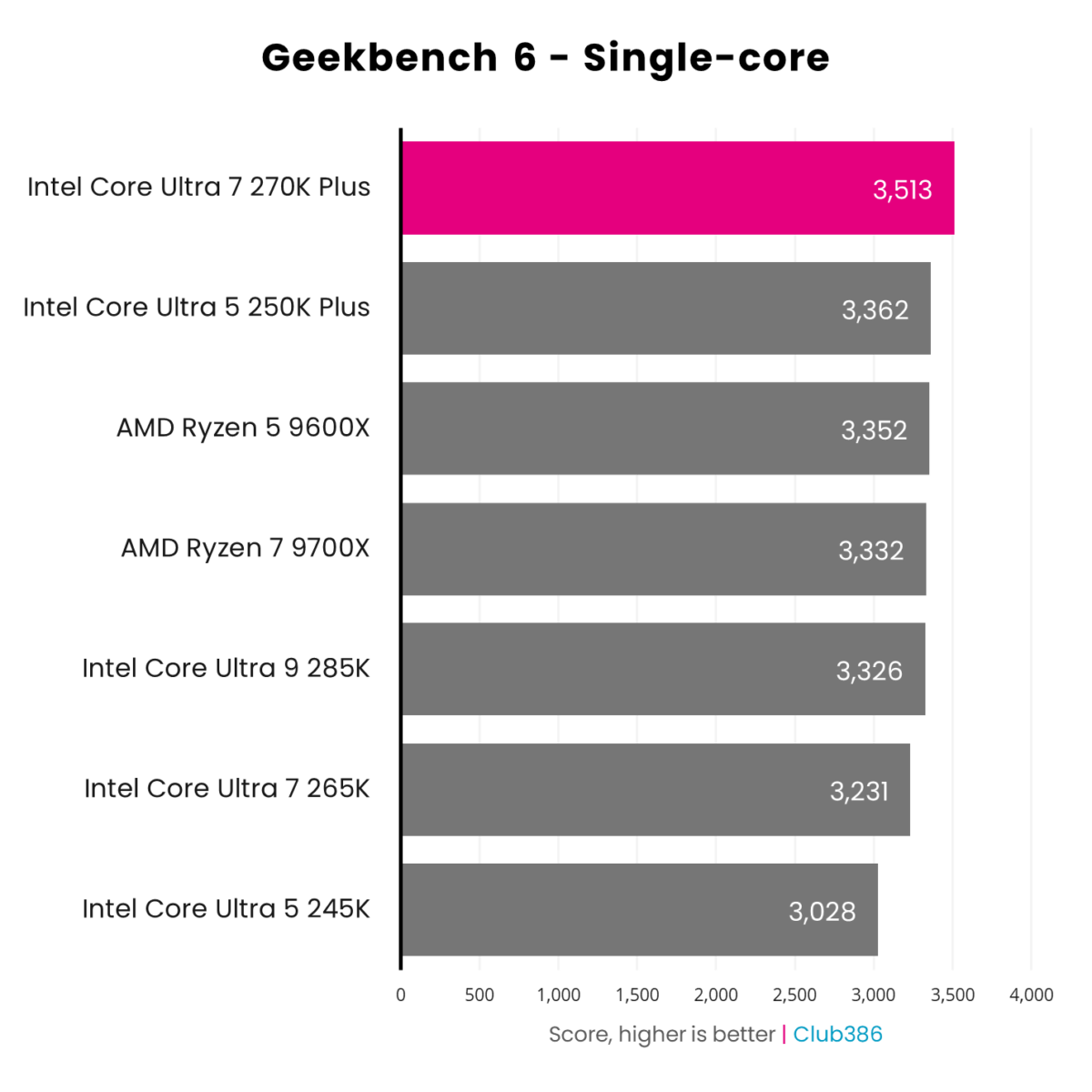
Geekbench 6 offers up our first taste of Intel Binary Optimisation. This is what Intel describes as a “proof-of-concept profile” through which the company aims to demonstrate potential performance gains from the technology.
Without the feature, the Core Ultra 7 270K Plus scores 3,311pts in the single-core benchmark. However, enabling Binary Optimisation sees points rise to 3,513pts, as the chart reflects. That’s a welcome 6% improvement without any downsides, giving the chip a clear lead over the rest of the field.
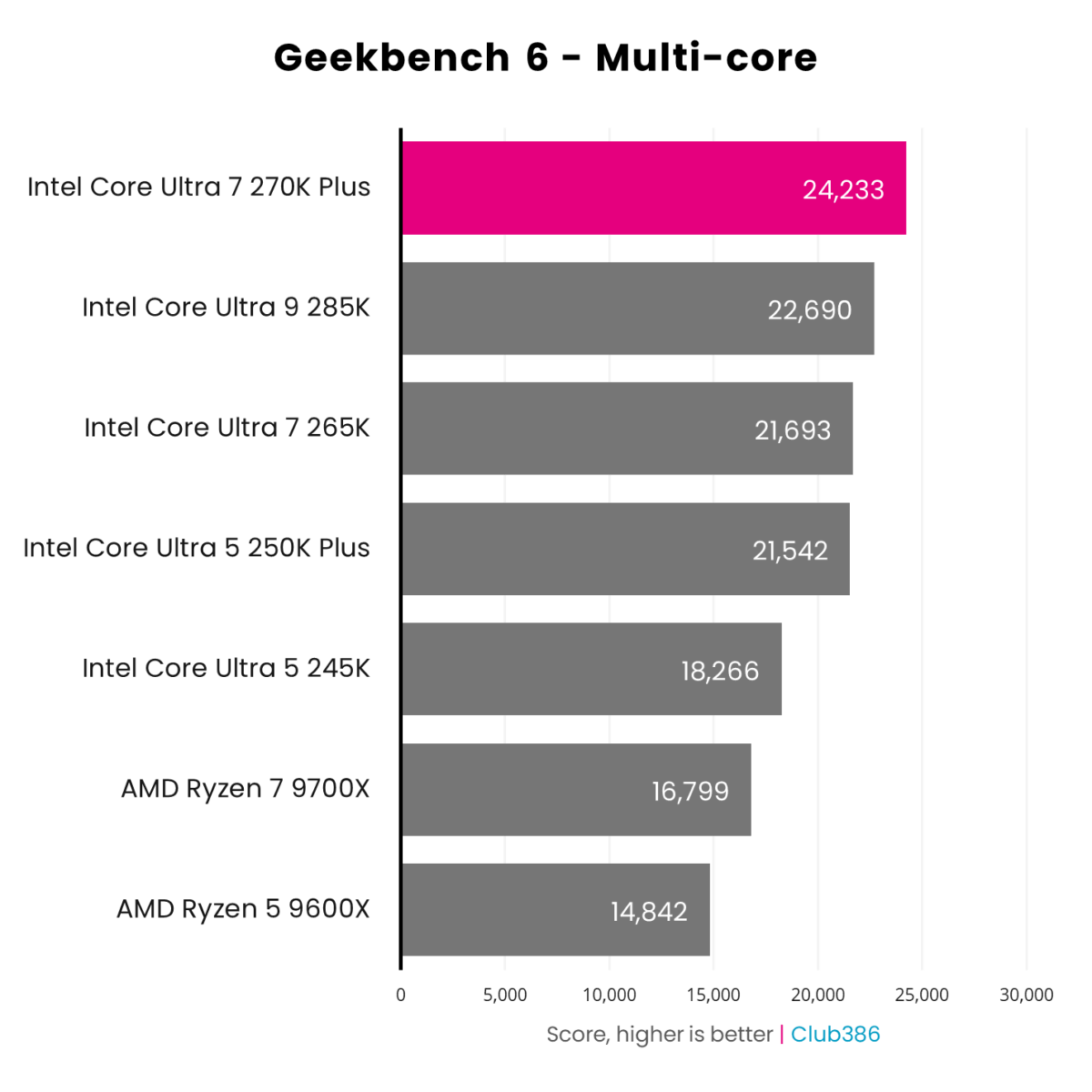
Core Ultra 7 270K Plus multi-core scores in Geekbench 6 similarly benefit from Binary Optimisation, albeit to a lesser degree. Rising from a baseline of 23,318pts to 24,233pts makes for a smaller but still welcome 4% boost.
Regardless of whether the feature is active, the 270K Plus rules the multi-core roost. It’s great to see respective 6% and 11% bumps over the Core Ultra 9 285K and Ultra 7 265K, but the 44% advantage over the Ryzen 7 9700X inarguably steals the show here.
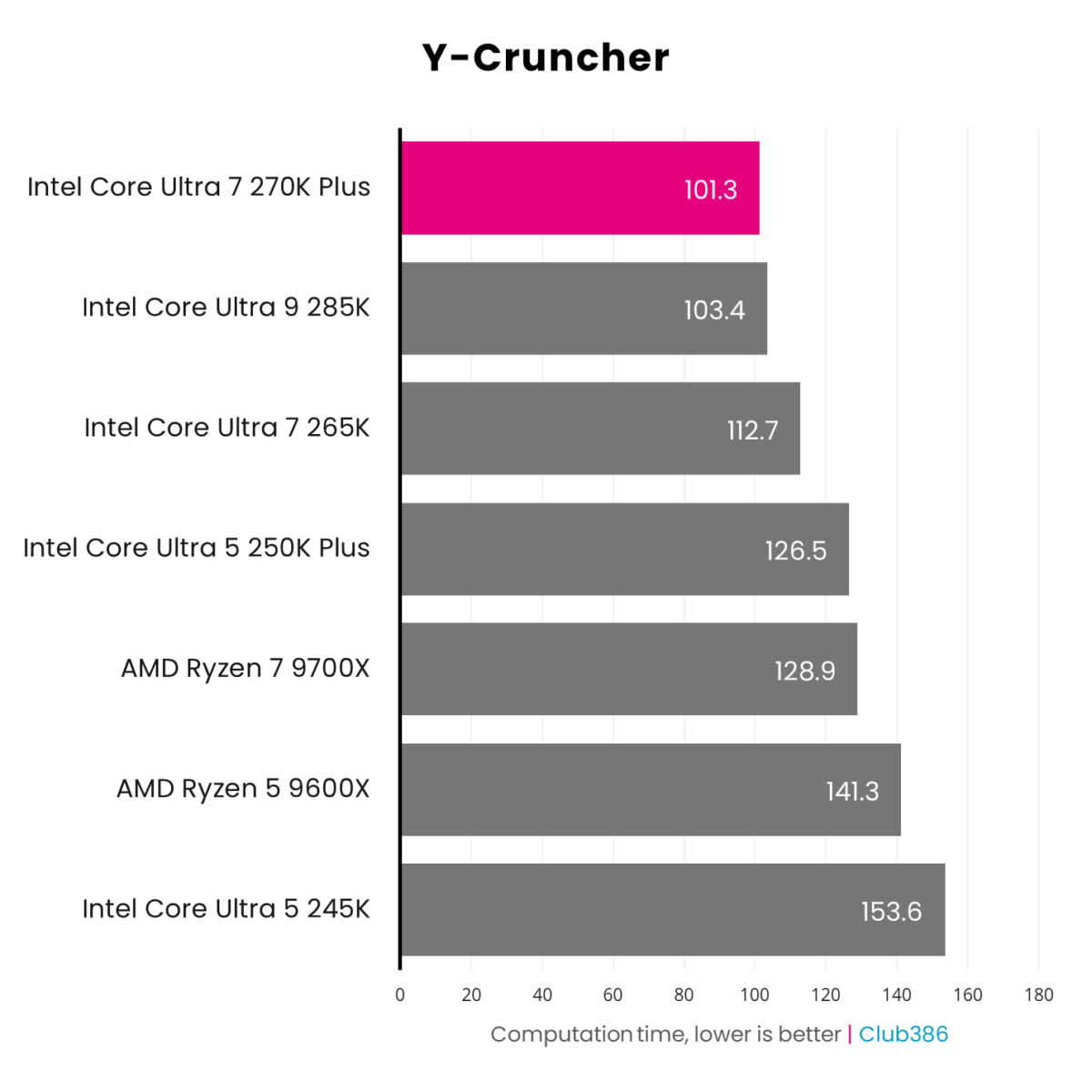
Calculating Pi to five billion digits in a timely fashion takes serious computational grunt, but the Core Ultra 7 270K Plus once again finds itself top of the table in this task. If you’re regularly crunching numbers and have no need for the AVX-512 instruction set, there’s no faster chip out there for $300 or less.
Content Creation
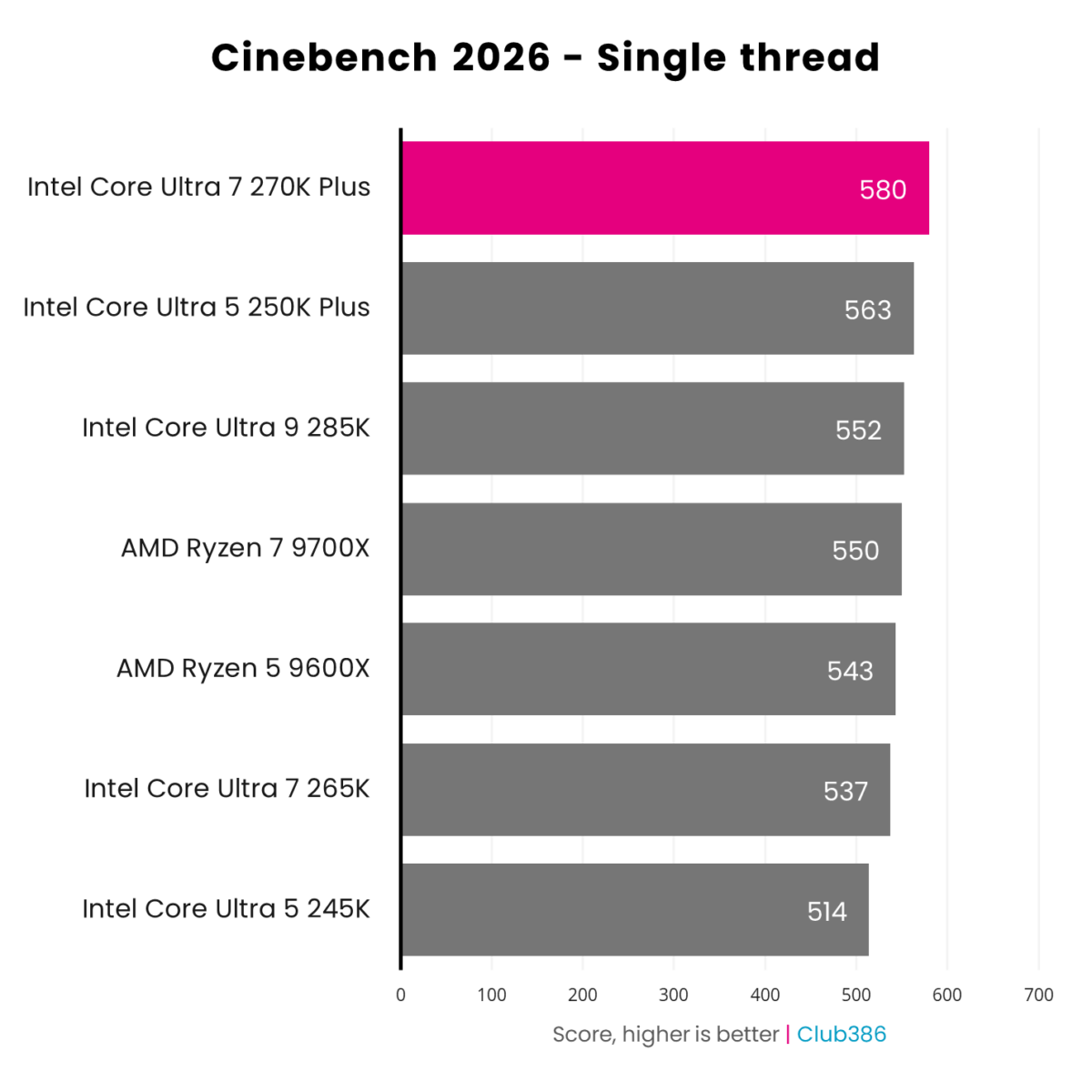
Cinebench 2026 sees the Core Ultra 7 270K Plus flaunt its single-thread prowess once again, comfortably leading the race against siblings and rivals with 580 points. An 8% improvement over the Core Ultra 7 265K proves crucial in re-establishing Intel as a leader in this performance category, confidently emerging from under the shadow of both sub-$300 AMD Ryzen 9000 series chips.
The 270K Plus even manages to beat the Core Ultra 9 285K here, despite its 200MHz boost clock deficit, with the Core Ultra 250K Plus managing the same feat even with a larger 400MHz gap to overcome. Results like these keenly highlight the performance benefits of Intel’s IPC improvements that come part and parcel with this refresh.
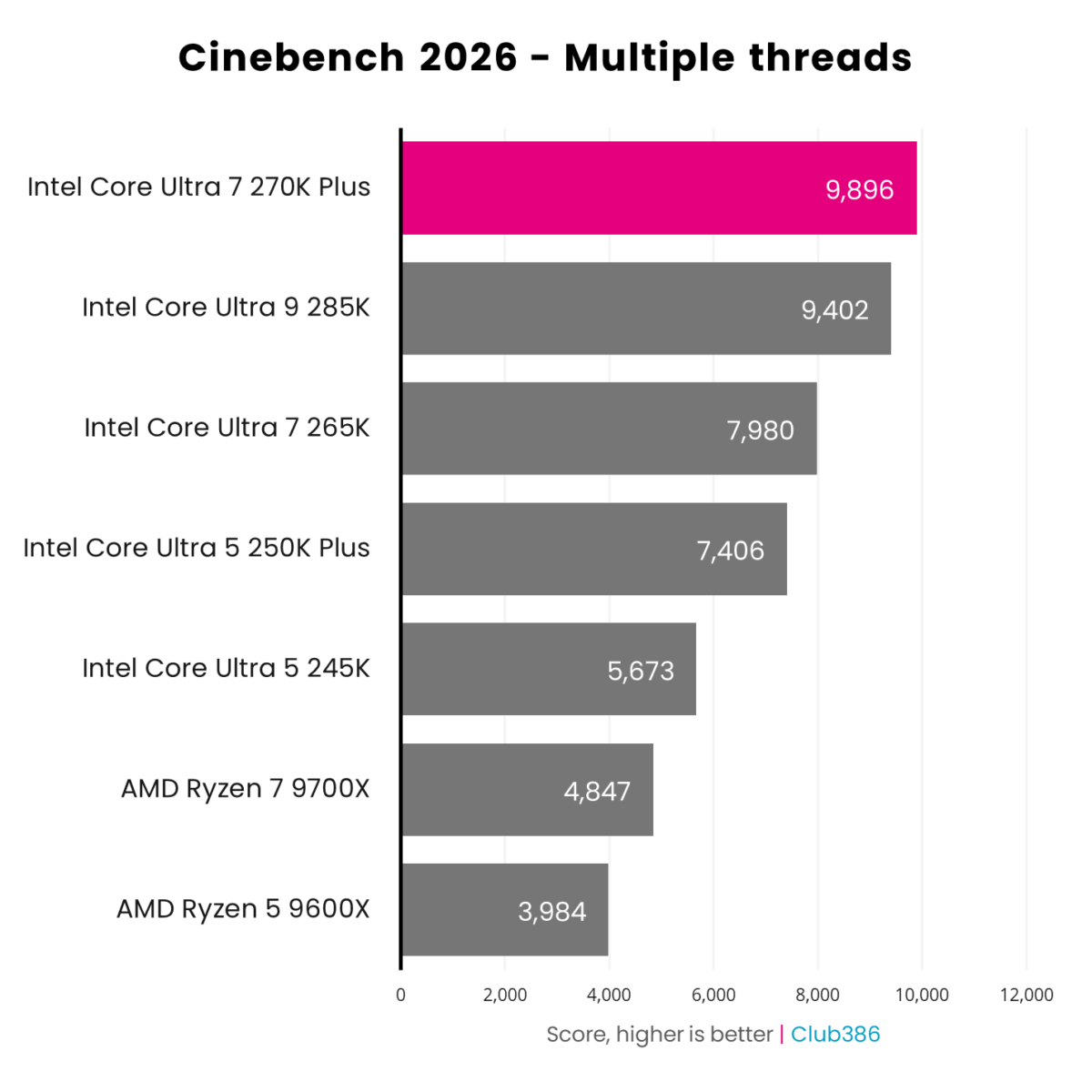
Firing up all threads on each processor leads to another victory lap for the Core Ultra 7 270K Plus. The CPU pulls ahead of the Core Ultra 9 285K by a cool 5% while delivering a decisive 24% improvement over the Core Ultra 7 265K.
Intel has little worry about from AMD in this battleground. While the Core Ultra 265K was already much faster than the Ryzen 7 9700X in multi-core score, the 270K Plus more than doubles the Zen 5 chip’s score.
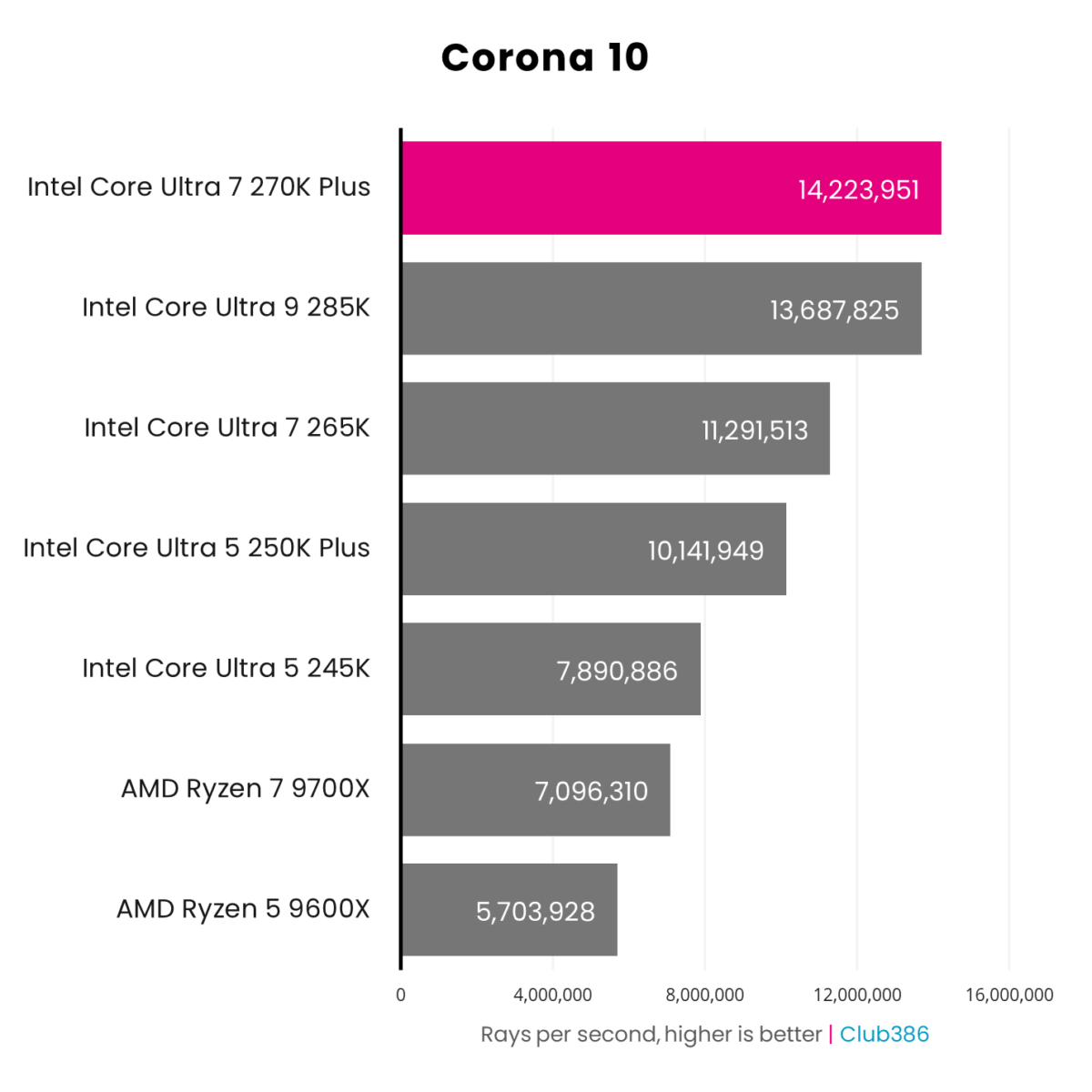
Corona 10 further cements Intel’s position as the processor brand of choice for rendering workloads, with both original and refreshed Arrow Lake processors handily defeating their AMD rivals. The Core Utlra 7 270K Plus leads the pack, lapping the Ryzen 7 9700X in rays per second. Staggering for a $299 chip.
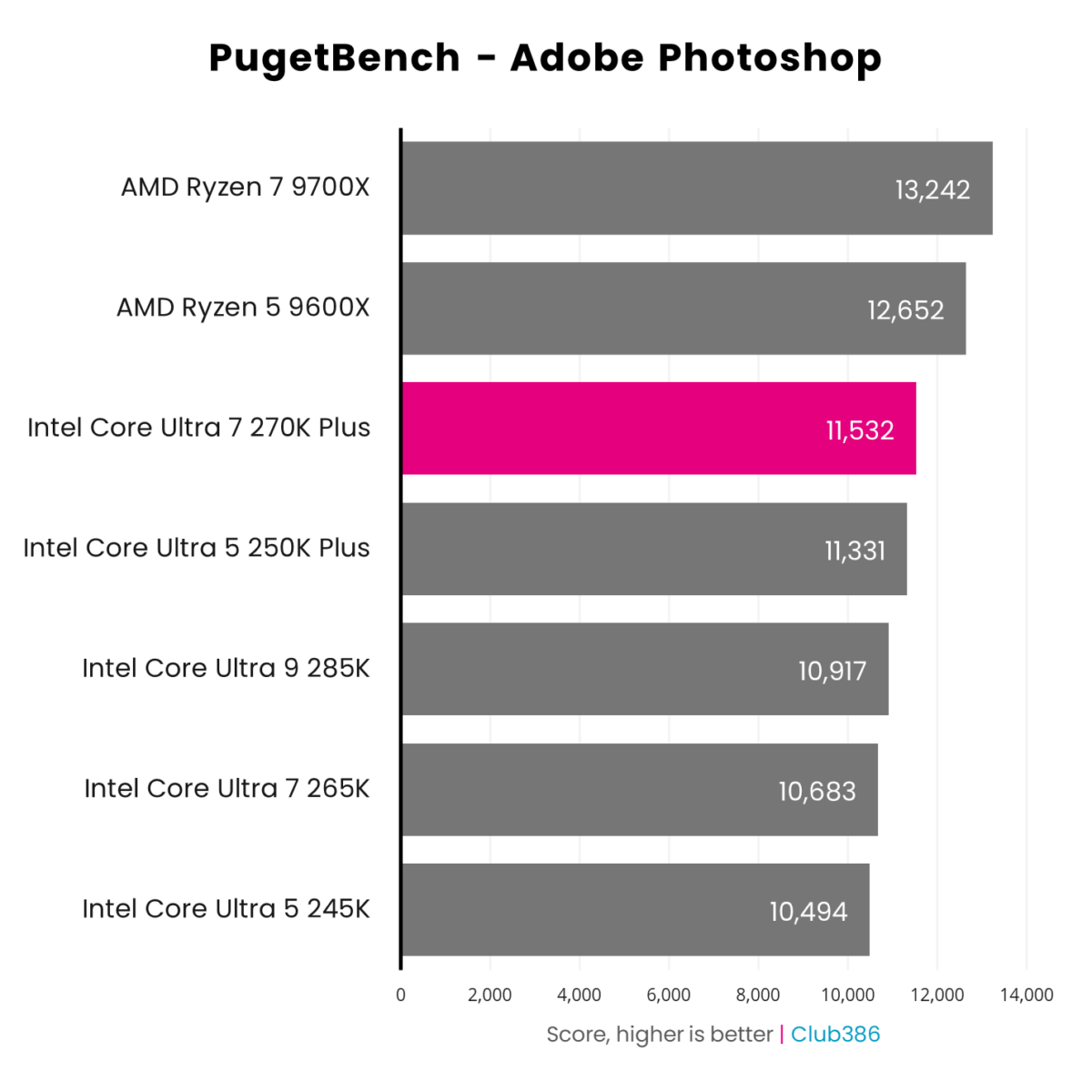
In an unexpected twist of fate, the Core Ultra 7 270K Plus finds itself behind both AMD CPUs in the PugetBench Photoshop benchmark. This isn’t a close race either, with Intel’s chip coming in 13% behind the Ryzen 7 9700X.
It’s unclear why Photoshop adamantly prefers AMD’s processors to Intel’s. This could stem from homogeneous versus heterogenous core designs, or more broad architectural optimisations for Zen 5 over Arrow Lake. Either way, the 9700X takes the crown here. Where’s my Photoshop Binary Optimisation, Intel?
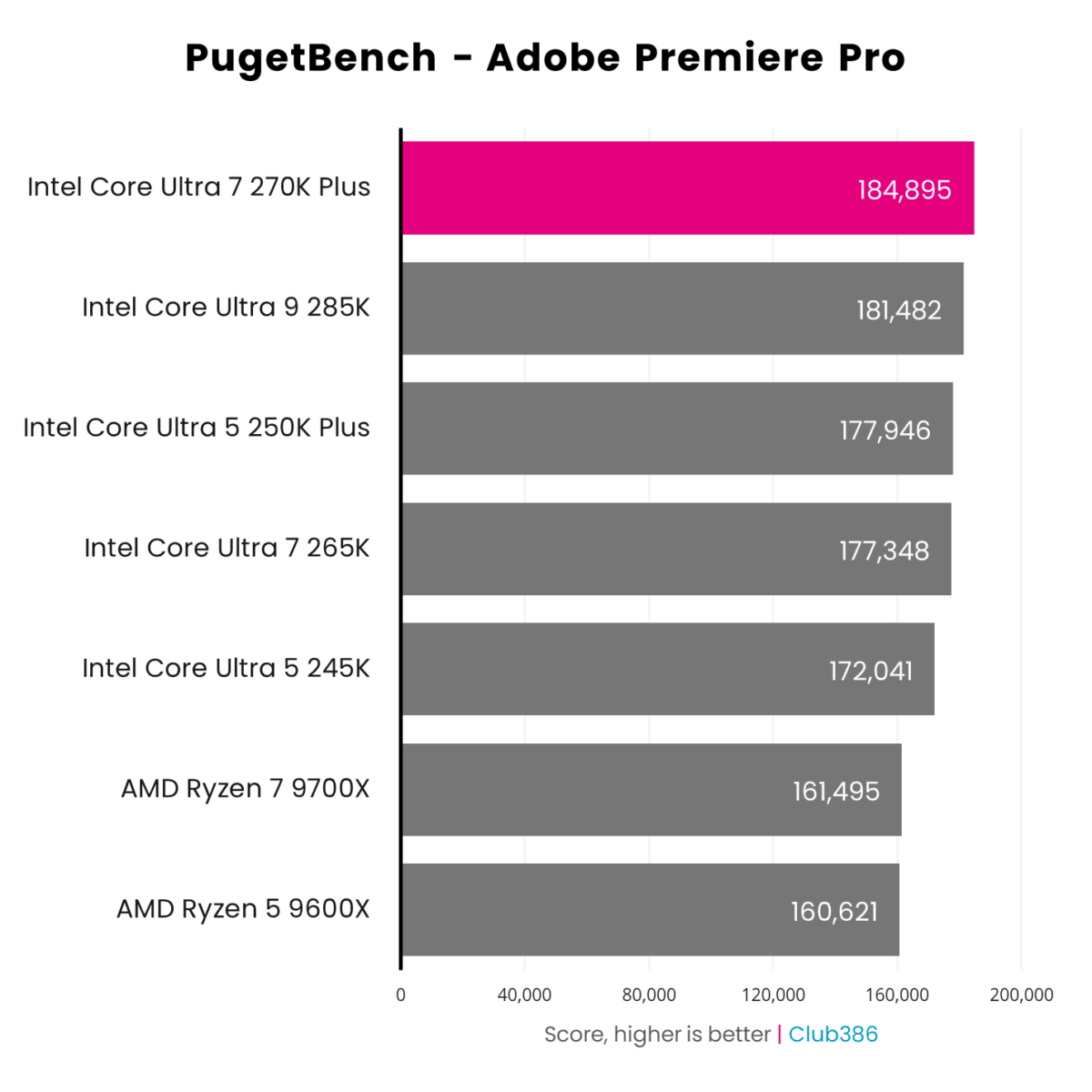
Rising from its surprising Photoshop podium position, the Core Ultra 7 270K Plus returns to top spot for Premiere Pro performance. Intel confidently dominates in this realm, with all Core Ultra 200S processors above the AMD rivals.
The 270K Plus is a mere 2% ahead of the Core Ultra 9 285K, but remember the latter launched at a $589 price point, which now feels astronomical in the face of the $299 Core Ultra 270K Plus. This may be a similar chip with a few tidy under-the-hood improvements, but it’s the revised price tag that really makes me stand up and take note.
Memory
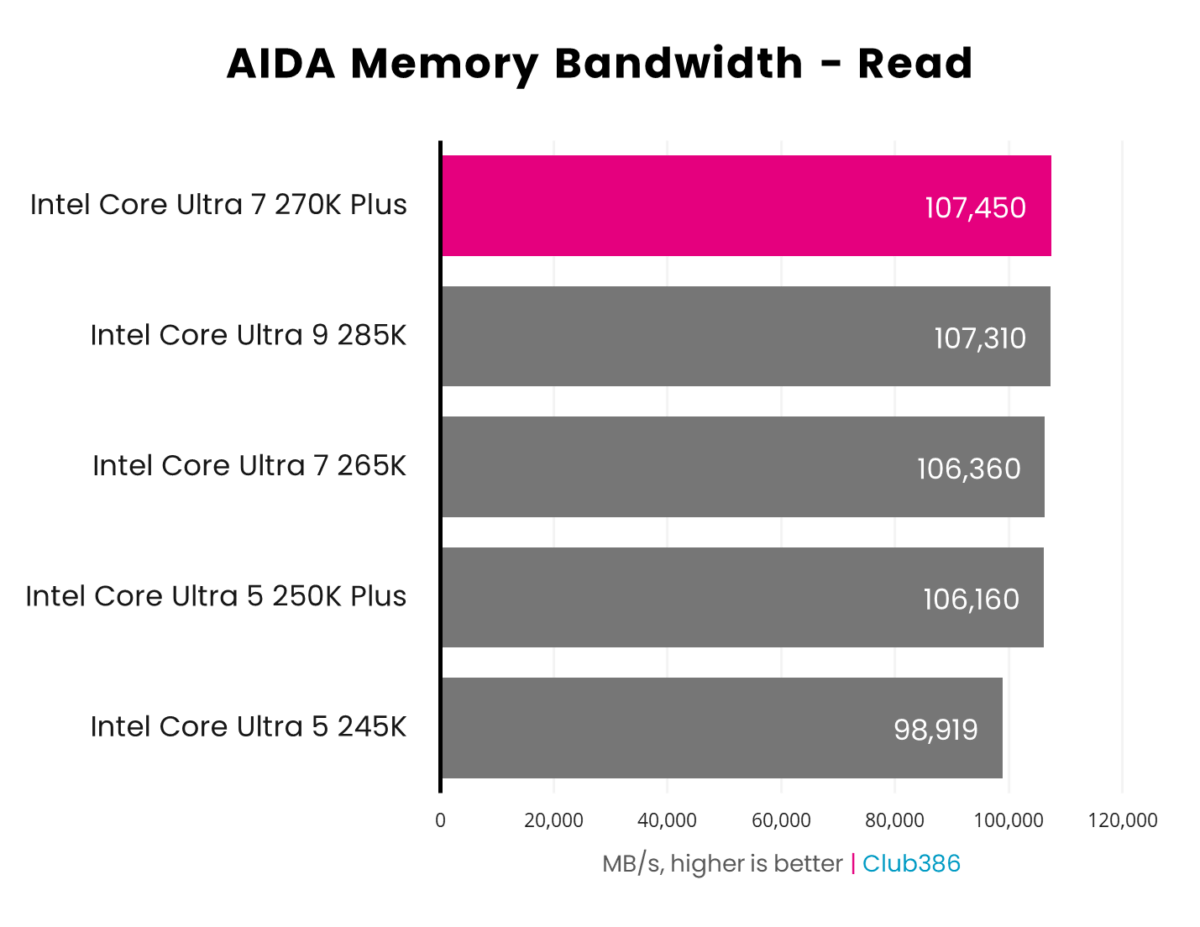
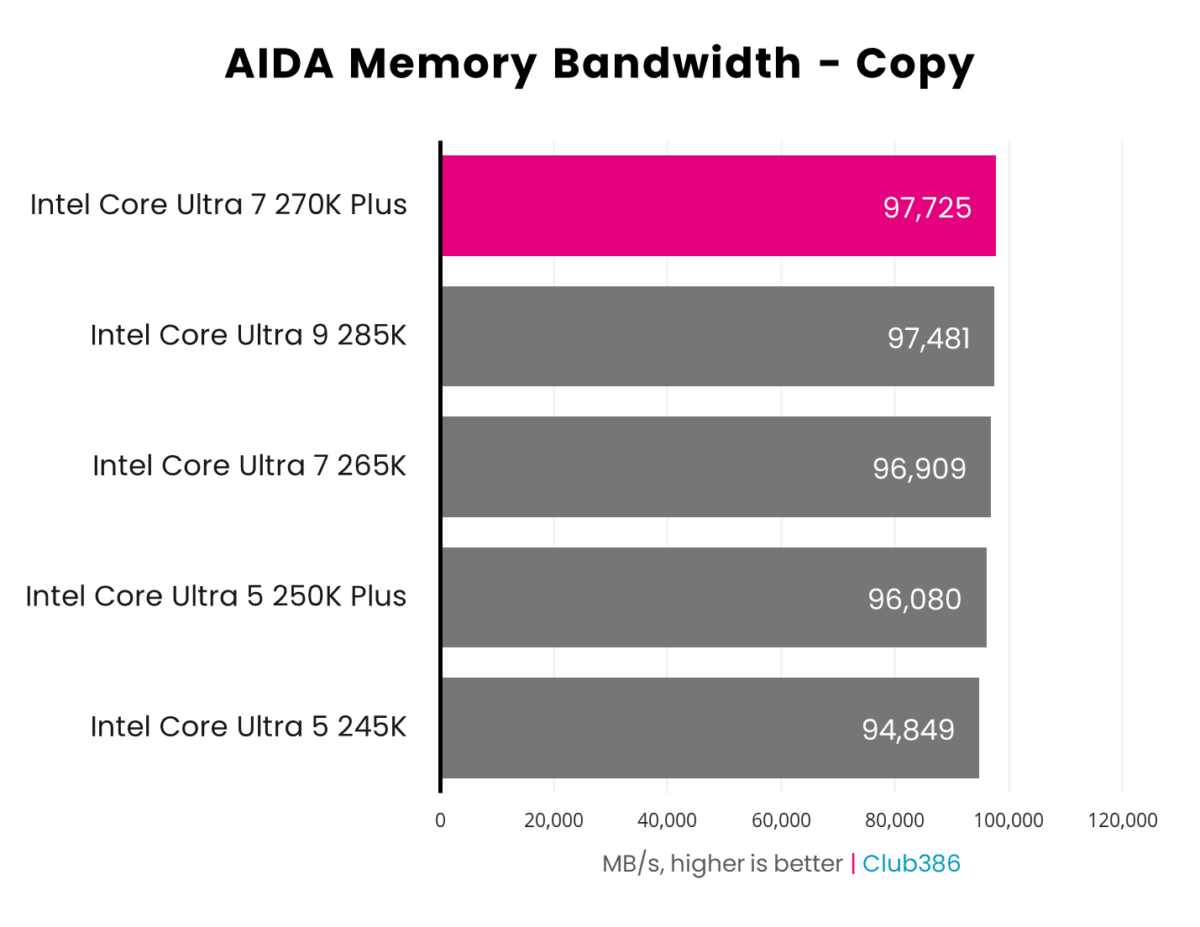
Our dual-channel DDR5-7200 CL34 kit provides plenty of legroom for the Core Ultra 200S processors to flaunt their memory bandwidth. While write performance is essentially a dead heat at ~93,000MB/s, there are some small differences elsewhere.
The Core Ultra 270K Plus sits at the top of the chart here yet again, clawing a victory over the Core Ultra 9 285K by a few hundred megabytes in both read and copy throughput. Broadly speaking, though, all these chips deliver heady performance with regards to high-speed memory support. Now if only DDR5-7200 kits would come back down to sensible price points.
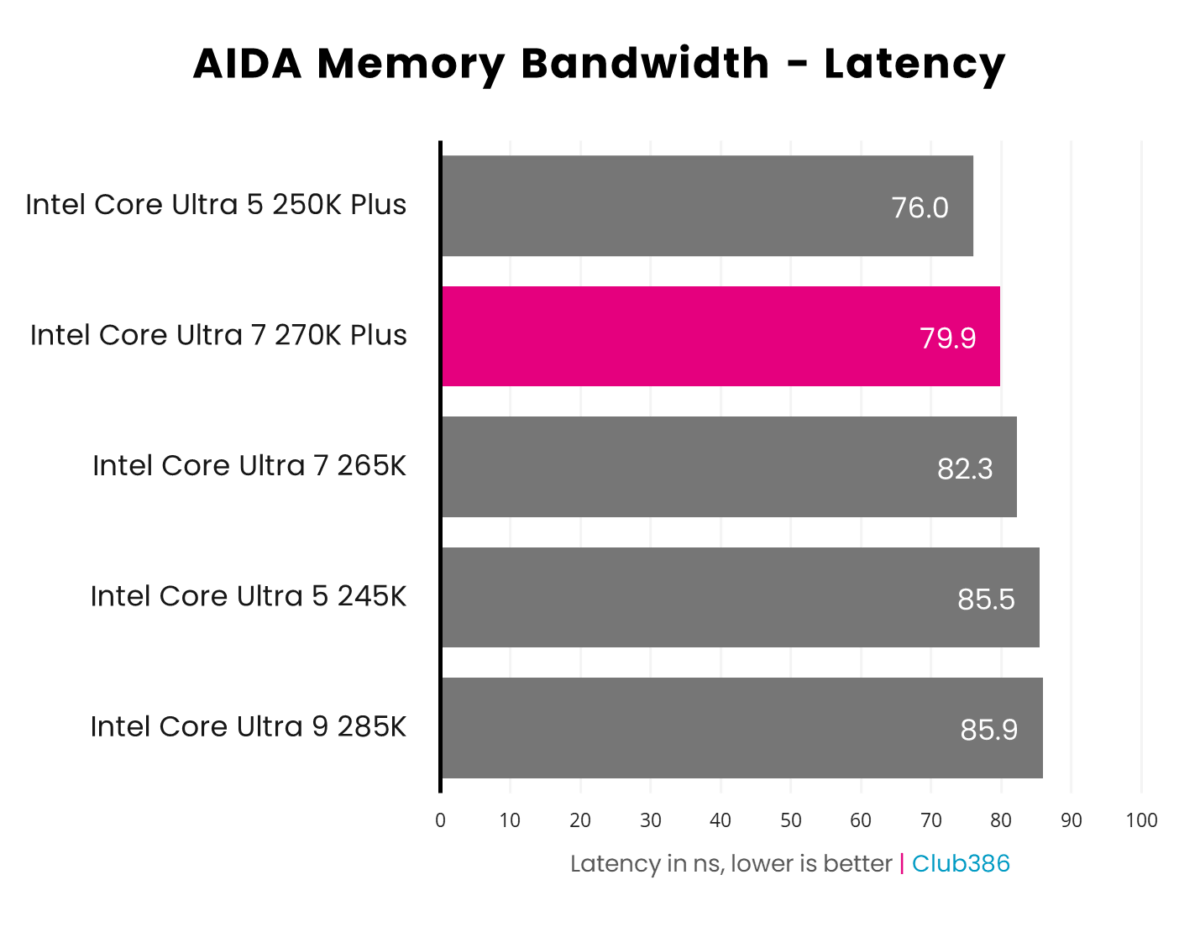
Speedier die-to-die communication proves a boon to memory latency. Every nanosecond counts in this race and the Core Ultra 7 270K delivers a 7% improvement over the Core Ultra 7 285K, despite both processors sharing the same core count.
Gaming
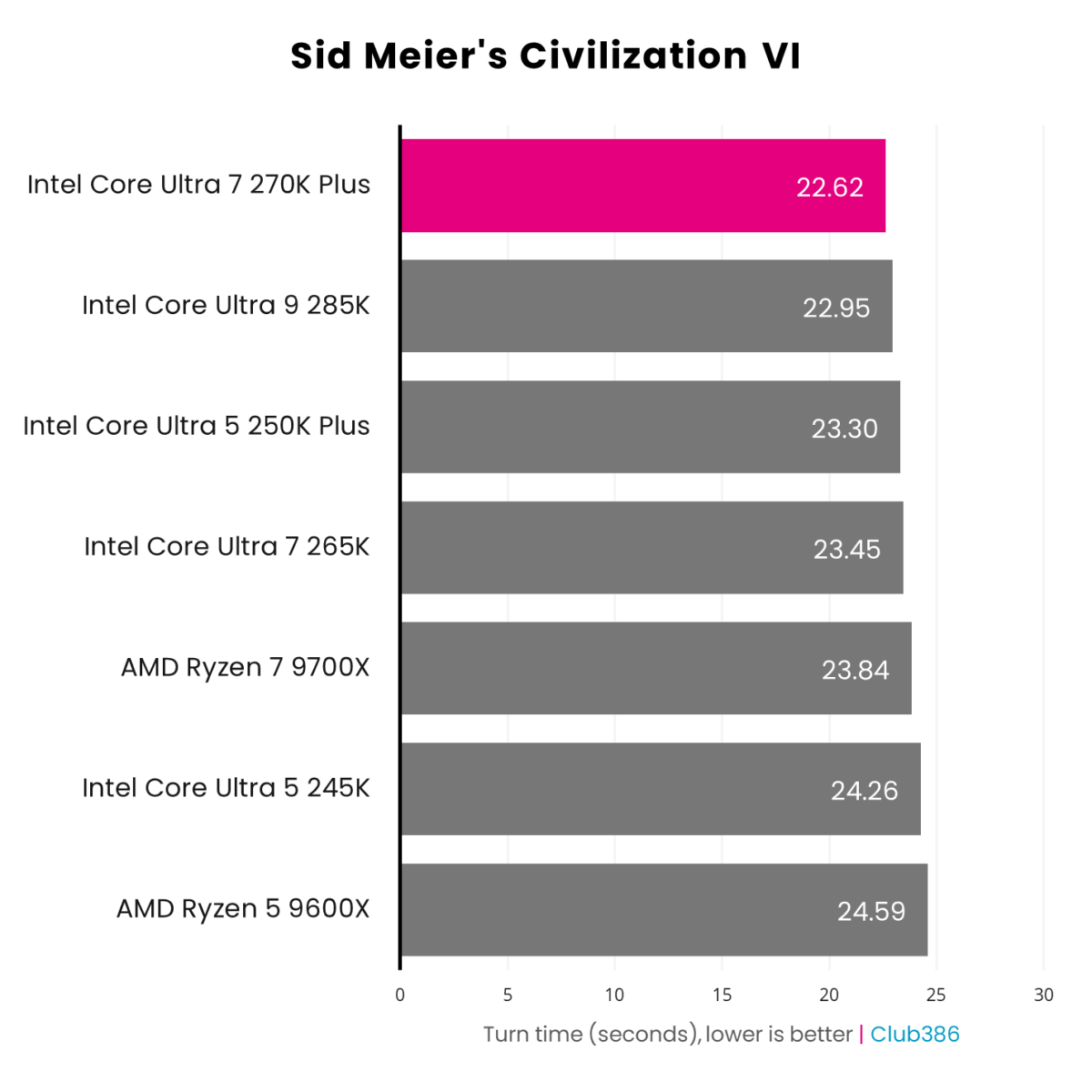
Civilization VI opens our gaming test suite with its Gathering Storm AI benchmark, emulating a late stage save that’s heavy on computational load. The Core Ultra 7 270K Plus expectedly takes the overall win as the most powerful multi-core processor on the chart, but we’re only talking about a 1.97s lead on average relative to the slowest chip.
I did test Civilization VII too, thinking the newest entry would prove more taxing. Curiously, though, differences in average turn time amounted to less than one second across the board. Suffice to say, any modern CPU is up for a bit of 4X action.
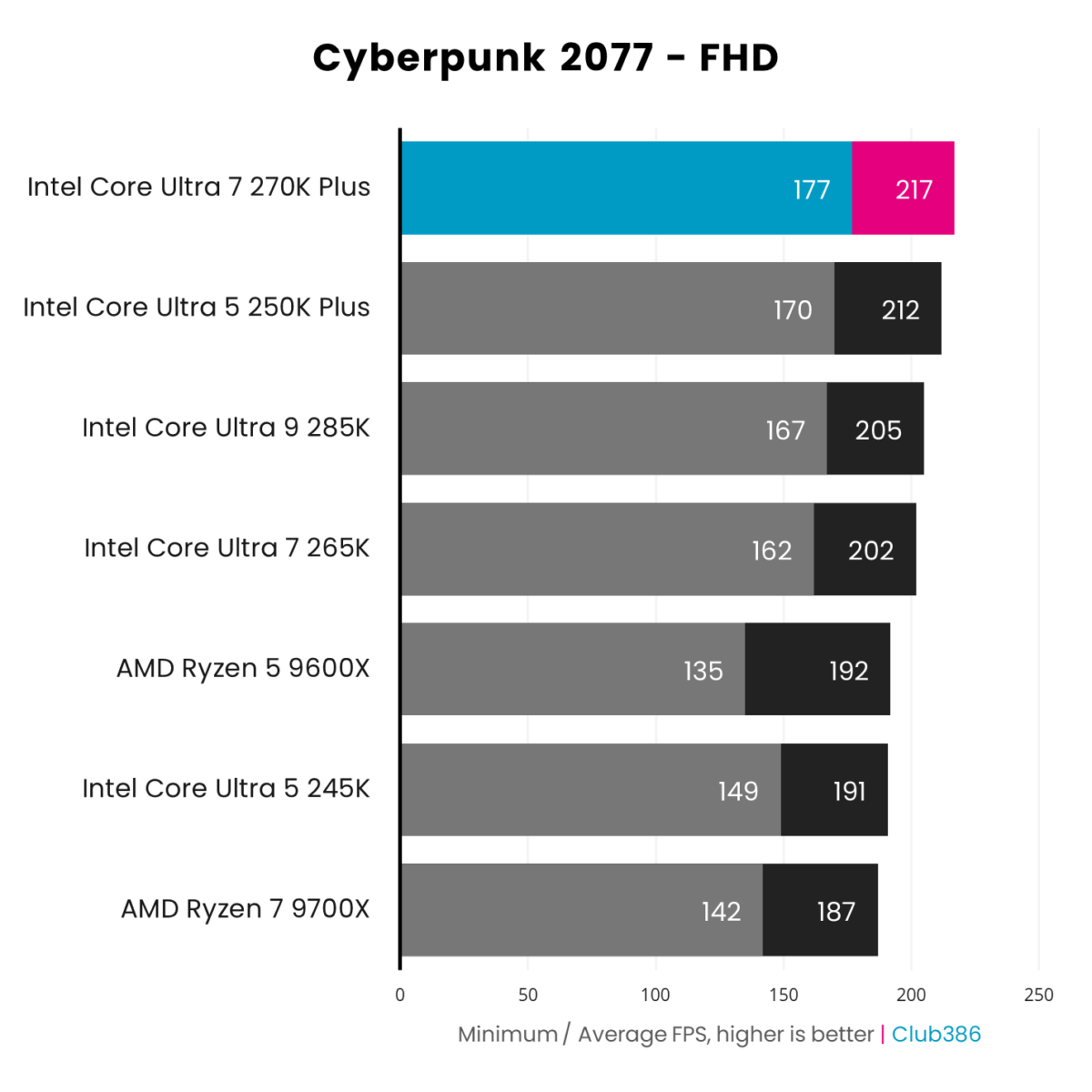
Our first taste of frame rates on the Core Ultra 7 270K Plus also marks an application of Binary Optimisation. The feature boosts average performance up from 210fps to 217fps (+3%), slightly above Intel’s advertised 2% improvement for Cyberpunk 2077.
1080p, High settings, sans Nvidia DLSS, creates a clear gap between the 270K Plus and Ryzen 7 9700X as the processors become the performance bottleneck. Intel’s chip is 16% ahead of AMD’s in terms of average frame rates and delivers more consistent minimums to boot.
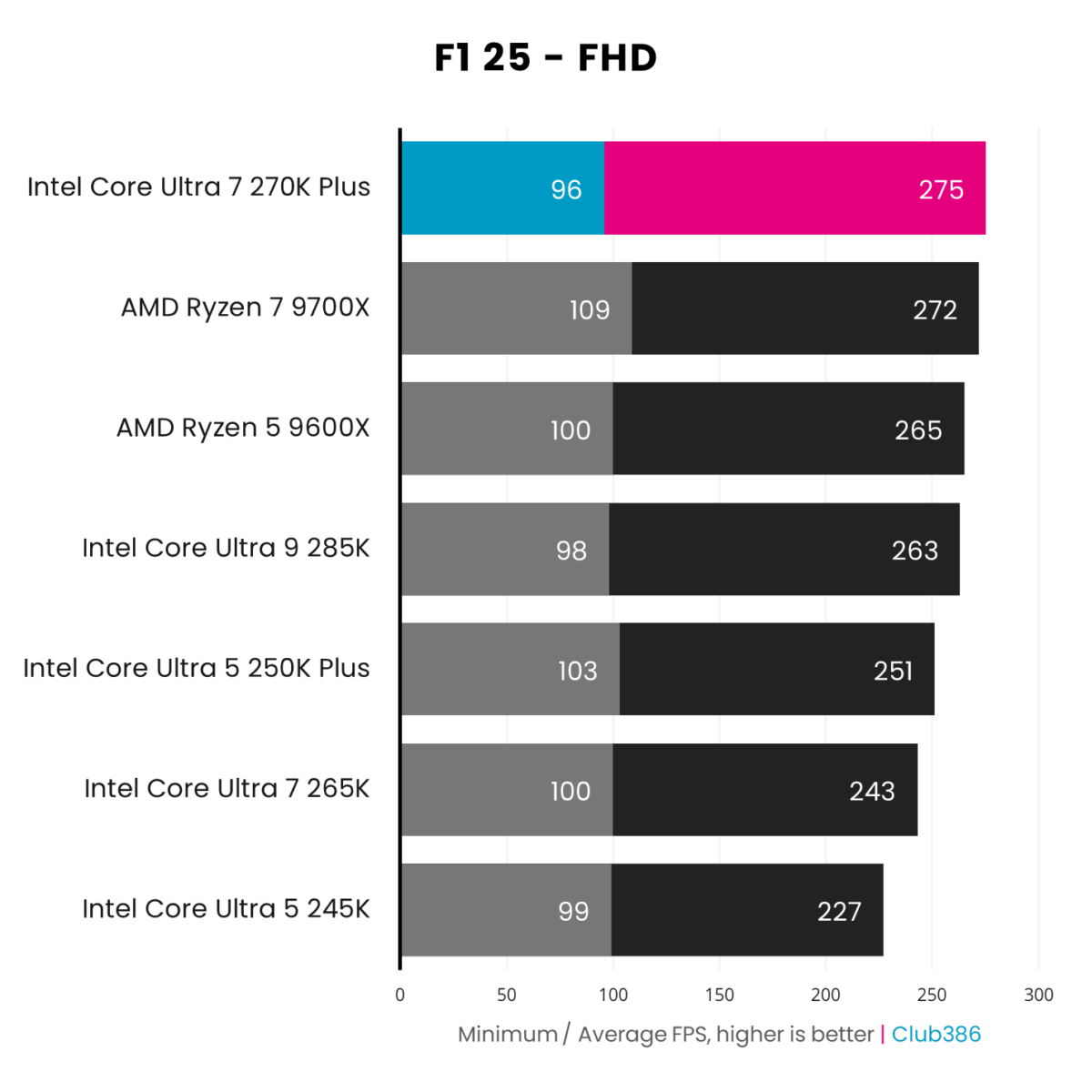
First to cross the finish line in F1 25, the Core Ultra 7 270K Plus revs up a 275fps average. This marks a substantial improvement in Core Ultra 200S performance in this title – an ‘overtake mode’ if you will, boosting past the Core Ultra 7 265K by 13% and 4% beyond the Core Ultra 9 285K.
Such an uplift gives the 270K Plus enough gusto to nip ahead of the Ryzen 7 9700X, but only by 3fps. Moreover, the AMD CPU delivers a more consistent frame rate with a higher minimum. What’s clear is that Intel has made meaningful strides in gaming performance.
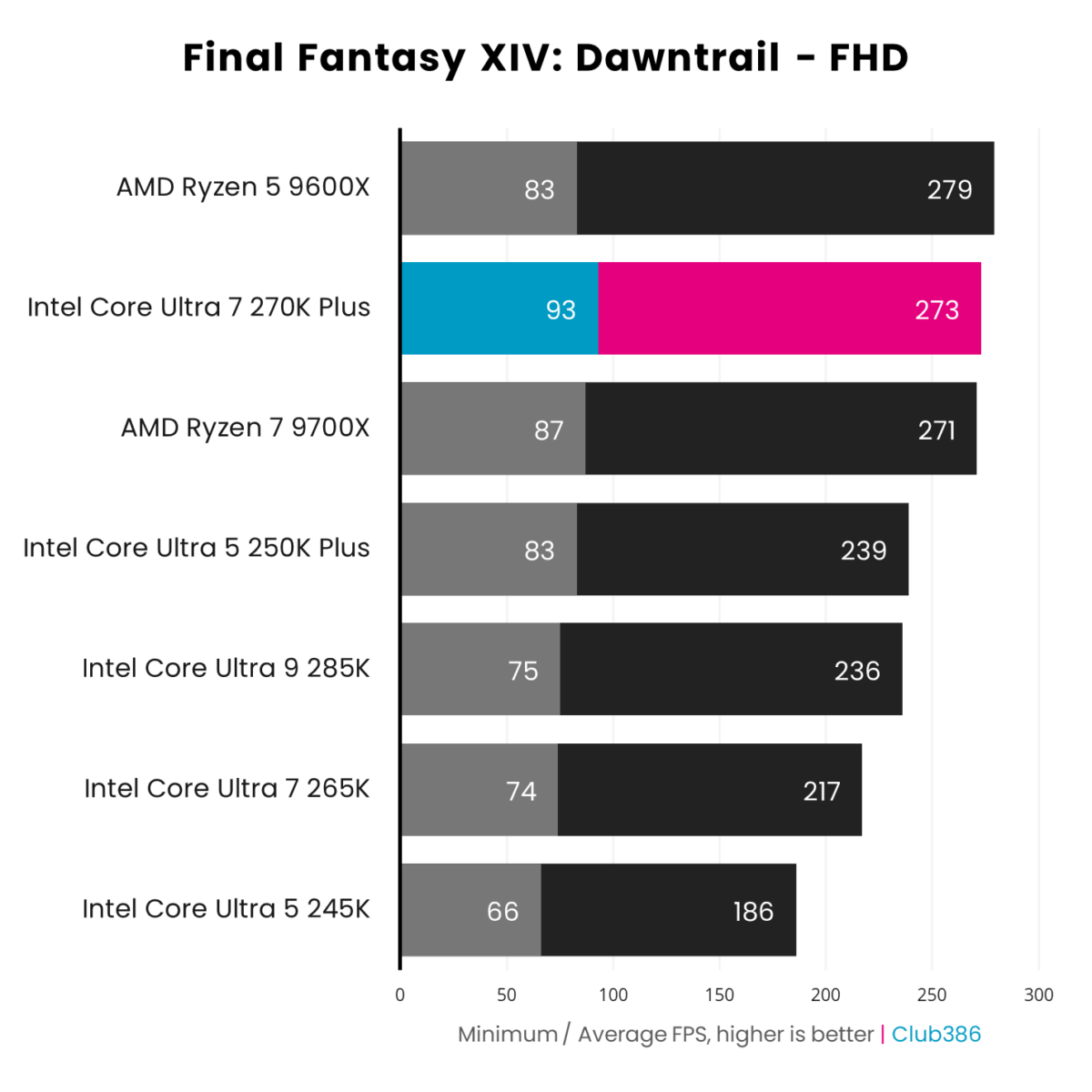
Final Fantasy XIV: Dawntrail is the only other game in our suite that benefits from Binary Optimisation, boosting a baseline 259fps average frame rate to 273fps. That’s a 5% increase from the profile alone, slightly below the 6% that Intel advertises but these are welcome free frames regardless.
Intel has traditionally performed relatively poor to AMD in Square Enix’s MMORPG, and the 270K Plus goes a long way to plugging that gap, improving on the Core Ultra 7 265K by a whopping 26%.
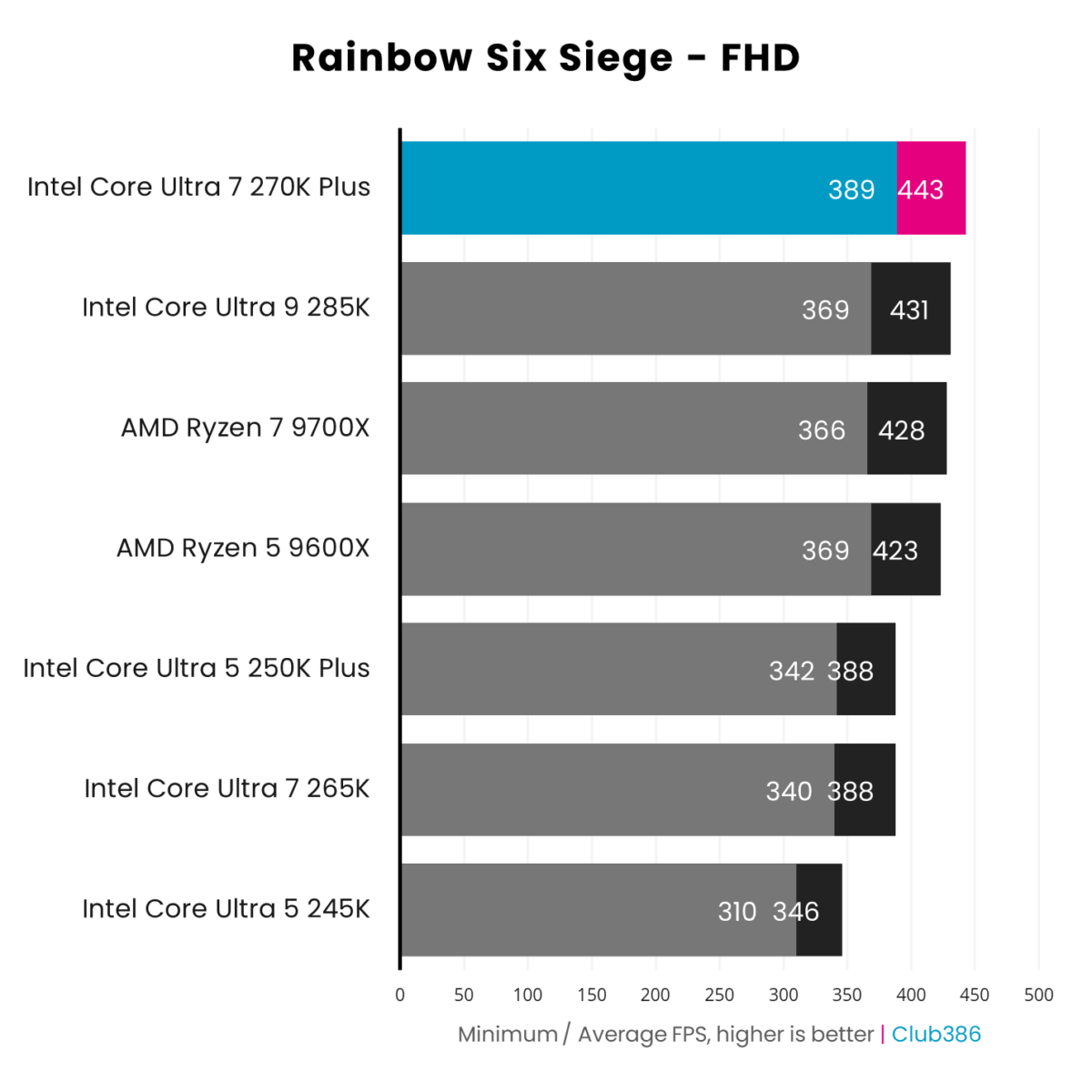
Every frame matters in competitive esports games like Rainbow Six Siege, and the Core Ultra 7 270K Plus continues to shine. Frame rates are 14% higher on Intel’s new chip relative to the Core Ultra 7 265K, breaking through the 400fps barrier that was largely out of reach for the Blue Team bar the expensive Core Ultra 9 285K.
AMD isn’t too far behind, with just 15fps separating the Ryzen 7 9700X from the 270K Plus. Even so, greater minimum frame rate consistency gives Intel an advantage in Ubisoft’s FPS.
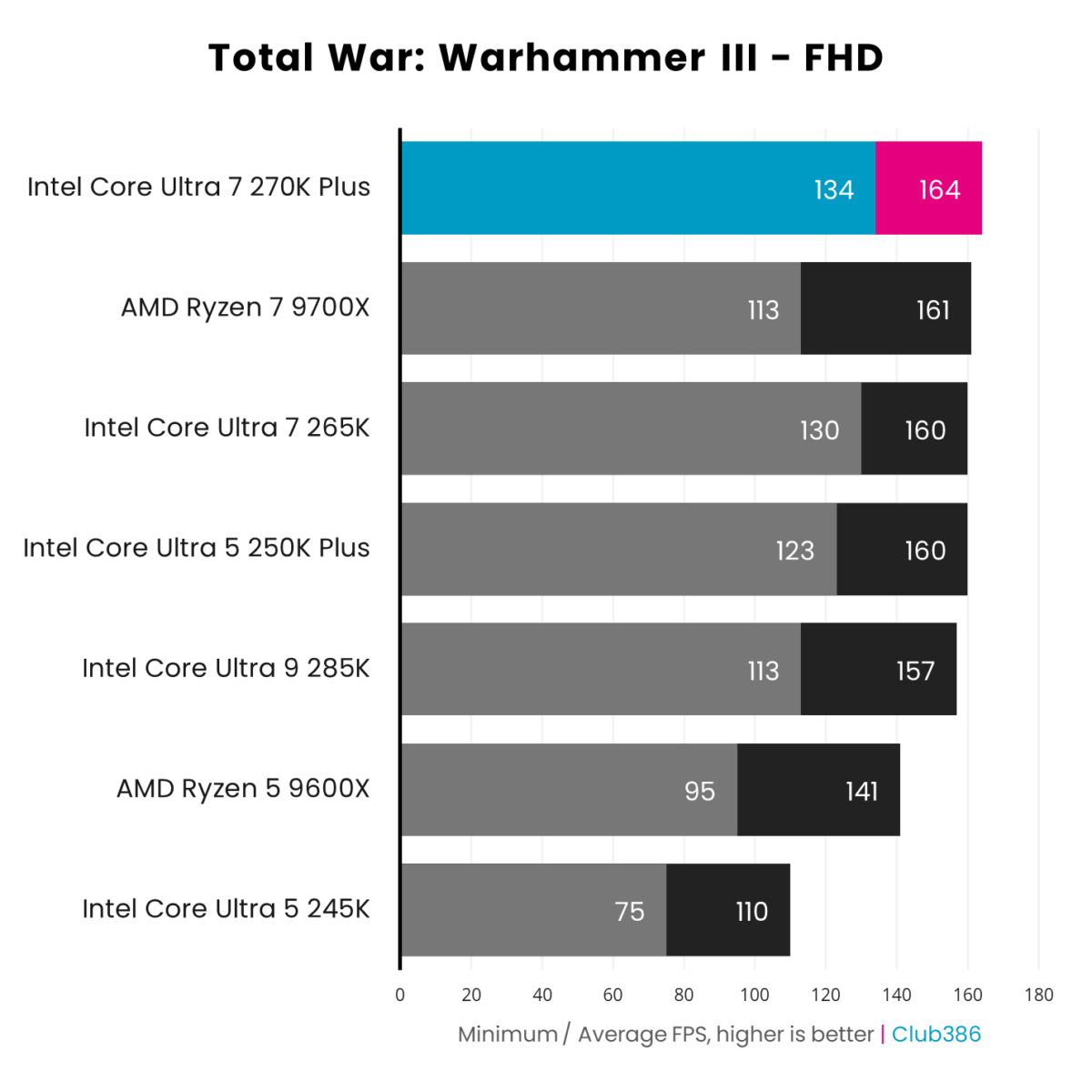
The computational battleground of Total War: Warhammer III’s Mirrors Madness benchmark sees the Core Ultra 7 270K Plus emerge the overall victor, once again. There’s little difference at the top of the pack here, but there’s no denying 270K Plus delivers excellent results at $299.
Power and Temperature
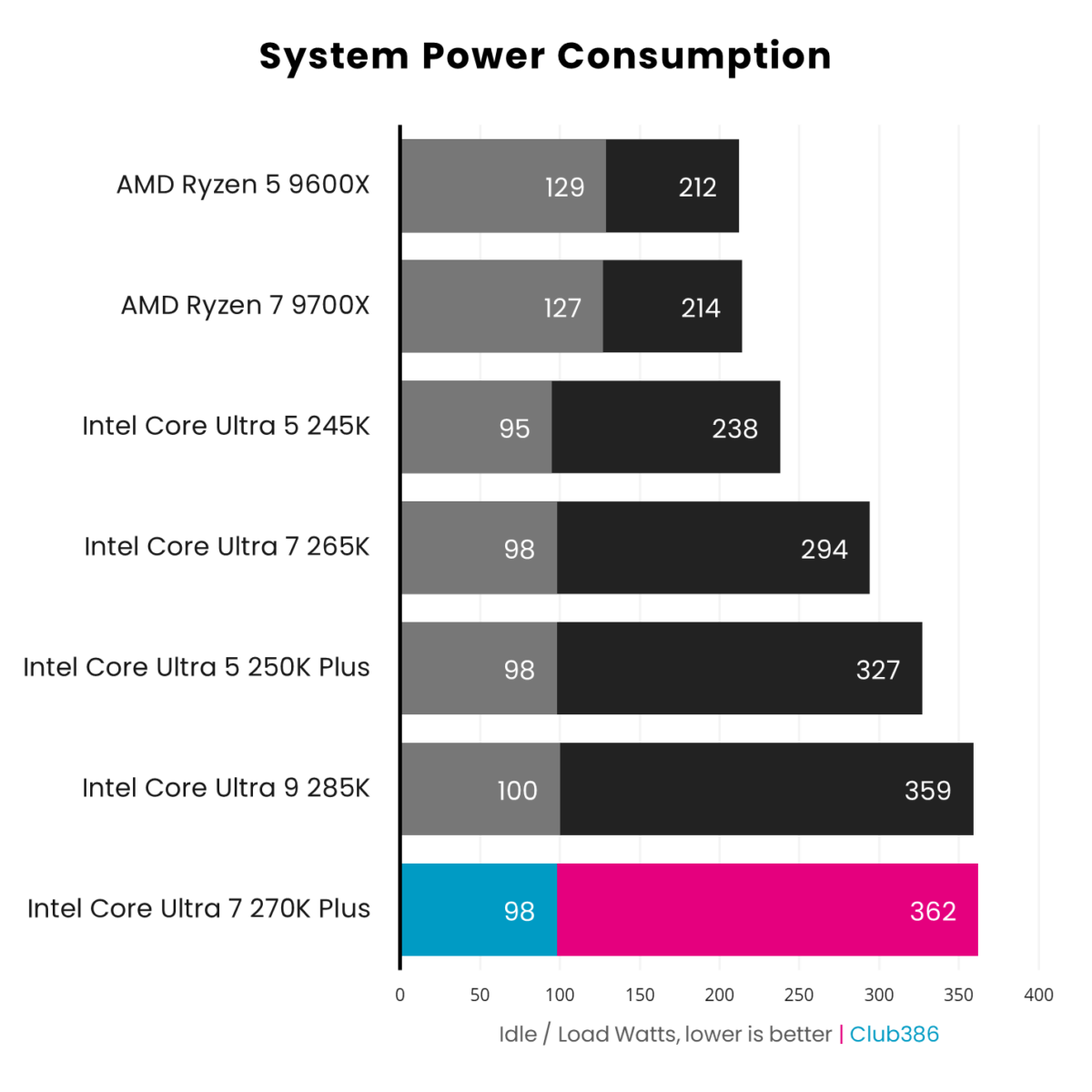
125W base power remains consistent across all the Core Ultra 200S processors, with the Ultra 7 and 9 chips able to boost up to 250W while Ultra 5 models cap out at 159W. Lofty core counts and high operating frequencies naturally lead to heightened power consumption, with Intel’s two 24-thread beasties expectedly proving thirsty.
Thankfully, the Core Ultra 7 270K Plus practically mirrors the Core Ultra 9 285K’s appetite for electricity with a 362W peak. While this does make Intel’s chips more power hungry than AMD’s, the extra watts are reflected in far superior multi-core performance.
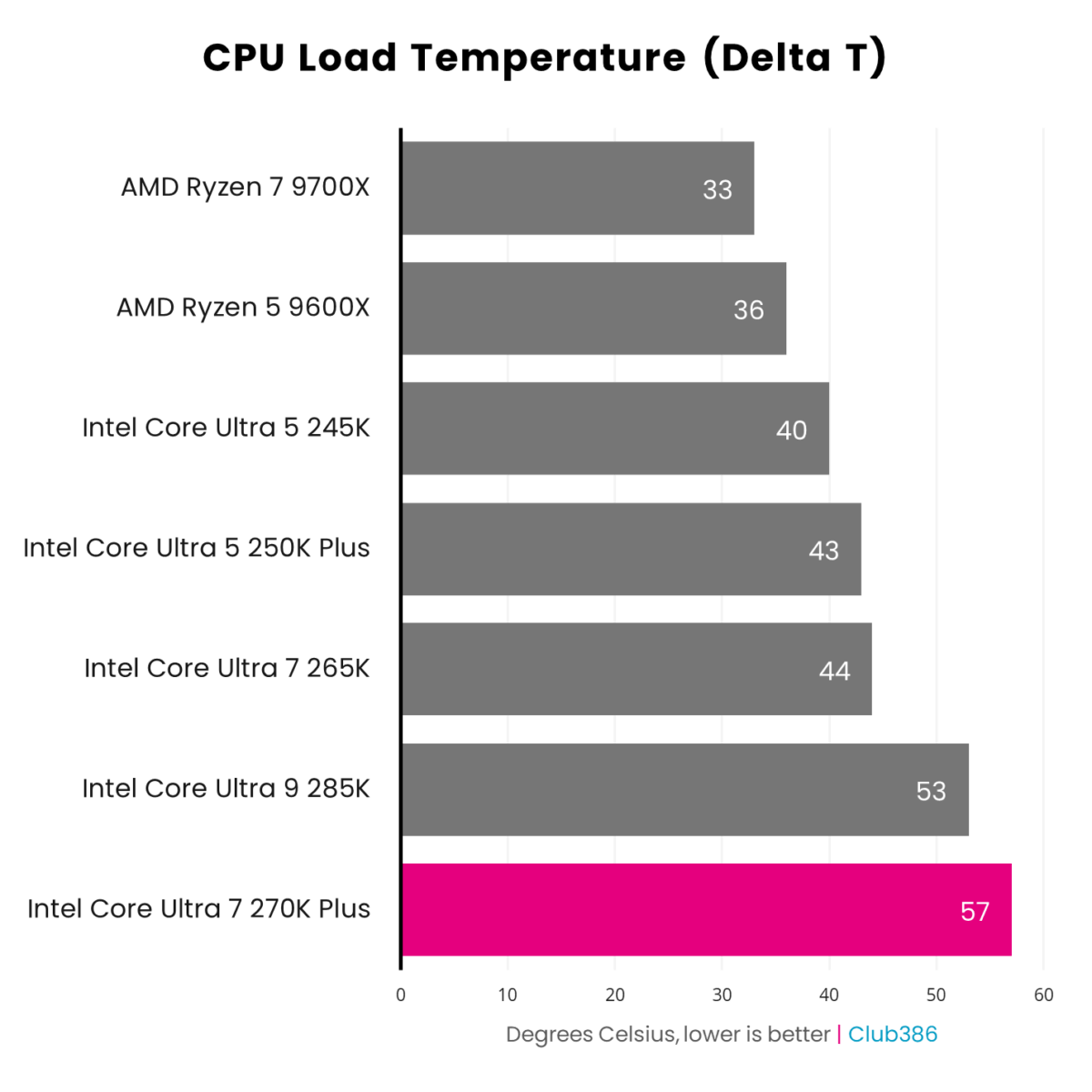
As power consumption rises, so do operating temperatures. Subtracting the ambient temperature of my testing room provides the Delta T values in the chart above, with the Core Ultra 7 270K Plus clocking in at a toasty 57°C. As a reminder, this is with a high-end 420mm AIO water cooler, so you’ll want to pair this CPU with relatively competent cooling to keep thermals in check.
Unsurprisingly, the Ryzen 7 9700X (33°C) and Ryzen 5 9600X (36°C) are much cooler thanks to their lower power draw. They’ll require comparatively less robust coolers, but won’t provide as much processing power in demanding multi-threaded tasks.
Value Ratings
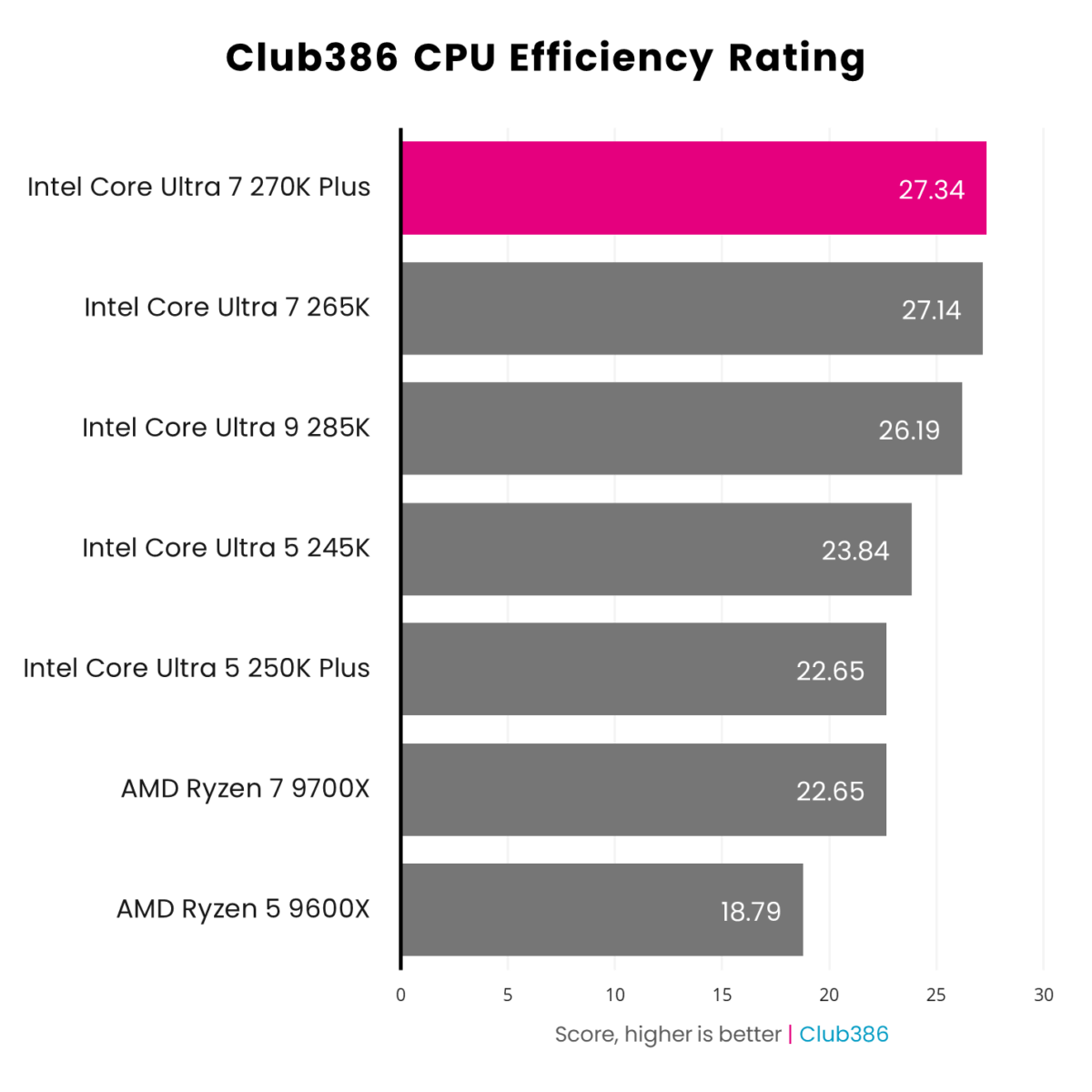
Looking at power draw another way, dividing each processor’s Cinebench 2026 multi-thread score by its respective system power consumption provides us with the Club386 CPU Efficiency rating. In doing so, the Core Ultra 7 285K scores 27.34 (9,896/362) and comes out the most efficient on the chart.
This doesn’t mark a radical departure from the Core Ultra 7 265K (27.14), but that’s no bad thing as it demonstrates performance is scaling in a linear fashion with power on the 270K Plus. Meanwhile the Ryzen 7 9700X returns a score of 22.65, matching the 250K Plus on the lower-end of the efficiency scale.
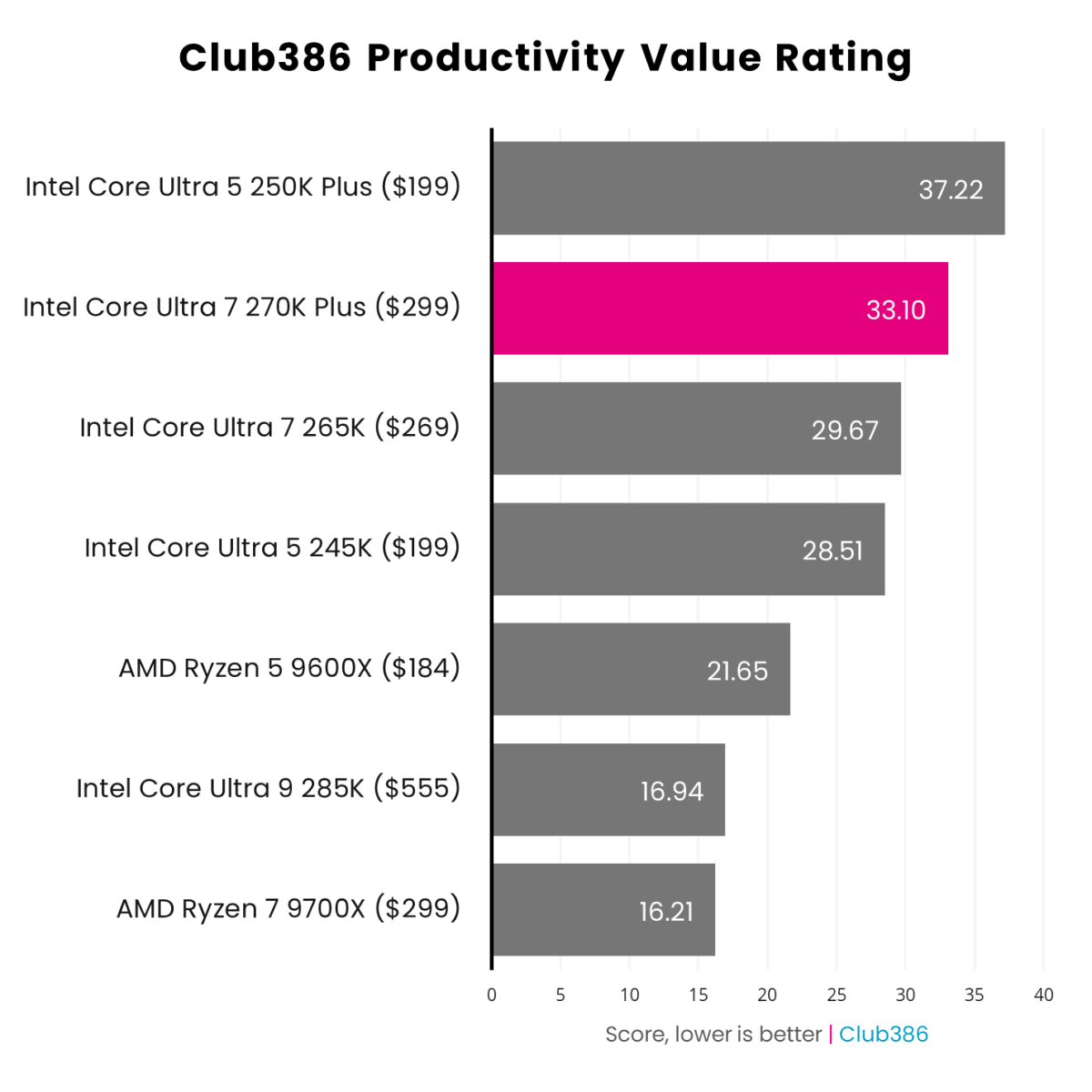
I particularly recommend the 270K Plus to anyone that needs their gaming rig to double as a workstation. Dividing the CPU’s Cinebench multiple thread score by its price ($299), we arrive at the Club386 Productivity Value Rating, where Intel’s new offering comes out well ahead of its AMD rivals. Proof that product positioning is key; with a few helpful tweaks and a radically improved price point, Core Ultra 270K Plus offers almost 2x the productivity value of Intel’s hapless 285K.
Conclusion
The multi-core performance this $299 chip offers blows its rivals out of the water, with great single-thread chops to boot.
Any pre-conception that Intel is treading water with Arrow Lake Refresh couldn’t be further from the truth, as the Core Ultra 7 270K Plus transforms the LGA1851 platform from a recalibrating exercise into a worthy competitor for AM5. The multi-core performance this $299 chip offers blows its rivals out of the water, with great single-thread chops to boot.
Concerns of platform longevity remain, though, as Intel seems intent on moving to a new socket come the release of Nova Lake later this year. While this may understandably put off some DIY builders, those that prefer purchasing complete PCs from system integrators shouldn’t think twice about going with the 270K Plus over the Ryzen 7 9700X if both are available at a similar price.
Enthusiast gamers may wish to consider AMD’s 3D V-Cache chips over the 270K Plus, namely the Ryzen 5 7600X3D ($249) and Ryzen 7 7800X3D ($384). The Intel chip will run laps around these alternatives in multi-core workloads, with the company claiming an 87% average advantage over even the Ryzen 7 9800X3D in this regard. In terms of frame rates, the brand says the CPU is ~12% behind the dearer 9800X3D, a claim I’m keen to explore in further testing.
Spare a thought, also, for anyone who recently purchased a Core Ultra 9 285K for the best part of five hundred pounds. While 270K Plus is a welcome addition, it frames Intel’s current standing in the desktop CPU arena. The company formerly revered as Chipzilla has been forced to sell its flagship wares for $299, and there’s no Core Ultra 9 refresh in the pipeline.
Still, Intel has to start somewhere in recapturing lost market share, and the Core Ultra 7 270K Plus is a pleasant surprise by all accounts, bringing meaningful disruption to the mainstream processor market that’s been missing for years. If nothing else, this release should give AMD food for thought about its multi-core performance in this price sector, particularly as Nova Lake will more than likely push this envelope further. Until then, welcome back to the game, Intel.