
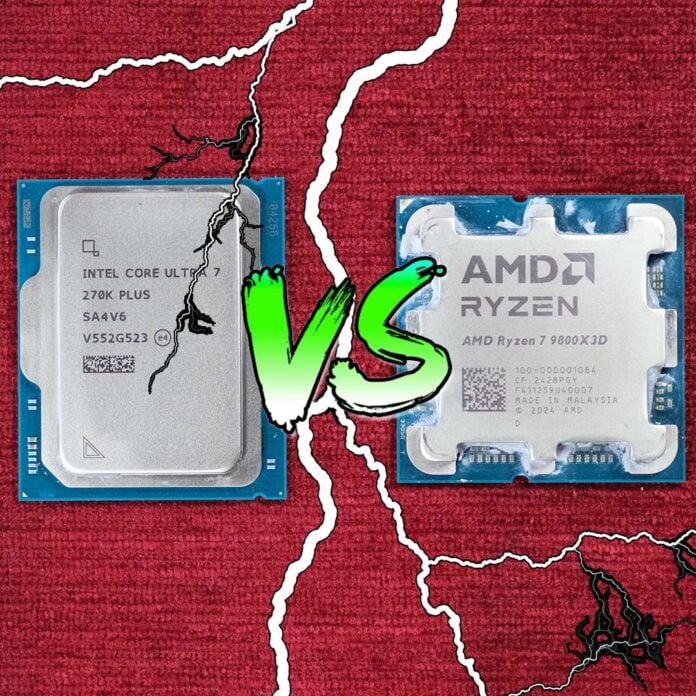
The Core Ultra 7 270K Plus marks a corker of a comeback for Intel, particularly in the realm of productivity, but now it’s time to pit Intel’s new de facto flagship against AMD’s gaming darling, the Ryzen 7 9800X3D. This will be an uphill battle for the Arrow Lake Refresh CPU, as the power of Zen 5 with 3D V-Cache is no trifling opponent, but this is a closer fight than one might think.
In addition to gaming analysis, I’ll also be comparing how the two processors compare in general computing and workstation tasks. You’ll also find analysis of value not found in my initial Core Ultra 7 270K Plus review.
Specifications
Before diving into tech specs, I want to acknowledge the stark price difference between these two processors. The Core Ultra 7 270K Plus arrives with an MSRP of $299, while the Ryzen 7 9800X3D debuted at $479 but is now available for ~$420 at the time of writing.
Pitting these two chips against one another given the 50% difference in MSRP may seem strange, but doing so provides insight into how AMD and Intel’s very best gaming chips compare. Moreover, we can examine how much more performance you’re getting by spending that extra $150.
| Core Ultra 7 270K Plus | Ryzen 7 9800X3D | Ratio | |
|---|---|---|---|
| Release date | March 2026 | November 2024 | – |
| Platform | LGA1851 | AM5 | – |
| Architecture | Arrow Lake Refresh | Zen 5 | – |
| Cores | 24 (8P+16E) | 8 | 3.00 |
| Threads | 24 | 16 | 1.50 |
| TDP | 250W | 120W | 2.08 |
| L2 cache | 40MB | 8MB | 5.00 |
| L3 cache | 36MB | 96MB | 0.38 |
| Base clock | P-core: 3.7GHz E-core: 3.2GHz | 4.7GHz | 0.79 / 0.68 |
| Boost clock | P-core: 5.5GHz E-core: 4.7GHz | 5.2GHz | 1.06 / 0.90 |
| Launch MSRP | $299 | $479 | 0.62 |
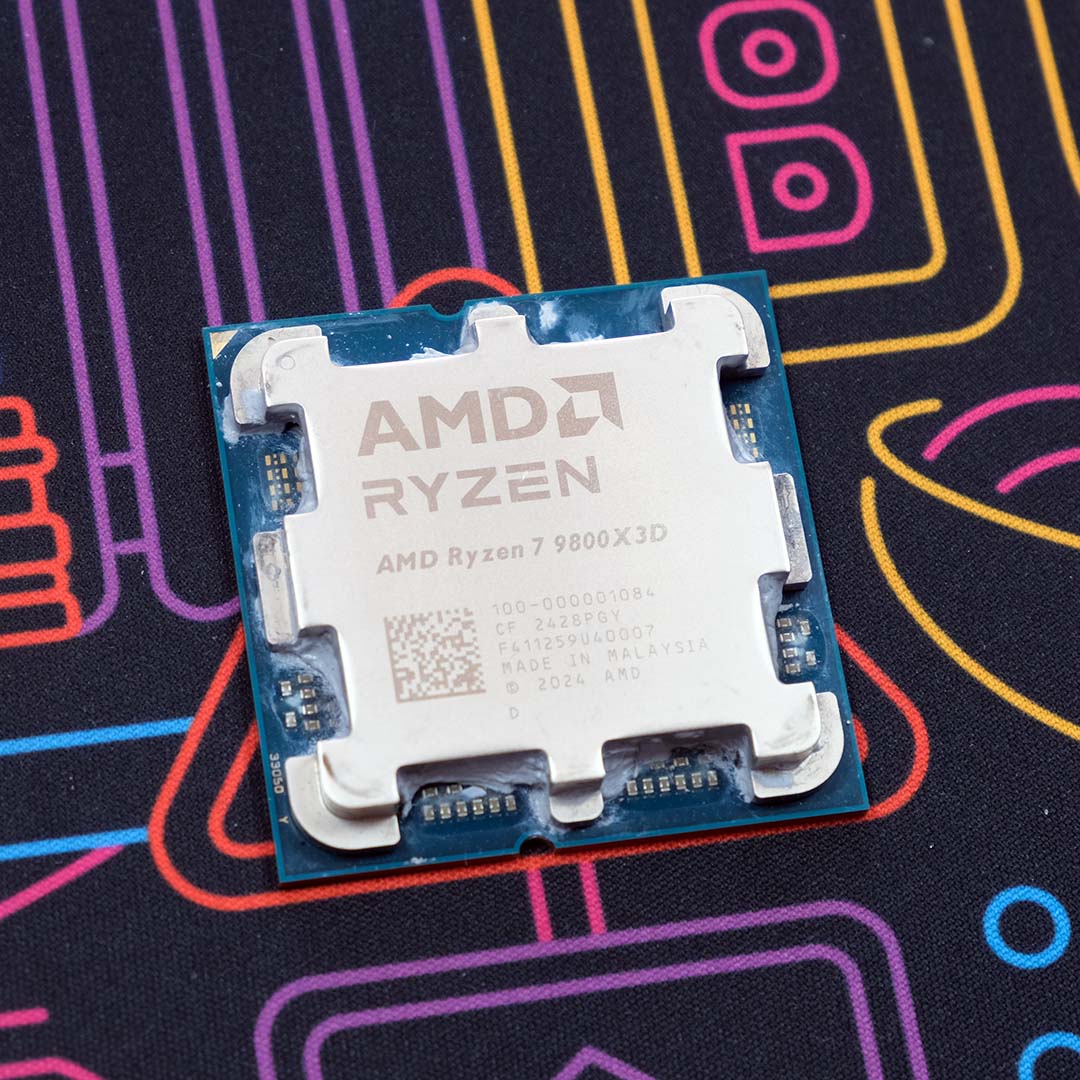
So, what’s under the hood? In the red corner, the 9800X3D comes loaded with eight Zen 5 cores. Meanwhile, in the blue corner, the 270K Plus brings a total of 24 cores to the table, made up of eight P-cores focused on performance, and 16 E-cores optimised for power efficiency.
A lack of hyper-threading means the 270K’s thread count mirrors its core count at 24. Contrastingly, AMD’s current generation CPUs continue to offer simultaneous multithreading, giving the 9800X3D a total of 16 cores with which to play.
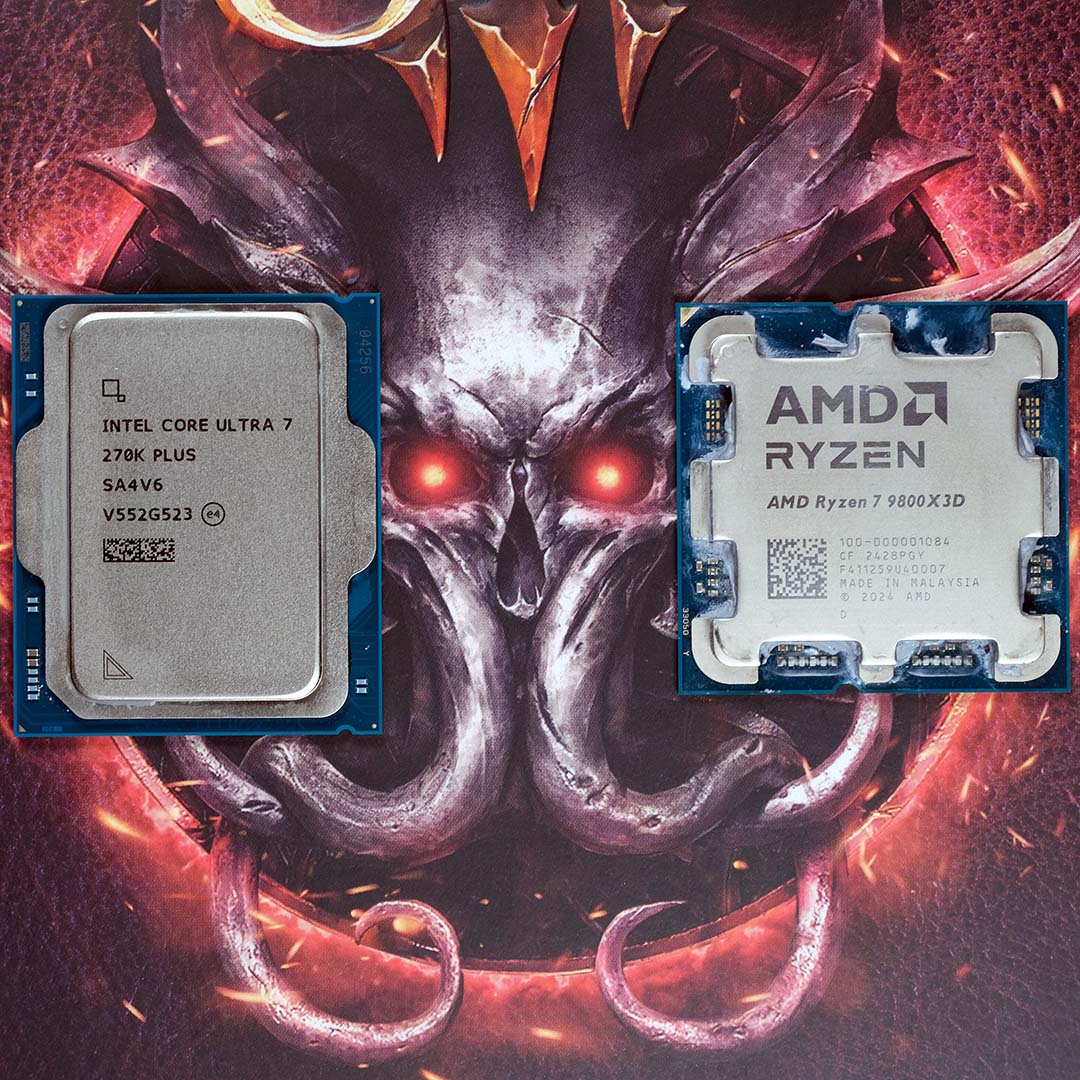
However, it’s L3 cache that plays a large part in separating the 9800X3D from the 270K Plus, and from other non-X3D Zen 5 chips like the Ryzen 7 9700X. A 96MB pool of L3 cache (32MB on-die, plus 64MB 3D V-cache) gives AMD a distinct advantage over the 36MB at the Intel chip’s disposal, meaning it’s less likely to have to page your system memory during gaming, which helps it maintain frame rates.
Rocking a 250W TDP, the 270K Plus has more than double the power budget of the 120W 9800X3D. More watts don’t necessarily beget more performance, of course – the proof is in the benchmarks.
Finally, Intel has a slight lead in terms of boost clock speeds. While the 9800X3D can run up to 5.2GHz, the 270K Plus enjoys a 300MHz advantage and will boost up to 5.5GHz if thermal headroom allows.
Test methodology
Our CPU test suite gives the Core Ultra 7 270K Plus and Ryzen 7 9800X3D plenty of room to show off their performance across gaming and productivity workloads. When benchmarking games, I capture frame rates at 1080p, using ‘High’ settings without upscaling where possible, to place reasonable performance pressure on the processor.
To make this as fair a fight as possible, I’m using the same chassis, cooler, storage, and power supply in both our AM5 and LGA1851 test benches. My choice of graphics card is a GeForce RTX 5090 Founders Edition, so we’re rocking as much pixel-pushing power as you could throw at this system.
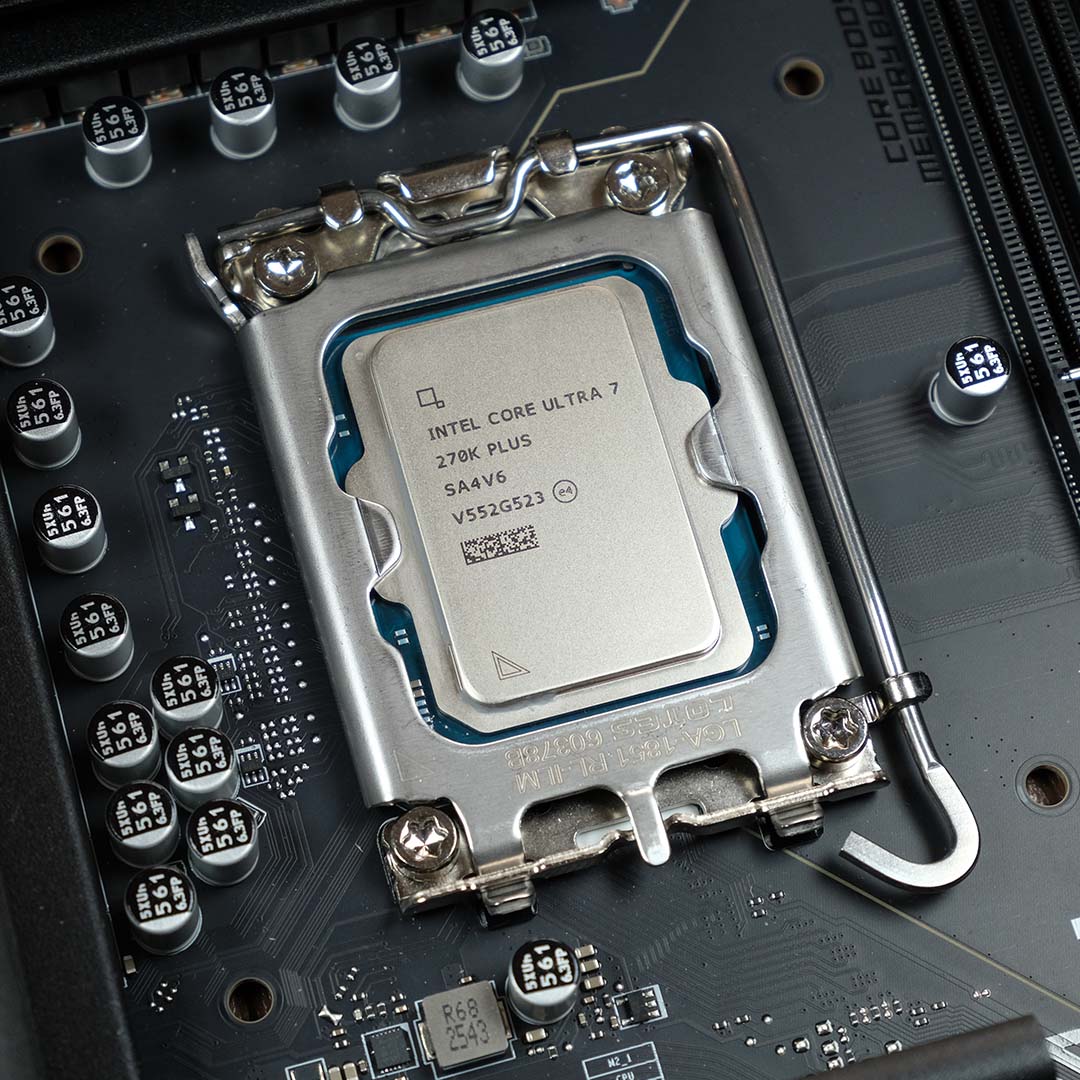
Core Ultra 7 270K Plus test PC
Club386 carefully chooses each component in a test bench to best suit the review at hand. When you view our benchmarks, you’re not just getting an opinion, but the results of rigorous testing carried out using hardware we trust.
Shop Club386 test platform components:
CPU: Intel Core Ultra 7 270K Plus
Cooler: Arctic Liquid Freezer III Pro 420 A-RGB
Motherboard: MSI MAG Z890 Tomahawk WiFi II
GPU: Nvidia GeForce RTX 5090 Founders Edition
Memory: 32GB DDR5-7200 CL34 G.Skill Trident Z5 RGB
Storage: 2TB WD_Black SN8100 NVMe SSD
PSU: 1,200W be quiet! Dark Power 14
Chassis: be quiet! Light Base 900 FX
An MSI MAG Z890 Tomahawk WiFi II motherboard heads up our LGA1851 system, alongside a dual-channel kit of 32GB DDR5-7200 CL34 G.Skill Trident Z5 RGB memory.
Ryzen 7 9800X3D test PC
Club386 carefully chooses each component in a test bench to best suit the review at hand. When you view our benchmarks, you’re not just getting an opinion, but the results of rigorous testing carried out using hardware we trust.
Shop Club386 test platform components:
CPU: AMD Ryzen 7 9800X3D
Cooler: Arctic Liquid Freezer III Pro 420 A-RGB
Motherboard: MSI MEG X870E Ace Max
GPU: Nvidia GeForce RTX 5090 Founders Edition
Memory: 32GB DDR5-6000 CL32 G.Skill Trident Z5 RGB
Storage: 2TB WD_Black SN8100 NVMe SSD
PSU: 1,200W be quiet! Dark Power 14
Chassis: be quiet! Light Base 900 FX
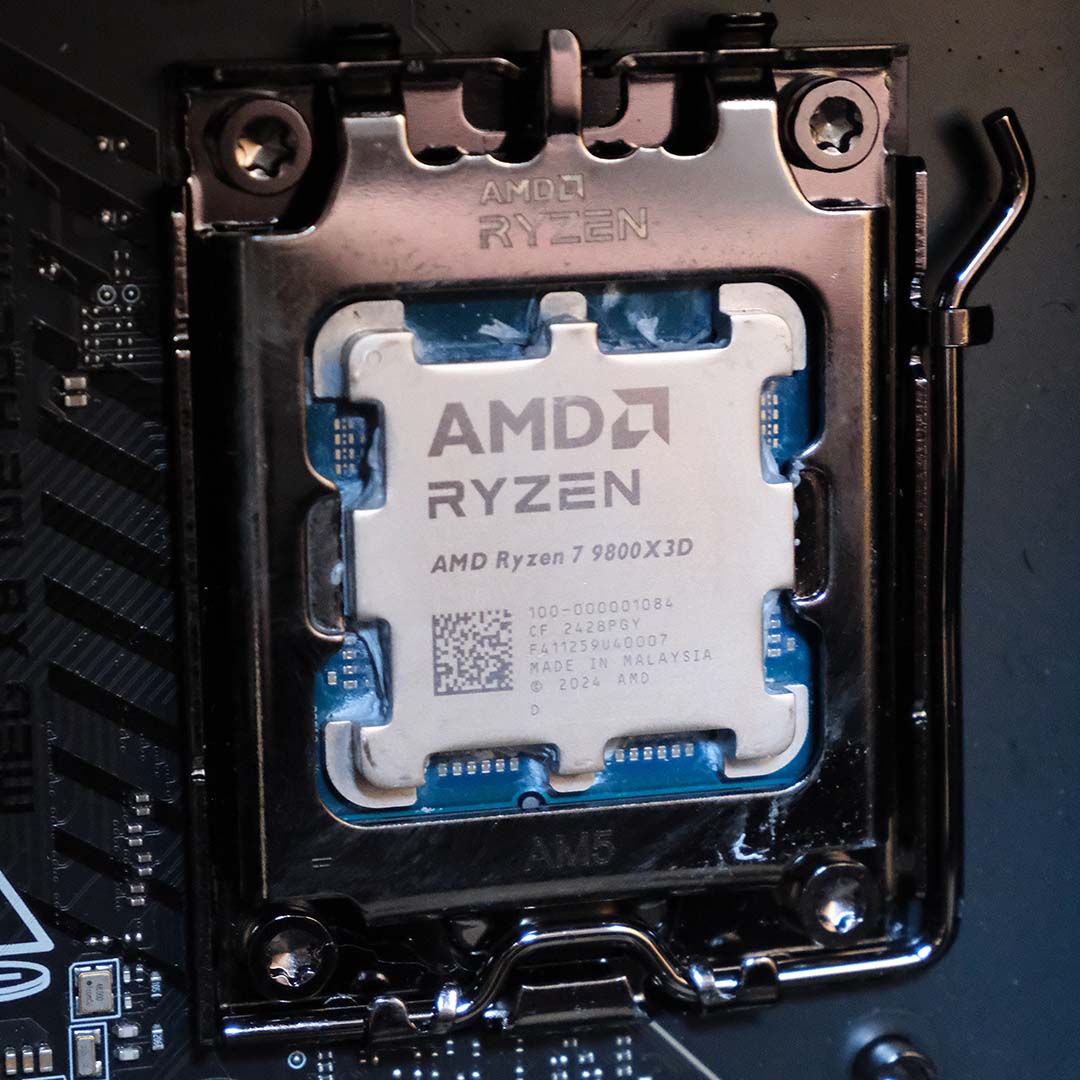
In the other corner, you’ll find an MSI MEG X870E Ace Max motherboard running our AM5 PC, and a dual-channel kit of 32GB DDR5-6000 CL32 G.Skill Trident Z5 Neo RGB RAM.
App performance
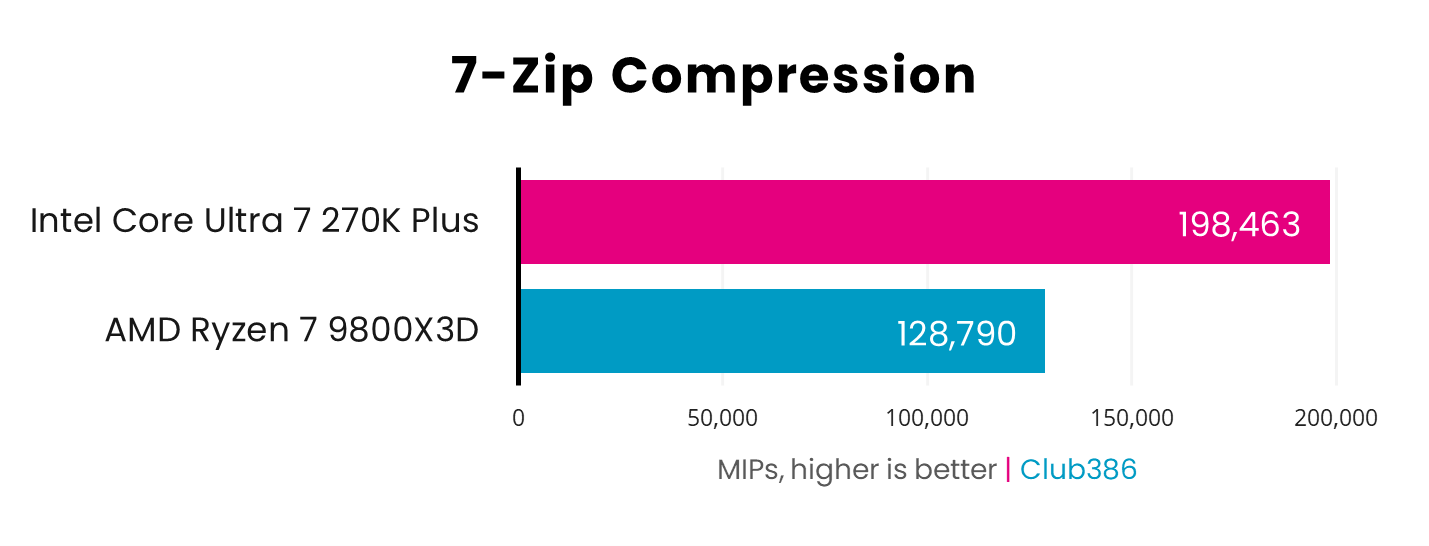
A higher count of cores and threads serves the Core Ultra 7 270K Plus well in our 7-Zip Compression benchmark. The 24-core Intel chip comes out 54% ahead of the 8-core AMD one in this common workload.
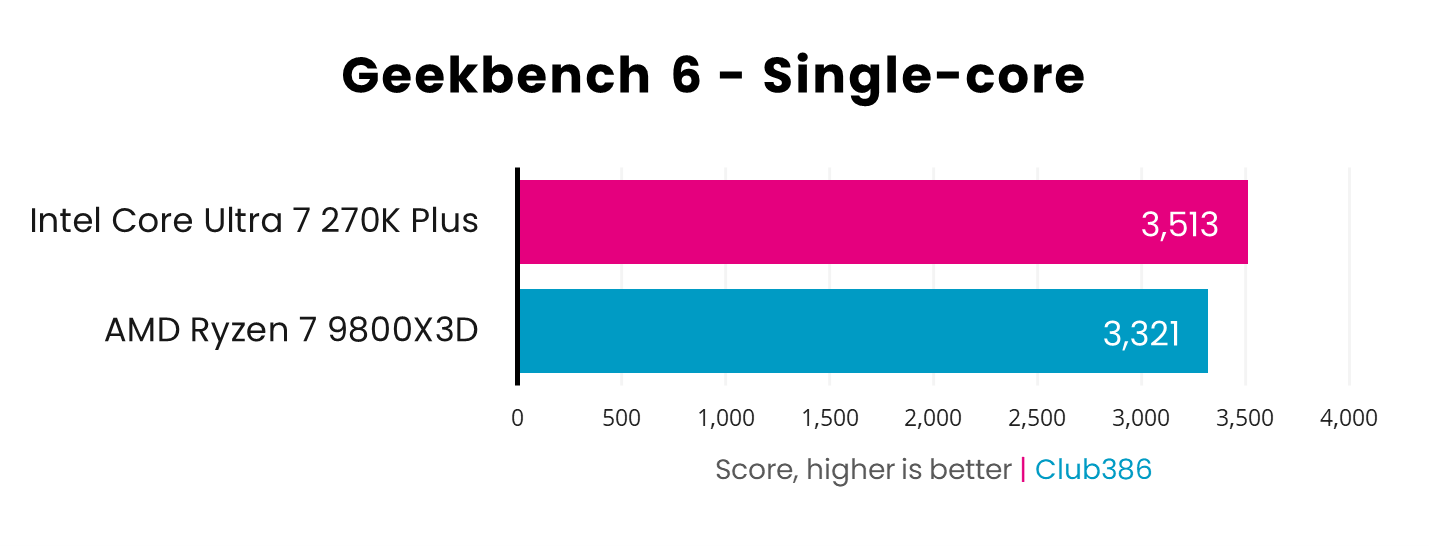
The raw single-core performance crown goes to the Core Ultra 7 270K Plus, but only with a Binary Performance Optimisation profile under its belt. Without this feature enabled, the Intel chip clocks 3,311pts in the Geekbench 6 single-core benchmark – 10pts behind the Ryzen 7 9800X3D.
Note that Primate Labs, the developer of Geekbench, does not consider Binary Performance Optimisation results valid, as per its blog post. I disagree with that assessment, but it’s worth noting regardless.
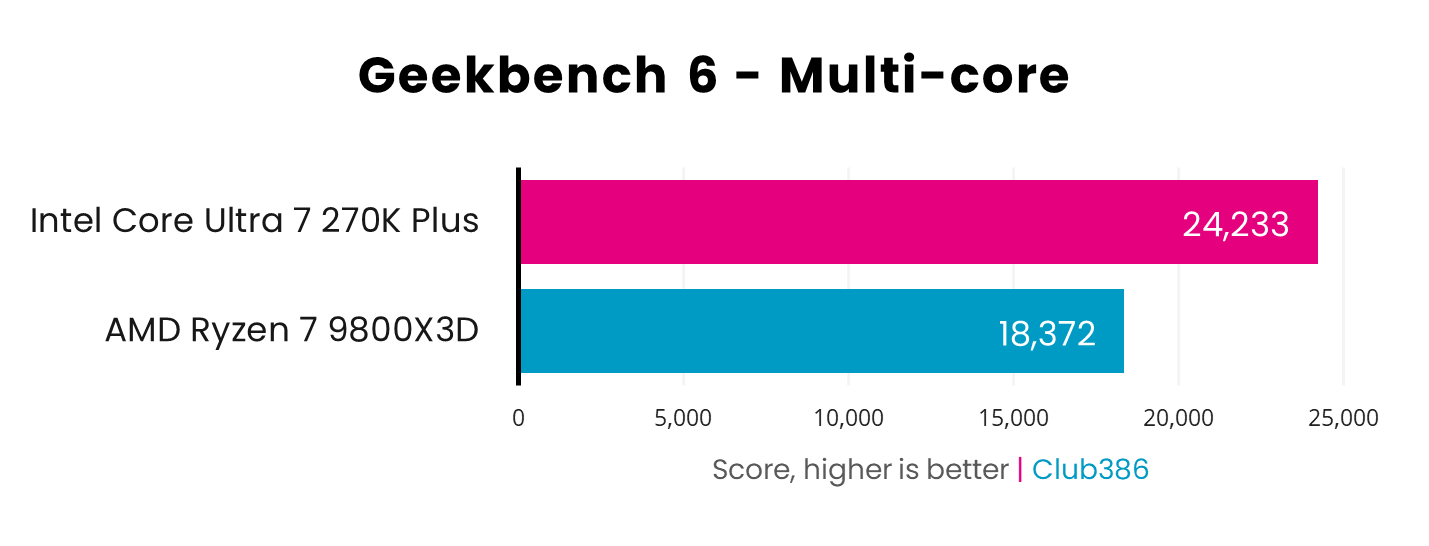
Stepping up to the Geekbench 6 Multi-core test, Intel’s Core Ultra 7 270K Plus enjoys a confident 32% lead with Binary Performance Optimisation providing a small boost. Intel is far ahead in this bout even without the tool, scoring 23,268pts out of the box – that’s 27% quicker than the Ryzen 7 9800X3D.
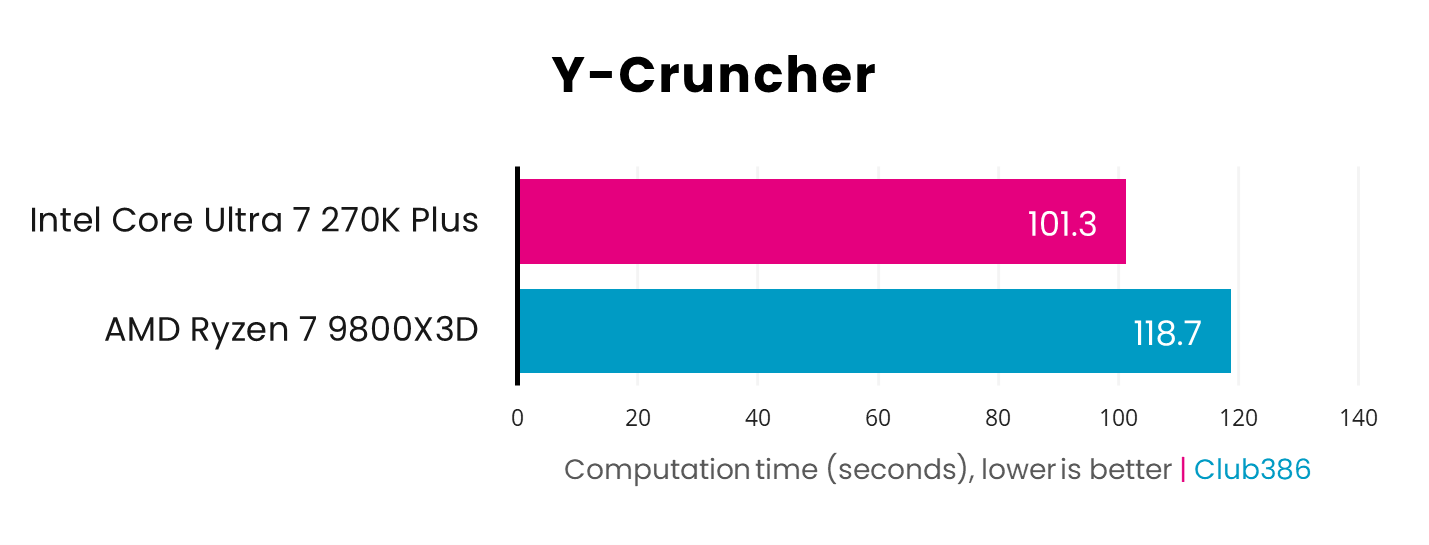
If time is money, the Core Ultra 7 270K Plus could save data scientists some cash. Crunching Pi to 5B digits takes the chip 101.3 seconds. That’s 15% faster than the Ryzen 7 9800X3D, which takes a still-respectable 118.7s.
Content creation
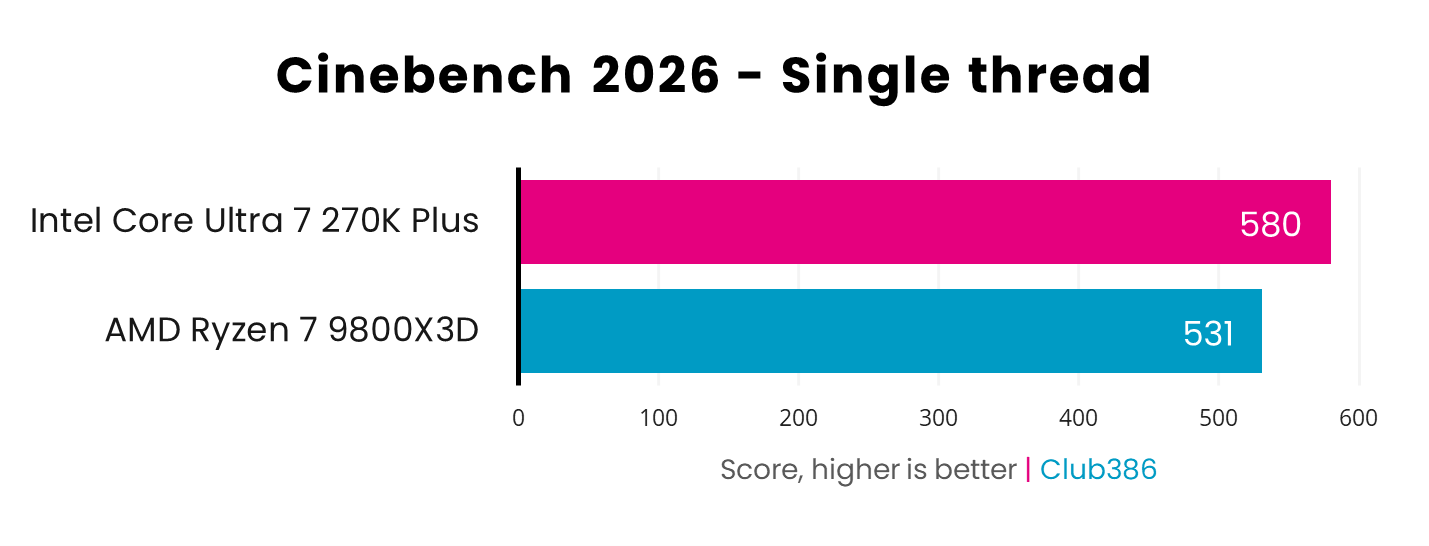
Rendering the Cinebench 2026 test scene with a single thread, the Core Ultra 7 270K Plus comes out ahead of the Ryzen 7 9800X3D with a 9% lead.
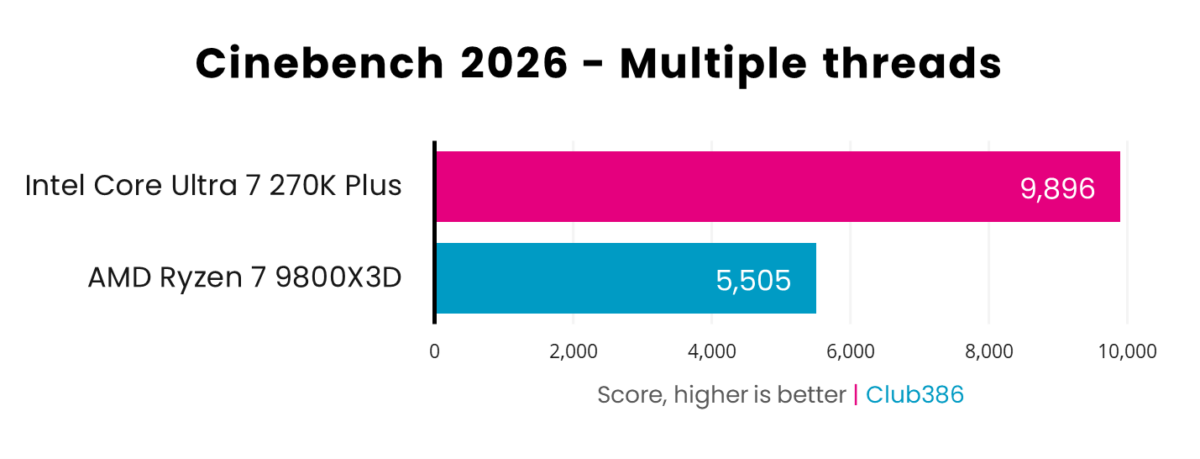
Tackling the same scene with multiple threads, the Core Ultra 7 270K Plus comes out the clear winner. The Intel chip’s score is a whopping 80% higher than the 9800X3D in this head-to-head, thanks to all those cores.
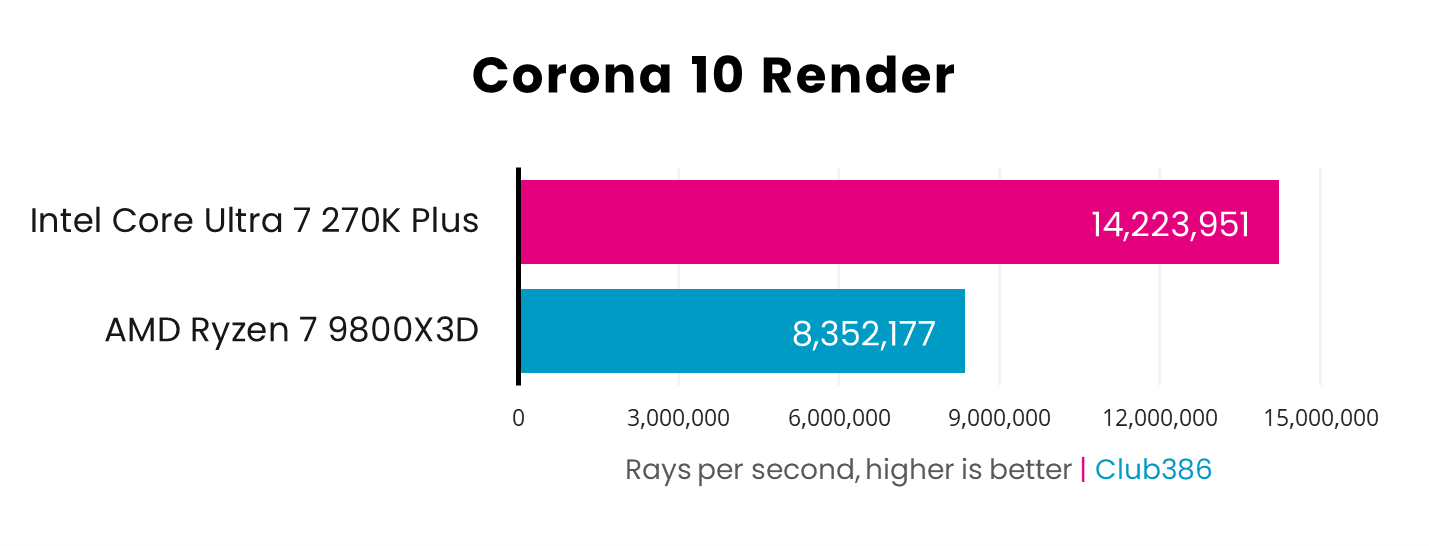
Another multi-core rendering workload, another clear win for the Core Ultra 7 270K Plus. With a 70% lead over the Ryzen 7 9800X3D, this Intel chip is the preferred choice for these types of workloads.
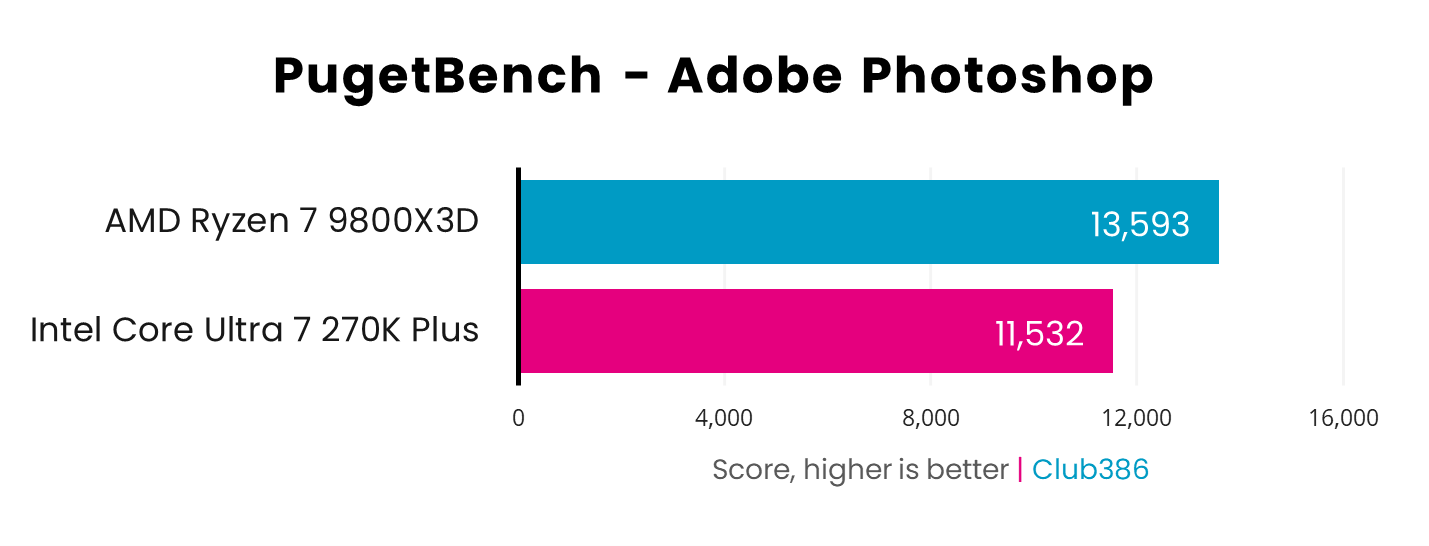
Intel takes the victory in all but one of our productivity benchmarks, namely Adobe Photoshop. This application runs better on all Zen 5 processors we’ve tested, relative to Arrow Lake (Refresh), and 9800X3D enjoys an 18% score advantage.
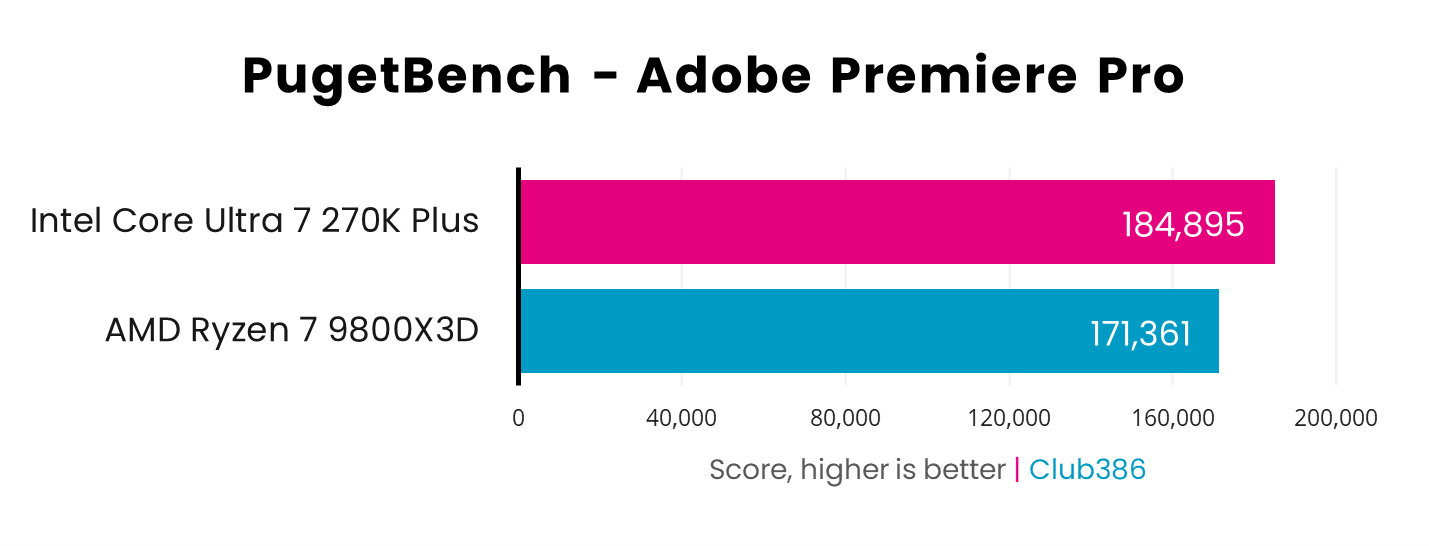
Switching to another program in the Adobe suite, Premiere Pro, the Intel chip emerges victorious over the 9800X3D once again. The Core Ultra 7 270K Plus pulls 8% ahead of the 8-core AMD chip.
Gaming
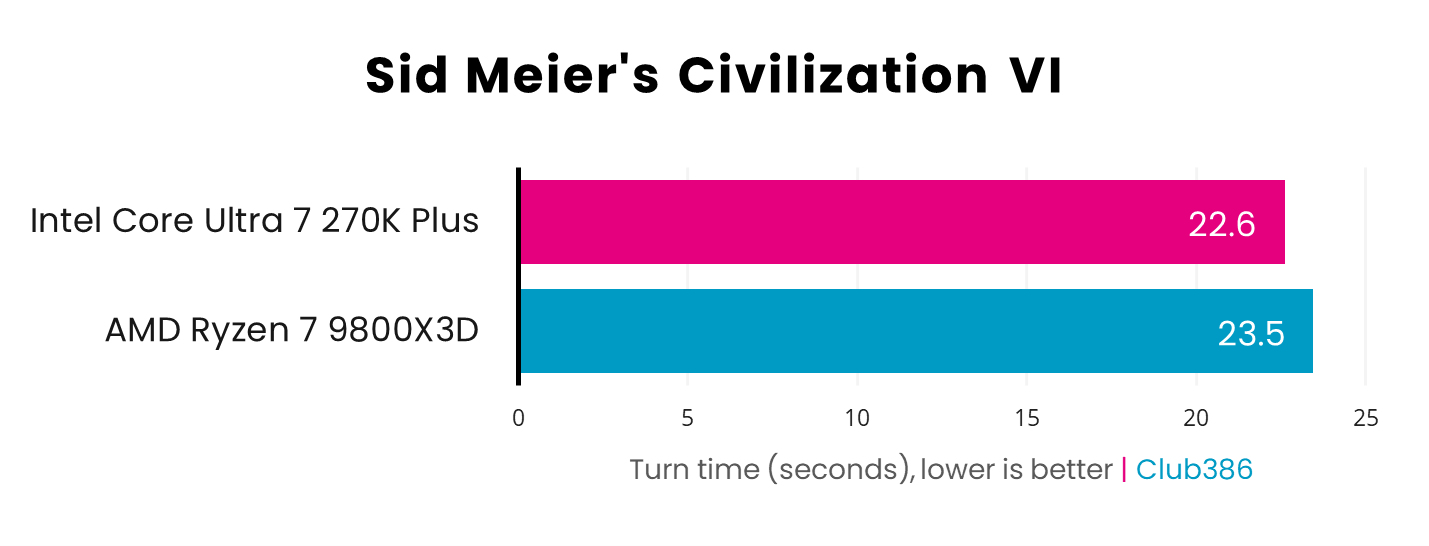
While the Ryzen 7 9800X3D is an excellent gaming processor by any stretch, the chip’s large pool of L3 cache doesn’t prove advantageous in Sid Meier’s Civilization VI. Instead, the Core Ultra 7 270K Plus comes out on top, albeit by less then a second.
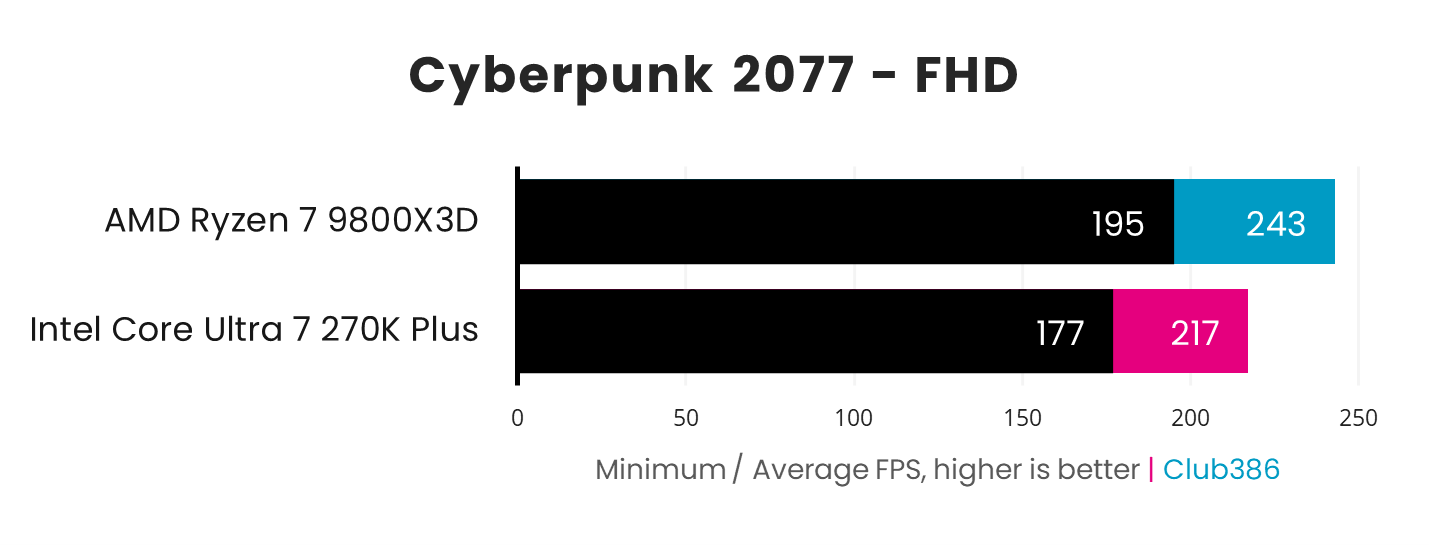
Swapping turn timers for frame rates, the Ryzen 7 9800X3D’s reputation precedes it as a supremely fast gaming processor. The 9800X3D is 10-12% ahead of the 270K Plus here across minimum and average frame rates, even with the latter receiving a leg up from Binary Performance Optimisation.
While the 9800X3D is faster, greater value lies with the 270K Plus. More specifically, you can either pay $420 and come out with $1.72 per frame with AMD, while the $299 Intel chip comes in at $1.38 per frame.
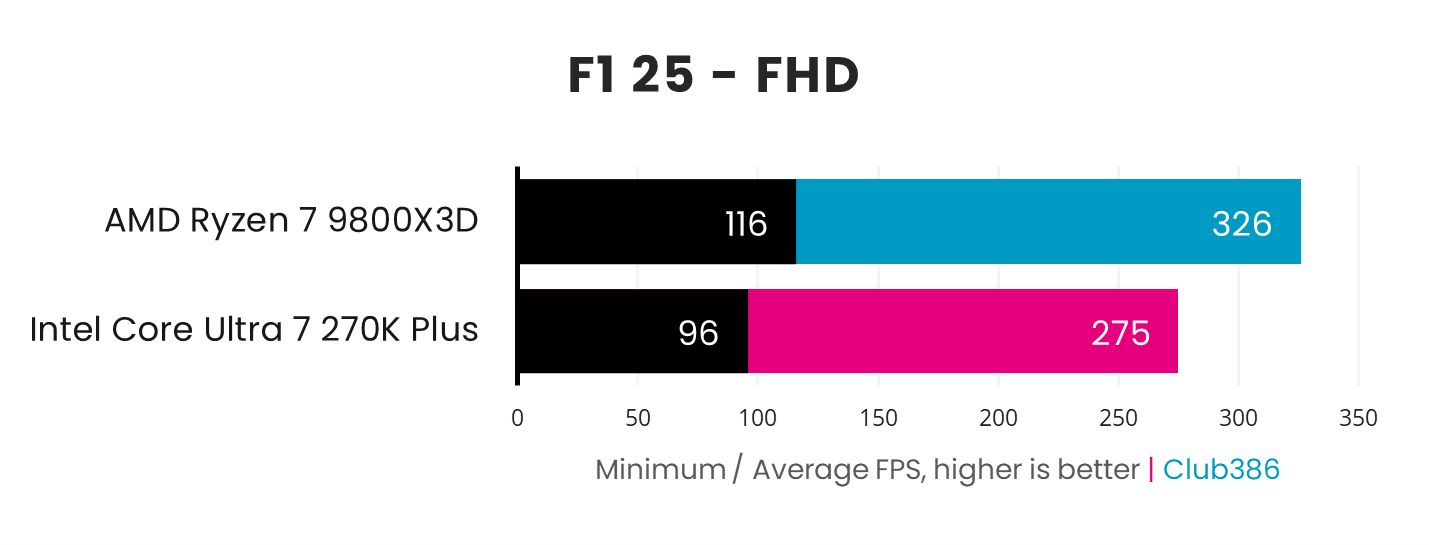
The Ryzen 7 9800X3D races ahead of the Core Ultra 7 270K Plus by 19-21% in F1 25. That’s $1.29 per frame for this AMD chip, but the Intel one offers better value again at $1.09 per frame.
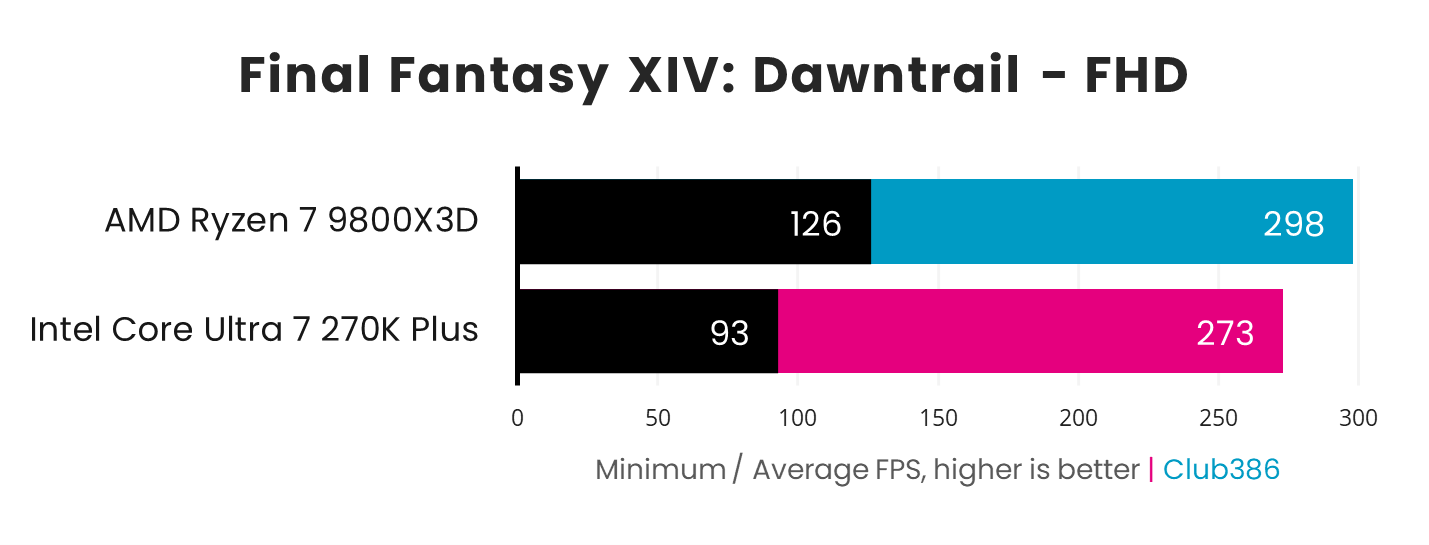
Final Fantasy XIV: Dawntrail sees the Ryzen 7 9800X3D earn another victory, with a 9% advantage in average frame rate, as well as a huge 35% improvement in minimums over the Core Ultra 7 270K Plus. Binary Performance Optimisation does little to aid Intel here.
Continuing with our cost per frame analysis of average performance, the 9800X3D clocks in at $1.41, but the 270K Plus once again makes your cash go further at $1.10.
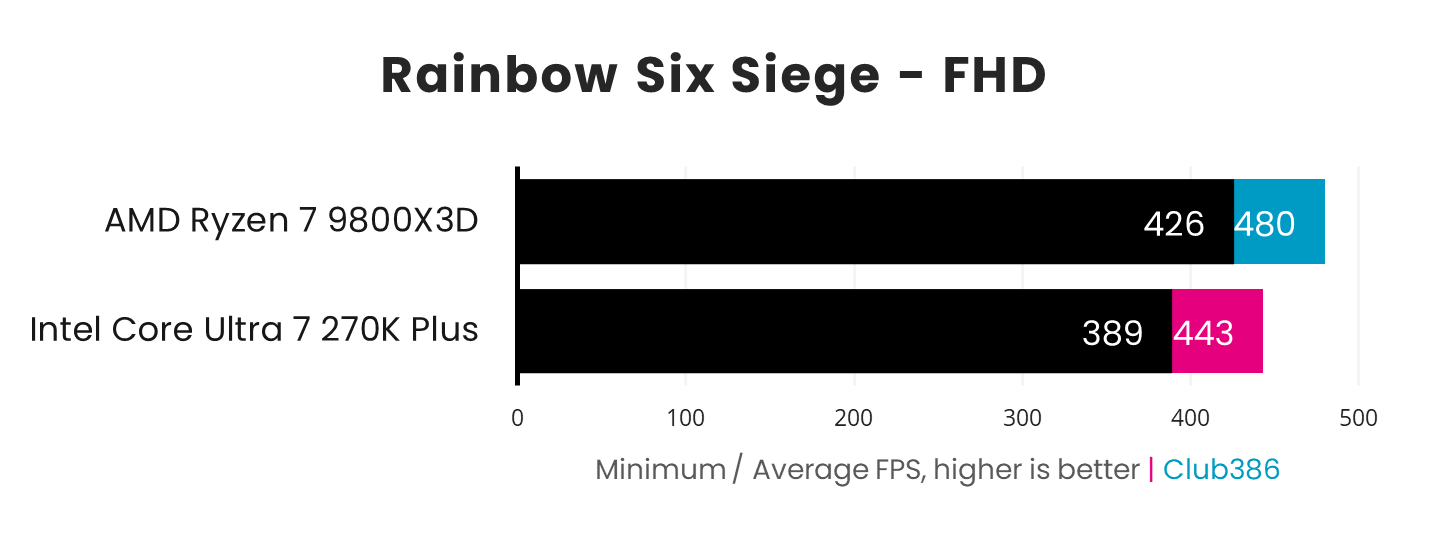
Breaching into Rainbow Six Siege, the Ryzen 7 9800X3D approaches 500fps on average, and is 8-10% faster than the Core Ultra 7 270K Plus.
Looking at the results with an eye towards value, Intel is once again the better buy at $0.67 per frame, while AMD comes in at $0.88.
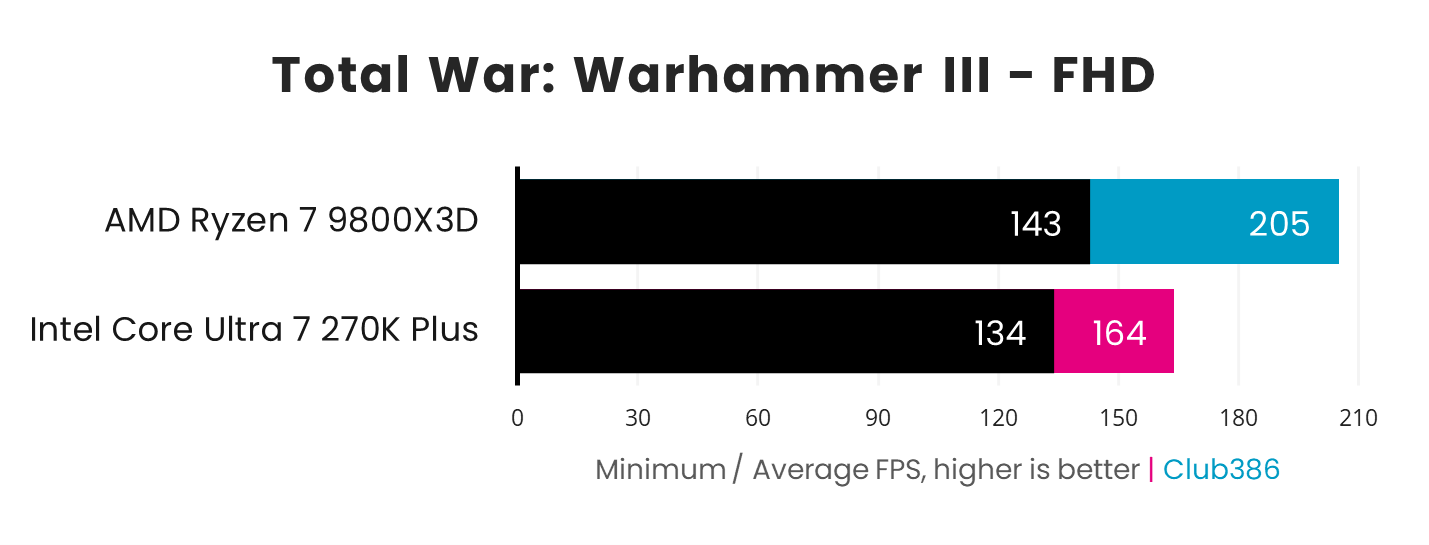
Closing out our frame rate head-to-heads, the Ryzen 7 9800X3D takes another win in Total: War Warhammer III. This is a ferocious beating of the Core Ultra 7 270K Plus, with 25% faster average performance.
However, cost per dollar still puts the 270K Plus Intel ahead of the 9800X3D. Each frame costs $2.04 on the 9800X3D, while the 270K Plus comes in cheaper at $1.82.
Power and temperatures
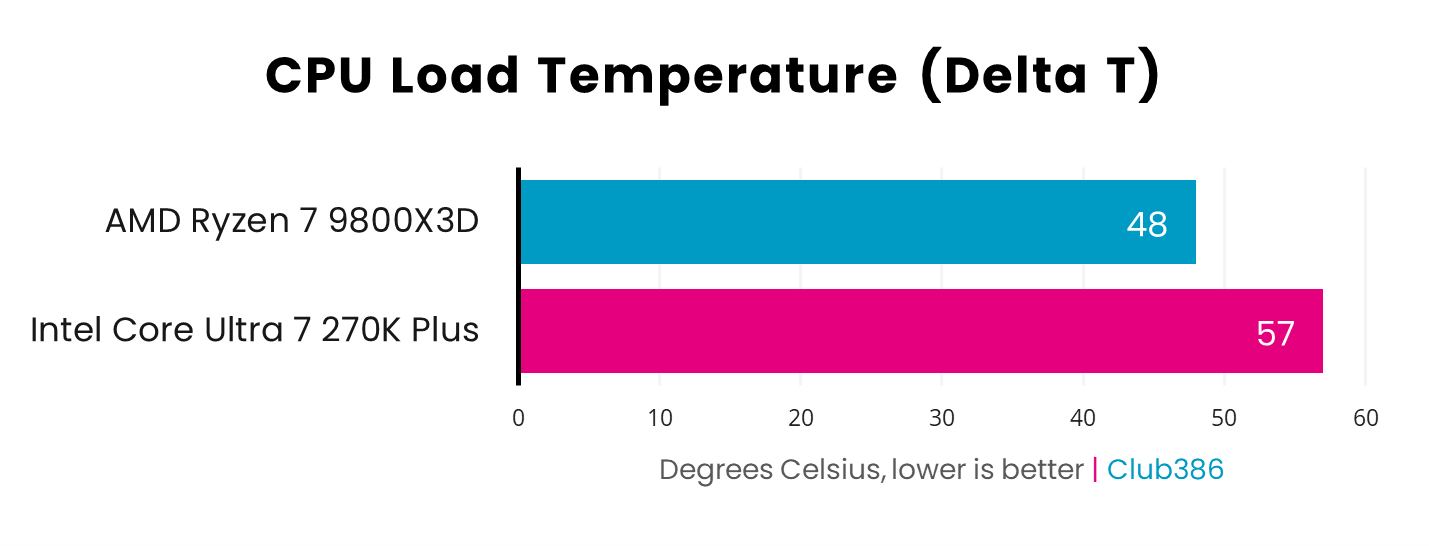
A higher TDP naturally inclines the Core Ultra 7 270K Plus (250W) to run hotter than the Ryzen 7 9800X3D (120W). It comes as no surprise that the Intel CPU runs 9°C hotter under a Cinebench 2026 multi-core load, meaning the chip will require slightly better cooling than AMD’s contender, but not drastically so.
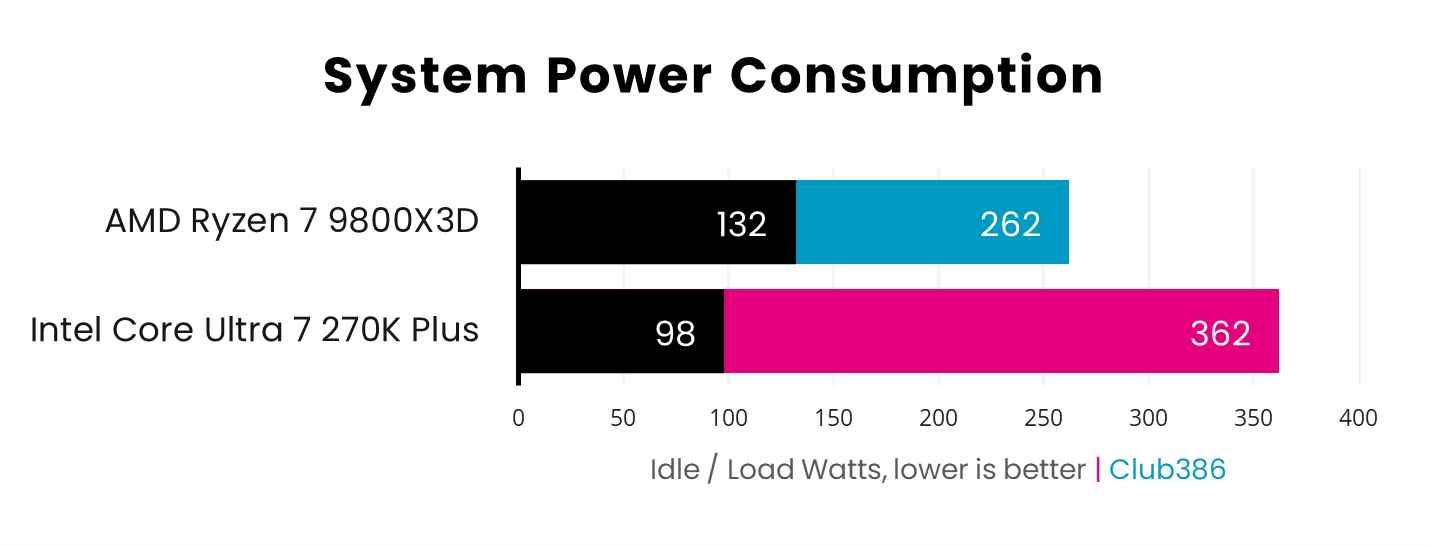
That 120W TDP keeps Ryzen 7 9800X3D system power consumption at a relatively low 262W compared to the 362W that the Core Ultra 7 270K Plus pulls from the wall. That’s a 38% increase by going from this AMD chip to the Intel 270K Plus.
Value ratings
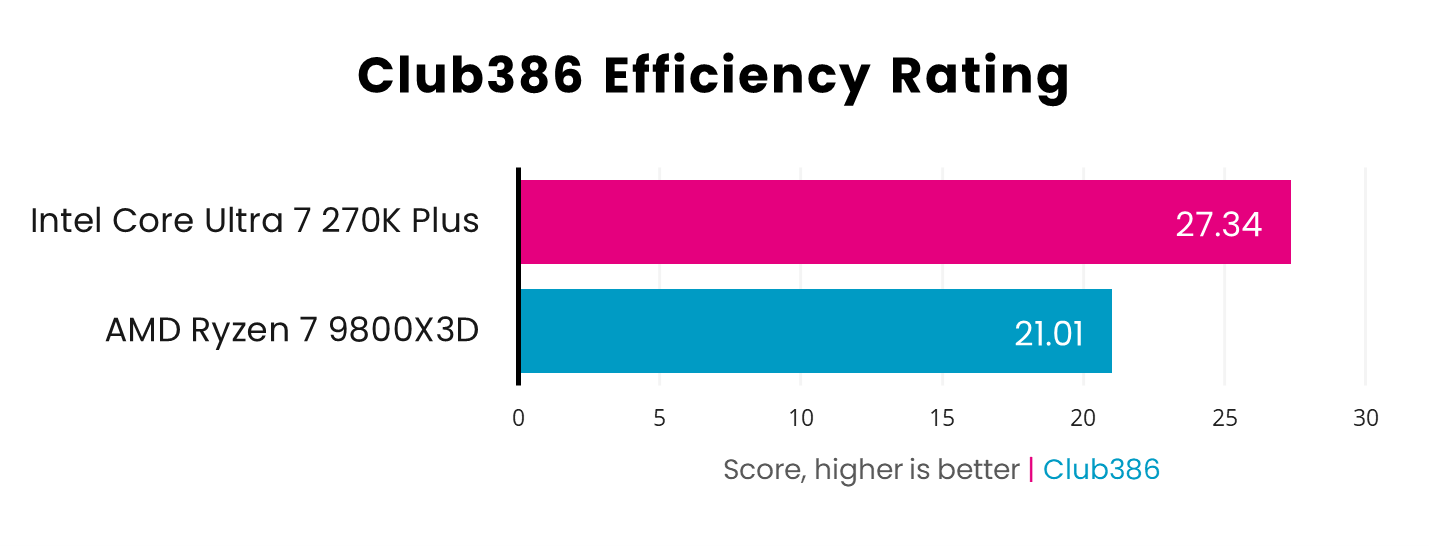
Of course, what matters most is how each chip puts its power budget to use. Taking respective Cinebench scores and dividing them by power consumption, we arrive at our efficiency ratings. Despite pulling more power outright, the Core Ultra 7 270K Plus emerges as the more efficient CPU at 27.34 (9,896/362) by a clear margin, as the Ryzen 7 9800X3D lags behind at 21.01 (5,505/262).
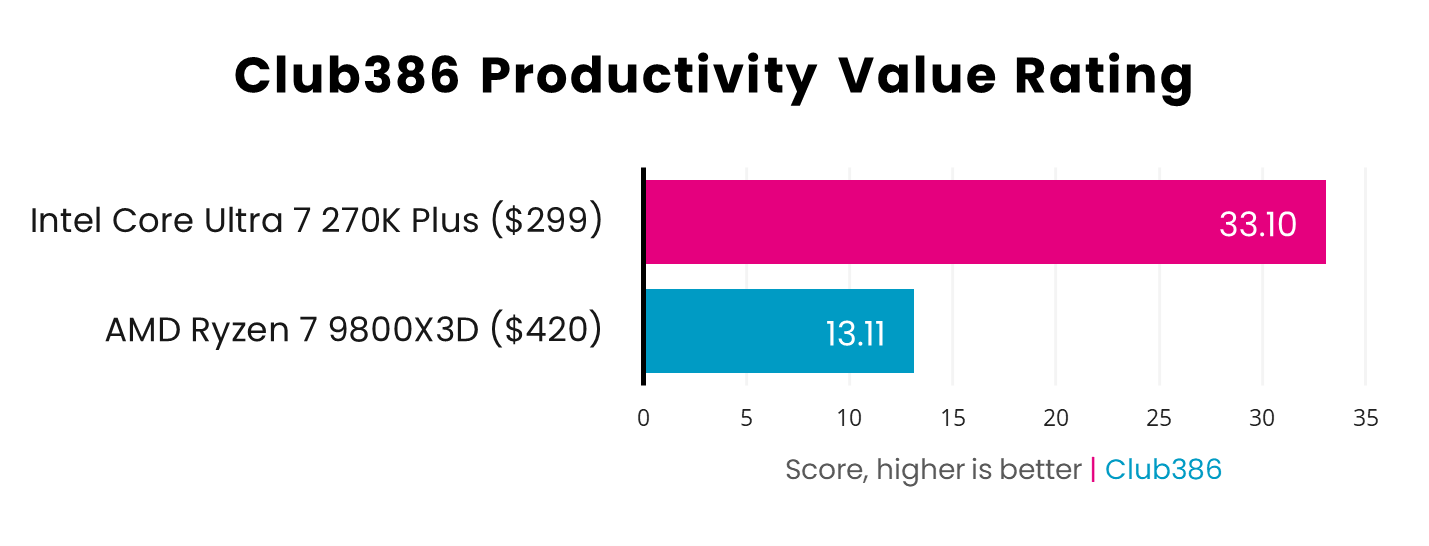
Taking those same Cinebench 2026 scores and dividing by price instead provides our Productivity Value Rating. As the processor with the higher score and lower price, the Core Ultra 7 270K Plus (9,896/299) expectedly clears the Ryzen 7 9800X3D (5,505/420) with a gargantuan 152% advantage.
Conclusion
While the Ryzen 7 9800X3D pushes frame rates to greater heights than the Core Ultra 7 270K Plus, the latter isn’t massively far behind in most cases. Moreover, Intel’s offering doubles as an excellent workstation chip to boot.
Those after the most well-rounded option between these two processors should go with the 270K Plus, without a shadow of doubt. However, if you’ve got cash to spare, and only care about hitting the highest frame rate possible at all times, the 9800X3D is your CPU.

Intel Core Ultra 7 270K Plus
The Core Ultra 7 270K Plus provides solid value for gaming and superb productivity performance for the money. Read our review.
Just don’t forget that building an LGA1851 system with the 270K Plus comes at the cost of sacrificing upgrade potential. We don’t expect new processors to hit this Intel platform now this generation is out, while the 9800X3D can make way for a successor without requiring a change of motherboard.
Additionally, for those of you running flagship PCIe Gen 5 storage, the 270K Plus sadly won’t run your SSD at full speed, owing to an inherent flaw in its design. In my tests, I saw throughput fall by up to ~2,800MB/s in synthetic benchmarks, while the 9800X3D test rig saw no such issue.
AMD Ryzen 7 9800X3D
The Ryzen 7 9800X3D remains an excellent gaming chip for those who want maximum gaming performance above all. Read our review.
If after all that you’re still yearning for more analysis of the latest processors on the market, check out our best CPU guide, where we take you through all the very best options you can buy at a range of budgets.