
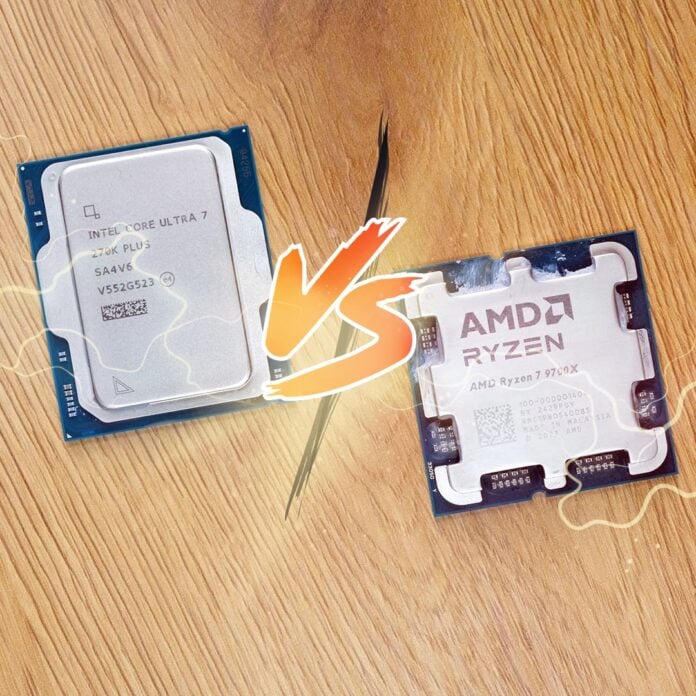
The arrival of Arrow Lake Refresh brings welcome competition to the processor market, as Intel takes the fight to AMD with souped-up chips. This battle of brands is fiercest at the $300 mark, as the Core Ultra 7 270K Plus and Ryzen 7 9700X face off for mid-range CPU supremacy.
Taking fresh data from our 270K Plus review, I’m zoning in on how Intel’s new offering compares specifically with the Ryzen 7 9700X. Below you’ll find analysis of their relative specifications, as well as gaming and workstation performance. Strap in, as this bout makes for quite the spectacle.
Specifications
Comparing processor specifications in a like-for-like fashion across different platforms, let alone manufacturers, is folly in most cases owing to underlying improvements to instructions per cycle (IPC) that don’t manifest on a table. Nonetheless, there are variables that warrant closer examination.
| Core Ultra 7 270K Plus | Ryzen 7 9700X | Ratio | |
|---|---|---|---|
| Release date | March 2026 | August 2024 | – |
| Platform | LGA1851 | AM5 | – |
| Architecture | Arrow Lake Refresh | Zen 5 | – |
| Cores | 24 (8P+16E) | 8 | 3.00 |
| Threads | 24 | 16 | 1.50 |
| TDP | 250W | 65W | 3.85 |
| L2 cache | 40MB | 8MB | 5.00 |
| L3 cache | 36MB | 32MB | 1.13 |
| Base clock | Performance: 3.7GHz Efficient: 3.2GHz | 3.8GHz | 0.97 / 0.84 |
| Boost clock | Performance: 5.5GHz Efficient: 4.7GHz | 5.5GHz | 1.00 / 0.85 |
| Launch MSRP | $299 | $359 | 0.83 |
AMD stuck to offering eight homogenous cores with the Ryzen 7 9700X, a practice that began back in 2017 with the Ryzen 7 1700X. Intel, meanwhile, continues to push a heterogenous set of cores, namely eight performance and 16 efficient on the Core Ultra 7 270K Plus (up four from the Core Ultra 7 265K).
Simultaneous multithreading provides the 9700X with double the thread count of its cores, but the 270K Plus forgoes this feature. As such, AMD has 16 threads under its belt in this head-to-head, while Intel has 24.
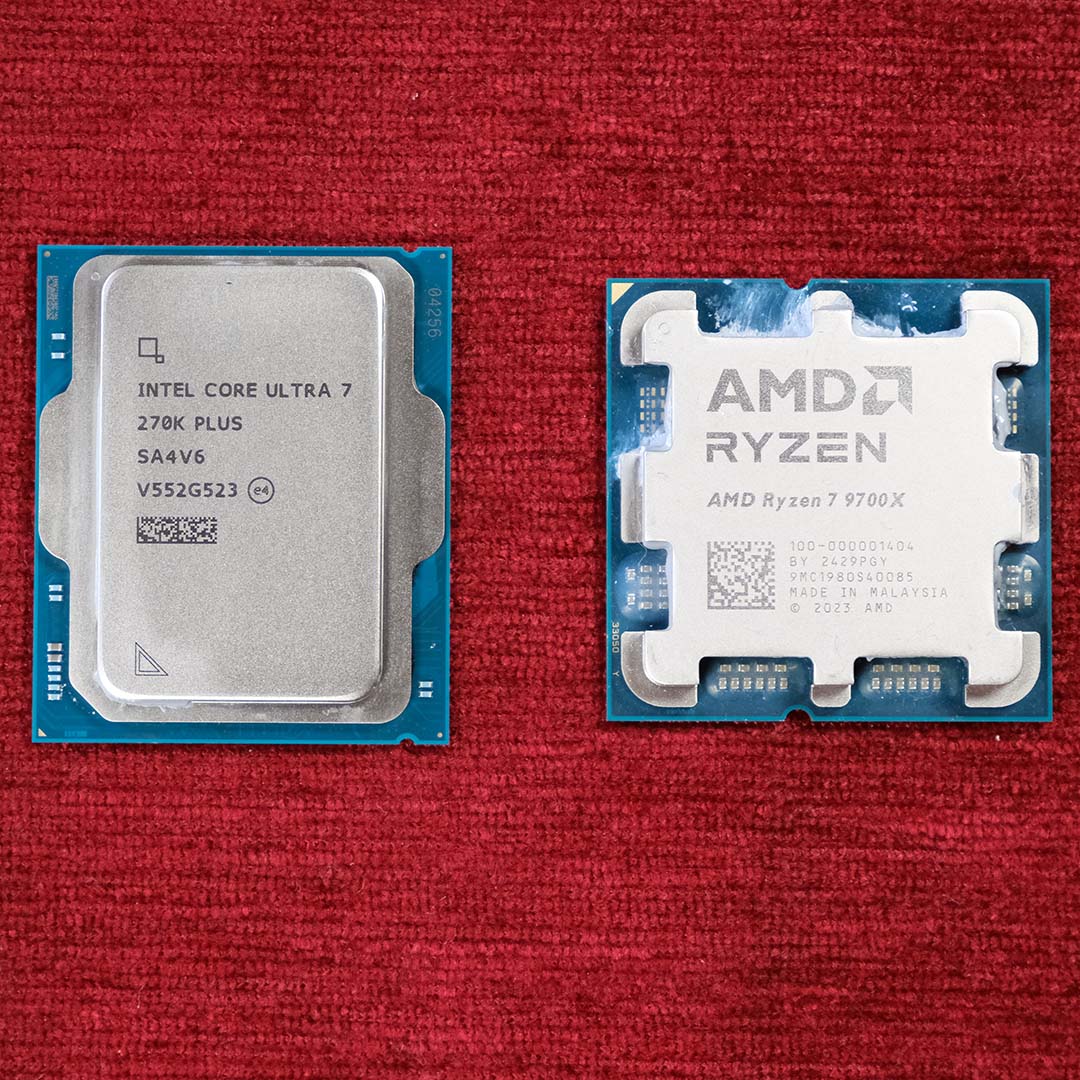
In terms of power, AMD ships the 9700X with a 65W TDP which can increase to 105W via BIOS tweaks. Contrastingly, Intel provides 3.85x that headroom to the 270K Plus through a 250W TDP. Neither manufacturer provides cooling to tame either power limit, but the Arrow Lake Refresh CPU will require a more robust setup.
The 9700X enjoys a 100MHz lead in base clocks, relative to the 270K Plus’ performance cores, but the processors are a match in terms of boost frequencies at 5.5GHz. Intel’s efficient cores are naturally less quick, but are only 15-16% behind AMD’s Zen 5 cores.
Launching at $359 back in August 2024, the 9700X is now readily available for under $300. Intel essentially matches AMD’s current pricing at $299, making performance per dollar calculations all the more pertient.
Test methodology
I have benchmarked both the Core Ultra 7 270K Plus and Ryzen 7 9700X using our revamped CPU test suite, which entails new applications and revised methodology. On the latter point, specifically, I have recorded frame rates in games at 1080p using ‘High’ presets without upscaling where possible. I’ve also tested each chip’s capabilities in productivity benchmarks.
I’ve maintained component parity as much as I can, including the use of a GeForce RTX 5090 Founders Edition to eliminate any potential GPU benchmarks. Chassis, cooler, storage, and power supply are consistent across each test bench. I’ve provided the full list of hardware for each test platform in the widgets below.
Core Ultra 7 270K Plus test PC
Club386 carefully chooses each component in a test bench to best suit the review at hand. When you view our benchmarks, you’re not just getting an opinion, but the results of rigorous testing carried out using hardware we trust.
Shop Club386 test platform components:
CPU: Intel Core Ultra 7 270K Plus
Cooler: Arctic Liquid Freezer III Pro 420 A-RGB
Motherboard: MSI MAG Z890 Tomahawk WiFi II
GPU: Nvidia GeForce RTX 5090 Founders Edition
Memory: 32GB DDR5-7200 CL34 G.Skill Trident Z5 RGB
Storage: 2TB WD_Black SN8100 NVMe SSD
PSU: 1,200W be quiet! Dark Power 14
Chassis: be quiet! Light Base 900 FX
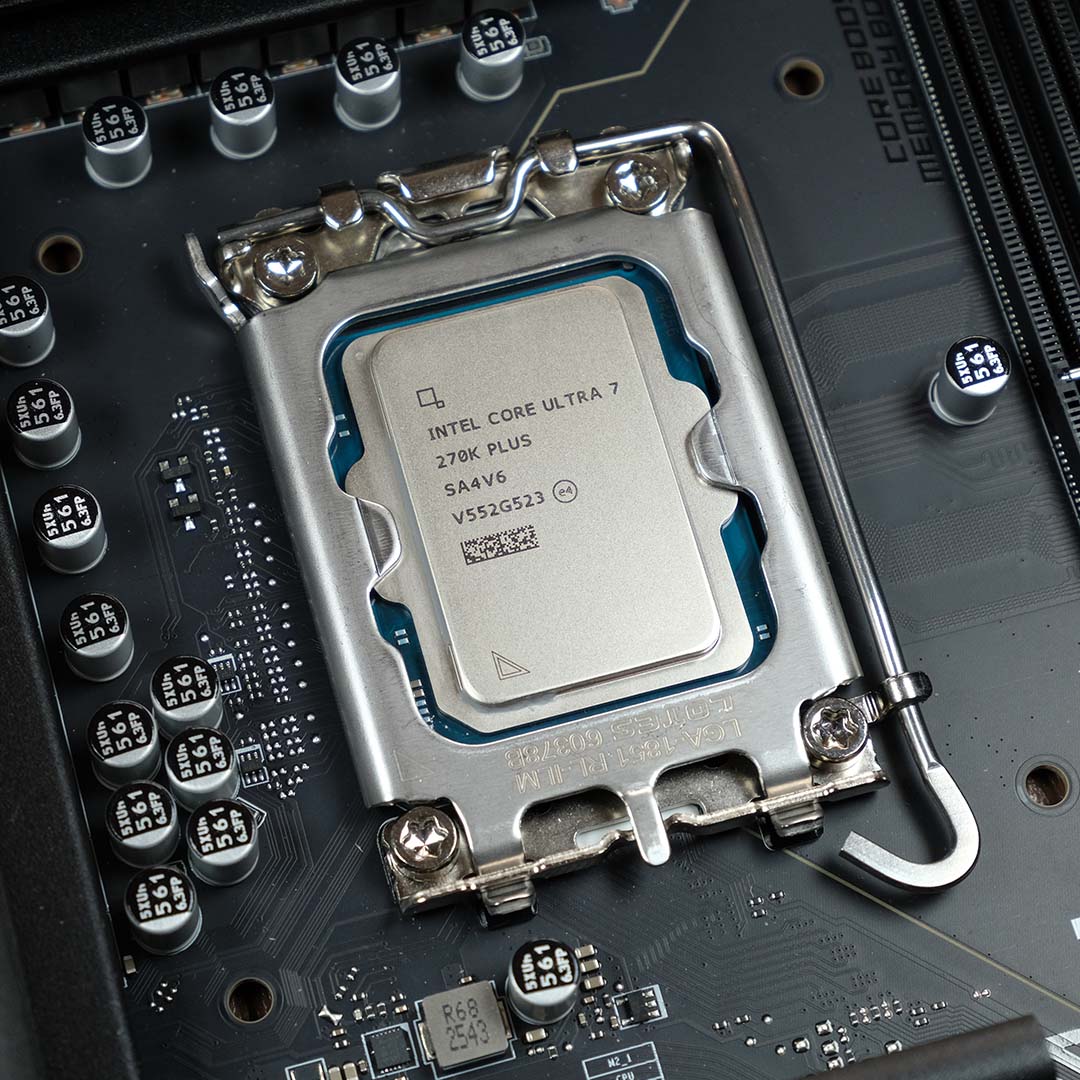
Unique to our LGA1851 test PC is an MSI MAG Z890 Tomahawk WiFi II motherboard, as well as a dual-channel kit of 32GB DDR5-7200 CL34 G.Skill Trident Z5 RGB memory.
Ryzen 7 9700X test PC
Club386 carefully chooses each component in a test bench to best suit the review at hand. When you view our benchmarks, you’re not just getting an opinion, but the results of rigorous testing carried out using hardware we trust.
Shop Club386 test platform components:
CPU: AMD Ryzen 7 9700X
Cooler: Arctic Liquid Freezer III Pro 420 A-RGB
Motherboard: MSI MEG X870E Ace Max
GPU: Nvidia GeForce RTX 5090 Founders Edition
Memory: 32GB DDR5-6000 CL32 G.Skill Trident Z5 RGB
Storage: 2TB WD_Black SN8100 NVMe SSD
PSU: 1,200W be quiet! Dark Power 14
Chassis: be quiet! Light Base 900 FX
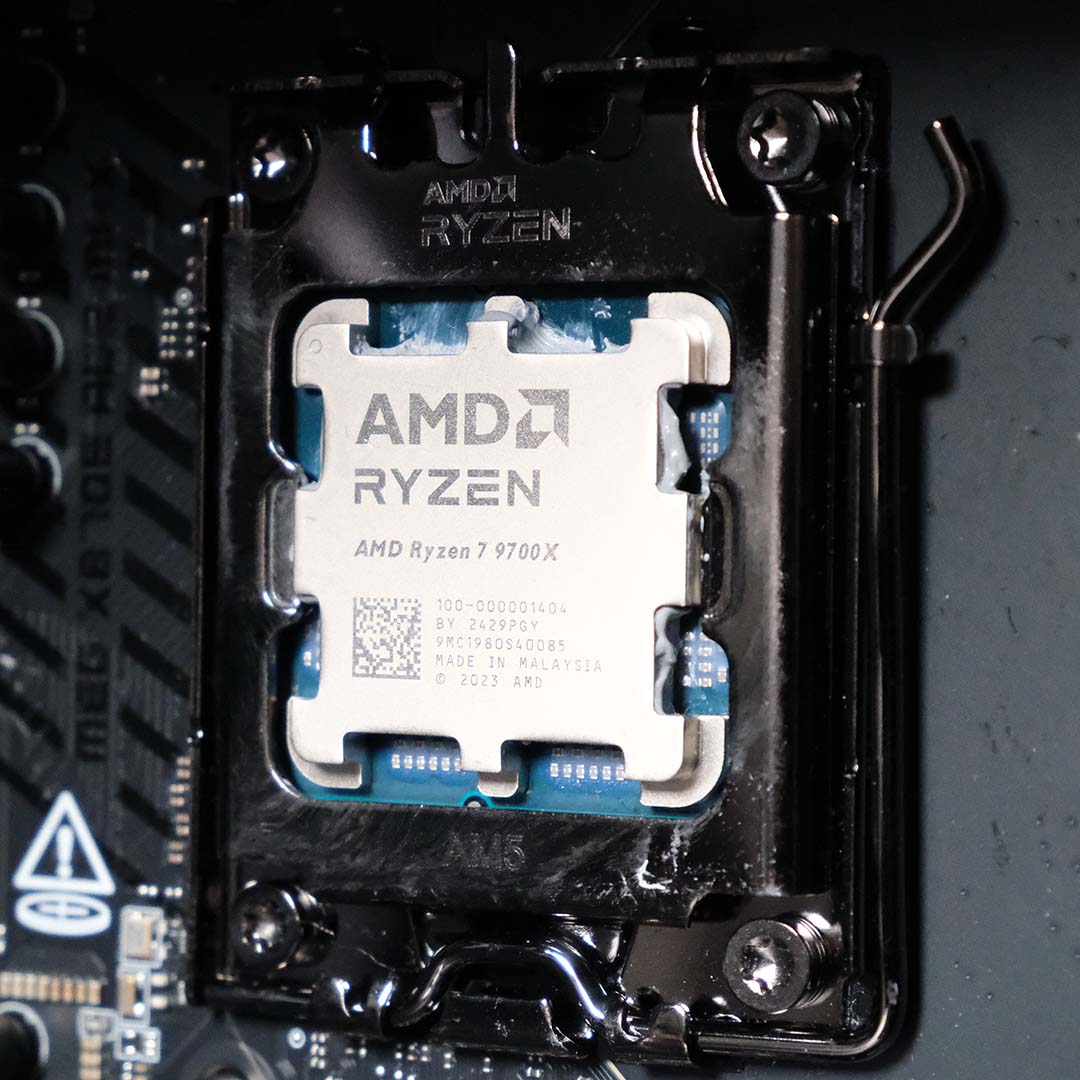
For our AM5 test PC, we’re using an MSI MEG X870E Ace Max and a dual-channel kit of 32GB DDR5-6000 CL32 G.Skill Trident Z5 Neo RGB RAM.
App Performance
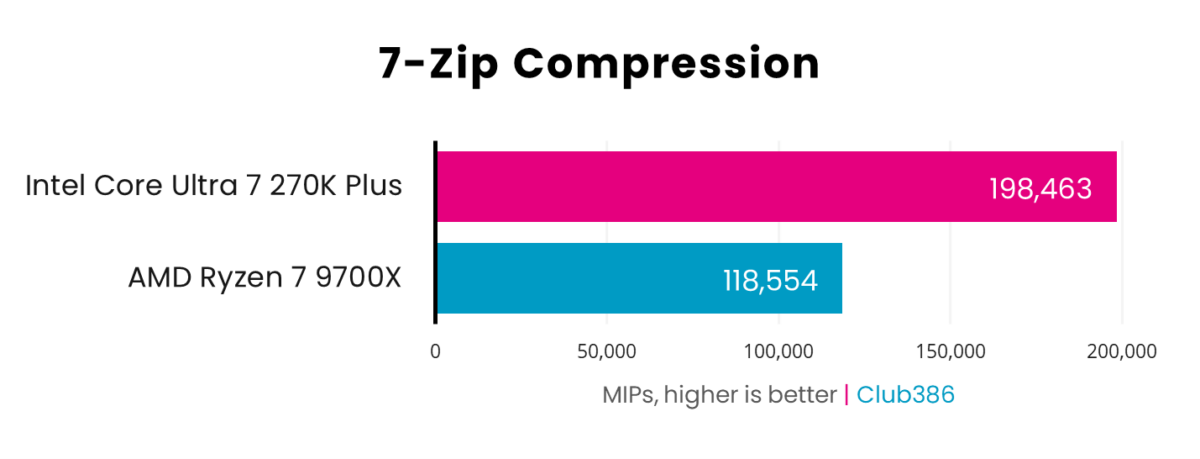
More cores, more threads, more millions of instructions per second. The Core Ultra 7 270K Plus makes relative light work of our 7-Zip Compression benchmark, zooming past the Ryzen 7 9700X by an impressive 67%.
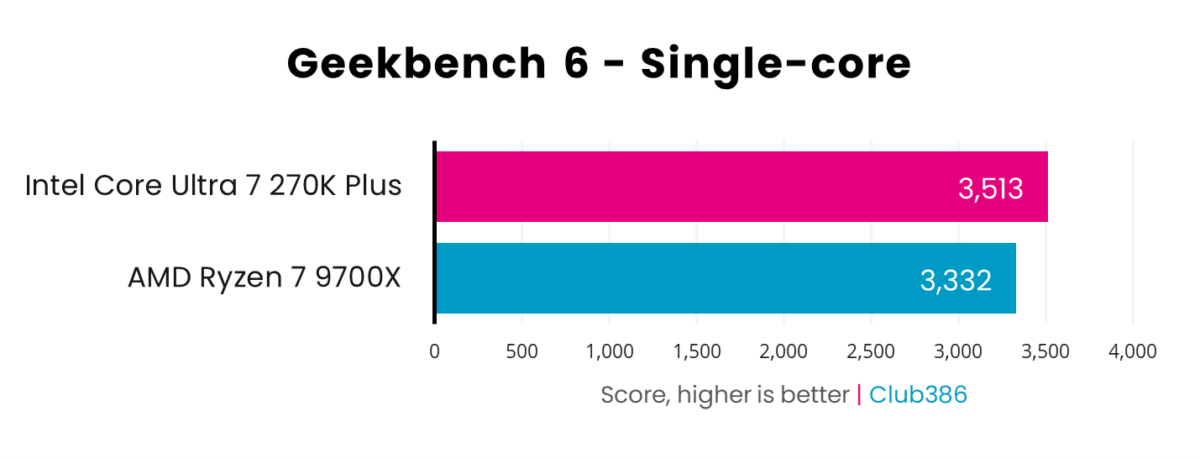
Both processors are capable of boosting up to 5.5GHz, but the Core Ultra 7 270K Plus puts that frequency to greater use in the Geekbench 6 single-core benchmark. The Ryzen 7 9700X puts up a good fight, but it’s ultimately Intel that walks away the victor with a score that’s 5% higher.
A 6% boost from Binary Optimisation proves key to putting the 270K Plus on top in this test, improving the CPU’s score from 3,311pts to 3,513pts. Out of the box, the 9700X would take the win, but there’s no reason not to use Intel’s performance boosting software.
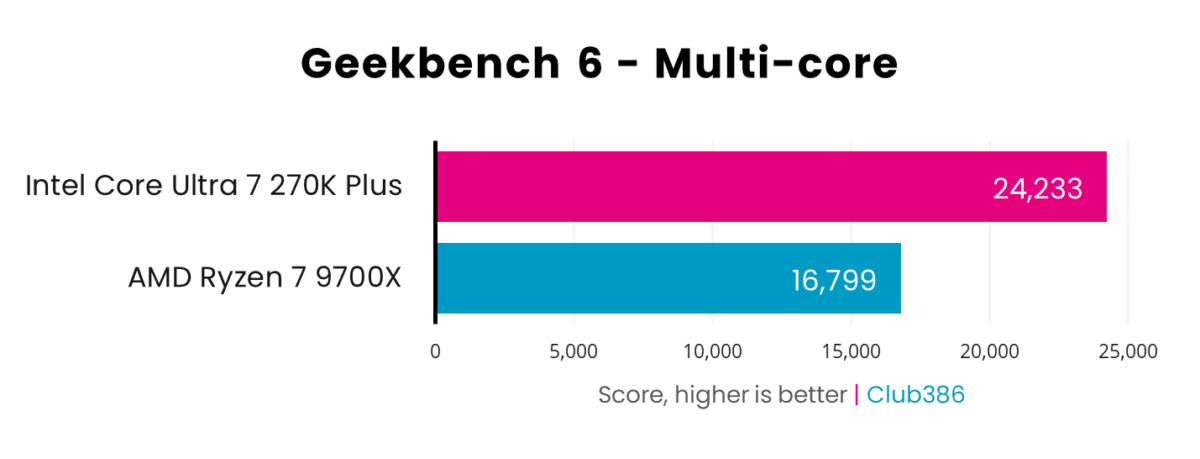
Both processors are rocking high-quality cores, but the Core Ultra 7 270K Plus has far more to play with. As such, it should come as no surprise that the CPU pulls confidently ahead of the Ryzen 7 9700X in the Geekbench 6 multi-core benchmark, to the tune of 44%.
4% of that advantage stems from Binary Optimisation, not that the 270K Plus needs the leg up on this occassion.
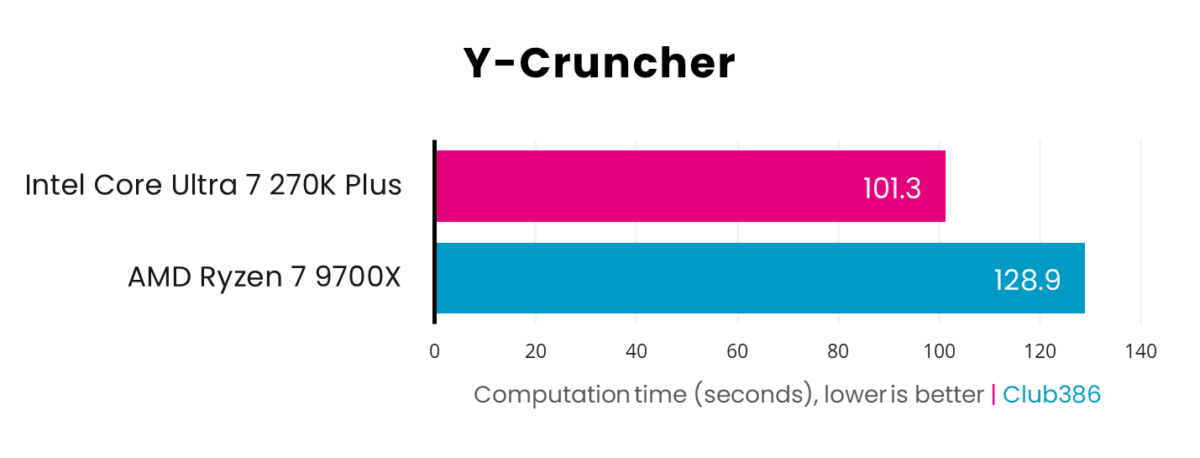
Greater multi-core chops provide more compute power, allowing the Core Ultra 7 270K Plus to crunch Pi to 5b digits within 101.3 seconds. That’s a welcome 21% time saved over the Ryzen 7 9700X, which clocks in at 128.9s.
However, it’s worth noting that AMD’s offering arrives complete with support AVX512 instruction sets, while Intel’s does not.
Content Creation
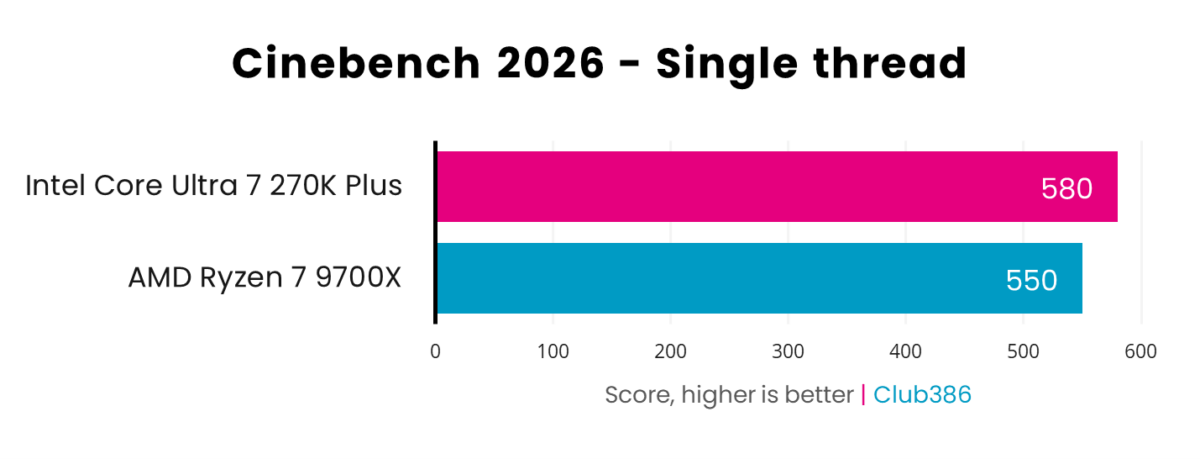
Single-thread rendering results in Cinebench 2026 mirror those of Geekbench 6. More specifically, the Core Ultra 7 270K Plus enjoys a small lead of 5% over the Ryzen 7 9700X.
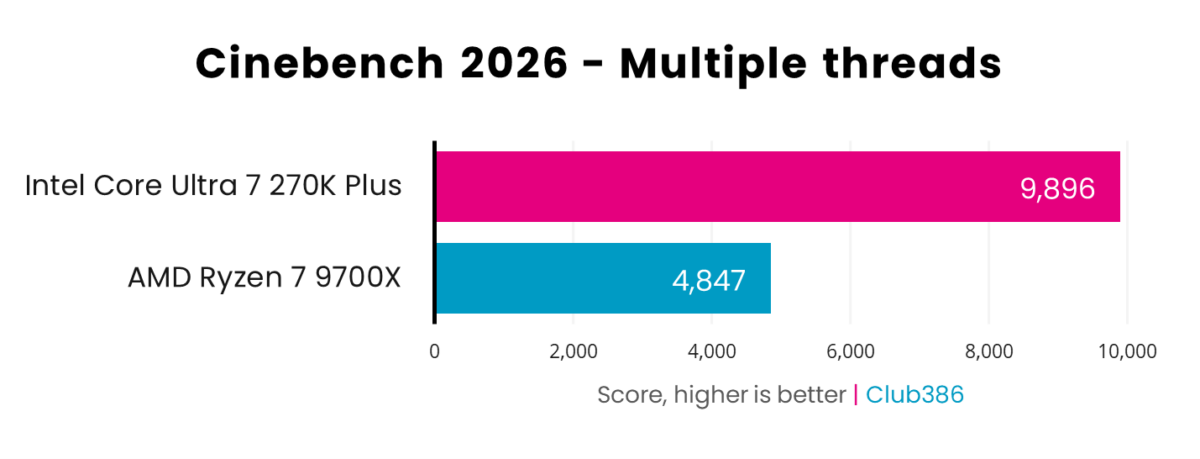
Once all processor threads are in play, however, a clear winner emerges. This time around, the Core Ultra 7 270K Plus runs a full lap around the Ryzen 7 9700X and then some with a score that’s an eye-watering 104% the better of its rival.
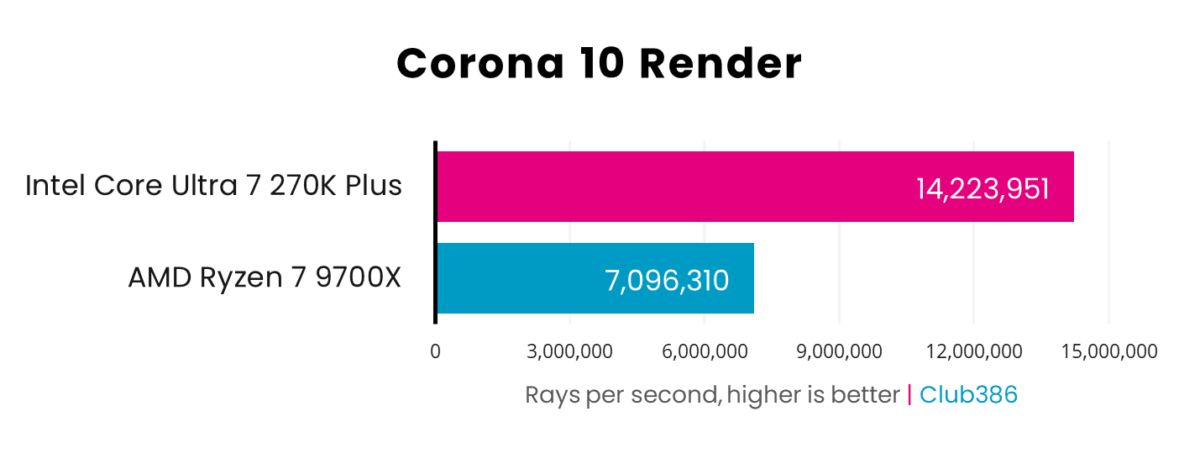
The triple-digit wins keep on coming as the CPUs go head-to-head in Corona 10 Render. The Core Ultra 7 270K Plus enjoys a neat and tidy 100% advantage over the Ryzen 7 9700X, further cementing its position as the processor of choice for demanding rendering workloads.
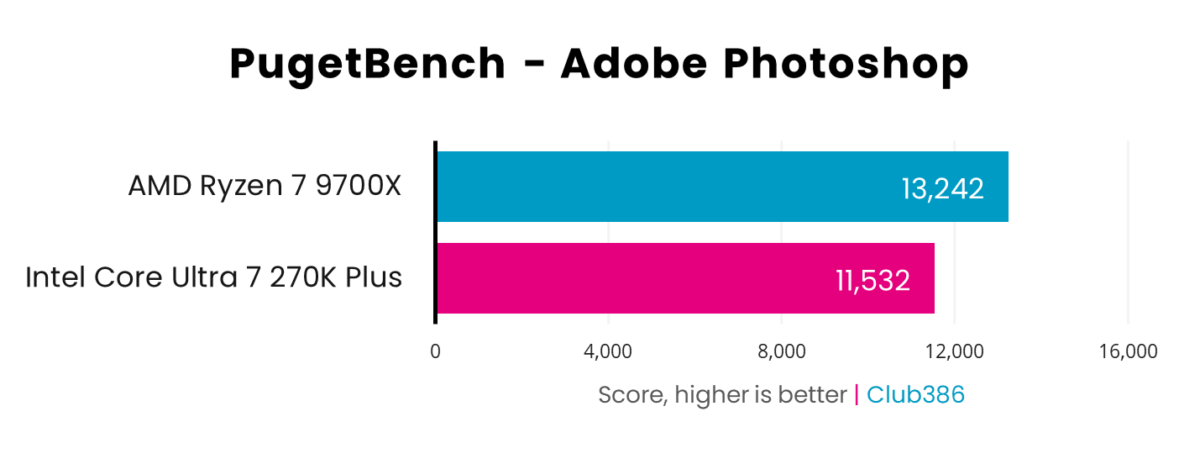
The tables take a rare turn when comparing chip performance in Adobe Photoshop, with AMD securing a win. The Ryzen 7 9700X is comfortably ahead in this showdown, offering 15% more performance than the Core Ultra 7 270K Plus.
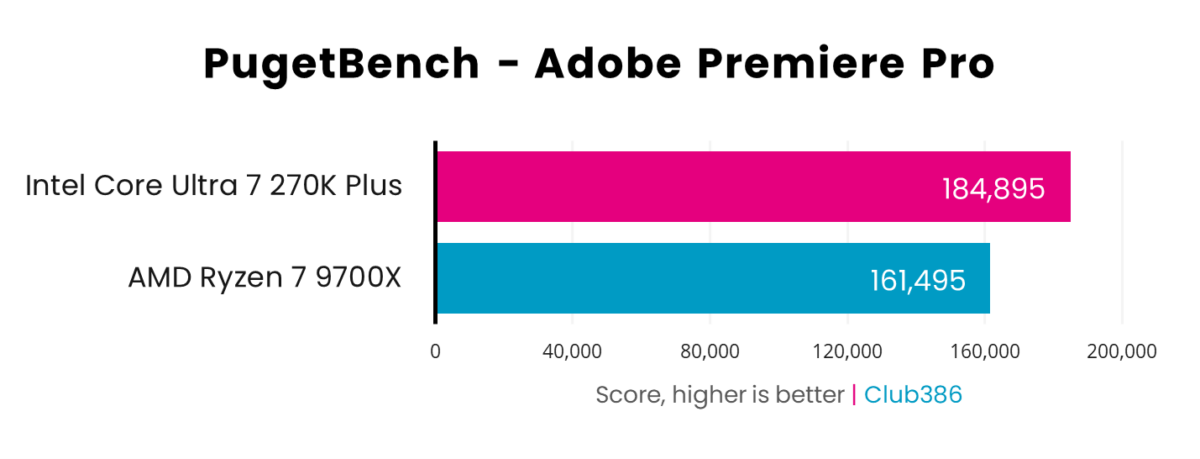
After that blip, Intel is back on top as testing swaps to Adobe Premiere Pro. The Core Ultra 7 270K Plus is scrubbing through timelines, applying effects, and more with greater ease than the Ryzen 7 9700X, boasting an additional 14% worth of performance.
Gaming
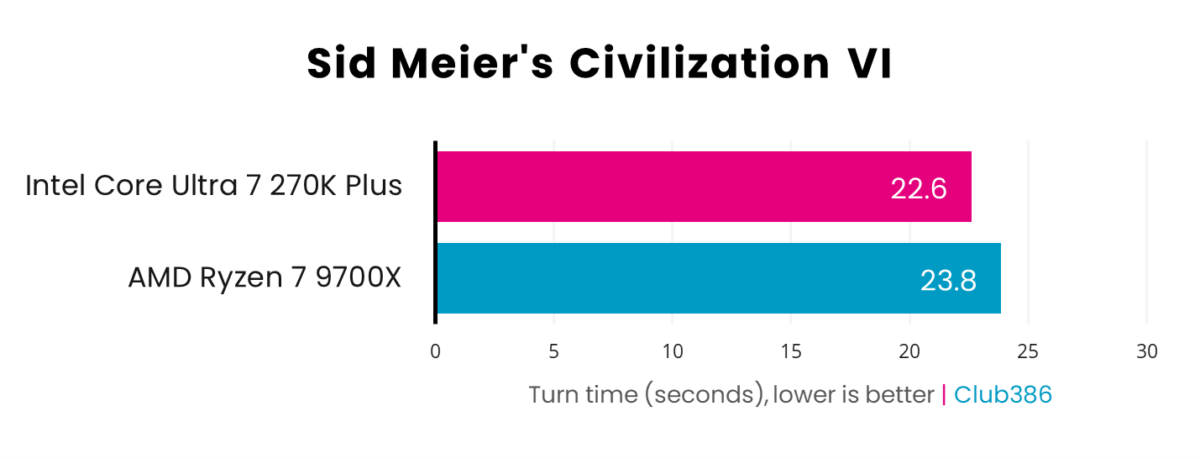
Loading up Sid Meier’s Civilization VI, the two chips race for victory in the game’s Gathering Storm AI Benchmark. It’s a close battle but the Core Ultra 7 270K Plus emerges the quicker of the two CPUs, outpacing the Ryzen 7 9700X by 1.2s (5%) in average turn time.
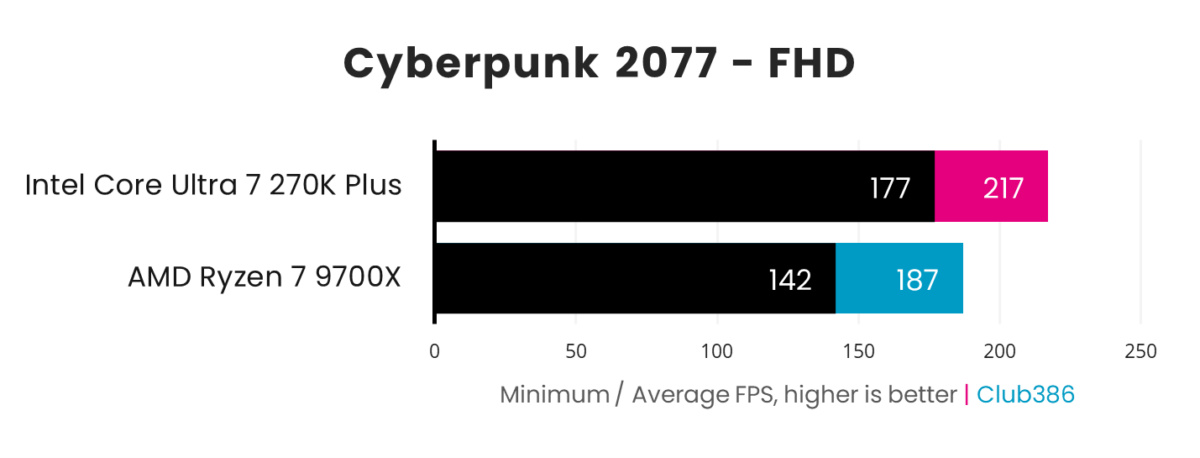
Cyberpunk 2077 proves an exceptionally strong showing for the Core Ultra 7 270K Plus. Intel’s processor not only beats AMD’s average frame rates by a welcome 16%, but minimum frame rates are also 25% the better of the Ryzen 7 9700X to boot.
Binary Optimisation does provide a 3% boost to the 270K Plus’ average frame rates, pushing performance from 210fps to 217fps. As such, even without the profile, the CPU is confidently ahead of its competition.
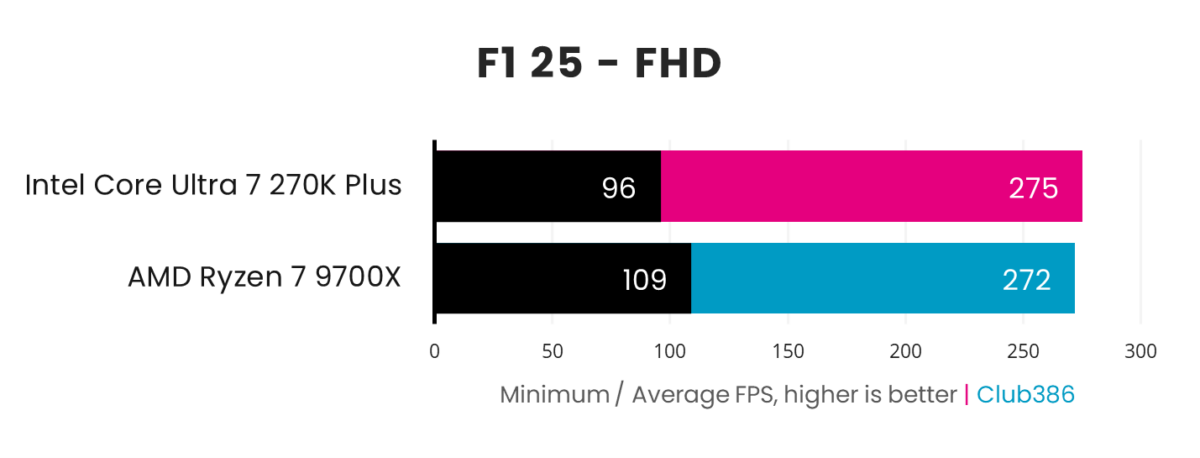
Both processors race towards the finish line in F1 25 at similar speed, but the Core Ultra 7 270K Plus pips ahead by 3fps (+1%) to secure the trophy. That said, the Ryzen 7 9700X does drive along more smoothly, with a more consistent minimum frame rate.
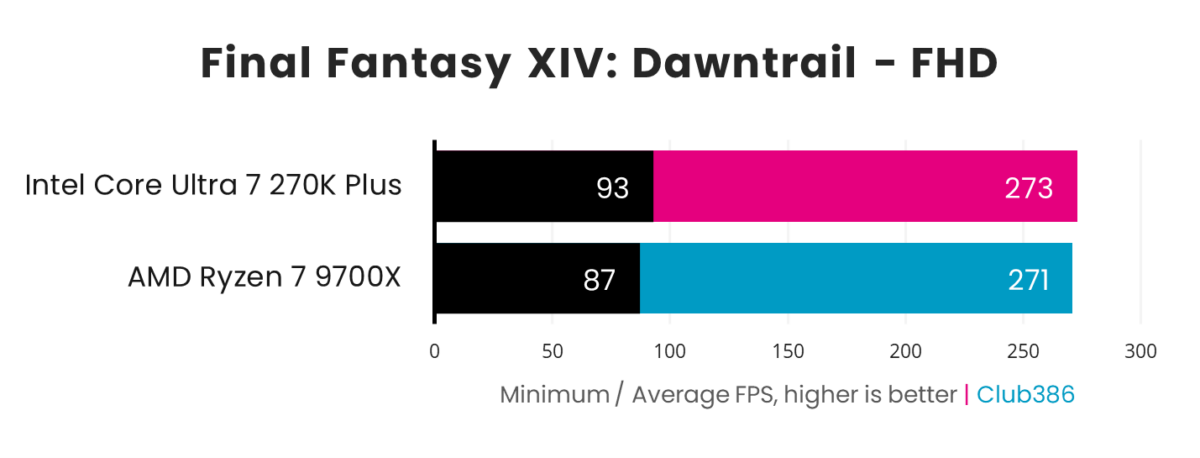
Frame rates in Final Fantasy XIV: Dawntrail are near-identical on both processors, but the Core Ultra 7 270K Plus tops the chart for both minimum and average frame rates. Although, this victory is only possible thanks to Binary Optimisation, providing a 5% boost that’s essential to securing this win.
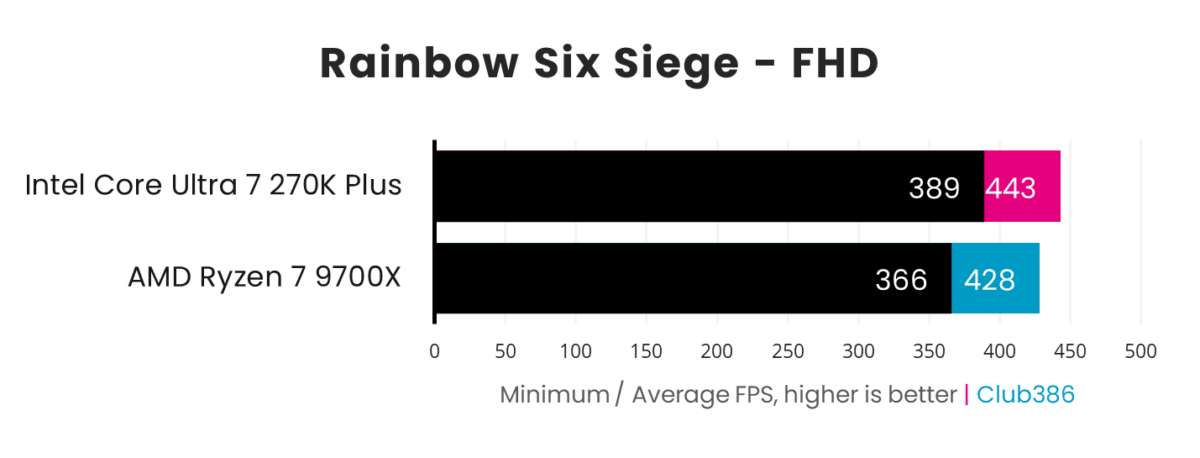
Neither processor leaves you wanting in Rainbow Six Siege, with dizzyingly high frame rates. However, those in search of the absolute best performance between the two chips should seek out the Core Ultra 7 270K Plus, which delivers 6% greater minimum fps and 4% higher average.
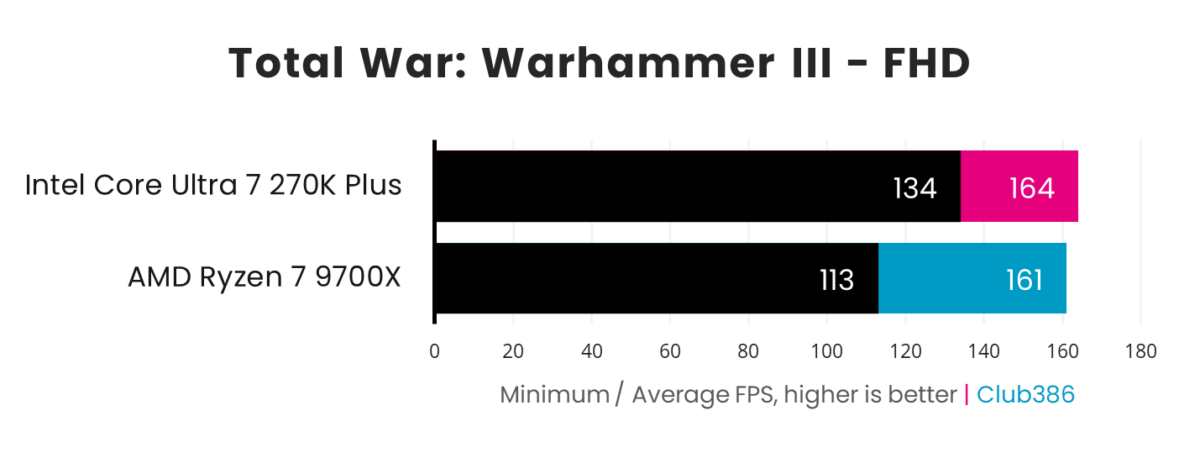
A final clash in Total War: Warhammer III secures another victory for the Core Ultra 7 270K Plus, defeating the Ryzen 7 9700X by 3fps (+2%) on average. The Intel CPU also comes out on top with superior minimum frame rates, 19% the better of its AMD opponent.
Power and Temperatures
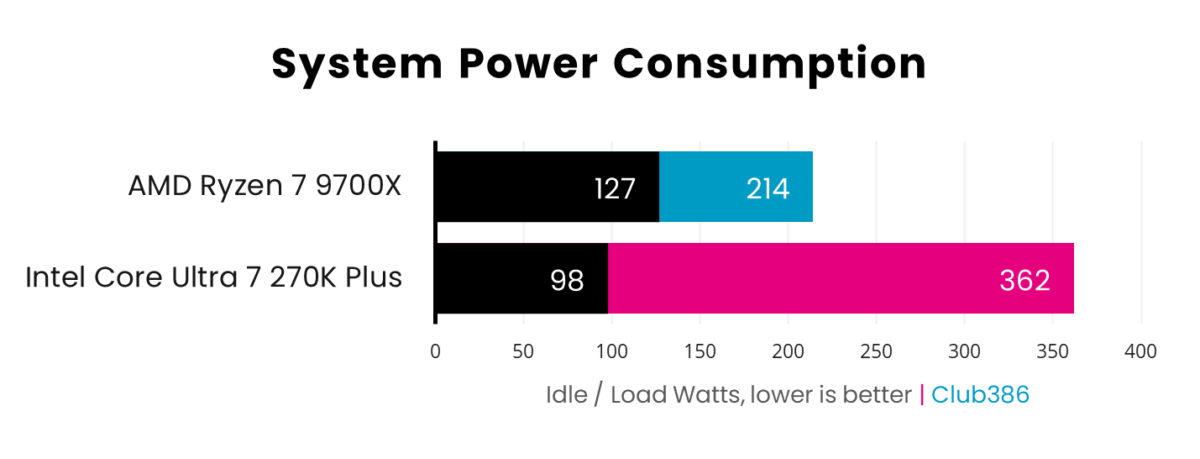
Given the differences in TDP (65W vs. 250W), system power consumption in Cinebench 2026 is expectedly wildly different across each processor. While the Ryzen 7 9700X PC hums along at up to 214W under load, the Core Ultra 7 270K Plus build approaches nearly double that at 362, making for a 69% increase.
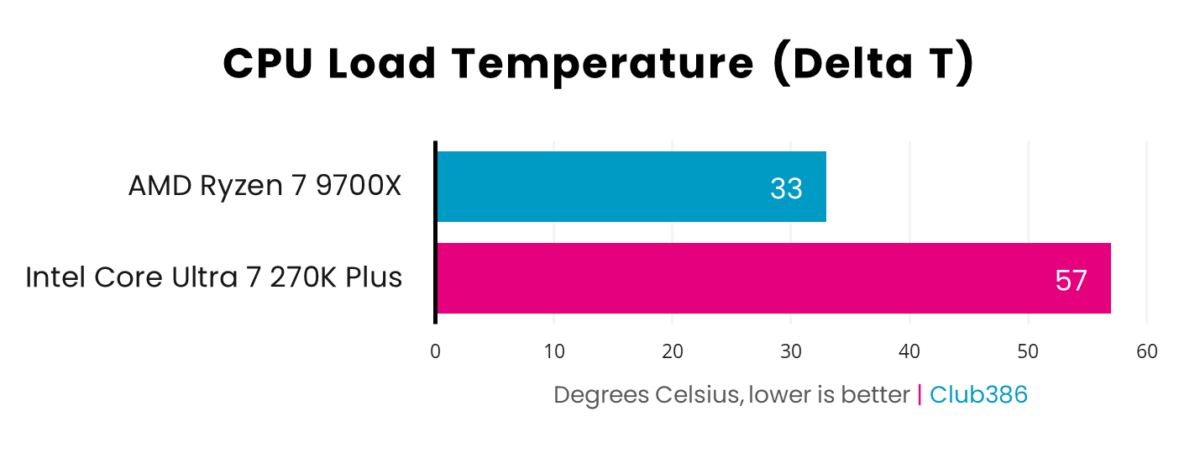
With more ‘leccy running through the veins of Core Ultra 7 270K Plus, it comes as no surprise that the chip runs much hotter than the Ryzen 7 9700X. Removing room temperature from the equation, we arrive at 33°C on AMD and 57°C for Intel, a 72% increase in delta temperature that prompts the need for relatively high-quality cooling.
Value Ratings
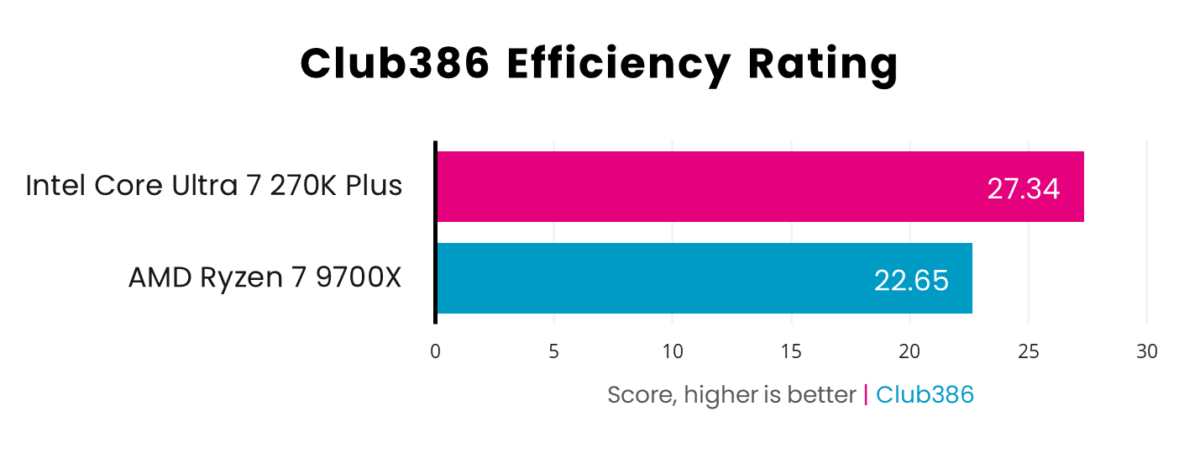
As much as the Core Ultra 7 270K Plus pulls more power under load, the chip translates those additional watts into performance with great effect. Dividing each CPU’s Cinebench 2026 multiple thread score by peak system power consumption, we arrive at the Club386 Efficiency Rating where Intel comes out on top with an enticing 4.69 (+21%) lead.
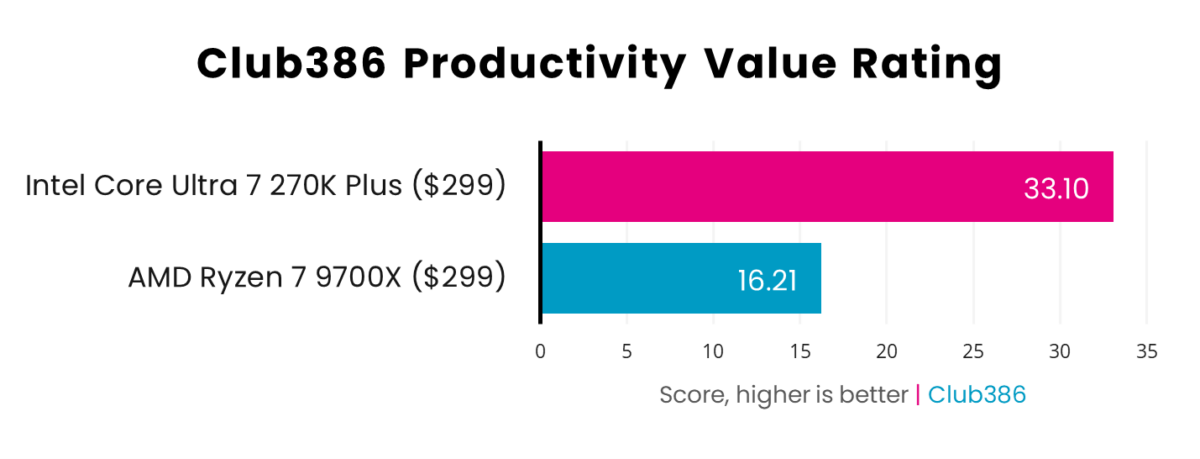
Taking the same score and dividing by puts a chasm between the Core Ultra 7 270K Plus and Ryzen 7 9700X. Both chips currently retail for $299 and Intel is offering substantially more bang for your buck when it comes to productivity, more than double (104%) in fact.
Conclusion

From the standpoint of raw performance, the Core Ultra 7 270K Plus is the clear winner in a face-off against the Ryzen 7 9700X. While Intel’s lead is relatively small in single-thread workloads, Arrow Lake Refresh leaves Zen 5 in the dust once multiple thread grunt is the name of the game.
There are a few important caveats that come with the 270K Plus. Most importantly, the LGA1851 platform likely won’t support any future CPUs beyond this one, while AM5 should receive at least one additional family of processors in the future. Of course, this only matters if you’re the type of person to upgrade individual components rather than swap out for a new system entirely.

Intel Core Ultra 7 270K Plus
The Core Ultra 7 270K Plus soars ahead of its closest competition, with more cores, high efficiency, and killer all-round value. Read our review.
Then there’s power draw to consider, as the 270K Plus demands far more than the Ryzen 7 9700X, even if it puts all that juice to more efficient use. If you have a reasonably competent cooler to hand, though, you’re golden, and electricity bills won’t necessarily rise; being able to process large renders quickly could technically lower bills in the long run.
Finally, the 270K Plus can’t run Gen 5 SSDs at full speed owing to an inherent design limitation in its I/O Extender Tile. Speeds cap out at ~12,100MB/s in our testing, leaving ~2,800MB/s of throughput on the table. Meanwhile, the 9700X can run storage at full throttle with no issues.
AMD Ryzen 7 9700X
The Ryzen 7 9700X remains a decent choice for anyone looking to build an AM5 system with room for a CPU upgrade down the line. Read our review.
With all this information to hand, you should now confidently be able to choose whether the 270K Plus and 9700X will form the centrepiece of your next system. For more processor recommendations across the price spectrum, check out our best CPU guide.