
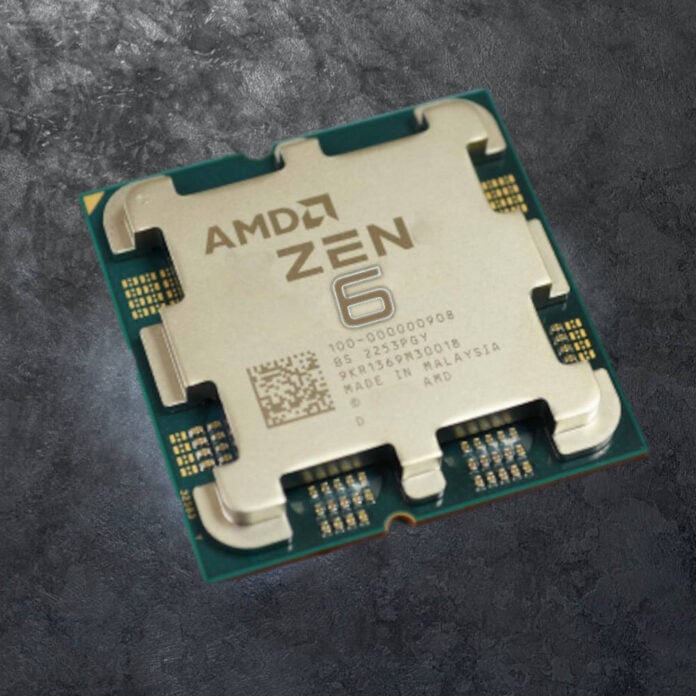
AMD may finally treat PC users to higher core counts with its upcoming Zen 6 architecture, pushing consumer hardware performance ceiling up by a noticeable degree. According to reliable leaker @9550pro on X, the company is preparing 12-core CCDs (Core Complex Dies), marking a 50% increase over existing desktop and laptop designs.
If this rumour is to be believed, Zen 6 would be the first architecture to pack more cores per CCD without constraining peak clock speeds. It adds to previous leaks regarding Zen 6, indicating that 12 cores per CCD is the new limit, meaning that dual-CCD processors, like a hypothetical Ryzen 9 10950X, would be a 24-core, 48-thread powerhouse. Understandably, AMD will undoubtedly continue offering six- and eight-core options, for entry and budget systems.
While 12 cores per CCD would still be less than AMD’s denser Zen 4c and Zen 5c designs, which bundle up to 16 cores per CCD, Zen 6’s speed and architectural improvements should allow it to bridge the gap. Furthermore, while Zen 6 brings 50% more cores than its predecessors, the overall silicon area remains nearly identical. According to @9550pro again, Zen 6 CCDs measure about 76mm², compared to 71mm² for Zen 5 and 72mm² for Zen 4. Since Zen 6 is expected to be manufactured using TSMC’s N2 node, which doesn’t seem to offer such a density increase, there are likely other design changes in play.
As you may have guessed, more cores also mean more cache at all levels, which should make games happy. With 48MB of L3 on each CCD (50% higher than Zen 5 CCDs), cache-sensitive apps could run faster without having to deal with the latency impact resulting from dual-CCD designs.
I’m not forgetting AMD’s famous X3D variants that include more L3 cache on top, which in this case could also see a further capacity improvement, adding another 96MB to the mix if previous rumours are to be believed. Going deeper into the hope well, we could also imagine a dual X3D processor boasting 24 cores and 288MB of L3 cache – all of that without requiring a new motherboard.
What is certain is that a 12-core CCD would mark a major change from AMD’s norms for Ryzen CPUs, which have used 8-core CCDs since Zen 2 (Ryzen 3000). Hopefully, power efficiency will also be great, as 50% more power consumption could be a deal breaker for SFF (Small Form Factor) PC builders. As for pricing, we expect it to be slightly higher, but not to the level of the current 12-core CPUs.