
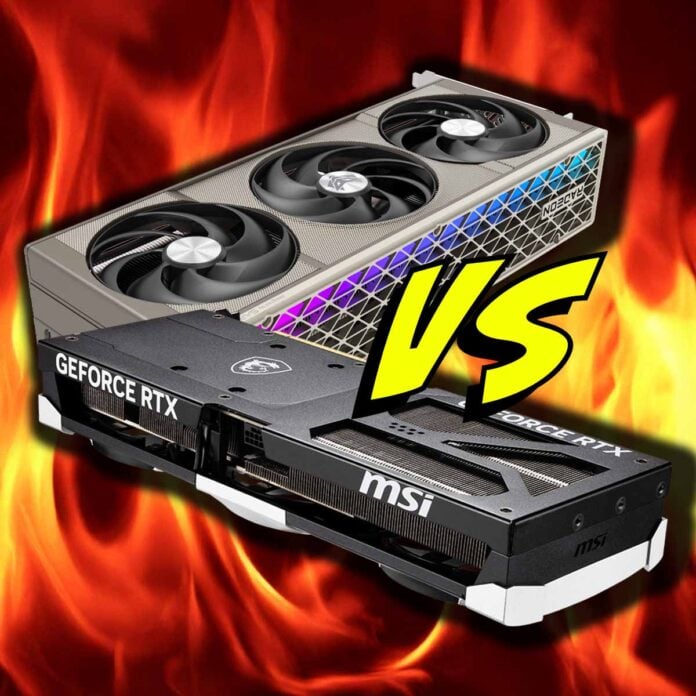
On the face of it, you might expect Nvidia’s GeForce RTX 5070 Ti to be rubbing the AMD Radeon RX 9070 XT’s face in the dirt at the end of this battle. With a 25% higher MSRP, and packing the latest GDDR7 memory, the RTX 5070 Ti ought to be way quicker, while AMD’s card offers a cheaper but much less powerful option, right? Nope. In fact, this has been one of the most complex GPU fights around this year. Not only does the 9070 XT actually beat the Nvidia GPU in some tests, but short supply and booming demand has meant it was also priced at a similar level until recently, particularly in the US.
Now that prices have settled down a bit, though, we thought it was about time we pitched these two GPUs against each other. After all, you can now genuinely pick up a Radeon RX 9070 XT for $599 / £539, and a 5070 Ti for $749 / £719. This situation may admittedly not last long, given the current chaos surrounding RAM prices, but at the moment there’s a big $150 price gap between these two GPUs. Should you save some money and get the cheaper Radeon RX 9070 XT, or is it worth stumping up for an RTX 5070 Ti? Let’s find out.
Specs
There are several areas of Nvidia and AMD’s rival architectures where you can’t really compare like for like. On the surface, it looks as though the 5070 Ti has over twice as many stream processors as the 9070 XT, for example, but that doesn’t mean it’s over twice as powerful as the architectures work so differently. There are some areas where you can nail down a definite difference between the two GPUs, though.
| RX 9070 XT | RTX 5070 Ti | Ratio | |
|---|---|---|---|
| Released | Mar 2025 | Feb 2025 | – |
| Codename | RDNA 4 | Blackwell | – |
| GPU | Navi 48 | GB203 | – |
| Process | TSMC N4P (5nm) | TSMC 4N (5nm) | – |
| Transistors | 53.9bn | 45.6bn | 0.84 |
| Die size | 357mm² | 378mm² | 1.06 |
| Stream processors | 4,096 | 8,960 | 2.19 |
| Boost clock | 2,970MHz | 2,452MHz | 0.83 |
| FP32 TFLOPS | 49 | 44 | 0.90 |
| CUs / SMs | 64 of 64 | 70 of 84 | 1.09 |
| RT cores | 64 (3rd Gen) | 70 (4th Gen) | 1.09 |
| AI / Tensor cores | 128 (2nd Gen) | 280 (5th Gen) | 2.19 |
| ROPs | 128 | 96 | 0.75 |
| Memory | 16GB | 16GB | 1 |
| Mem. type | GDDR6 | GDDR7 | – |
| Mem. clock | 20Gb/s | 28Gb/s | 1.4 |
| Mem. interface | 256-bit | 256-bit | 1 |
| Mem. bandwidth | 640GB/s | 896GB/s | 1.4 |
| Board power | 304W | 300W | 0.99 |
| Launch MSRP | $599 | $749 | 1.25 |
The main one is memory. Both GPUs have 16GB of VRAM attached to a 256-bit interface, but the GDDR7 memory used by Nvidia’s RTX 5070 Ti is considerably quicker than the GDDR6 RAM fitted to AMD Radeon RX 9070 XT cards. In fact, with an effective speed of 28Gbps, RTX 5070 Ti’s memory is 40% faster than that of a 9070 XT card.
Add in the same bus width and we’re looking at an overall bandwidth of 896GB/s on a 5070 Ti card, compared with 640GB/s on a 9070 XT. To put those figures into context, the 5070 Ti’s bandwidth is closer to the RTX 4090’s massive 1.01TB/s than it is to the 9070 XT’s figure. This means the 5070 Ti can retrieve data from its memory much quicker than the 9070 XT, which can have an impact on performance in VRAM-intensive games.
Meanwhile, AMD has massively improved its matrix cores for AI with the RDNA 4 architecture. Its excellent new FSR 4 upscaling tech for games requires these cores, and it enables AMD to properly compete with Nvidia’s DLSS tech. The exception here is frame gen. FSR frame gen currently still doesn’t use AI hardware, and AMD’s FSR frame gen is a long way behind Nvidia’s latest multi-frame gen tech, which requires Nvidia’s Blackwell Tensor cores to run. As we’ll see later, multi frame gen is a big selling point for the RTX 5070 Ti.
RDNA 4 has also seen AMD massively upping its ray tracing game, with Radeon RX 9070 XT cards coming equipped with 64 of its new RT cores, which are much better at ray tracing than previous GPUs. Nvidia still has the upper hand here, particularly when the RTX 5070 Ti comes with 70 RT cores, but the gap is much smaller now.
Both GPUs also consume a similar amount of power, with AMD saying the Radeon RX 9070 XT tops out at 304W, while Nvidia says its RTX 5070 Ti draws up to 300W. There’s not much separating these two GPUs when it comes to manufacturing tech either. They’re both produced using variations of TSMC’s N4P node which, despite its name, is technically a refined 5nm rather than 4nm process. TSMC 4N is a version specifically used to make Nvidia GPUs since the RTX 40 series, but there’s not much in it here.
There’s a good $150 in it between both these GPUs, meaning the RTX 5070 Ti is 25% more expensive at MSRP. Let’s get onto the benchmarks to see whether it’s worth the extra money.
How we test
Both our AMD Radeon RX 9070 XT and Nvidia GeForce RTX 5070 Ti cards have spent a stint in the Club386 test bench, guided by a top-notch Ryzen 9 7950X3D CPU. We put each GPU to the test using an assortment of benchmarks on a machine running Windows 11 24H2.
Both these GPUs mainly target 1440p (QHD) as their primary resolution, but we’ve also included 4K (UHD) and 1080p (FHD) figures for all our game benchmarks, so you can see how these GPUs will perform on practically any 16:9 monitor setup.
There’s also one caveat to bear in mind, which is that our 9070 XT results come from a Sapphire Nitro+ card, one that overclocks the game clock by 120MHz (5%). Comparatively, our RTX 5070 Ti sample is a stock-speed MSI Ventus 3X card. As such, bear in mind that a cheaper 9070 XT card at stock speed will be slightly slower than the results below, although the margins will be small for the most part.
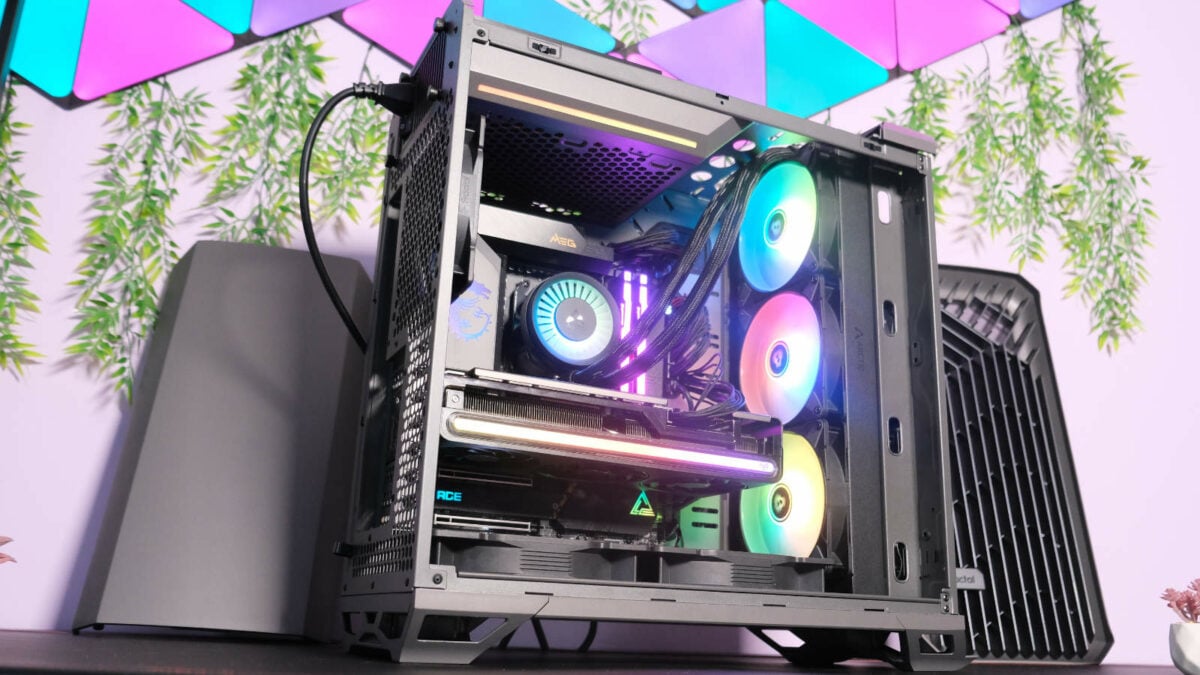
Our 7950X3D test PCs
Club386 carefully chooses each component in a test bench to best suit the review at hand. When you view our benchmarks, you’re not just getting an opinion, but the results of rigorous testing carried out using hardware we trust.
Shop Club386 test platform components:
CPU: AMD Ryzen 9 7950X3D
Motherboard: MSI MEG X670E ACE
Cooler: Arctic Liquid Freezer III 420 A-RGB
GPU: Sapphire Nitro+ Radeon RX 7800 XT
Memory: 64GB Kingston Fury Beast DDR5
Storage: 2TB WD_Black SN850X NVMe SSD
PSU: be quiet! Dark Power Pro 13 1,300W
Chassis: Fractal Design Torrent Grey
3DMark
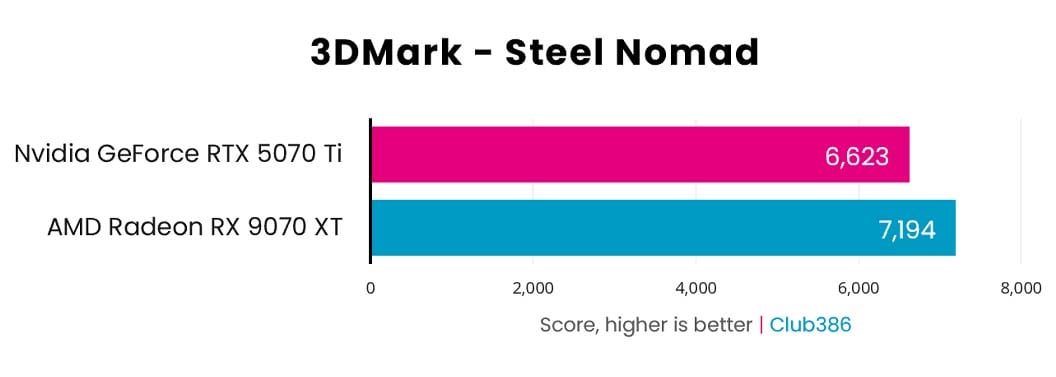
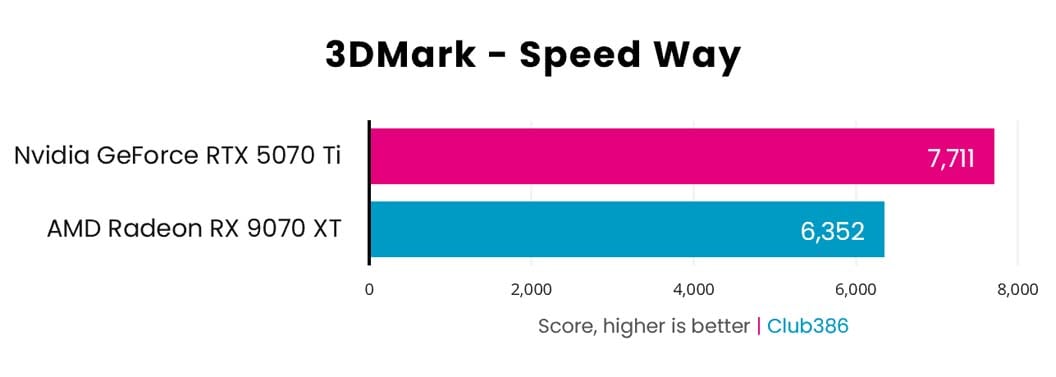
Let’s kick off with some simple synthetic benchmarking from 3DMark, which handily shows the main pros and cons of these GPUs when it comes to gaming. As you can see from the Steel Nomad result, AMD’s fastest RDNA 4 chip has the lead when it comes to rendering games with standard rasterisation, and no ray tracing. That’s remarkable when you consider the Radeon’s cheaper price – it’s 8.6% faster.
Enable ray tracing in 3DMark’s Speed Way test, which is full of shiny metal, and you can see Nvidia’s GPU pulling away. Thanks to its new Blackwell RT cores and Nvidia’s prowess in ray tracing, it’s 21.4% faster than the 9070 XT in this test.
AI performance
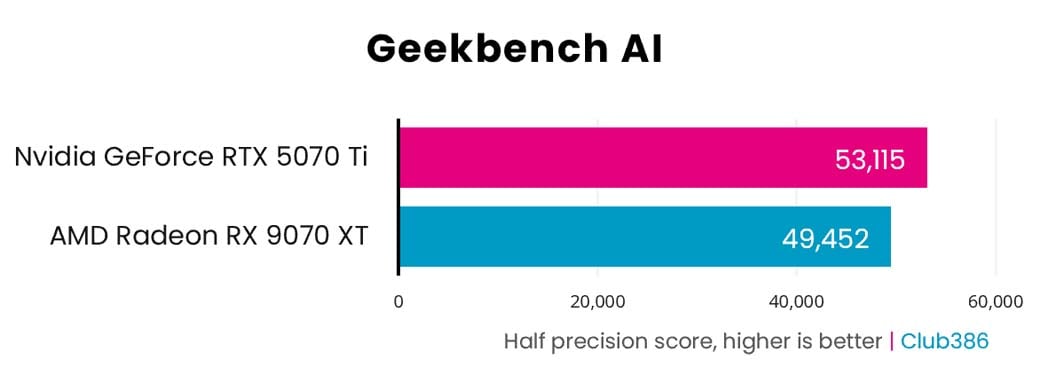
Nvidia leads the way in both our AI tests, although AMD has played a good game of catch up here since RDNA 3. In Geekbench AI, the Nvidia GPU is only 7.4% faster than the AMD card, for example, which is fine when you consider the price difference.
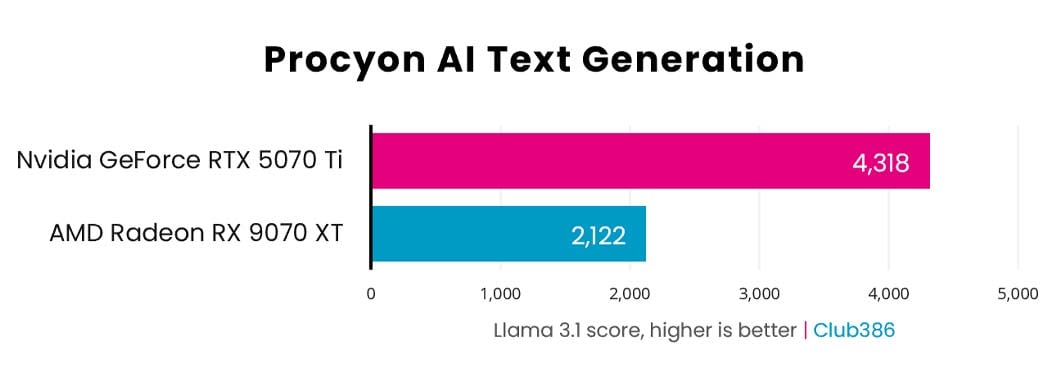
It’s a much worse picture for AMD when it comes to generating text with the Llama 3.1 large language model (LLM), though. Running Procyon AI, which has the benefit of directly supporting Nvidia CUDA, the RTX 5070 Ti is over twice as fast as the 9070 XT.
Gaming
With both GPUs trading blows in 3DMark, and Nvidia having a definite lead in AI performance, it’s now time for the game tests. How do these GPUs get on when faced with generating frame rates in real games? Let’s take a look.
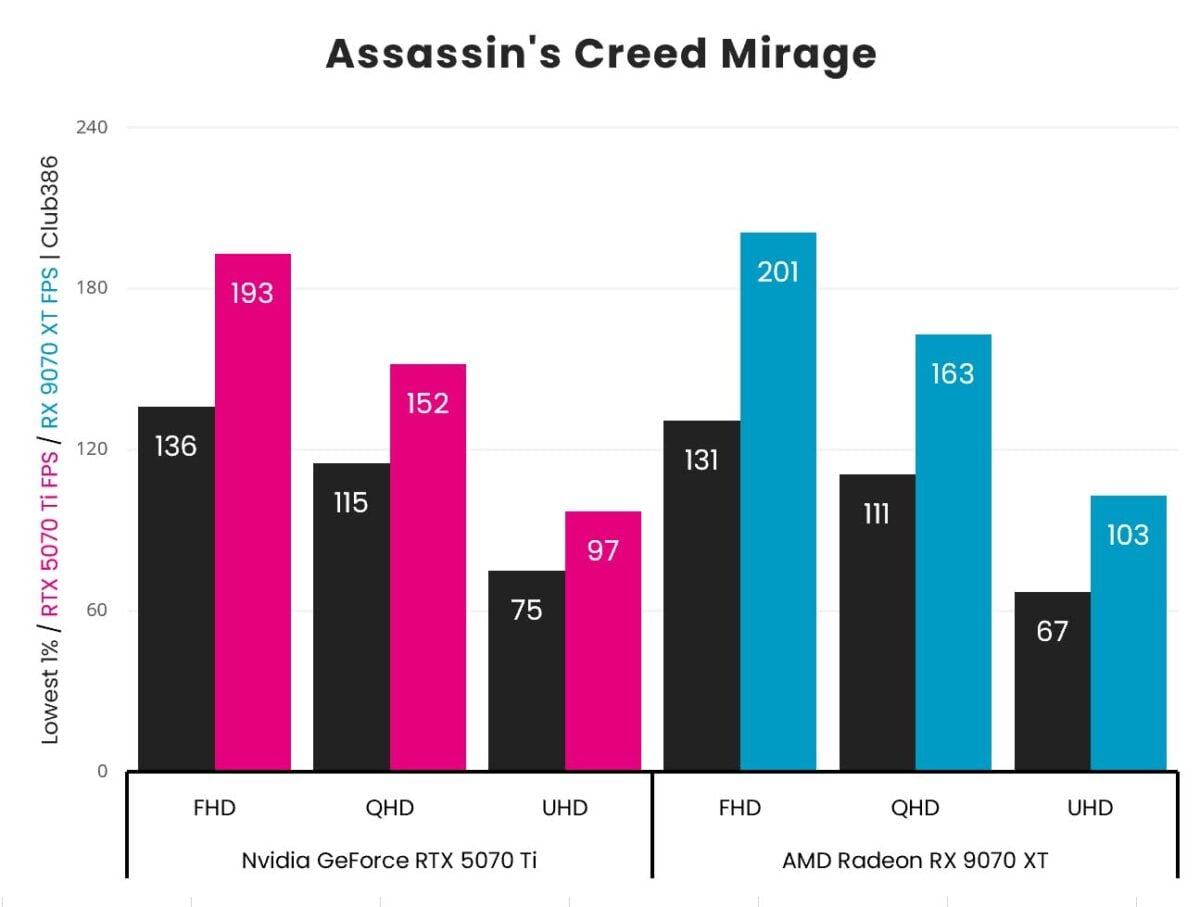
Running Assassin’s Creed Mirage at maximum settings reveals a very close fight between these two GPUs – there’s really not much in it. The 9070 XT’s averages are quicker across the board, but the 5070 Ti’s minimums are a bit quicker. There’s really not much in it here when it comes to performance, but the 9070 XT’s cheaper price makes it a much better buy for this game.
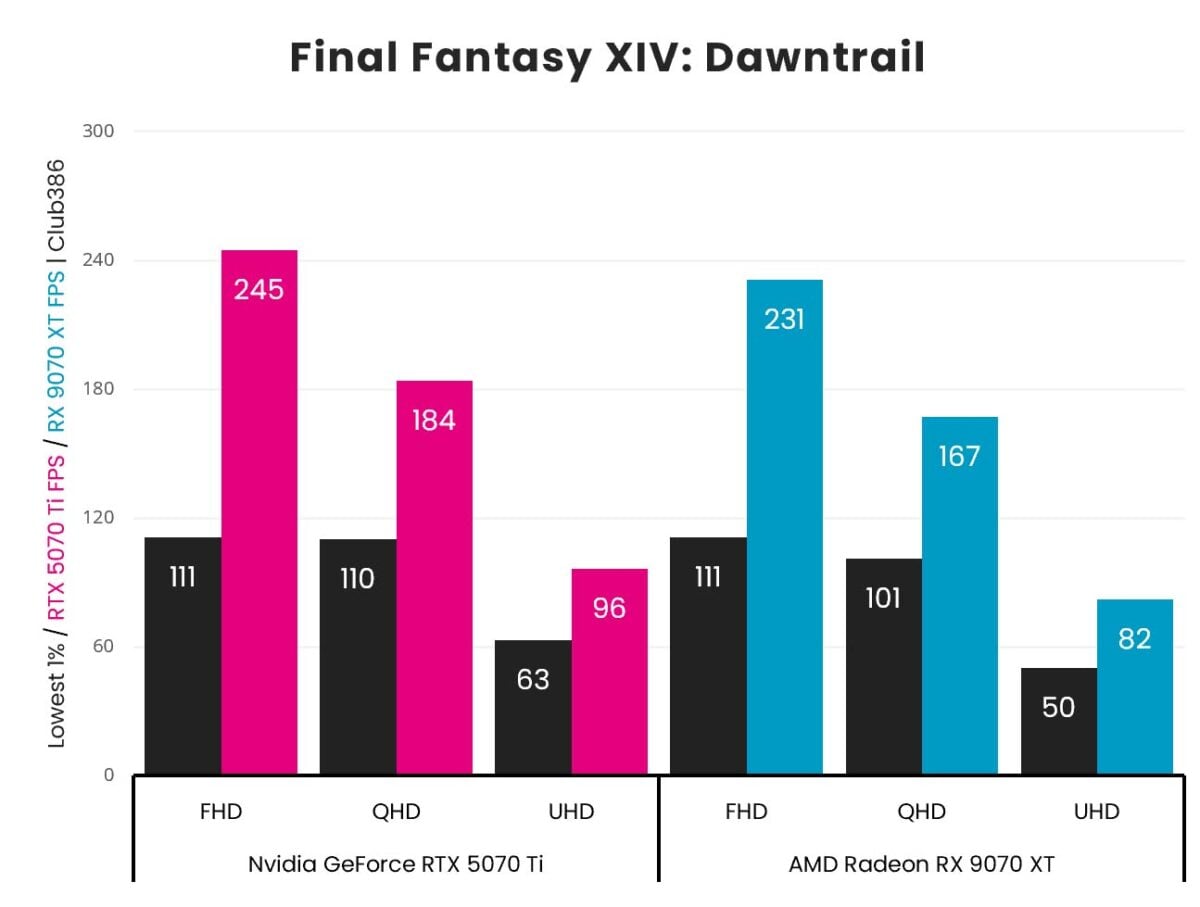
Final Fantasy XIV: Dawntrail definitely favours the Nvidia GPU, averaging 184fps at QHD compared to 167fps on the 9070 XT. The difference is starker at 4K, where the 5070 Ti never drops below 63fps, but the 9070 XT drops down to 50fps. Both cards are clearly capable of playing this game at all our test resolutions, but the 5070 Ti has a solid edge. The problem for the 5070 Ti, however, is its price. It’s 25% more expensive than the 9070 XT, but these frame rates are, at best, 17% quicker at 4K, and at worst, only 6% faster at 1080p.
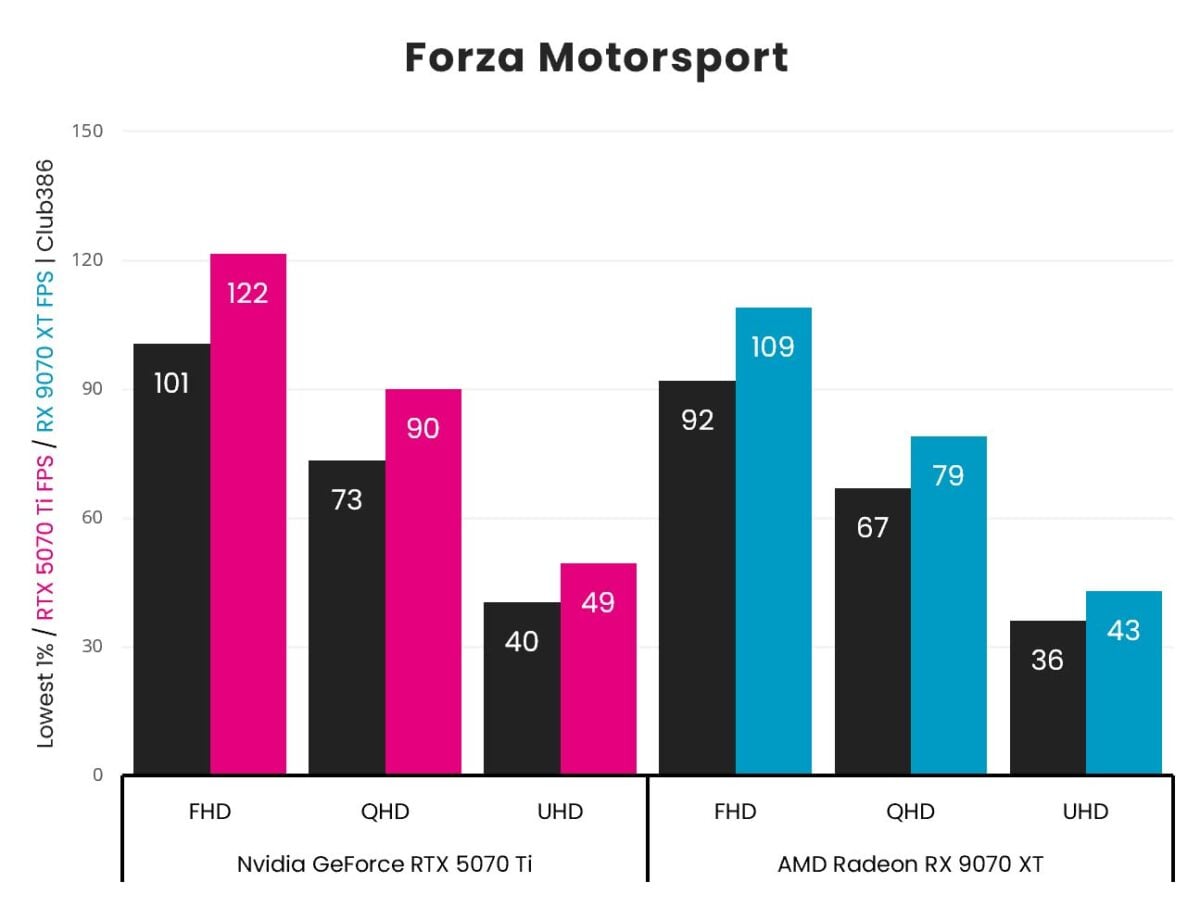
Forza Motorsport really pushes the latest GPUs to their limit, especially with all its settings maxed out in our benchmark. Again, we see the Nvidia GeForce RTX 5070 Ti beating the 9070 XT here, with a 13.9% performance advantage at QHD. Both GPUs handle this game well at FHD and QHD, though, and both also struggle a bit at 4K. QHD is really the limit in this price bracket if you want to run this game at top settings, and the Nvidia GPU has the edge.
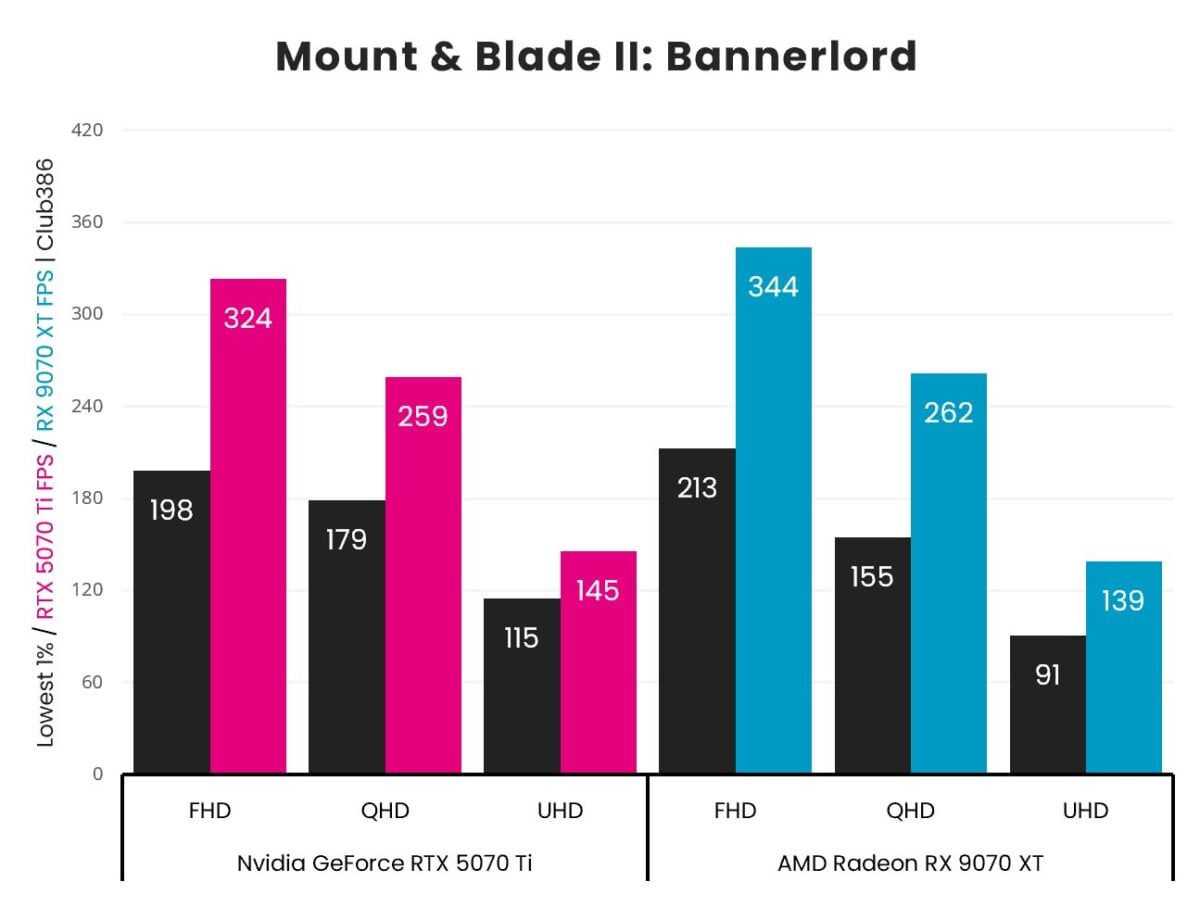
In a bit of a turnaround, Mount and Blade II: Bannerlord favours AMD’s GPU silicon at 1080p and 1440p, but the RTX 5070 Ti is faster at 4K. Both GPUs handle this game remarkably well, though, particularly at QHD. There’s really not much in it in this game – you may as well save some money and buy the cheaper GPU.
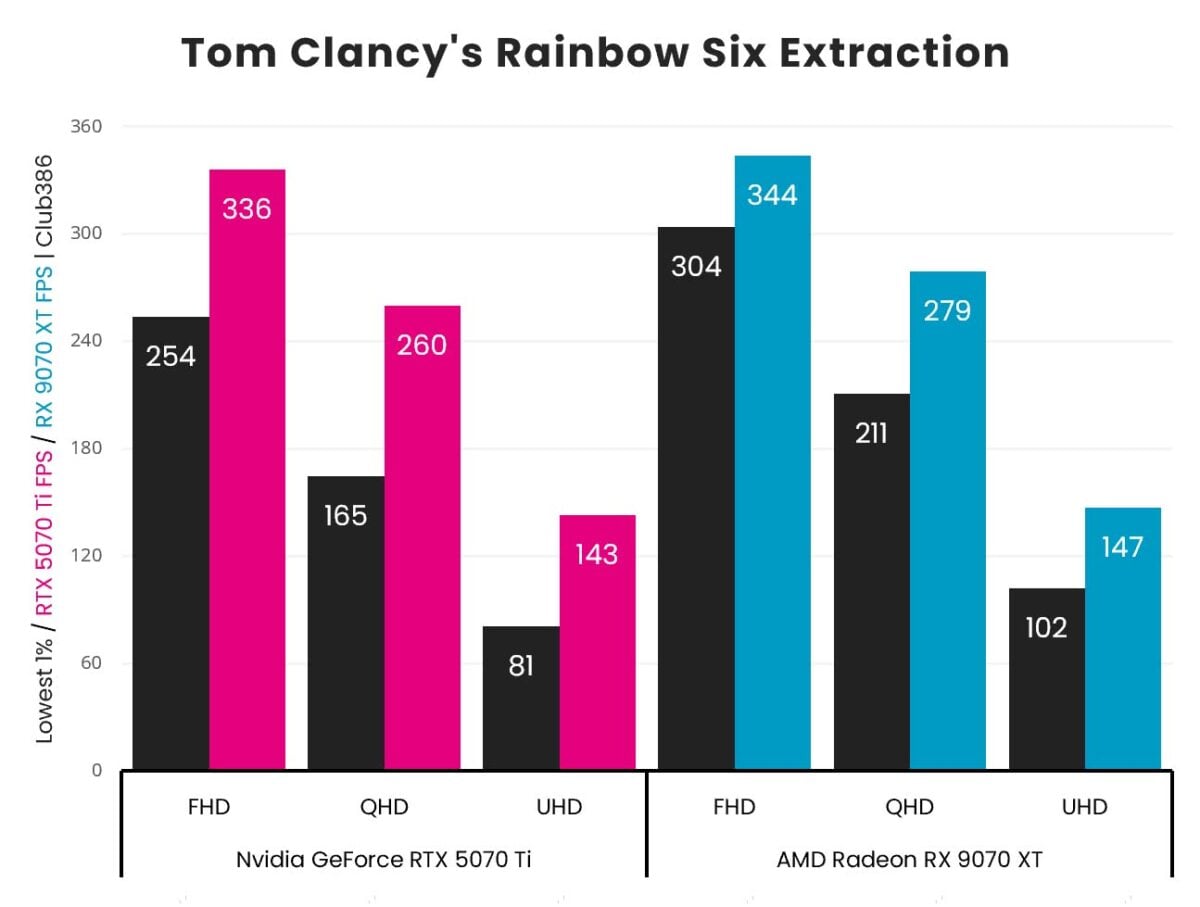
Tom Clancy’s Rainbow Six Extraction tells a similar story, but this time the AMD Radeon RX 9070 XT is quicker at all resolutions. There isn’t a huge difference when it comes to averages, but the 9070 XT is clearly able to maintain stronger minimums, meaning the frame rate isn’t dropping as far in more demanding moments. In particular, the 9070 XT’s 211fps minimum at QHD is significantly quicker than the 5070 Ti’s 165fps – the AMD GPU is 27.9% faster in this metric.
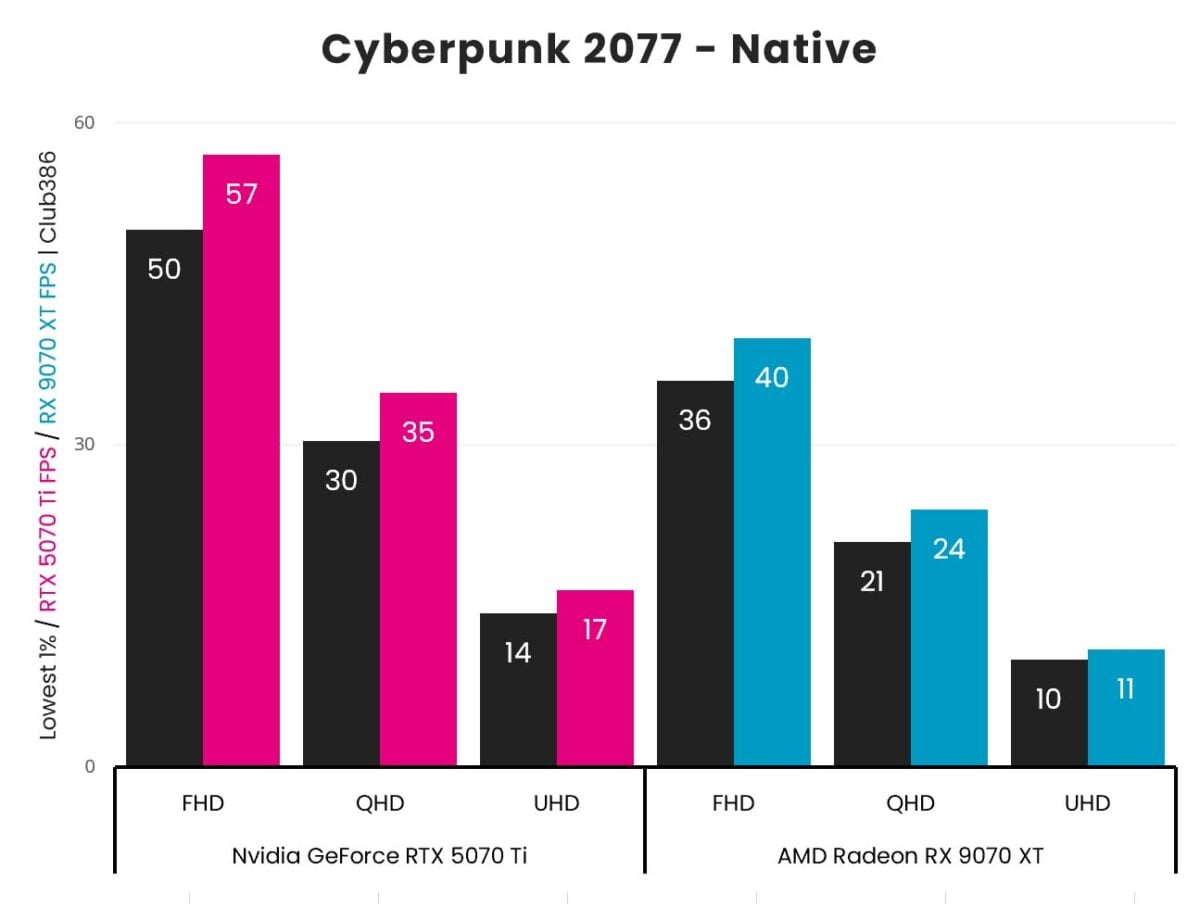
The modern-day Crysis really shows a benefit of paying more for the Nvidia GPU, as the AMD Radeon RX 9070 XT struggles in this title at the ultra ray tracing preset. To be fair, neither GPU can achieve a 60+ frame rate without any help from DLSS or FSR, even at FHD, but the 5070 Ti is clearly well ahead of the 9070 XT here. In fact, at QHD, the 5070 Ti is a massive 45.8% quicker than the 9070 XT. AMD may have made big strides in ray tracing performance with its new GPU, but it still can’t catch Nvidia in this super-demanding game with ray tracing enabled.
This test without DLSS or FSR enabled is largely academic, though, as you won’t actually want to play the game at these settings. After all, 35fps might be much quicker than 24fps, but it still feels pretty clunky in action.
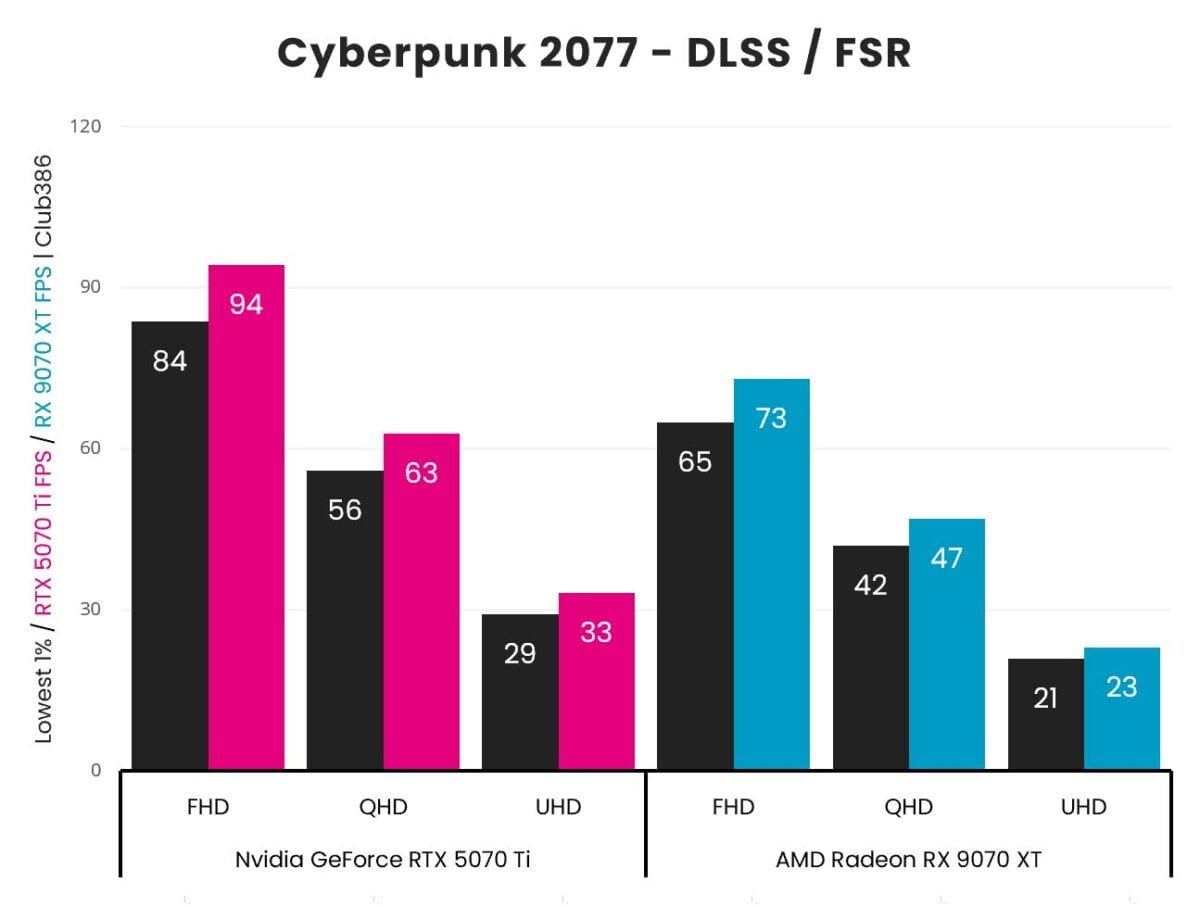
Switch on AMD FSR 4 or Nvidia DLSS Transformer with the Quality setting, and we start cooking with gas. Both GPUs can now handle this game at FHD without dropping below 60fps, and the game still looks good using these latest upscaling technologies.
Again, though, there’s no getting round the fact that the Nvidia GPU is significantly quicker here. You could even run this game at QHD with these settings on the 5070 Ti, where it looks fantastic and has a solid 63fps frame rate. Comparatively, the 9070 XT feels distinctly more sluggish at 47fps.
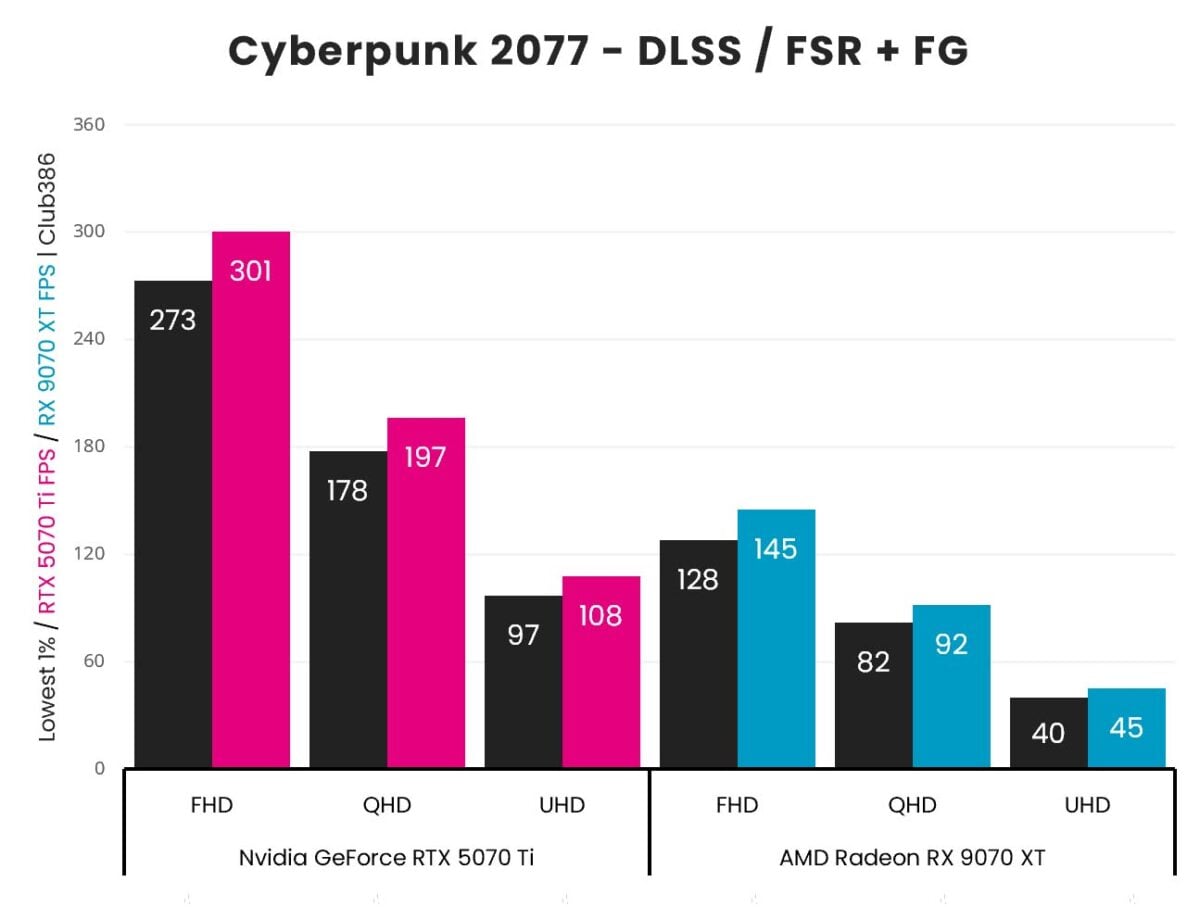
Once you shoot Nvidia’s magic frame gen bullet, the 9070 XT starts to look rubbish, but bear in mind that these sky-high frame rates don’t give you the full picture. These figures were achieved by enabling Nvidia’s 4x multi-frame gen tech, which uses AI to insert three frames between every pair rendered by your GPU. It does a great job of smoothing out motion if you have a monitor with a high refresh rate, but these figures can also mask poor performance and latency.
As a case in point, Cyberpunk 2077 looks like it has a smooth frame rate of 108fps at 4K with this tech enabled, but in actuality the game is horrible to play at these settings, with high latency, as the frame gen algorithm can only work with 33fps as a starting point. It makes for fantastic motion at FHD, though, and action is still smooth at QHD as well. Meanwhile, AMD’s basic FSR frame generation, which even now isn’t based on machine learning, struggles. Again, the game is clunky to play at QHD, as the starting frame rate isn’t high enough, and it also introduces nasty shimmering artefacts. I’d just reduce the settings to run this game without frame gen on the 9070 XT.
Power draw
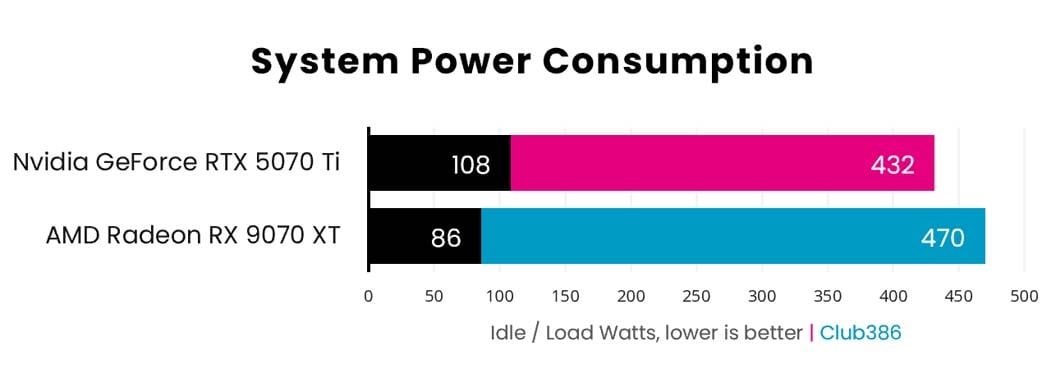
There isn’t a reference cooler for either the Nvidia GeForce RTX 5070 Ti or AMD Radeon RX 9070 XT, so it would be unfair to compare system noise and GPU temperature, as it will depend on the specific card you buy. However, we can take a look at power draw, with the caveat that one of these cards is overclocked.
As you can see in the graph below, our system draws 470W from the mains with the Sapphire Nitro+ Radeon RX 9070 XT running at full load, compared to 432W with a stock-speed 5070 Ti. That’s a difference of 37W, although the Sapphire card’s overclock will definitely count towards some of that figure. If we were comparing two stock-speed cards the difference would likely be negligible. Either way, both GPUs will be happily governed by a 750-850W PSU, and are pretty power-efficient for the performance on offer.
Conclusion
AMD has done an amazing job of catching up with Nvidia, and its Radeon RX 9070 XT is the better buy of these two GPUs at MSRP. In some games, AMD’s GPU is even faster than the pricier RTX 5070 Ti, and it’s not far behind the Nvidia GPU in most other titles. If you want to play games at QHD, then it offers fantastic performance for the money now that it’s back to normal pricing. AMD might not have an answer to Nvidia’s multi frame gen tech yet, but in terms of raw rendering power, you get much better value from the AMD GPU
AMD Radeon RX 9070 XT
“There’s a new midrange marvel in town.” Read our review.
GeForce RTX 5070 Ti
“Should it remain available and maintain its $749 MSRP, it could very well be the perfect upgrade for users still clinging to 30- or 20-Series cards.” Read our review.
It’s not a complete slam dunk, though. Cyberpunk 2077 really demonstrates the benefits of Nvidia’s latest tech, where the 5070 Ti doesn’t just have more rendering power when you enable ray tracing, but its multi-frame gen tech can make action look super smooth when your starting point is high enough. Outside of these benchmarks, we’ve also found that Nvidia’s latest GPUs are considerably better at path tracing than AMD’s RDNA 4 GPUs.
That’s not a big deal for most games, and even the 5070 Ti struggles here, but it can play Indiana Jones and the Great Circle at FHD with path tracing enabled, unlike the 9070 XT. Meanwhile, Nvidia’s DLSS tech has a lot more game support than AMD’s rival FSR 4 tech. In games that don’t support the latter, you’ll be stuck with earlier versions of FSR 3, which look poor compared to FSR 4 and DLSS.
The question is whether these features are worth the extra $150, and we’d argue that they’re not for most people’s gaming needs. When it comes to the basic raw power that’s fundamental to gaming performance, the 9070 XT is nearly as fast as the 5070 Ti, and considerably cheaper. Also, while DLSS has wider game support, FSR 4 does look great in games that support it. The 9070 XT will also support AMD’s upcoming FSR Redstone tech, which should substantially improve AMD’s AI features in games that carry it.
In short, if you can afford the extra cash for the 5070 Ti, there are good reasons to consider it. However, it’s hard to look past the big difference in price, and you’ll get much more bang for your buck with the 9070 XT,