

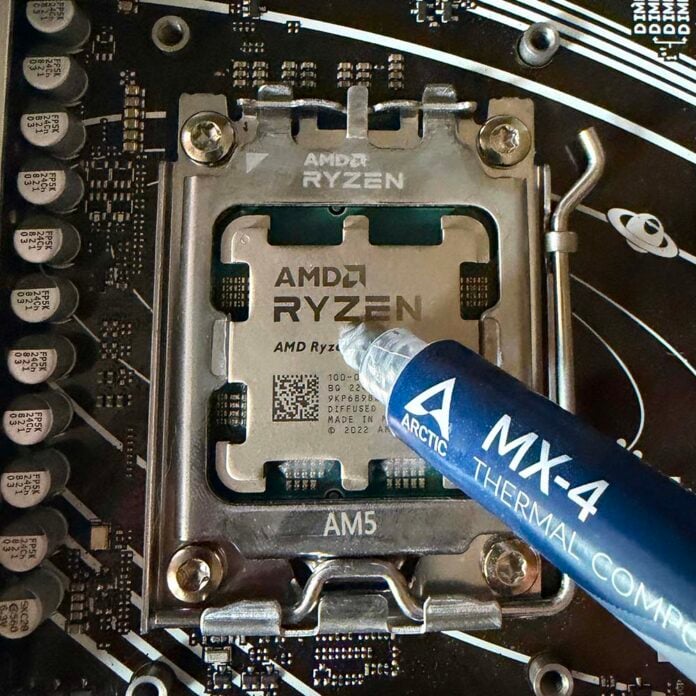
Thermal paste application has become almost as contentious as which compound to buy. For modern high-density CPUs and GPUs, how paste is distributed across the IHS could influence peak temperature, fan speed, and boost behaviour. Just as the Club386 thermal paste roundup treats paste choice in a structured, data-driven way, this text focuses on how different spreading patterns behave thermally when everything else in the test system and methodology is held constant.
Introduction
Using the same controlled environment described in the aforementioned roundup (fixed ambient temperature, repeatable mounting pressure, and repeatable load in Cinebench), various application methods can be compared by examining the steady-state average core temperature after a sustained all-core stress test. The goal is not to maximise theoretical precision, but to show which patterns deliver dependable performance on everyday gaming PCs, workstations, and small-form-factor builds.
Test methodology
During testing, ambient temperature was maintained at 21 °C ±0.5 °C. I standardised paste application patterns according to each manufacturer’s guidance and conducted a 30‑minute, all‑core stress test and recorded steady‑state average core temperature.
The aim is to achieve a controlled environment where differences of a few degrees are detectable, yet is still representative of the behaviour users can expect under sustained loads. The purpose of this configuration is not to emulate every real‑world scenario, but to provide a stable, repeatable platform.
Only conventional non-conductive pastes are used – liquid metals and pads excluded this time around – and tests are carried out on modern AMD and Intel PCs, with full specifications available below.
- CPU: AMD Ryzen 9 9950X3D
- Motherboard: Asus Crosshair X870E Hero
- RAM: 2×16GB G.Skill Trident Z5 Neo RGB 6,000MT/s CL28
- GPU: Asus TUF Gaming GeForce RTX 5080
- Chassis: Havn BF360
- Cooler: Tryx Panorama 360
- PSU: be quiet! Dark Power 14 1000W
- CPU: Intel Core i9-13900K
- Motherboard: Asus ROG Strix Z690-E Gaming WiFi
- RAM: 2×16GB Geil Gemini RGB TUF 6,000MT/s CL34
- GPU: Asus TUF Gaming GeForce RTX 5080
- Chassis: Havn BF360
- Cooler: Tryx Panorama 360
- PSU: be quiet! Dark Power 14 1000W
Application Patterns
Enthusiast and professional guides consistently highlight a handful of popular patterns for desktop CPUs:
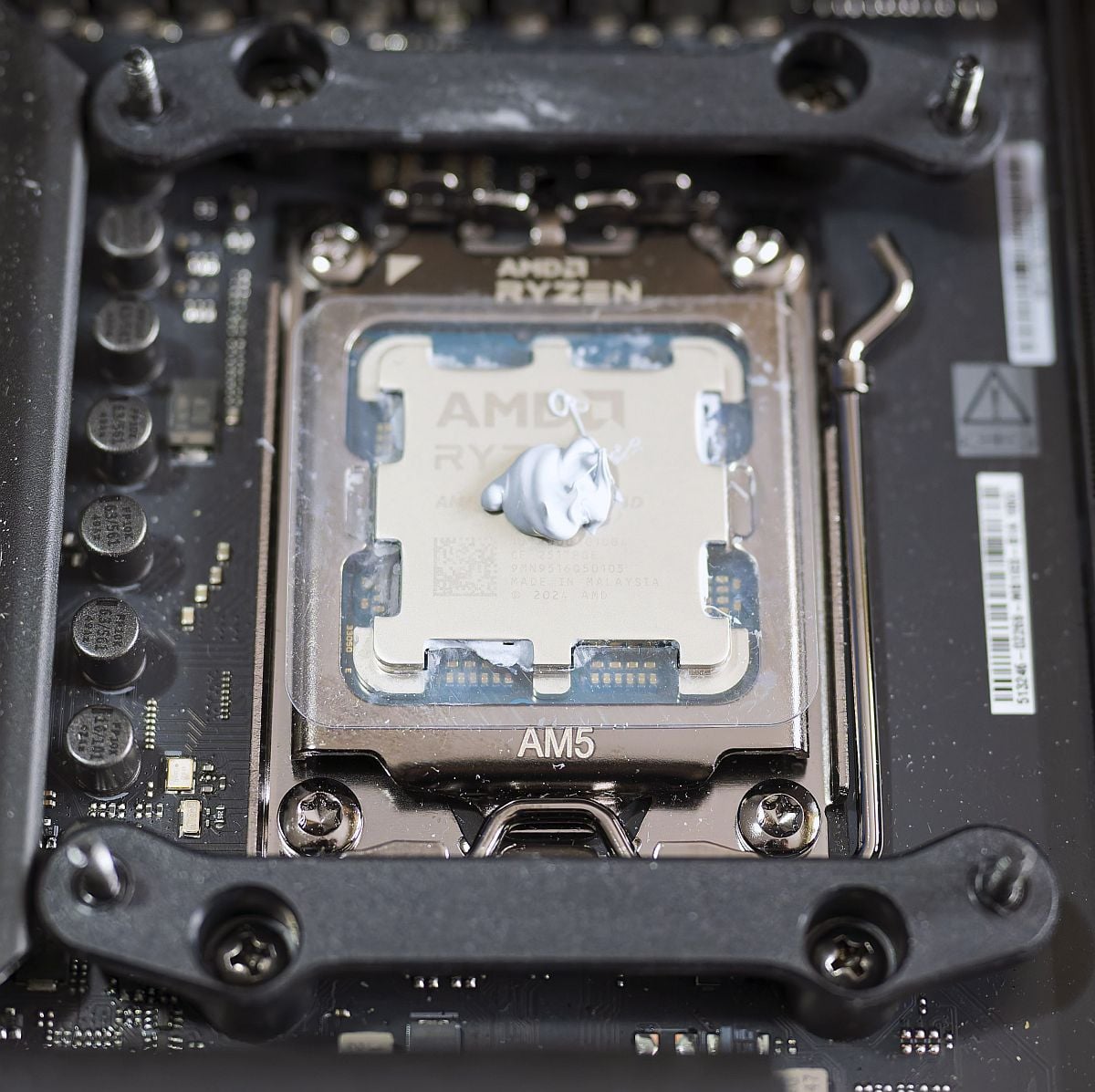
• Single central dot (“pea method”). A rice-to-pea-sized blob is placed in the centre, relying on mounting pressure to spread.
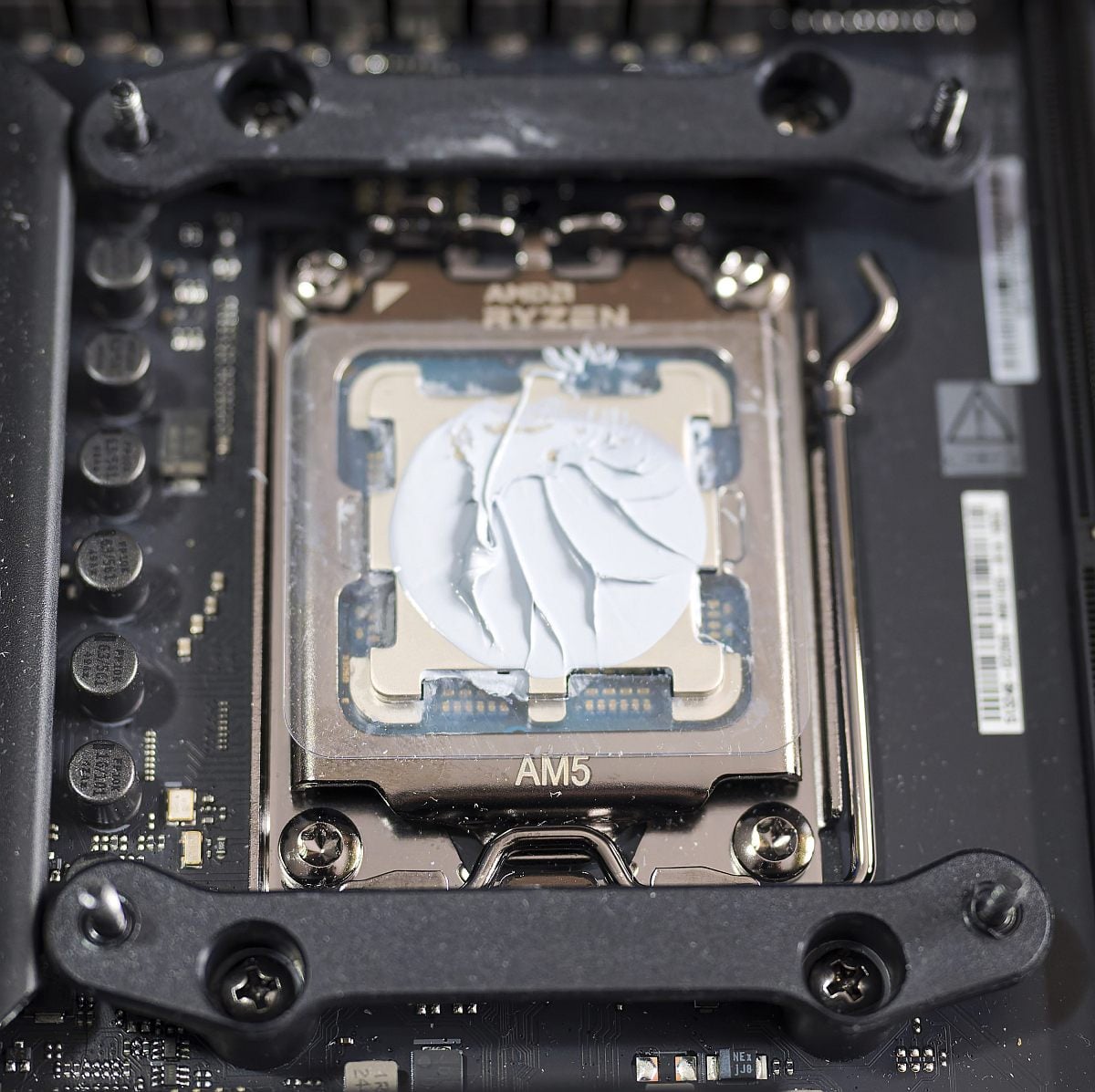
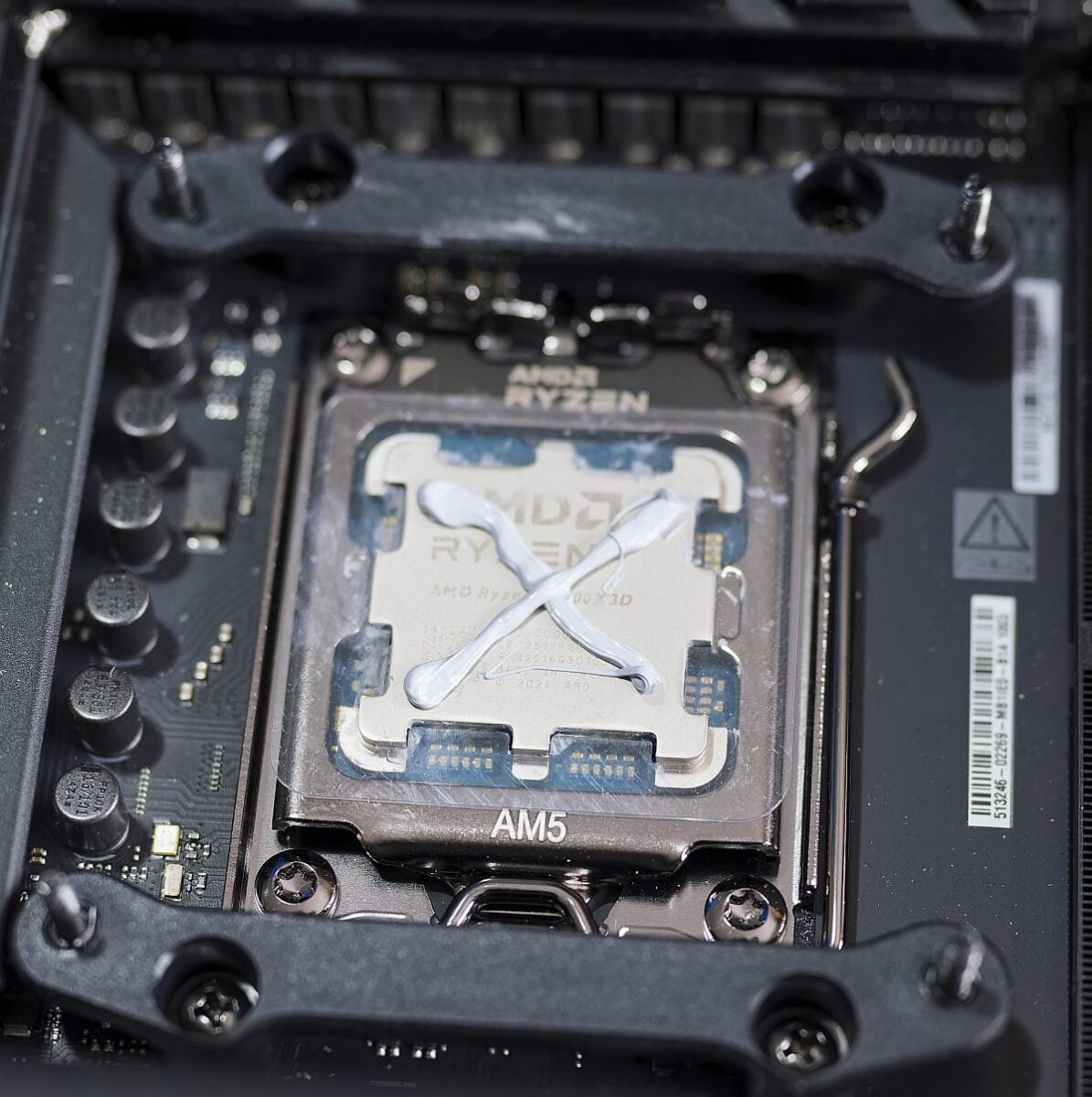
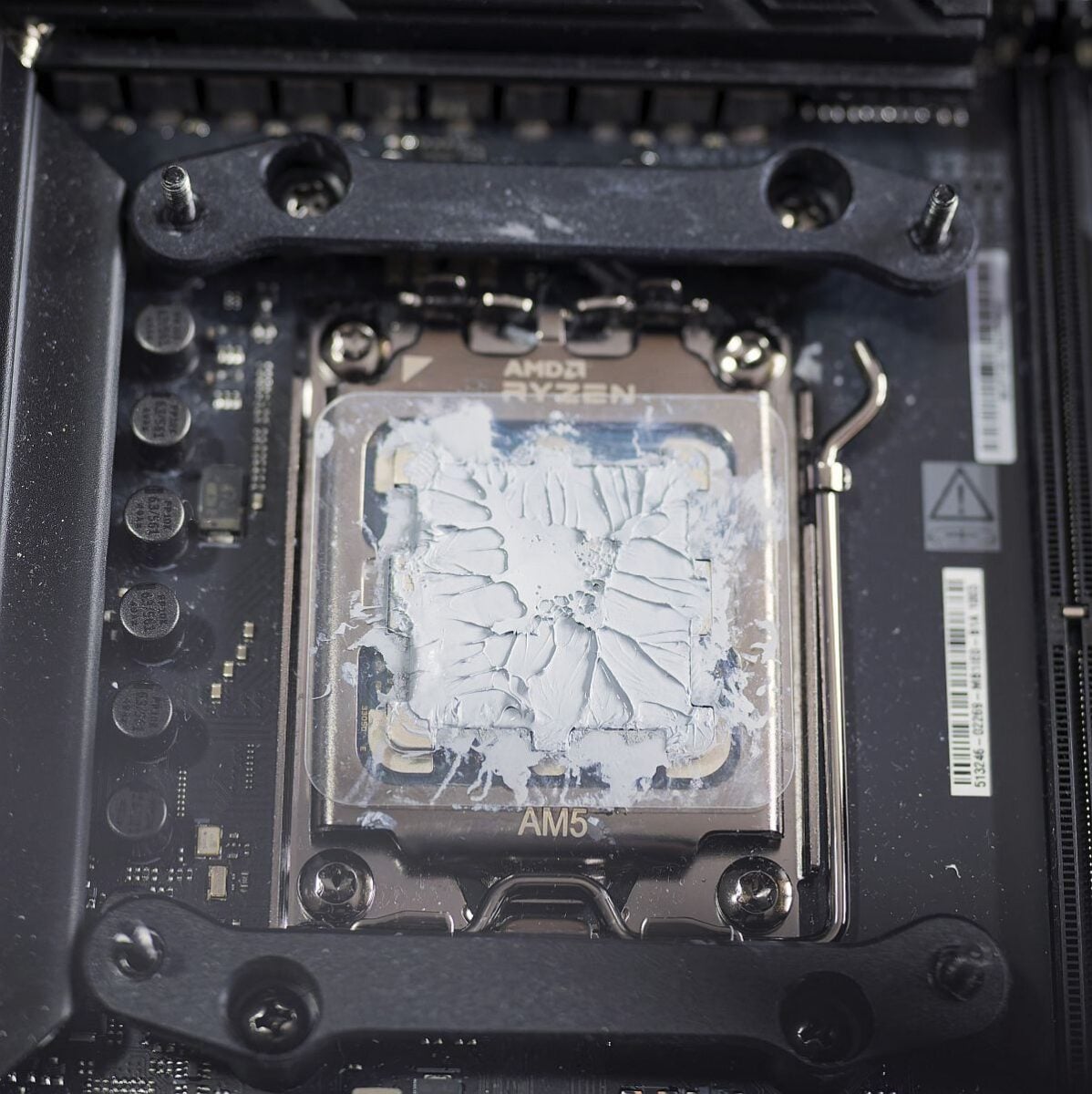
• X or cross pattern. Two diagonal lines forming an X to encourage spreading from the centre outward and into the corners.
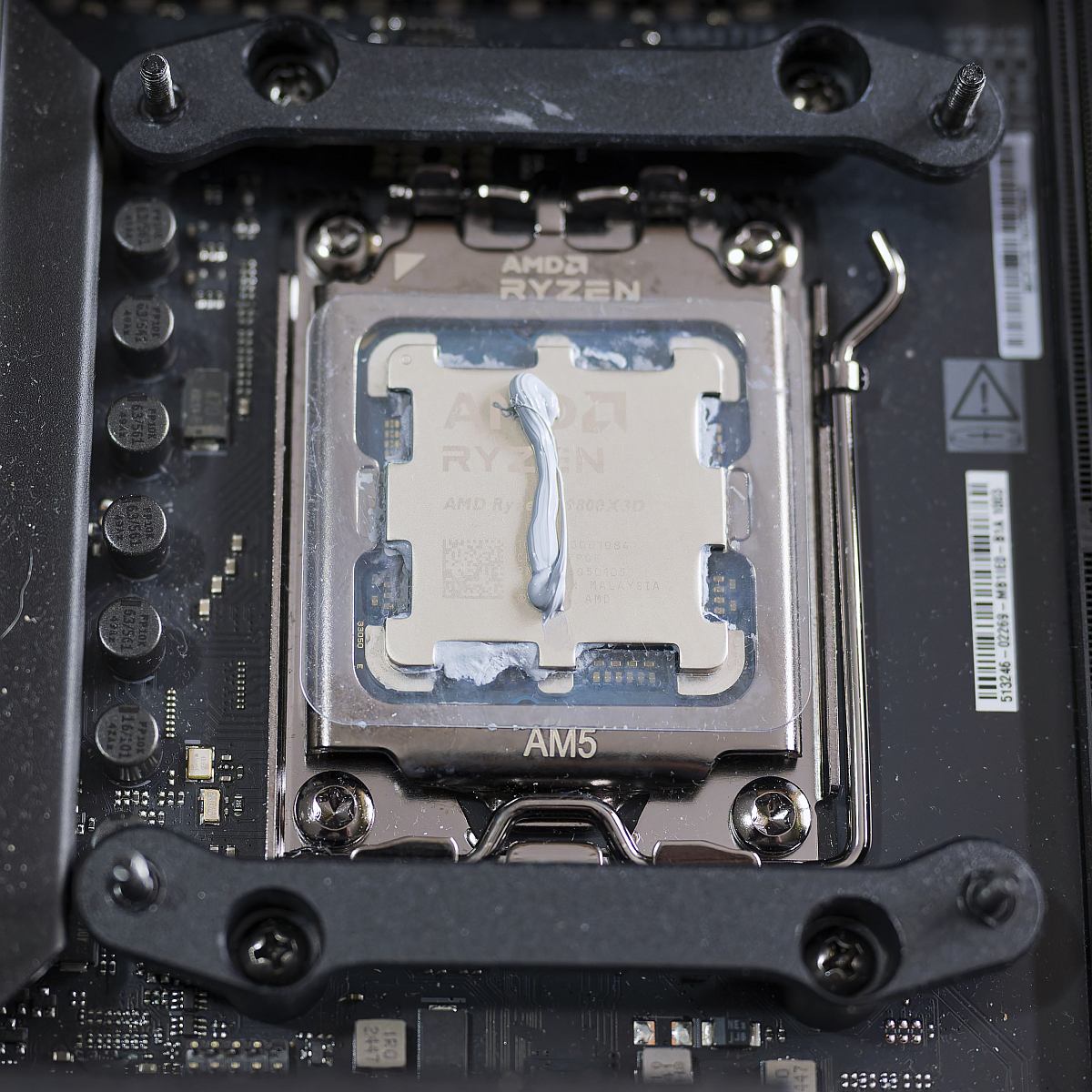
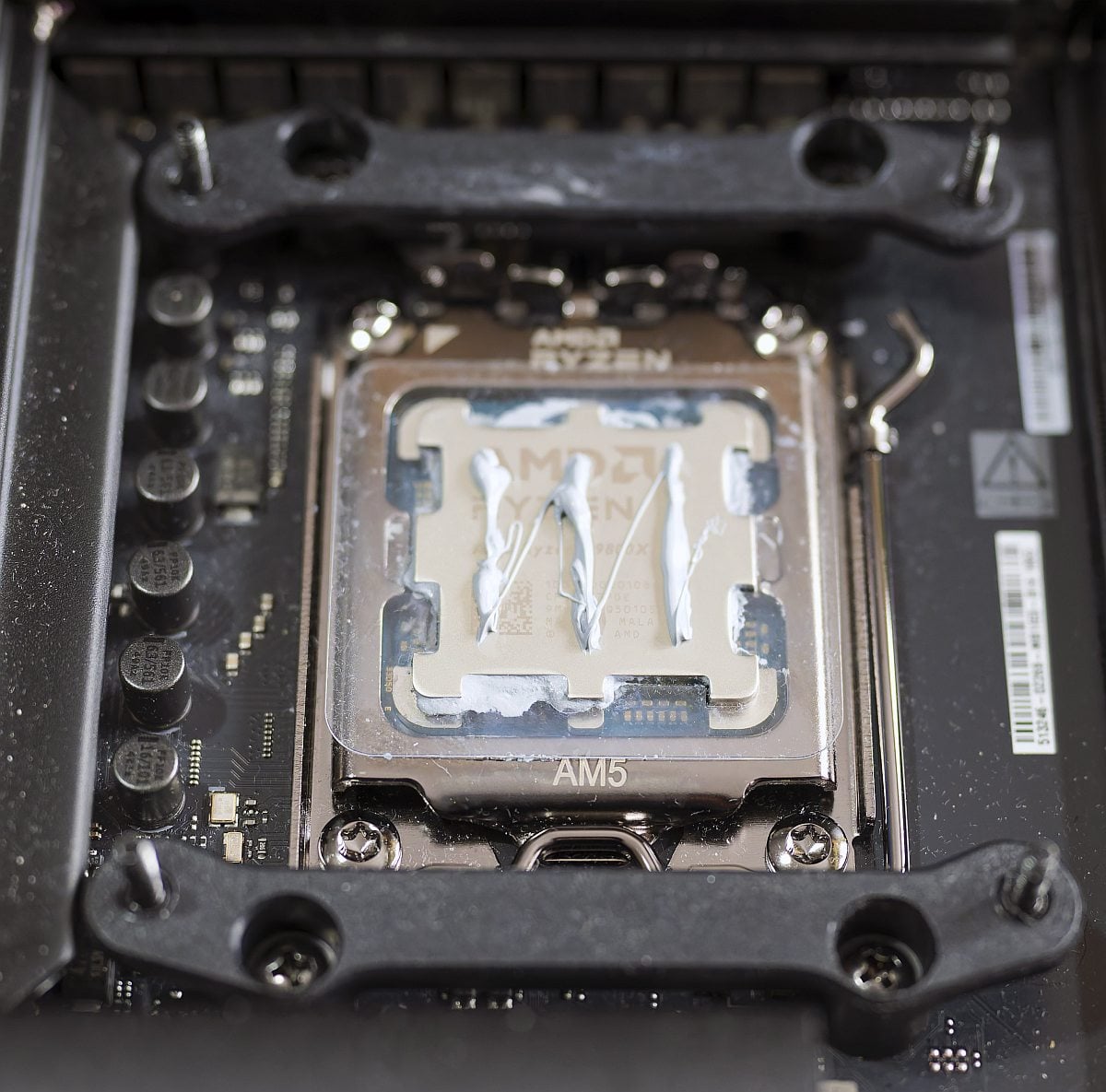
• Single line (or multiple parallel lines). One vertical line or three thinner lines intended to align with the die layout under the IHS.
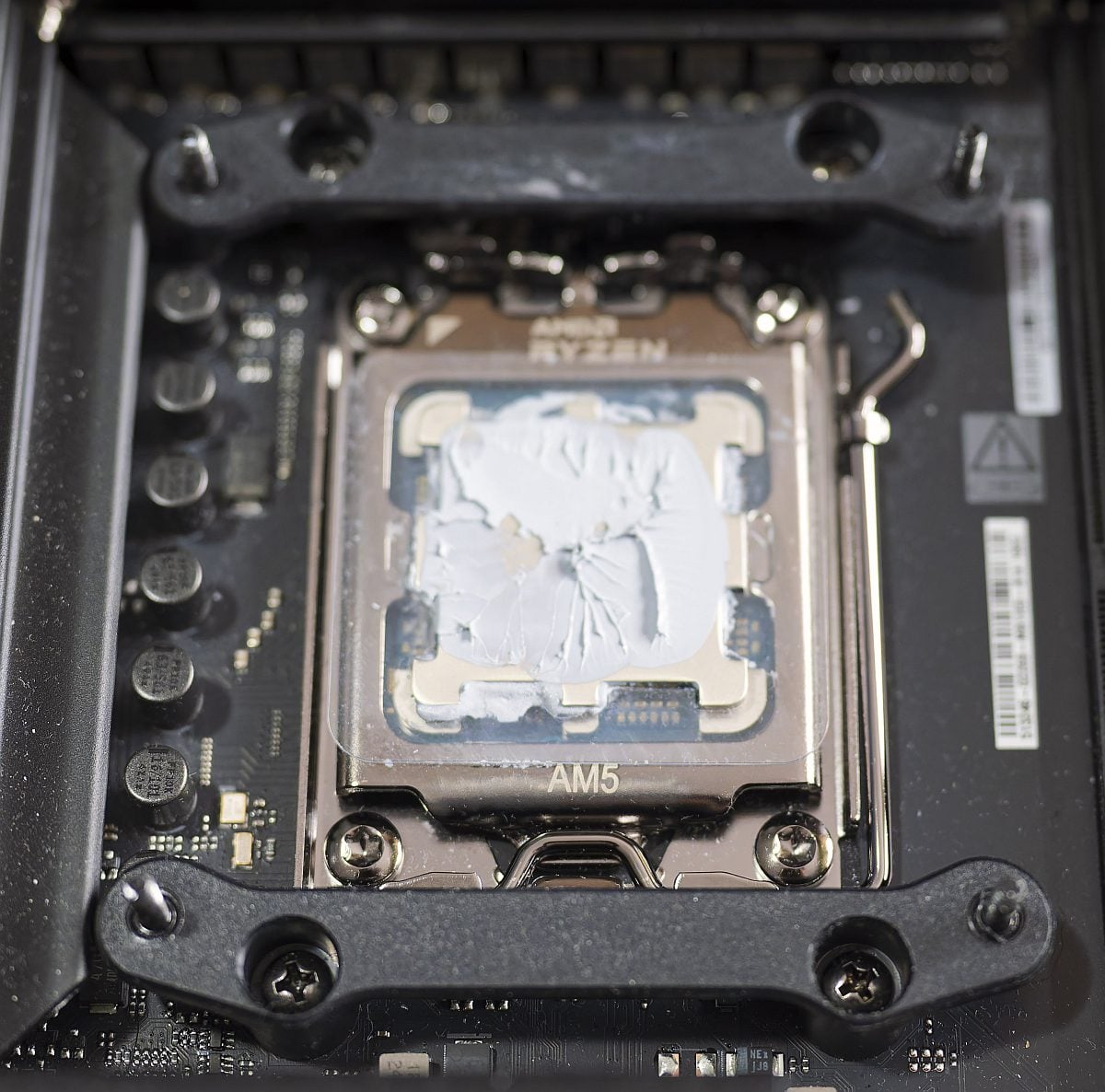
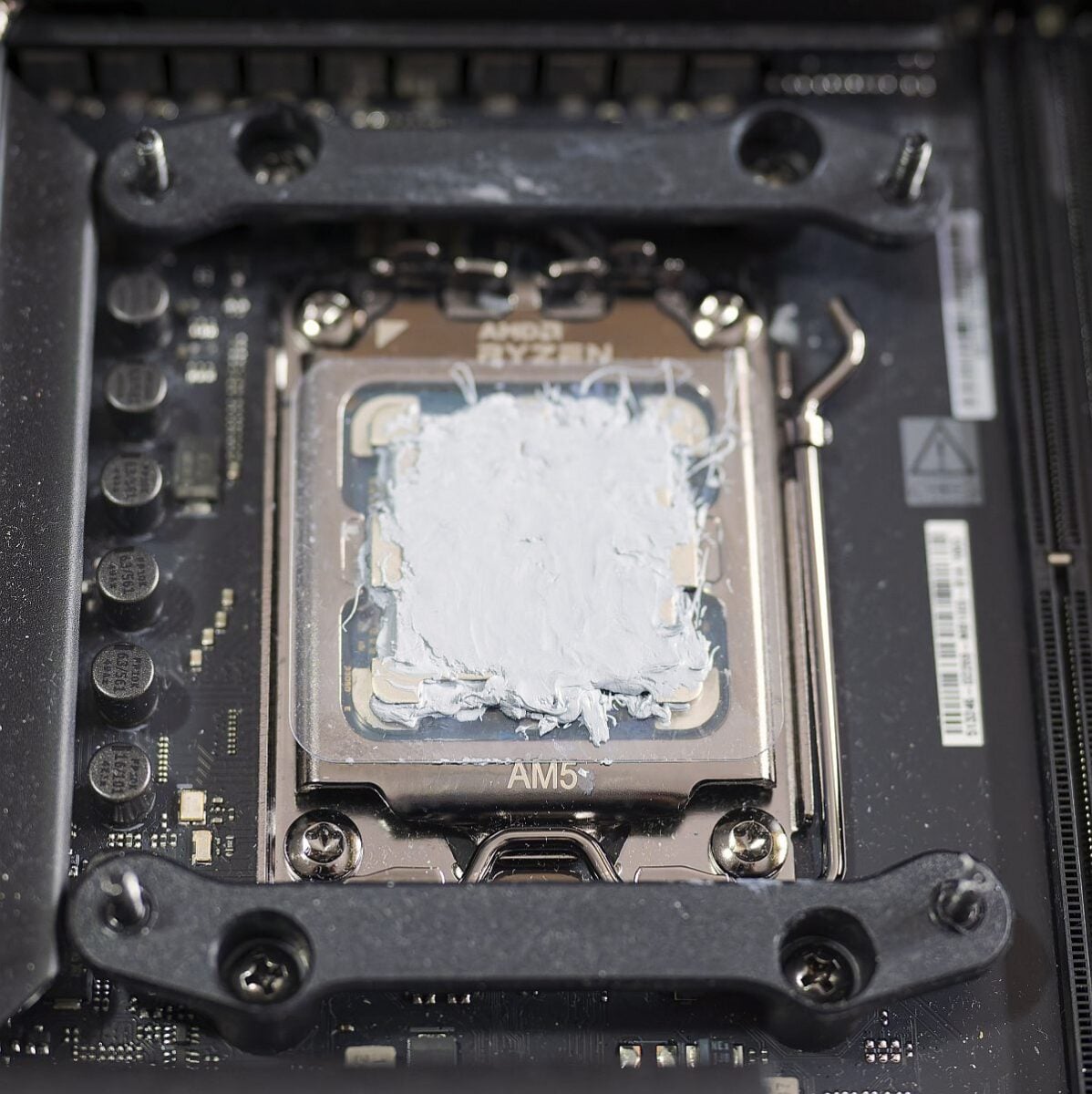
• Full manual spread (“buttered toast”). Apply the paste in a thin, uniform layer across the entire IHS using a card or spatula.
• Multi-dot / five-dot patterns. Several small dots are spaced across the IHS to improve coverage on larger heat spreaders.
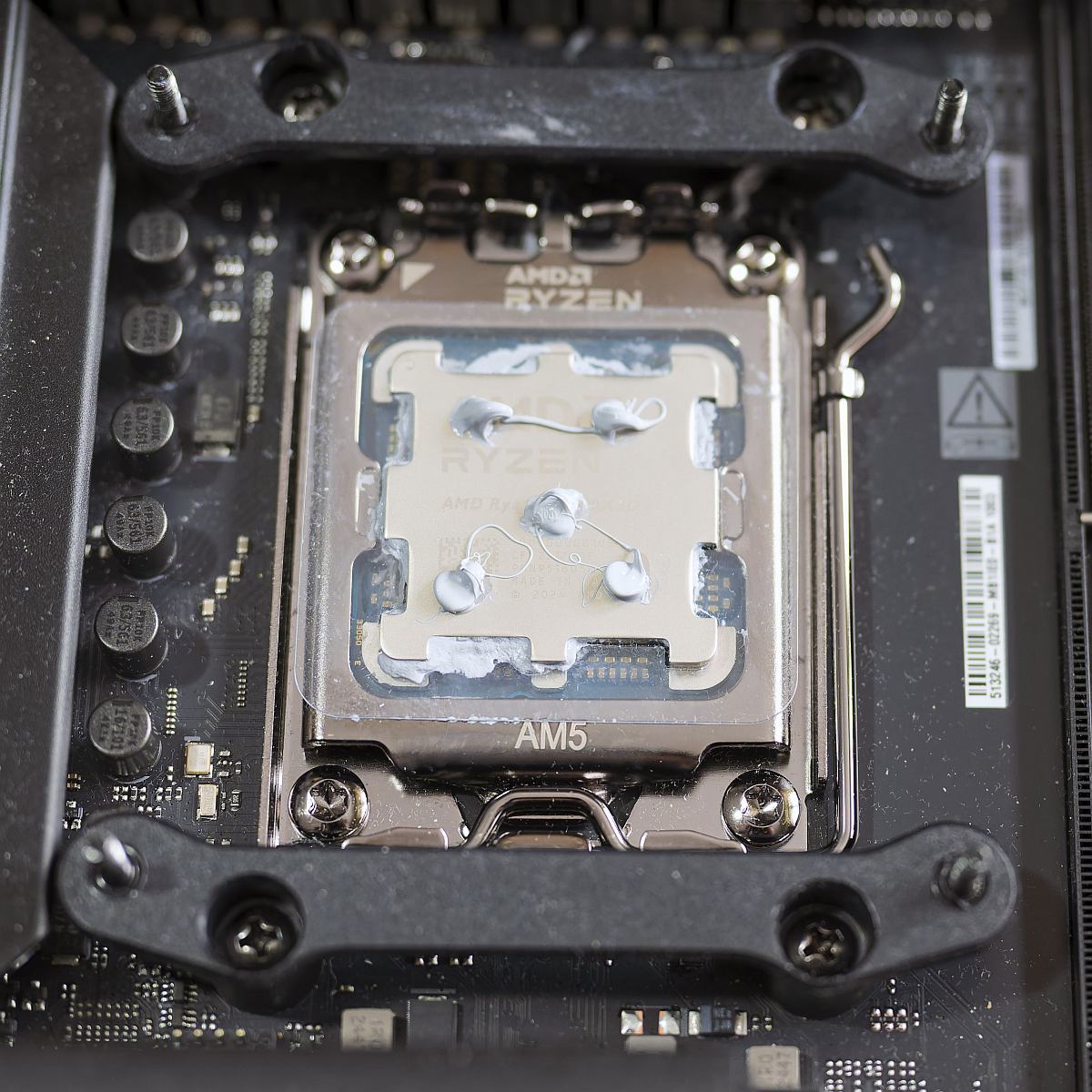
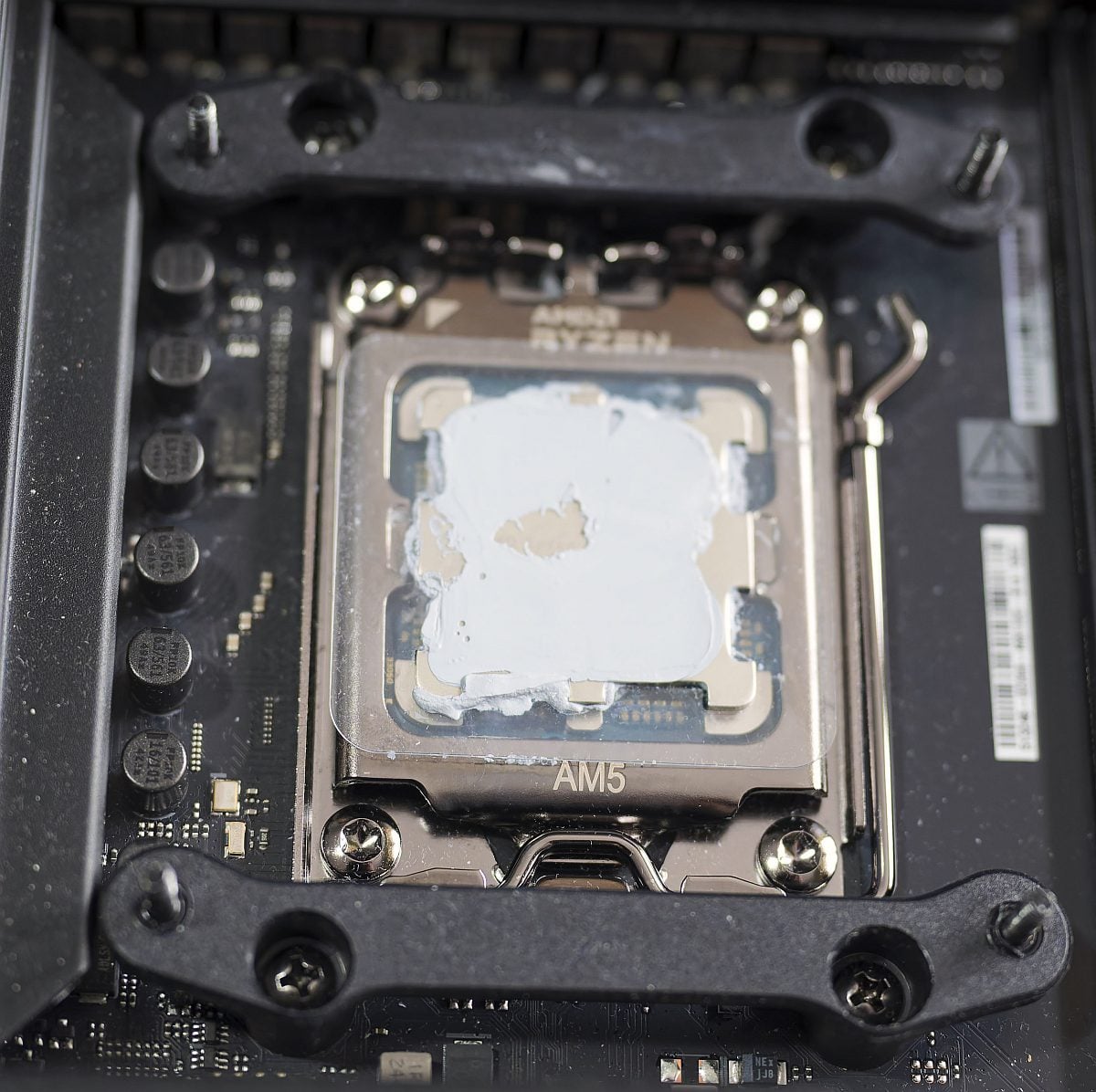
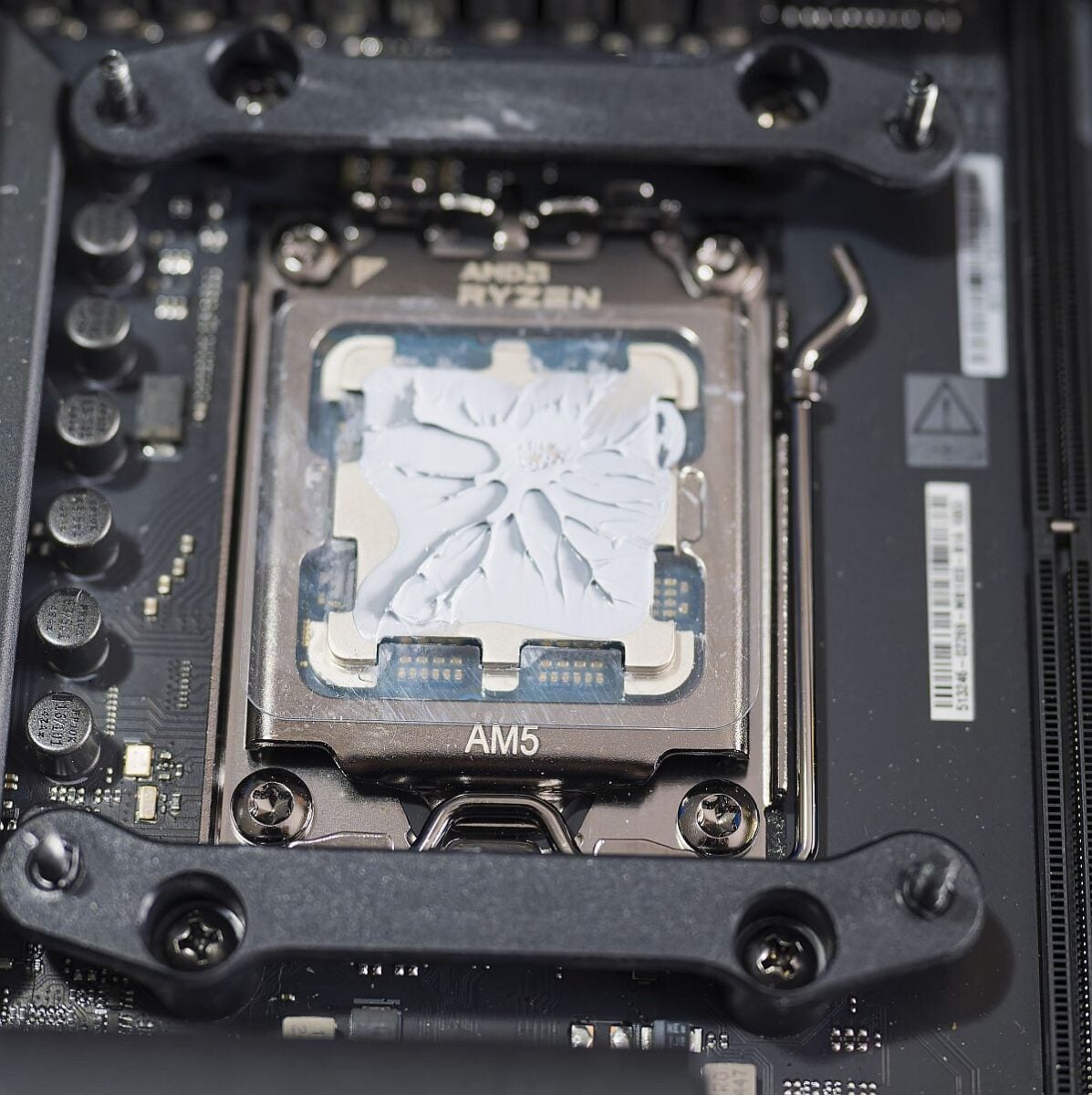
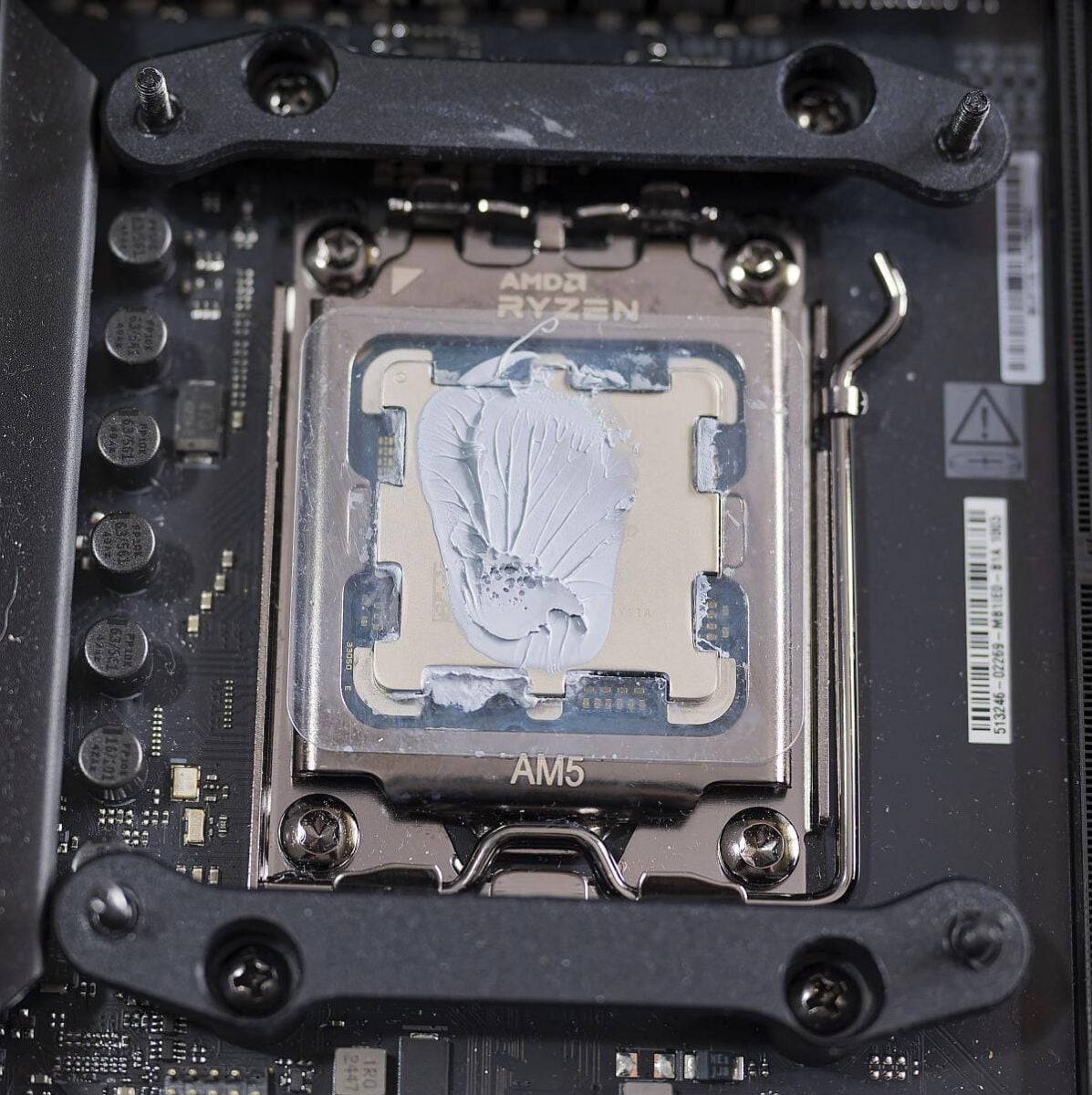
Visual spread on test setups shows that central dots and single lines often leave thin or uncovered edges on larger heat spreaders. In contrast, patterns like X or full spread tend to cover more of the surface and minimise trapped air pockets. At the same time, excessive paste creates more mess and slightly higher pump-out risk rather than drastically worse thermals, provided coverage remains continuous.
Performance Measurements
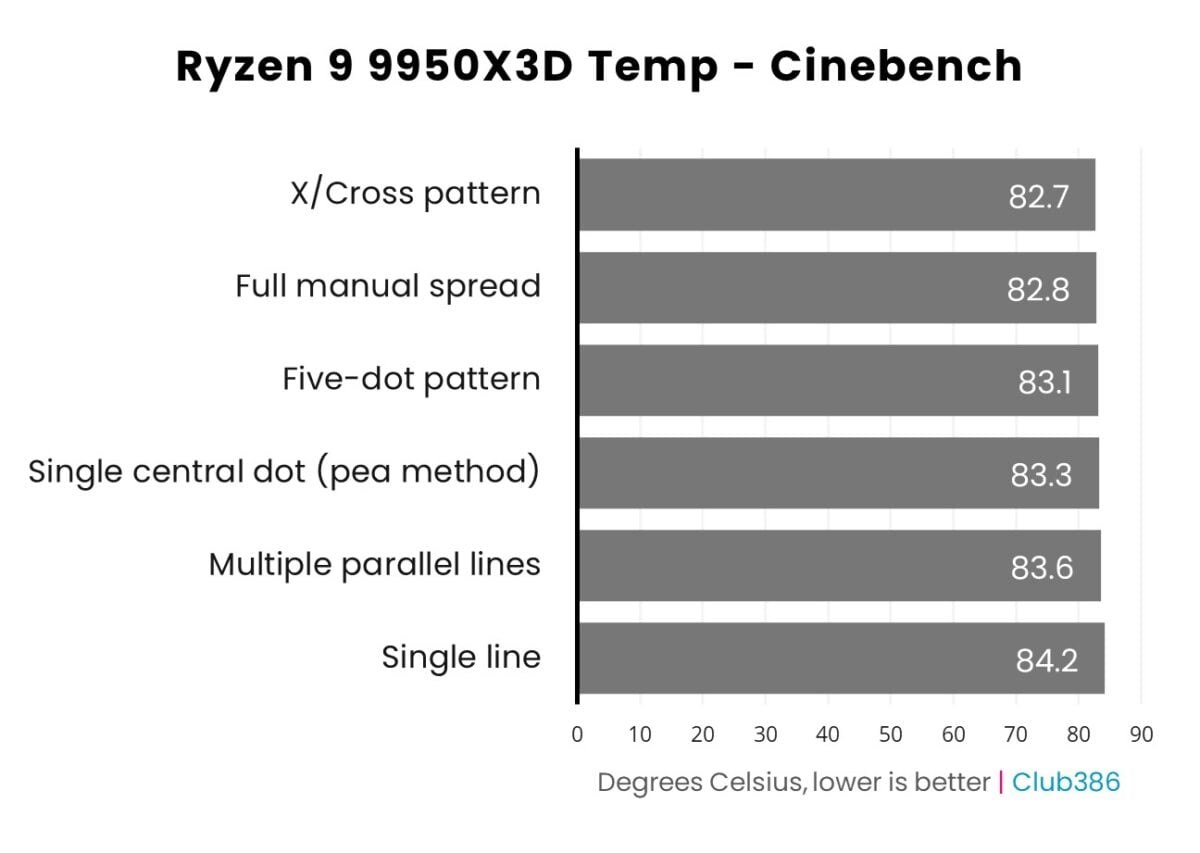
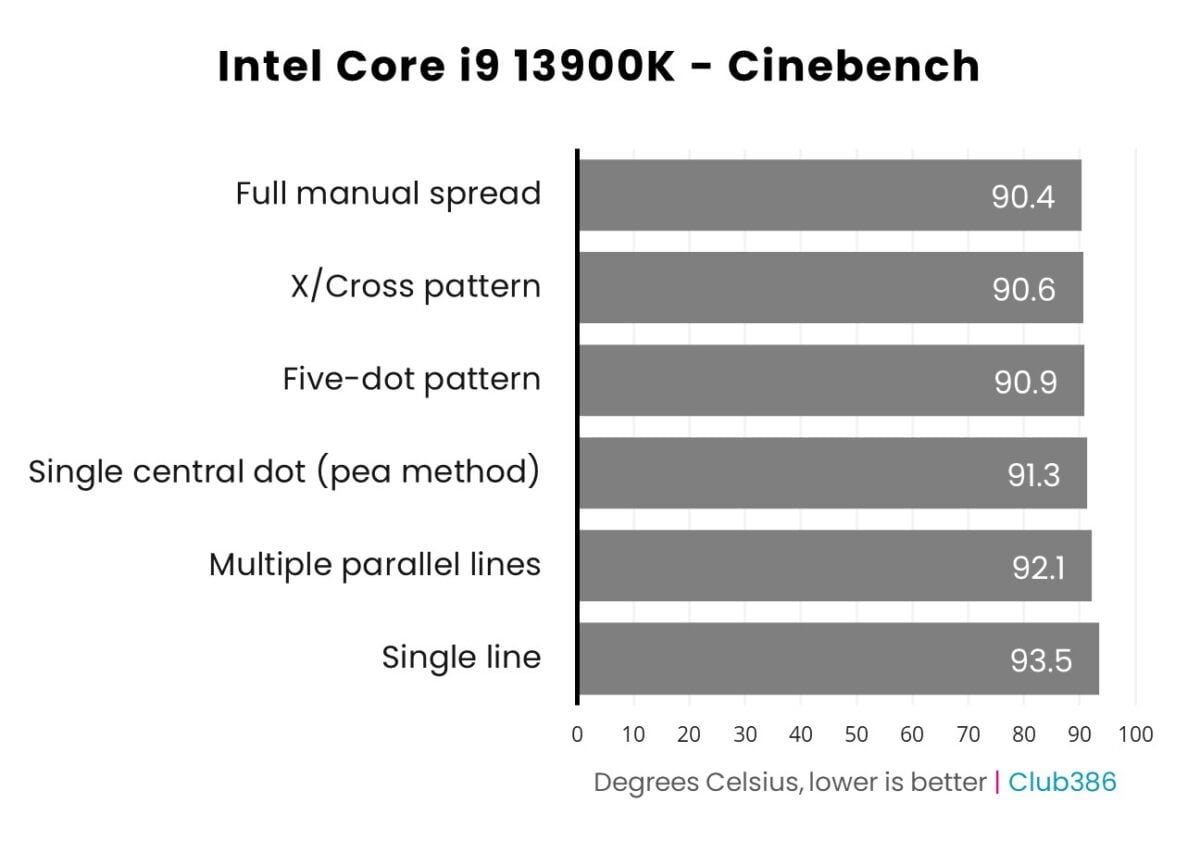
Findings
Unsurprisingly, most common thermal paste patterns perform very similarly as long as they achieve full, bubble-free coverage with a thin layer. Putting the available evidence together, the most practical methods balance temperature, coverage reliability, and ease of application:
- Single central dot
Offers a simple, repeatable application with performance typically within about 0.5–1.0 °C of the best methods on standard desktop CPUs. Recommended by several vendors and reviewers as a safe default, especially when the IHS is not unusually large, and cooler mounting pressure is strong. - X / cross pattern
Consistently delivers excellent coverage with minimal air pockets and has topped at least one controlled benchmark by a small margin. Particularly attractive on larger heat spreaders or multi-chiplet CPUs, where corner coverage and diagonal spread help ensure all hot spots are bridged. - Full manual spread
When done carefully with a spreader or card, it achieves near-perfect coverage and temperatures that are effectively tied with the X. Best suited to users who are comfortable with a slightly more involved application process to avoid an overly thick layer. - Single line / Multi-line / five-dot pattern
The single line, in particular, can create air bubbles, whereas multi-dot faring performs better in this regard. In contrast, patterns that either under-cover the IHS (too small a dot, overly narrow line) or create complex shapes that trap larger air bubbles tend to be marginally worse and less predictable, offering no real benefit.
For most users, ensuring a thin, continuous layer over the die’s active area and avoiding obvious gaps matter far more than choosing between chart-topping patterns.
Summary
Under a controlled test system and methodology similar to that used for comparing different thermal pastes, application pattern influences CPU temperature by only a few tenths of a degree when executed correctly, with X, thin spread, and pea-style methods all falling within a narrow performance band.
Temperature differences between well-executed patterns are small but measurable. An X pattern and full spread produced the best average result under full load. Once there is enough paste to fill microscopic gaps and ensure full coverage, adding more paste or slightly changing the pattern rarely costs more than 1-2 °C on mainstream desktop CPUs.
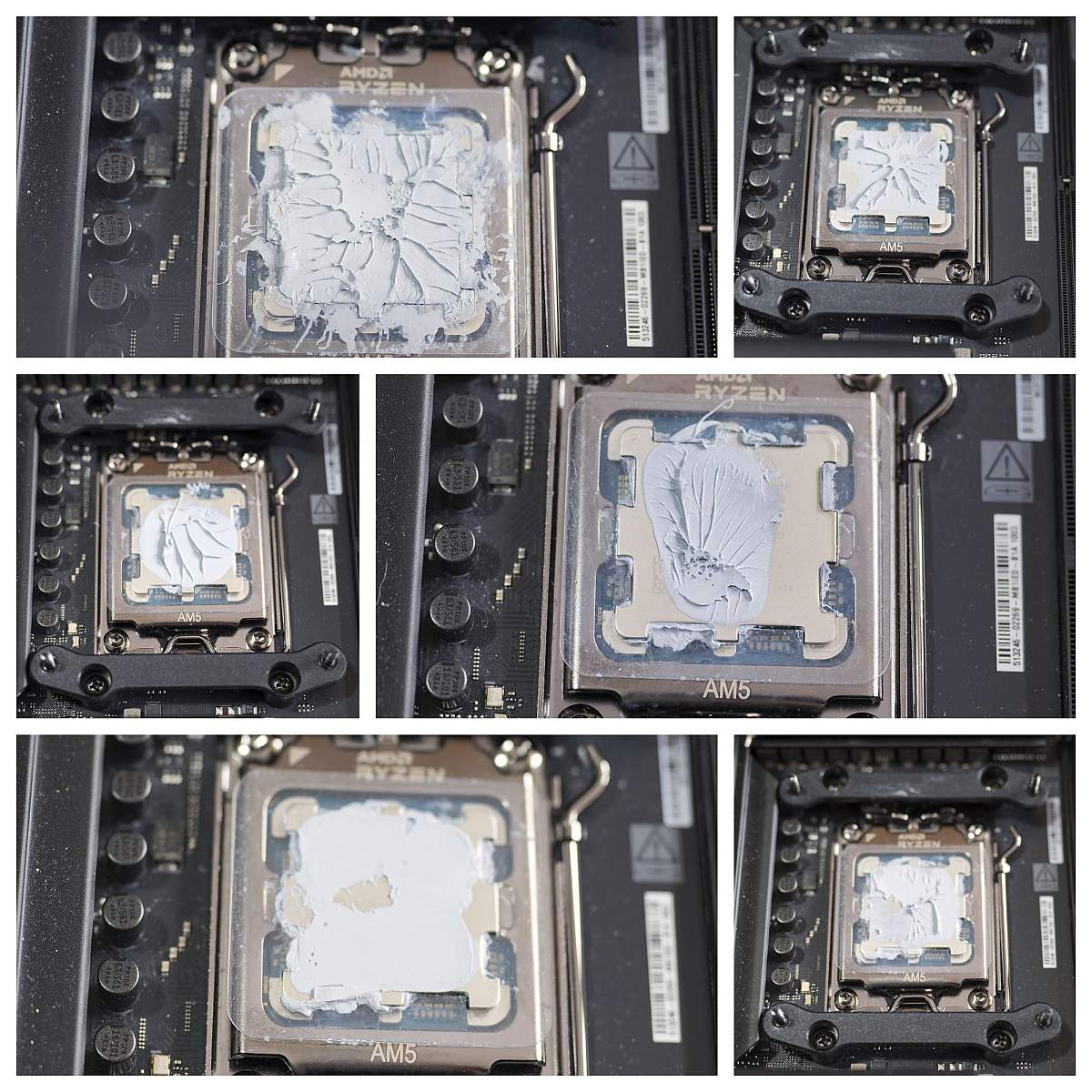
A whole lot of applications later, and with paste everywhere, I can safely say the most sensible choice is to pick a pattern that reliably ensures full coverage and minimal air pockets for your specific CPU size and mounting system. Aim for an X for larger IHS, a pea dot for straightforward mainstream installs, or a careful full spread for enthusiasts who value absolute consistency.