
Western Digital has showcased its latest innovations in HDD storage, promising up to an 8x performance boost. The company aims to make HDDs more competitive by boosting their capacity and speed through a dual-pivot access technology, with the hope of countering QLC NAND SSDs.
Though SSDs continue to dominate all market segments that require loads of bandwidth or quick access, HDDs still manage to maintain a foothold thanks to their lower cost per terabyte and stronger cold-storage characteristics. As such, they remains a solid option for mass-storage servers and datacentres thanks to technologies such as Heat-Assisted Magnetic Recording (HAMR), despite QLC SSDs’ growing competitiveness.
To ensure their future relevance, Western Digital is developing High-Bandwidth HDDs, which increase transfer speed while reducing access at the same time. To do so, these drives use two separate read and write heads on each platter surface, enabling simultaneous operations and boosting performance. The initial implementation of this technology should provide about a 2x increase in bandwidth, with subsequent iterations aiming for 4x improvement, and even 8x when the technology becomes mature enough.
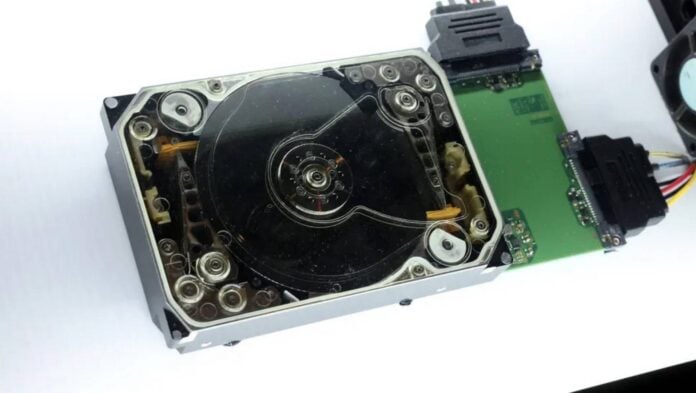
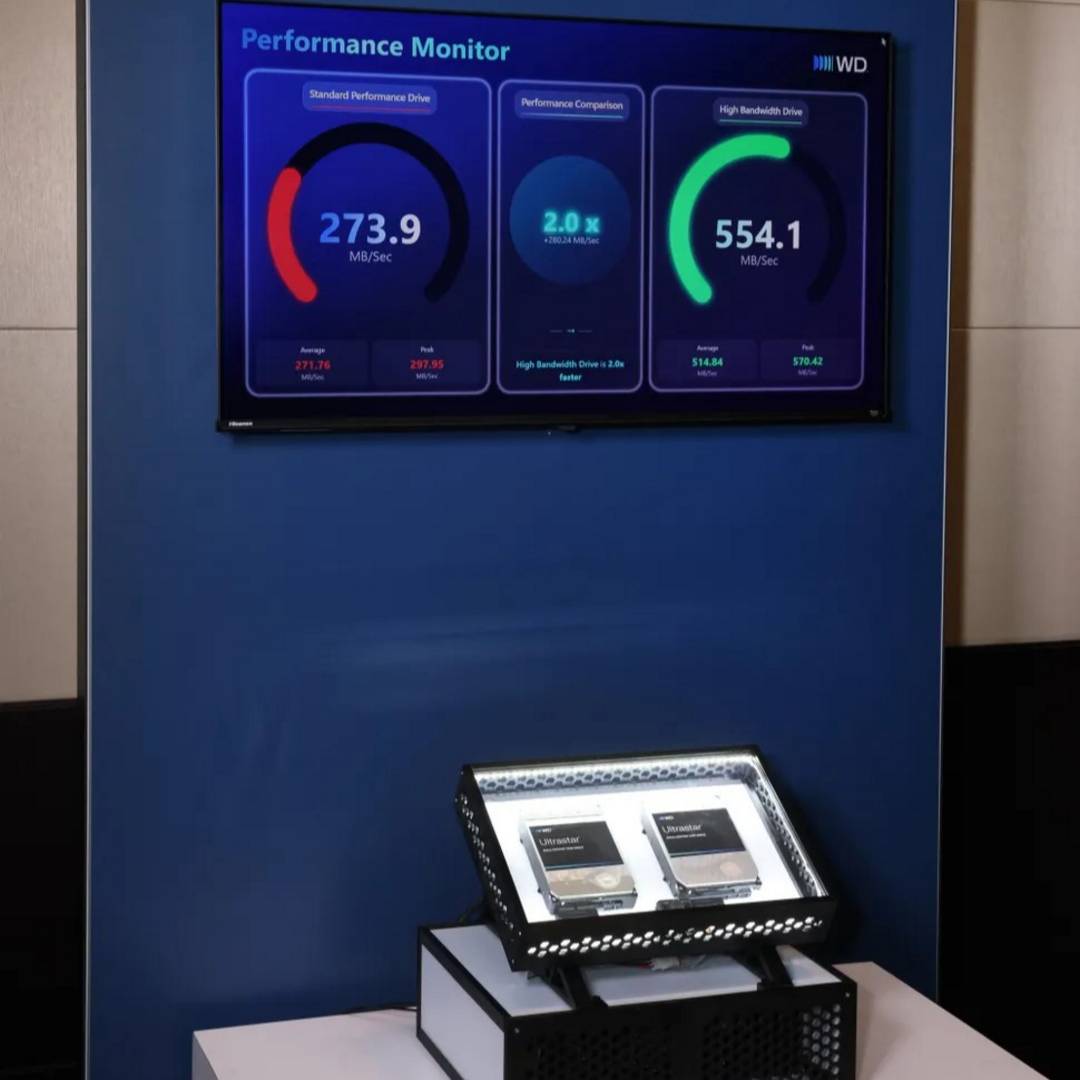
Western Digital showcased a prototype unit in which you can clearly see the separate actuators, alongside some speed measurements. According to these, a High-Bandwidth HDD can reach up to 570MB/s compared to 297MB/s for regular HDDs, i.e. nearly 2x the speed. Down the line, the brand expects to reach 2GB/s, moving HDDs closer to QLC SSDs. Understandably, such speed would require modern interfaces as SATA III’s 6Gb/s wouldn’t cut it. Perhaps SAS-4 with its 22.5Gb/s (~2,000MB/s real speed) or NVMe U.2/U.33.
The best part is that this technology doesn’t seem to require any external changes to the HDDs’ design, meaning they would remain compatible with existing interfaces and server bays. Better yet, these I/O and bandwidth increases are said to be at no extra power cost, which is another important metric in petabyte-capacity deployments. In other words, these new HDDs should be a drop-in upgrade.
But that’s not all, Western Digital is also developing another lineup of power-optimised drives targeting cold storage and AI-generated data. These will be designed for long-term data retention while maintaining quick access at a moment’s notice. The idea is to slot these between tape storage and HDDs, trading some random I/O speed for higher capacity and 20% lower power consumption.
As we speak, some aspects of High-Bandwidth HDDs are currently being validated by Western Digital’s clients, with a release scheduled sometime in 2028. As for the power-optimised HDDs, they should begin customer qualification in 2027, likely releasing after 2028.