
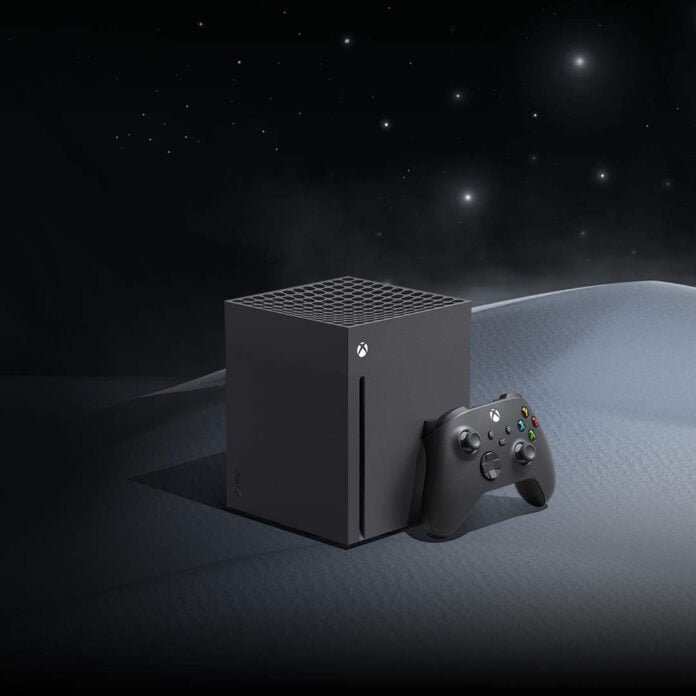
Microsoft has reportedly settled on the final silicon configuration for its next-gen Xbox, combining Zen 6 CPU cores with RDNA 5 GPU compute units (CUs). Code-named Magnus, this console is expected to launch sometime in 2027, offering a significant performance boost over its predecessor.
According to Moore’s Law Is Dead (MLID) on YouTube, a serial leaker, the next-gen Xbox will benefit from several architectural leaps over current Xbox Series machines, which should translate into a massive performance uplift. Specifically, Magnus is rumoured to pack three Zen 6 cores plus eight (dense) Zen 6c cores with 12MB of L2 cache in a hybrid CPU design like the Ryzen Z2 Extreme powering MSI’s Claw A8 handheld, albeit more powerful.
This combination should strike a good balance between single-threaded and multi-threaded performance while taking up less silicon area compared to traditional homogeneous designs. That said, Zen 6c’s higher density and lower power consumption will likely come at the cost of lower operating frequencies and cache levels, and the impact of which will be interesting to measure when the console launches.
On the graphics side, MLID’s sources indicate that Microsoft opted for 68 CUs sharing at least 24MB of L2 cache, based on a cut-down 70 CU RDNA 5 chip. This means that Magnus’s GPU is 30% richer than the Xbox Series X. However, despite that, Magnus’s GPU is expected to be 29% smaller than the Series X’s thanks to the use of TSMC’s N3 node. This GPU is believed to have the exact design AMD intends to use for its RX 9070 XT successor. Overall, the chip powering next-gen Xbox is said to measure 408mm², split into 144mm² for the SoC and 264mm² for the GPU.
Memory-wise, Magnus is said to house up to 48GB of GDDR7 memory, linked via a 192-bit bus. This is a hefty amount of memory, which seems unrealistic in current market conditions. Well, unless Microsoft managed to obtain fantastic contract pricing or plans to sell its console for over £1,000.
| Xbox Series X | Next-gen Xbox | |
| CPU cores | 8 Zen 2 | 3 Zen 6 + 8 Zen 6c |
| GPU | 52 RDNA 2 CUs | 68 RDNA 5 CUs |
| Memory | 16GB GDDR6 | Up to 48GB GDDR7 |
| NPU | N/A | Up to 110 TOPS |
Lastly, the SoC is expected to feature a built-in NPU (Neural Processing Unit) capable of delivering up to 110 TOPS of AI performance. This NPU is said to offer two operating modes, accessible to developers, allowing them to target 110 TOPS at 6W or 46 TOPS at 1.2W. While it’s unclear what tasks this NPU will be responsible for – if the rumours claiming Windows 11 will power next-gen Xbox are true – the NPU could be used by the Copilot AI.
If MLID’s sources are accurate, Microsoft is unlikely to make any major design changes ahead of launch. The latter is expected to be sometime in 2027, as AMD’s CEO Lisa Su confirmed earlier this month, stating that AMD will be ready to support the launch of Microsoft’s next-gen Xbox in 2027. All that is left to confirm is the CPU/GPU frequency and system power draw.