
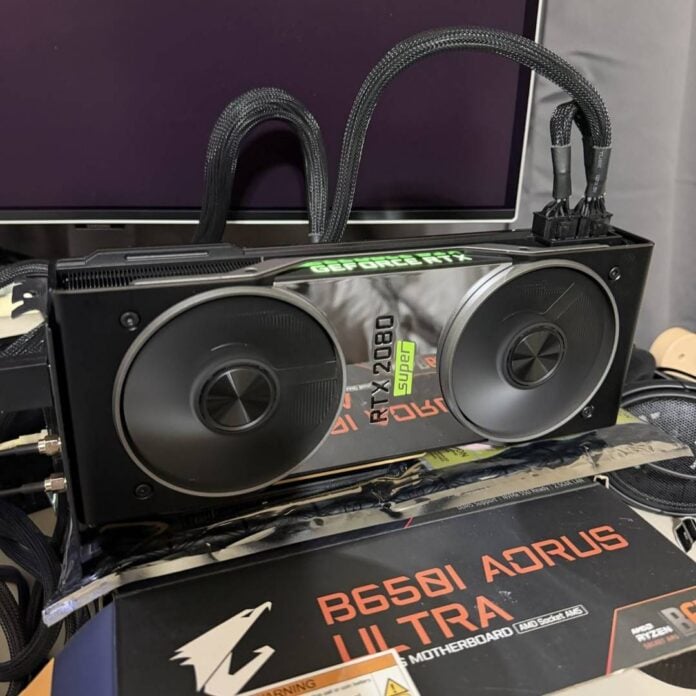
An unreleased Nvidia GeForce RTX 2080 Ti Super GPU has been spotted on eBay by a Reddit user who turns out to also own one. This graphics card is an engineering sample that features a fully-unlocked GPU, boasting more CUDA cores and VRAM than the non-Super variant.
Shared by Reddit user @tendermeemay, this RTX 2080 Ti Super is based on TU102 Turing GPU, manufactured using TSMC’s 12nm node, and with all its parts enabled. This means it has 4,608 active CUDA cores, which represents a 5.8% increase over the RTX 2080 Ti non-Super’s 4,352. The GPU is also clocked slightly higher according to the shared GPU-Z report, reaching a 1,410MHz base and 1,650MHz boost clock, 1,350MHz and 1,545MHz, respectively, on the non-Super.
The card comes equipped with 12GB of GDDR6 memory, which is 1GB more than the RTX 2080 Ti non-Super. This VRAM is interfaced via a 384-bit wide bus, which is a bit larger than the non-Super’s 352-bit bus, and the GDDR6 also runs at 20Gb/s, compared with 17.5Gb/s on the standard Ti. The result of this combo is a 24.6% increase in total memory bandwidth, reaching 768GB/s on this unreleased model, compared to 616GB/s on the standard card.
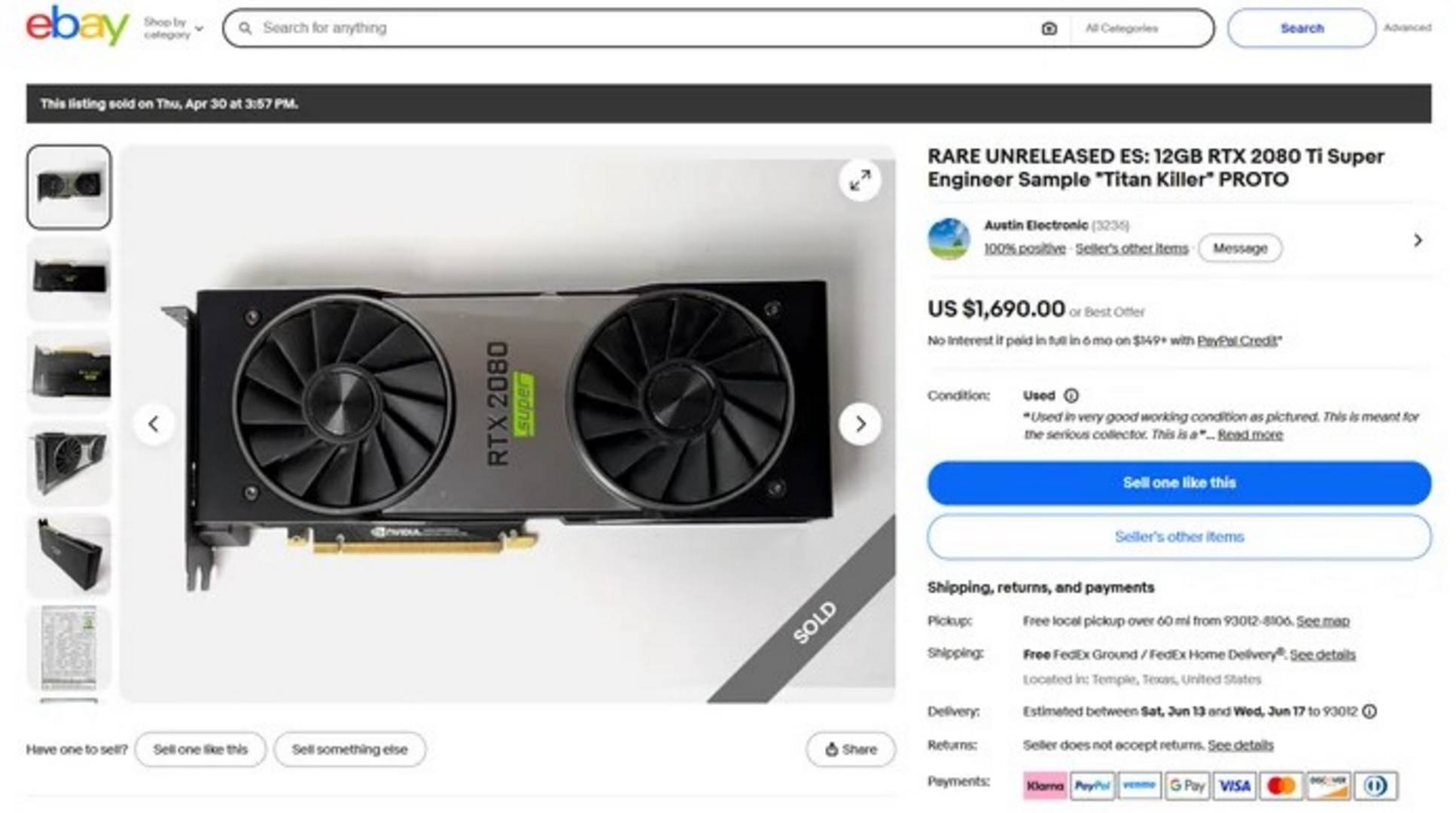
The eBay listing claimed that the card was meant to bridge the gap between RTX 2080 Ti and the Titan RTX, using the same GPU configuration but with less VRAM and lower boost clocks. Overall, the card follows the design aesthetics of Nvidia’s Founders Edition cards, but uses a glossy, reflective front plate and a black frame/backplate. Note that while the card is marked as being an RTX 2080 Super, GPU-Z identifies it as an RTX 2080 Ti engineering sample. Regardless of who is correct, the GPU and memory configuration is clearly above the commercialised RTX 2080 Ti 11GB’s spec.
Also, note that while Nvidia did release an RTX 2080 Super without the Ti suffix, it had a highly cut-down spec compared with the Ti, packing just a TU104 GPU with 3,072 CUDA cores, not to mention a much smaller memory pool of 8GB. This fully-unlocked RTX 2080 Ti Super would have been a great addition to the RTX 20 Series lineup, giving gamers a true flagship option since the Titan was aimed at workstations with a price to match.
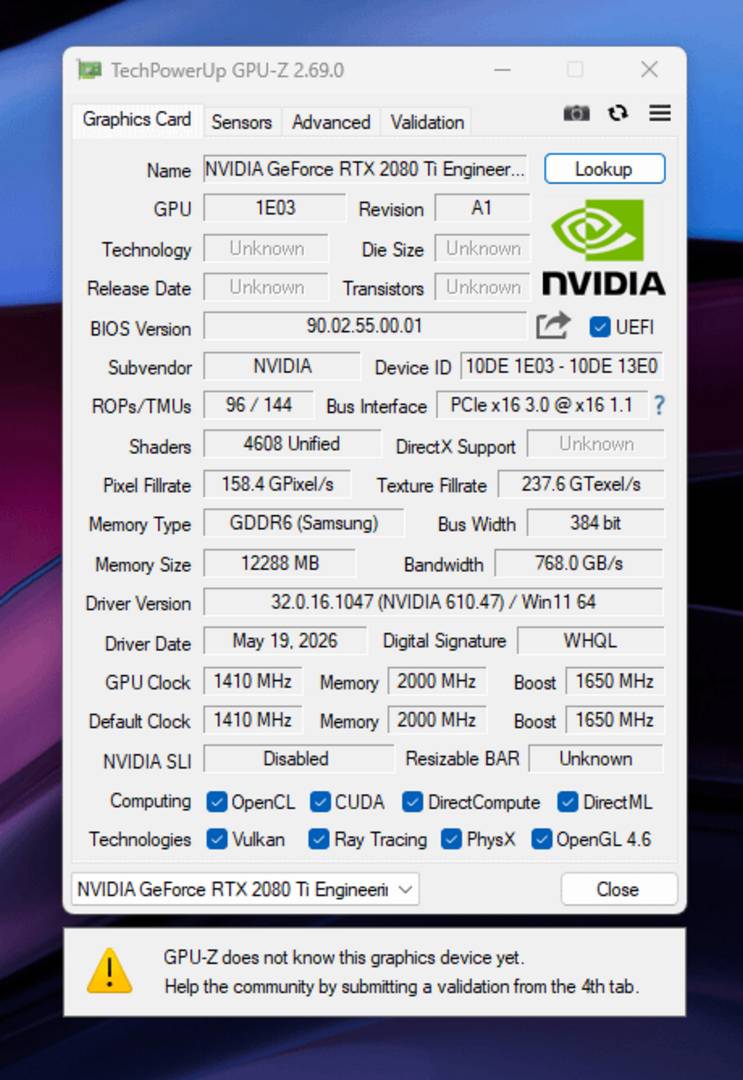
Unsurprisingly, the Redditor was unable to run the card using official Nvidia drivers, but that didn’t deter them from trying. After modifying the driver’s INF files, they finally managed to install it. Unfortunately, the Redditor didn’t share any gaming benchmarks, and any results wouldn’t be optimised for this engineering sample anyway. It’s likely this GPU would perform slightly slower than the Titan RTX, however.