

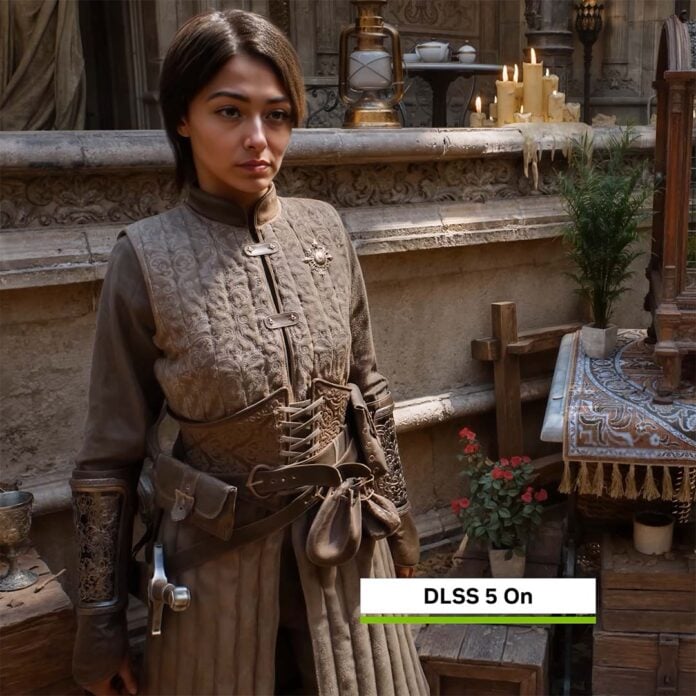
We’ve just had our first look at Nvidia DLSS 5 following its controversial debut earlier this year, and this time we’ve been given a greater wealth of information concerning the feature’s inner workings. Keen to stress that the software isn’t a replacement for traditional rendering, Nvidia has demoed some of the controls available to developers for tweaking the look, intensity, and prevalence of this AI layer.
During Nvidia’s keynote at the SIGGRAPH 2026 conference, the company’s director of applied deep learning research, Edward Liu, took to the stage to discuss DLSS 5. As a basic recap, this tech uses generative AI to enhance a scene’s photo realism. More specifically, as Liu explains, it aims to improve lighting, shadows, and subsurface scattering.
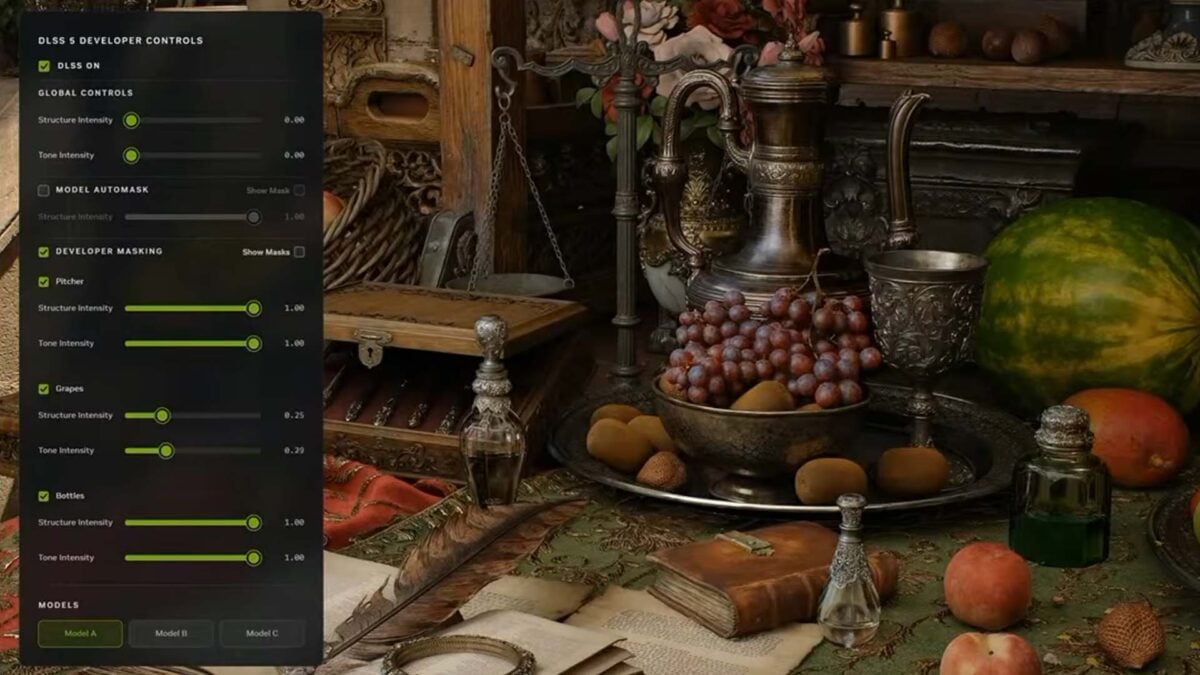
Of course, making such changes to a scene can dramatically affect their appearance. This is where developer controls come in, which allow artists to control which objects DLSS 5 affects, and to what degree.
There are three DLSS 5 models available for developers, each with varying training data and parameters. This trio of models can differ across scenes, allowing artists to pick and choose what finish they prefer on a per-environment, per-object, and per-character basis at different points in the game.
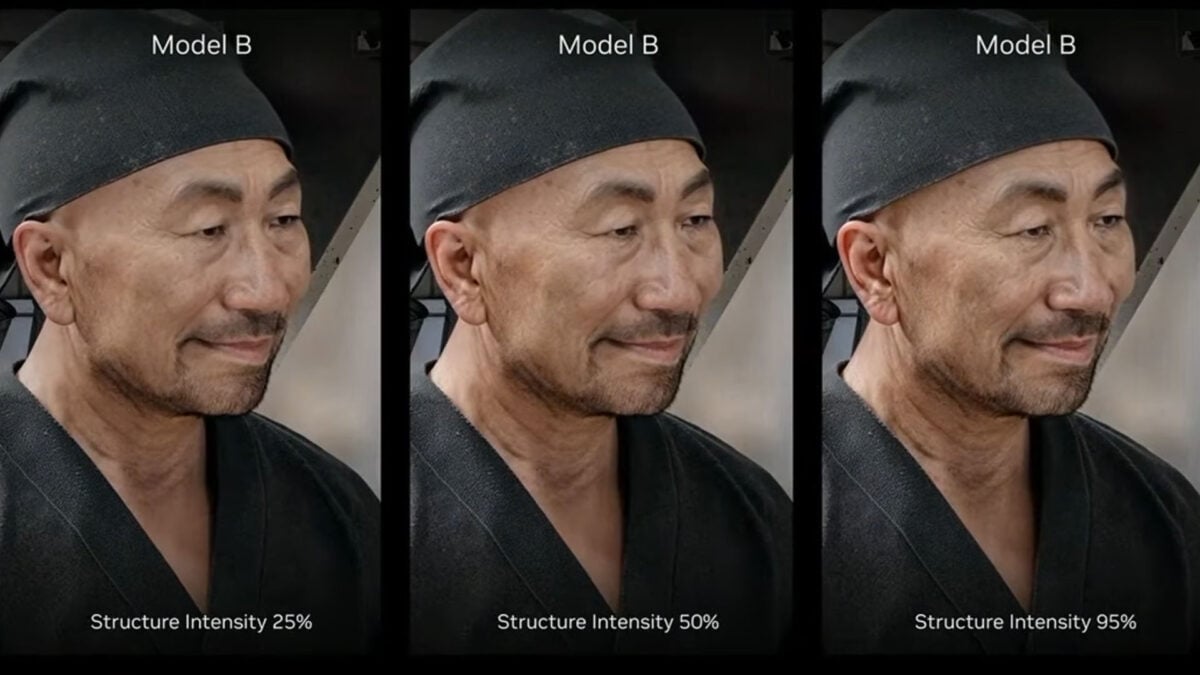
Liu explains the reasoning for these three models, saying there’s no reference ground truth for these 3D scenes from which DLSS 5 can draw. As such, multiple outcomes could make sense, requiring developer input for the final image.
Nvidia also showcased sliders for structure and tone intensities. In short, these modulate the strength of DLSS 5 across high-density (complex) and low-density (simple) elements within a scene. The difference between the minimum and maximum thresholds is easy to see, with the latter unflatteringly looking more akin to AI-generated video content.
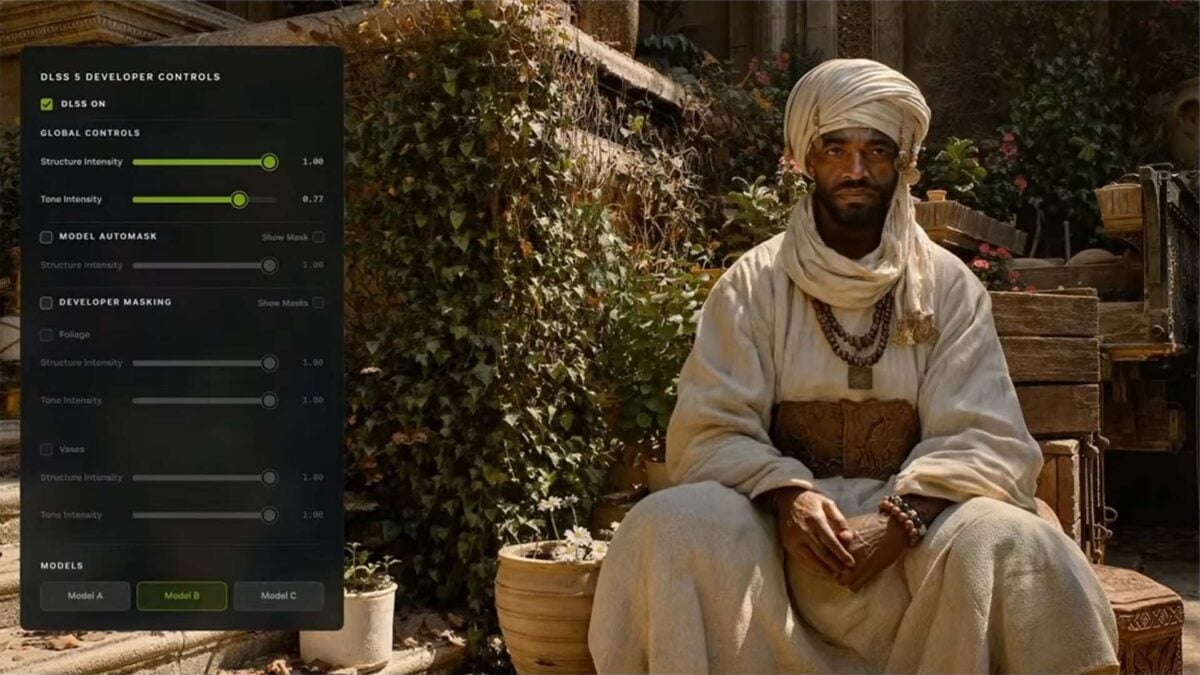
These are just some of the controls that developers can expect for DLSS 5, with more apparently on the way. Nvidia says it’s communicating with partners and incorporating feedback into the feature, so that it becomes “a tool for artists and creatives to have their vision reflect in the final frame.”
In conclusion, Nvidia stresses that DLSS 5 doesn’t replace traditional rendering techniques, nor prior DLSS technologies, and instead serves as an extension of that pipeline. The company isn’t claiming to have solved real-time photo realism via this feature either, noting that there is room to improve the technology.
Like DLSS Super Resolution, which shifted from a convolutional neural network (CNN) model to a transformer model, Nvidia can make backend improvements to DLSS 5 without increasing scale. “Improvements on the offline side, such as better training data, dynamics, and loss functions, will also translate into a direct improvement in image fidelity at runtime without any additional cost,” Liu states.
Nvidia plans to release DLSS 5 later this year, so it won’t be long before we can sample the feature for ourselves. This presentation has allayed some of my concerns regarding the technology, but we’re yet to see a demonstration during actual gameplay, and there’s still an uncanny feel to some of the final renders, which gives me pause.
Moreover, realism is just one of many artistic styles. I’m curious to see how DLSS 5 services cel shading, or any number of unrealistic approaches. After all, following the feature’s initial backlash, Jensen promised us toon and glass shaders. So, where are they?
While we wait for DLSS 5 to grace our graphics cards, check out our DLSS 4.5 analysis to learn more about how the feature’s current form can benefit your games.