
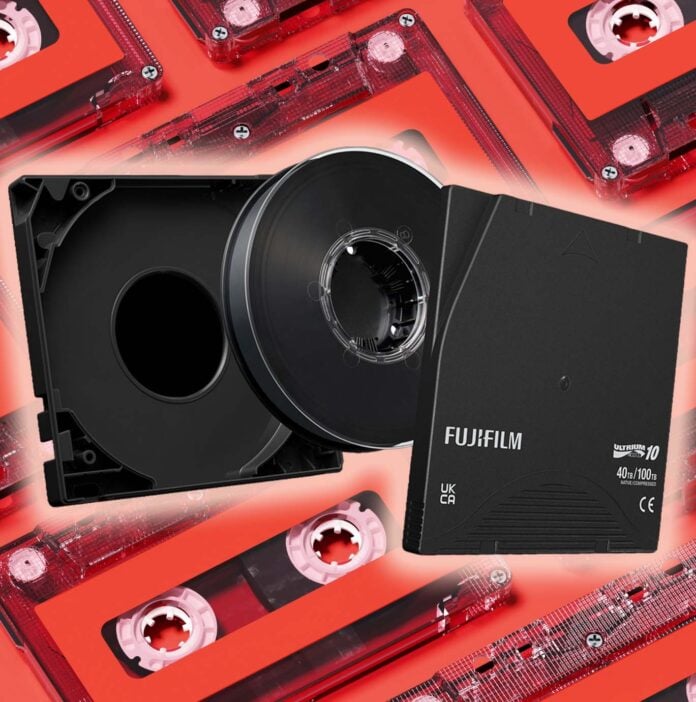
First it was SSDs, then it was hard drives, and now even demand for tape storage is booming to feed the AI machine’s insatiable appetite. Fujifilm has just confirmed that its quintupled production capacity for magnetic tape storage (compared to 2025), costing the firm 10 billion Japanese Yen (around £47 million).
There are two main reasons why tape is suddenly becoming much more attractive. Firstly, it can store a lot of data very cheaply, as long as you don’t mind waiting and don’t require random access to it immediately. That’s important in a new digital world that’s generating data that needs archiving at an unprecedented pace. Secondly, tape can be stored in a case entirely offline, where it can’t be vulnerable to cyberattacks. You’d have to physically steal the tape if you were thinking about sending out ransomware notices.
“In recent years, the use of magnetic tape has been expanding,” said Fujifilm as it announced the move, “particularly among major cloud service providers and data centre operators.” This latest investment, says the company, will give it a “stable supply system for magnetic tape in response to growing data archiving demand accompanying the spread of generative AI.”
In particular, Fujifilm says it’s responding to demand for “environments in which the enormous amounts of data accumulated through AI training and inference,” can be “stored and utilised securely and efficiently.”
Fujifilm first started dabbling in magnetic tape in the 1950s, but this new production capacity specifically targets its latest LTO Ultrium10 recording medium. Launched in 2025, the company says this tech “uses proprietary fine hybrid magnetic particles” to increase storage density.
A 30TB Ultrium10 cartridge can hold up to 75TB of compressed data and costs £297.99 ex VAT in the UK. If you want to store a boatload of data offline, that’s massively cheaper per terabyte than a hard drive at today’s prices.