

A new market analysis report reveals that the NAND flash market may recover to normal pricing levels sooner than memory, as production catches up with demand. According to tech market research firm TrendForce, the storage supply chain is expected to reach a balance by 2027, hopefully marking a return to stability.
According to this report, NAND Flash, and thus SSDs, could be the first major PC component to become abundant in supply again. The firm estimates that the balance between supply and demand is expected to turn positive in the second half of 2027, gradually easing the ongoing shortage. Before that, however, TrendForce expects the market to record a 4-to-5% supply deficit this year. Its July report reveals an undersupplied market throughout 2026, driven by surging AI-related demand and limited capacity expansion.
This is expected to change in 2027, thanks to persistently weak demand for consumer electronics in the wake of increased prices, ongoing process migrations by suppliers, and a steady growth in bit output.
The latter refers to manufacturing capacity, but it’s expressed in bits instead of wafers. It can be a direct result of an increase in the number of wafers produced each month, but it can also be affected by technology improvements, such as higher-layer 3D NAND and denser memory cells. As a result, TrendForce expects the current NAND shortages to subside by the latter half of 2027.
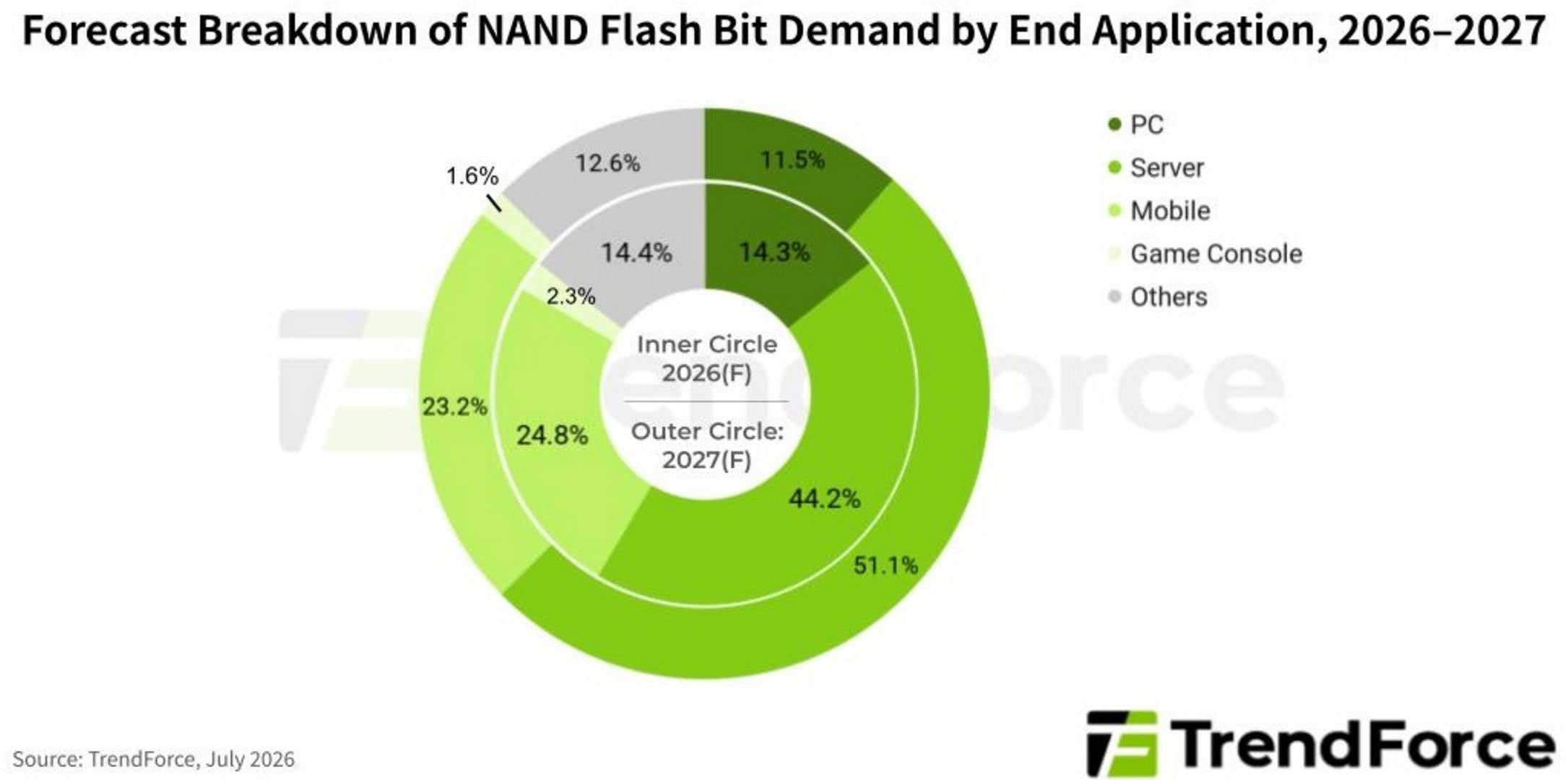
Interestingly, this doesn’t mean that demand for NAND to put in servers will drop. According to the firm’s forecast, servers are expected to consume 51.1% of NAND production in 2027, compared to 44.2% in 2026. At the same time, PC and mobile NAND consumption is expected to drop from a combined 39.1% to 34.7%.
TrendForce notes that, in 2026, NAND Flash suppliers will rely primarily on process node migrations to meet rising demand, as DRAM capacity expansion continues to hog resources, which is expected to persist into 2027. In addition to Korean, US, and Japanese suppliers, Chinese brands such as YMTC are also expected to significantly boost their production capacity, as new manufacturing equipment comes online, pushing the country’s share of global NAND flash bit output to nearly 19%.
While this news doesn’t provide any relief from high RAM prices, which are causing most of the headaches for consumers, it’s good news nonetheless. That said, don’t expect prices to drop overnight, as retailers would still need to clear any stock bought at higher prices.