
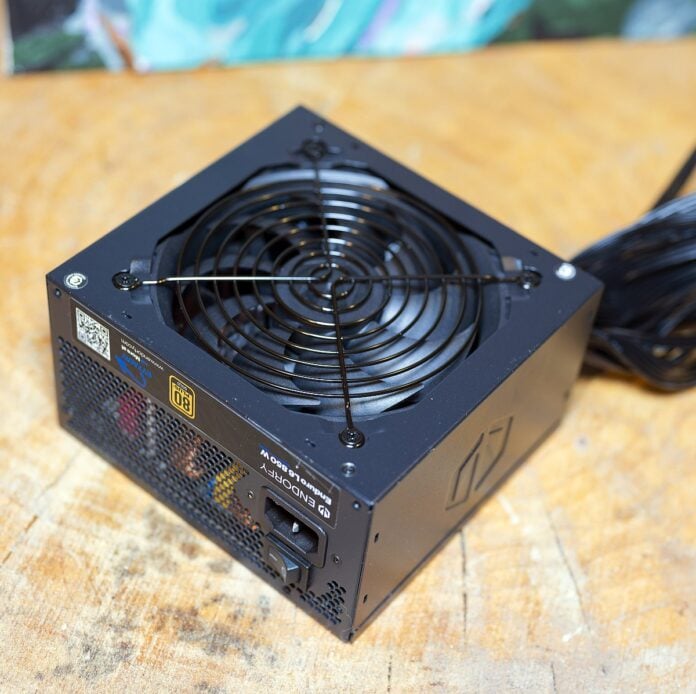
Despite its sub-€100 price tag, Endorfy’s Enduro L6 850W offers a lot of power, while also ticking many of the latest feature boxes. These include a native 12V-2×6 cable for GPUs, as well as full ATX 3.1 and PCIe 5.1 compliance. It even sports 80 Plus Gold and Cybenetics Platinum badges.
What’s the catch? Firstly, it’s a non-modular cable design, so you’ll need to route any of the wires you don’t need out of sight. There’s also no semi-passive mode, so the fan is always spinning, even when your machine is idle. Even so, in terms of power and efficiency, it looks as though you get a lot for your money, so let’s take a closer look.
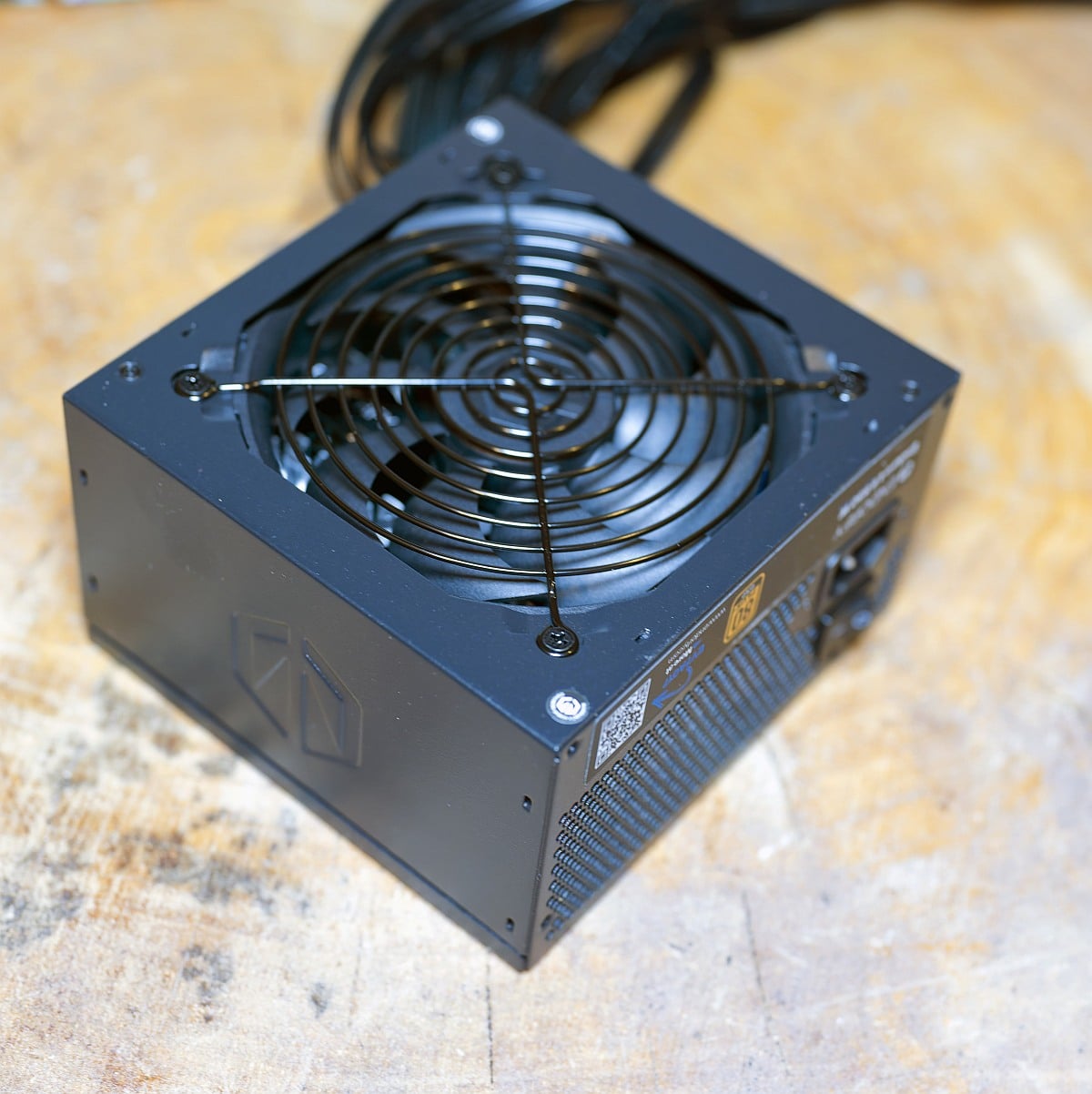

Endorfy Enduro L6 850W
€94.90
Pros
- Solid efficiency
- Quiet overall operation
- ATX 3.1 and PCIe 5.1 compliant
- Native 600W 12V-2×6 cable
- 7-year warranty
Cons
- Captive cables
- No semi-passive (zero-rpm) mode
- Fan speed ramps up above 50% load
Club386 may earn an affiliate commission when you purchase products through links on our site.
How we test and review products.
Features
As I mentioned earlier, the Endorfy Enduro L6 850W fully supports the ATX 3.1 and PCIe 5.1 standards. That ensures full compatibility with the latest components, particularly when it comes to GPUs, such as high-end Nvidia GeForce RTX 4000 and 5000-series models, as it can accommodate occasional high power excursions.
ATX 3.1 provides clear target values for the maximum amount of headroom above a PSU’s nominal power rating, as opposed to ATX 2.X, which supports high load peaks but doesn’t define a limit. Specifically, on an ATX 3.1 unit, the connection for your graphics card must allow load changes of up to 3x the power consumption, with up to 235% of surge tolerance.
That compliance also means this PSU uses the latest 12-pin 12V-2×6 power connector, designed to deliver up to 600W of raw, unhindered power to your graphics card, without having to faff around with 8-pin adaptors and extension cables.
You wouldn’t want to plug a 600W GPU into this PSU, though – it only comes in 650W, 750W, and 850W flavours, none of which will be able to handle an RTX 5090. The 850W model we’re reviewing is rated for 70A on its 12V rail (up to 840W), though, so it could just about handle an RTX 5080, and would be comfortable with RTX 5070 Ti or Radeon RX 9070 XT. Should you need to use the 5V and 3.3V rails, there’s 20A available on each, though not concurrently, of course.
Variants
The 850W version we’re reviewing costs €94.90, while the 650W model comes in at €72.90, and the 750W unit brings that price up to €83.90. Comparatively, an 850W be quiet! Pure Power 13M costs about $134.90, but it also has a semi-passive mode and modular cables.
As such, this Endorfy PSU sits right in the value segment of the PSU market. It’s not a high-wattage unit, but it’s designed to stay efficient, stable, and quiet under punishing loads. You also get a seven-year warranty, which is good for this price. It’s also worth noting that the 650W version “only” has a 450W PCIe 5.1 12V-2×6 cable, while the 750/850W variants have the “full” 600W one, although, as I mentioned earlier, you wouldn’t want to actually hook either of these units up to a 600W GPU.
Design
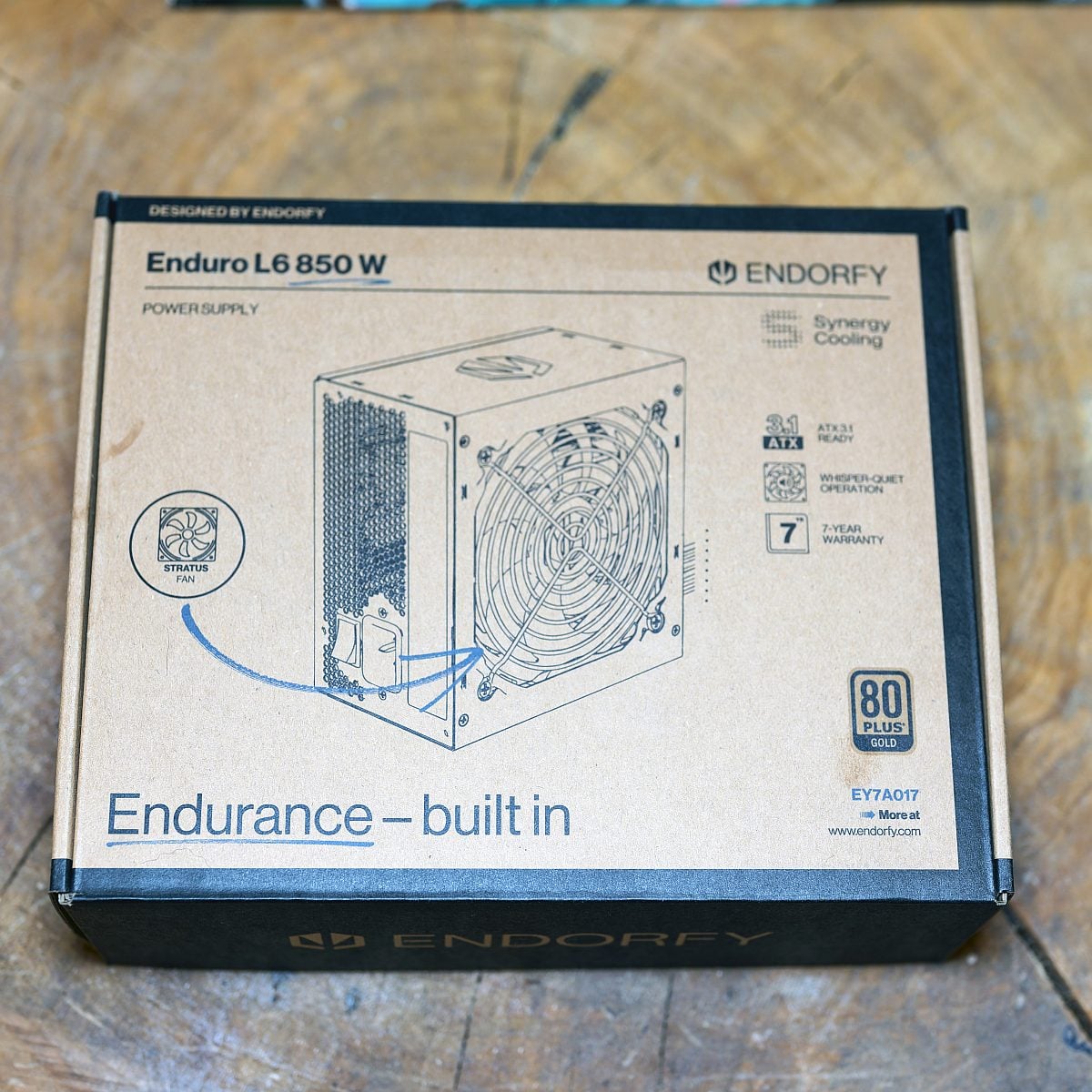
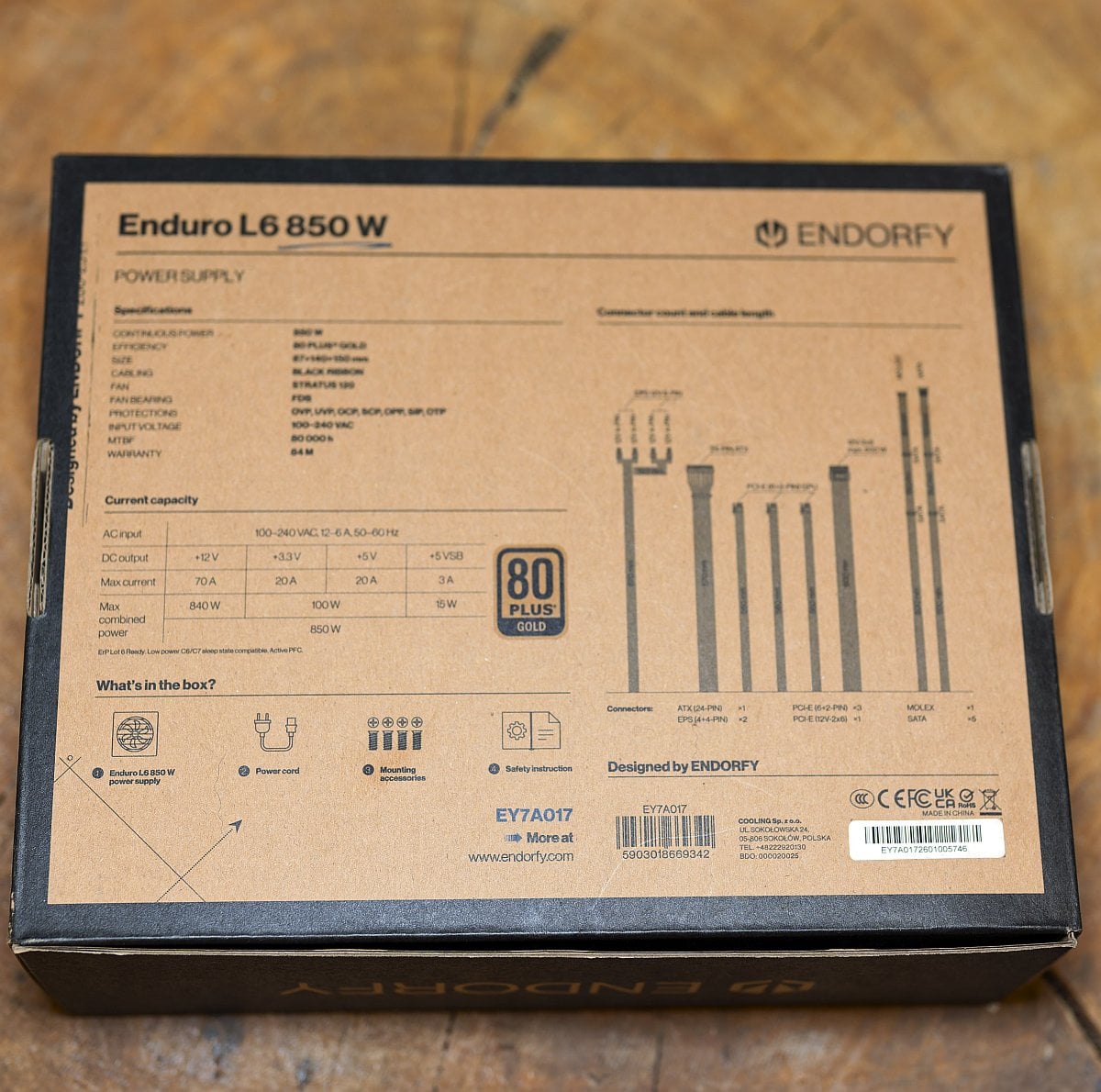
The Endorfy Enduro L6 850W arrives in a simple, understated cardboard box. The front displays the unit’s key highlights: its 850W rating, 80 Plus Gold and Cybenetics Platinum icons, and ATX 3.1 compliance badge. Flipping it over to the rear reveals a comprehensive voltage and current specification label, connector overview, and QR code pointing directly to online documentation.
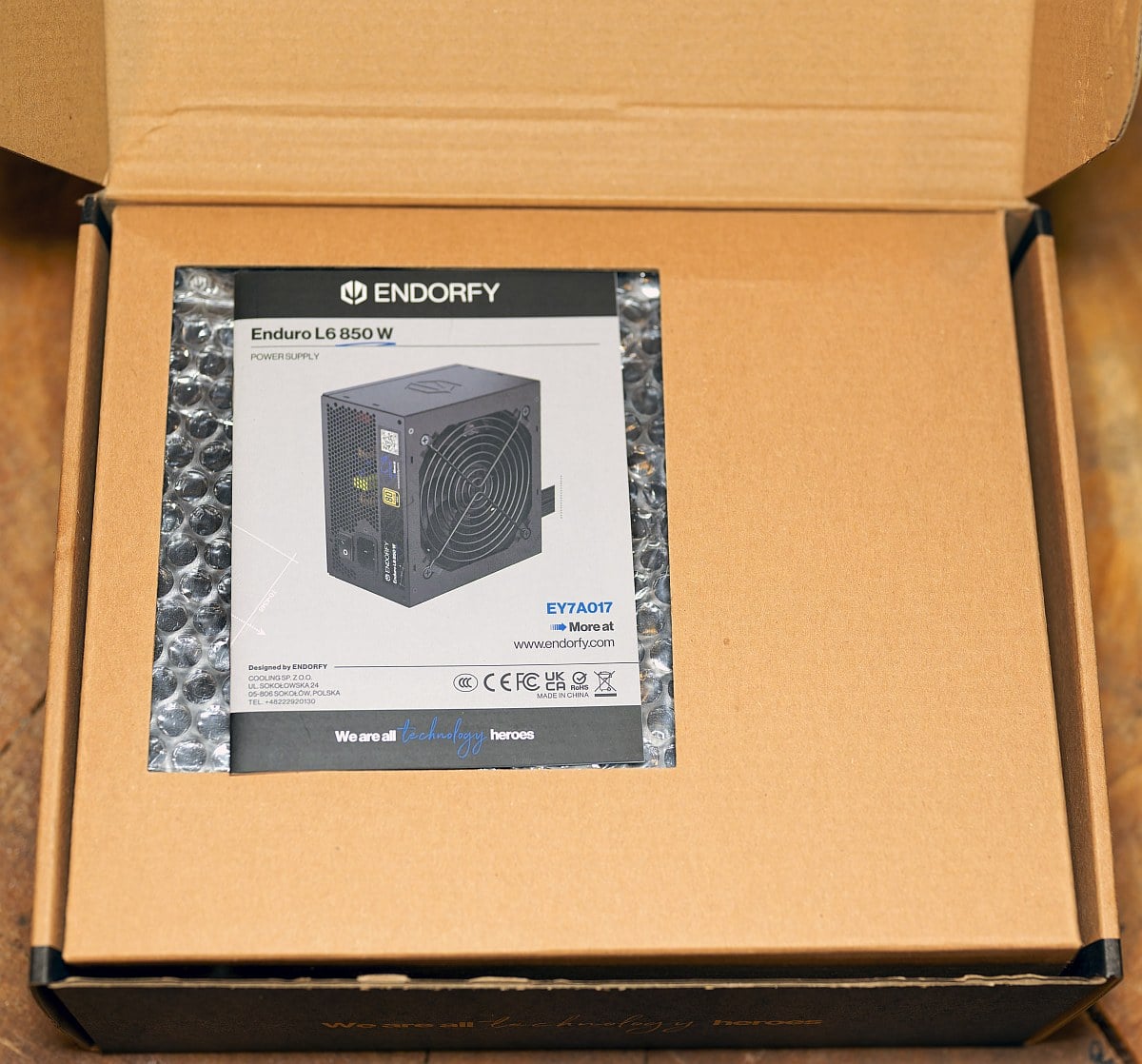
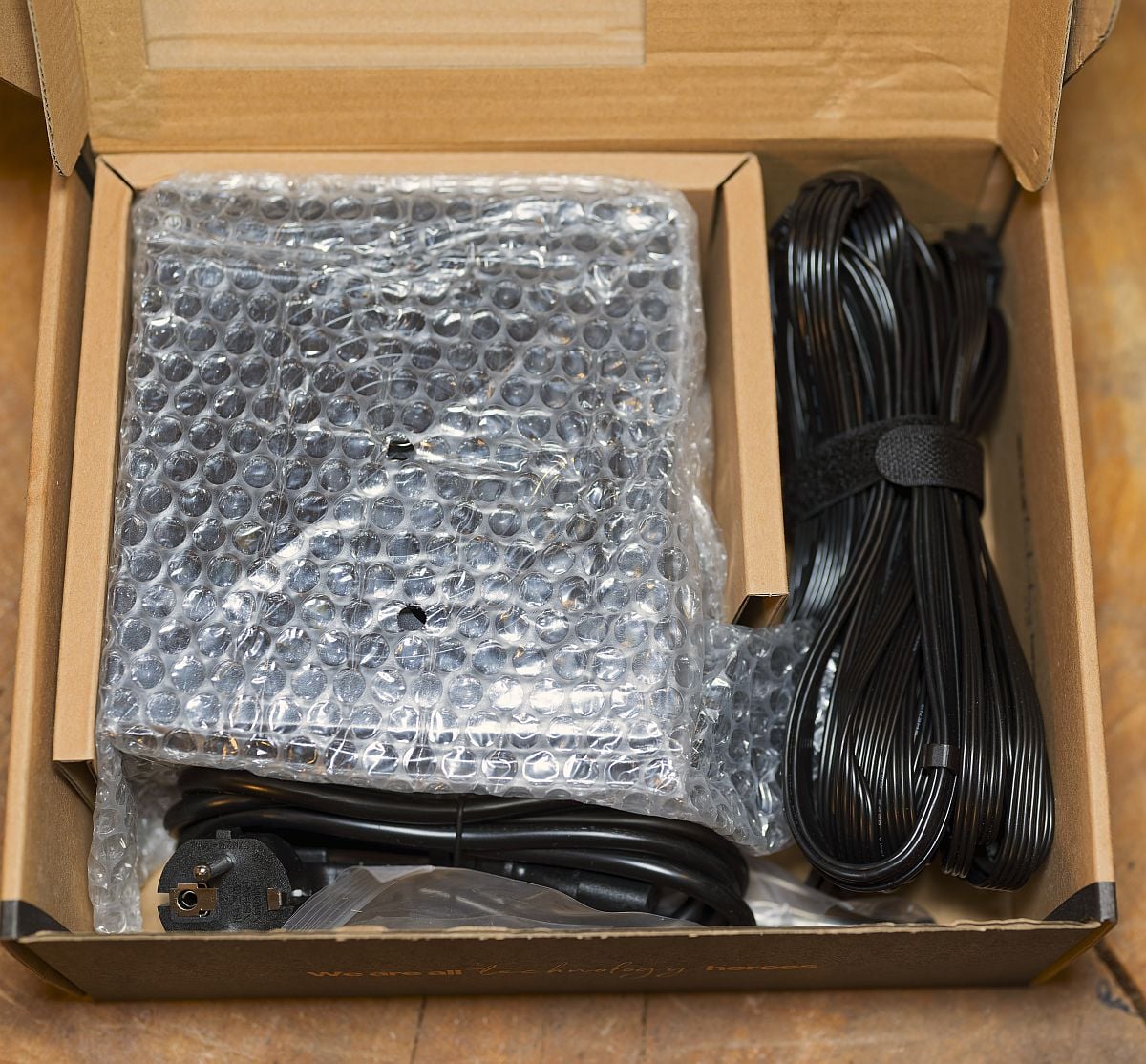
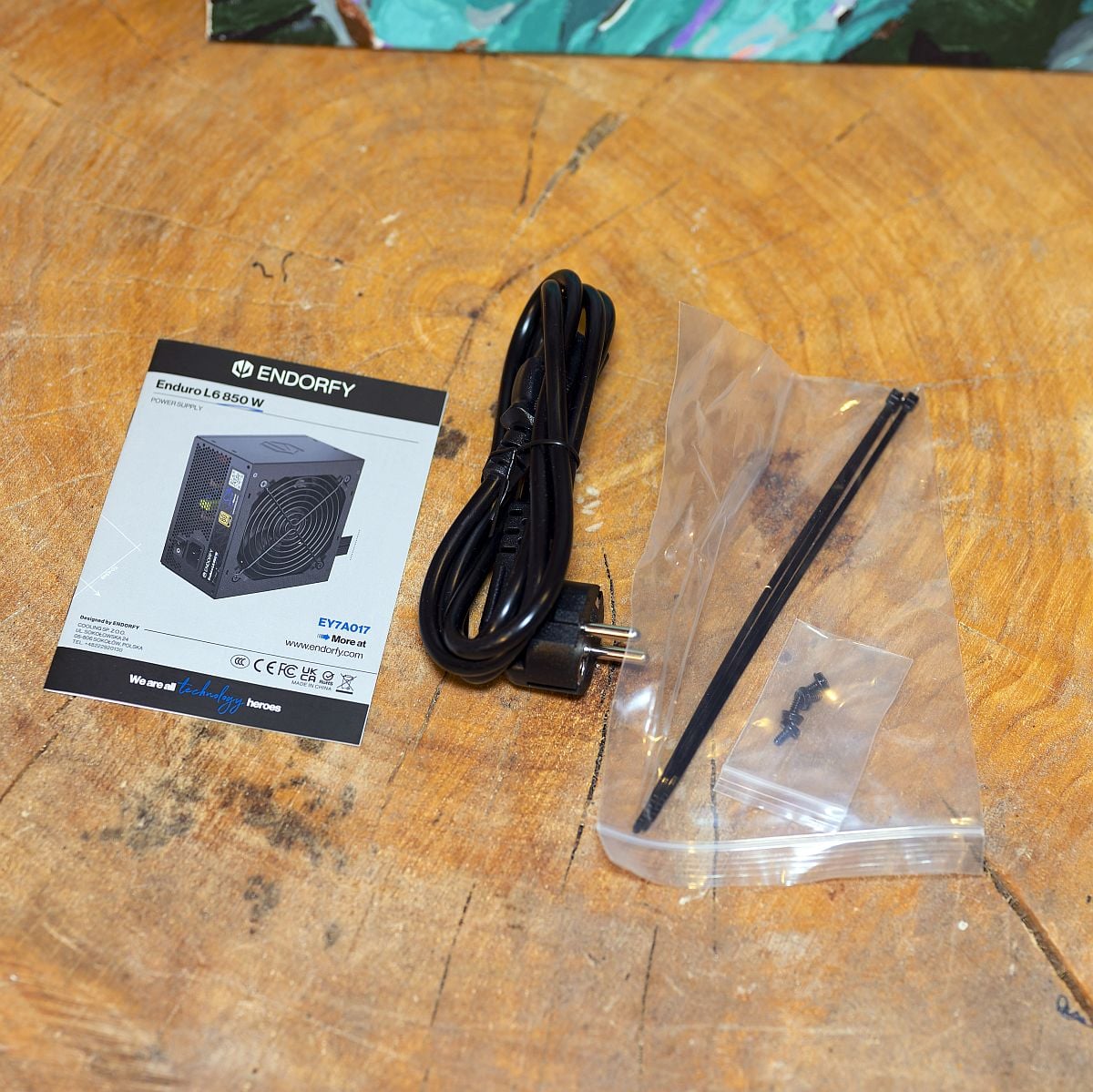
Inside the package, Endorfy keeps it all down to the essentials so it can maintain a low price. There’s just the power supply itself with native tethered wiring, an AC power cord (18AWG), mounting screws, plastic zip-ties , and a safety manual.
Cables
Because the Enduro L6 has a non-modular structure, all cables emerge directly from a single rubber grommet on the chassis. Endorfy opts for black, flat ribbon cables, which lie flat against your motherboard tray and simplify routing compared to traditional thick braided sleeves.
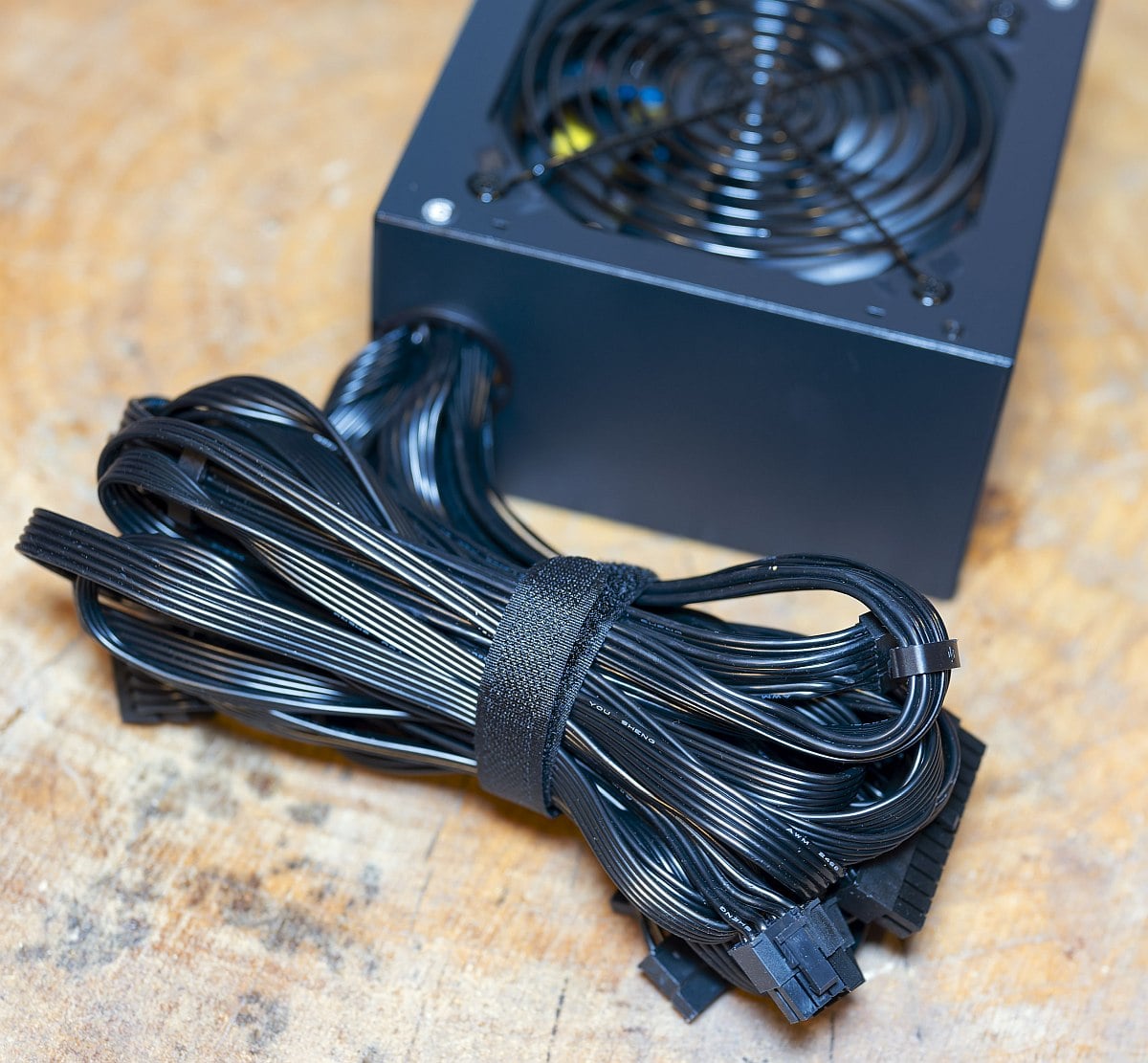
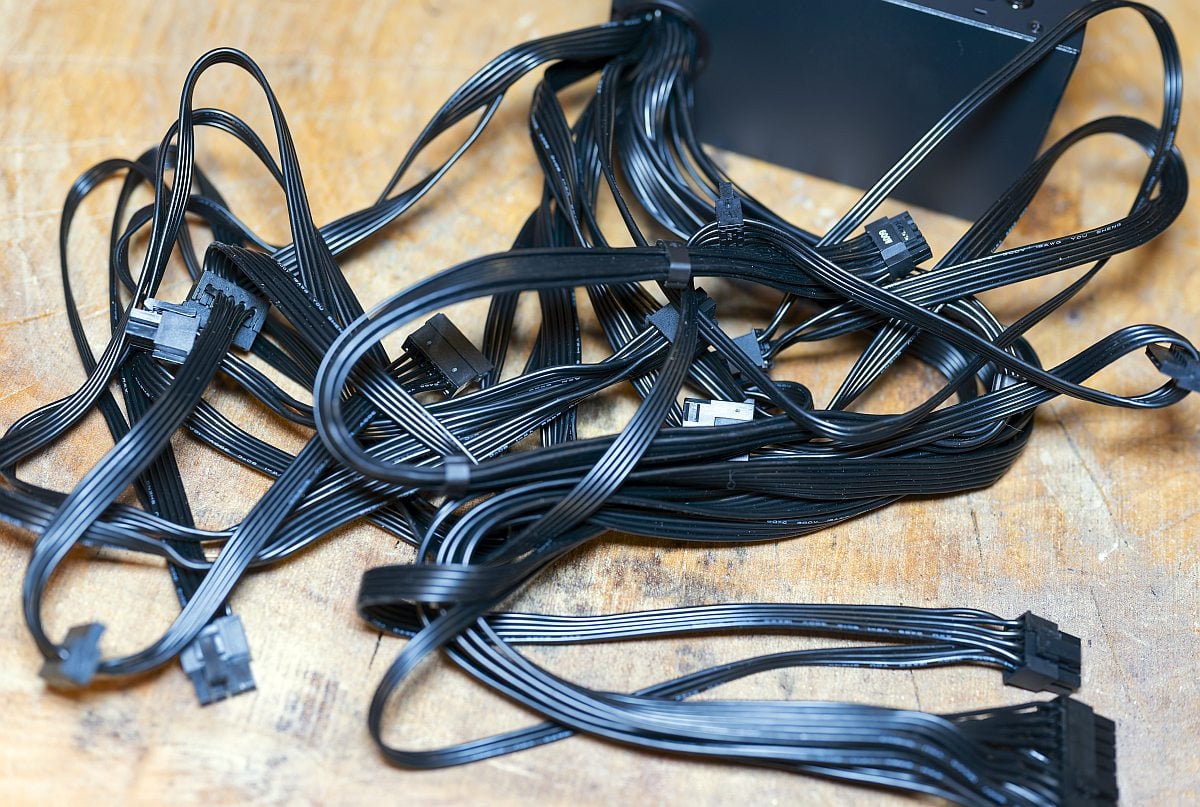
The cabling configuration is well suited for modern high-performance systems, and encompasses the following connectors:
• 1x 24-pin ATX (580mm)
• 1x EPS 12V 4+4-pin (680+150mm)
• 1x PCIe 12V-2×6 (600W, 610mm, 16-26AWG tinned copper)
• 3x PCIe 6+2-pin (570mm, 18AWG)
• 1x SATA triple-header (500+150+150mm)
• 1x SATA dual-header + Molex (500+150+150mm)
Detailed inspection
Measuring 150 x 85 x 140mm (W x H x D) and weighing in at 1.82kg (4.01lb), the Enduro L6 850W maintains a compact footprint – you won’t have any trouble fitting it into a standard ATX case.
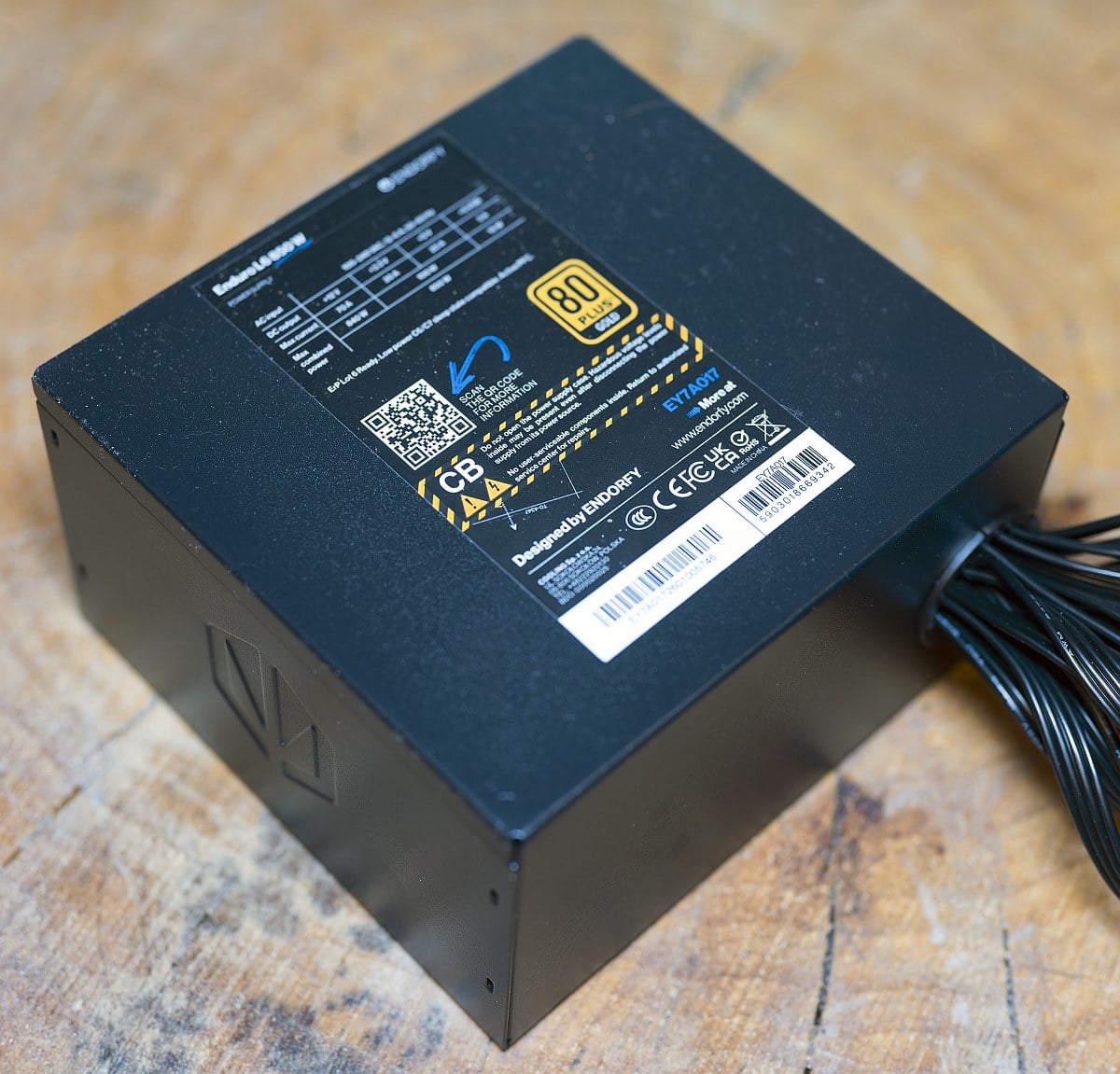
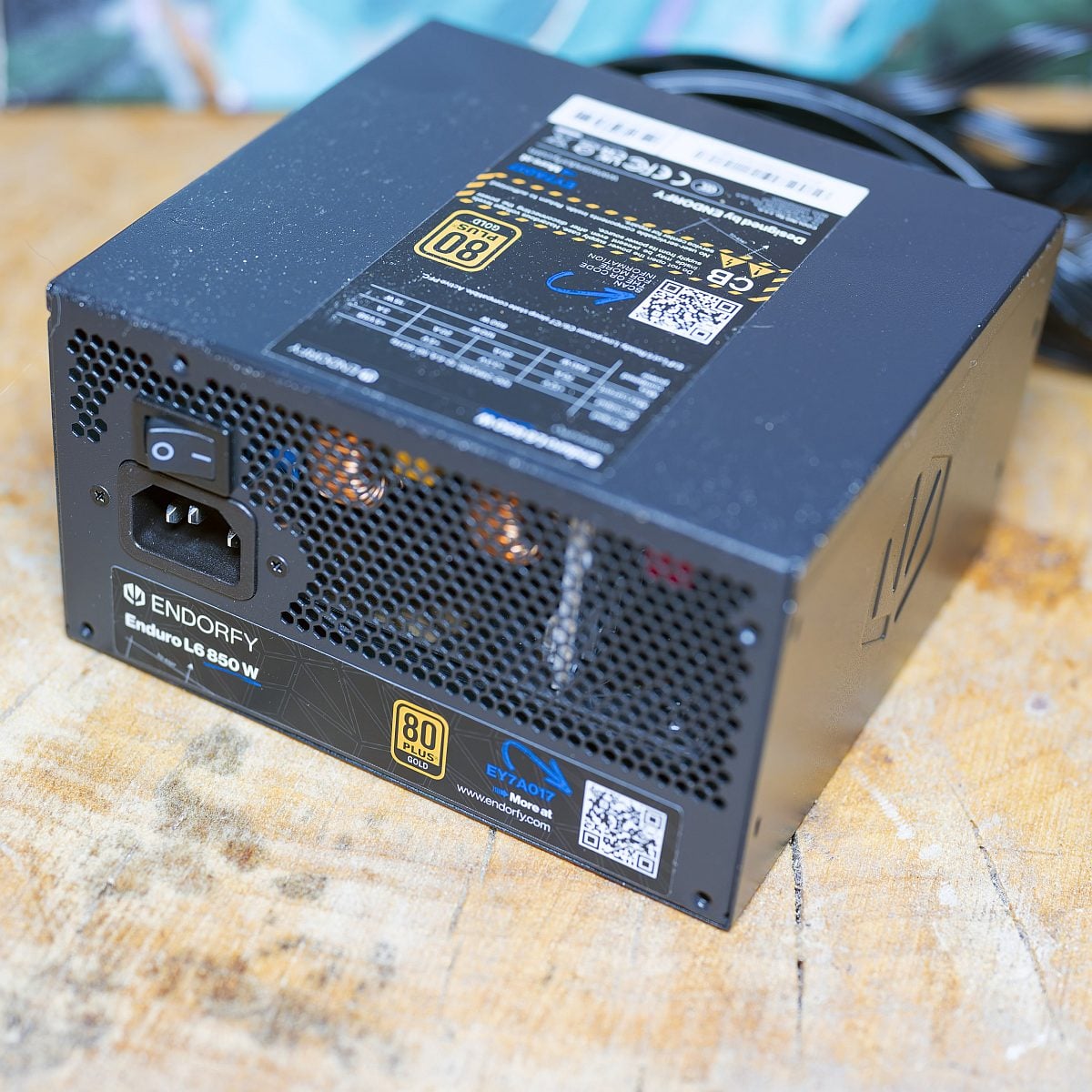
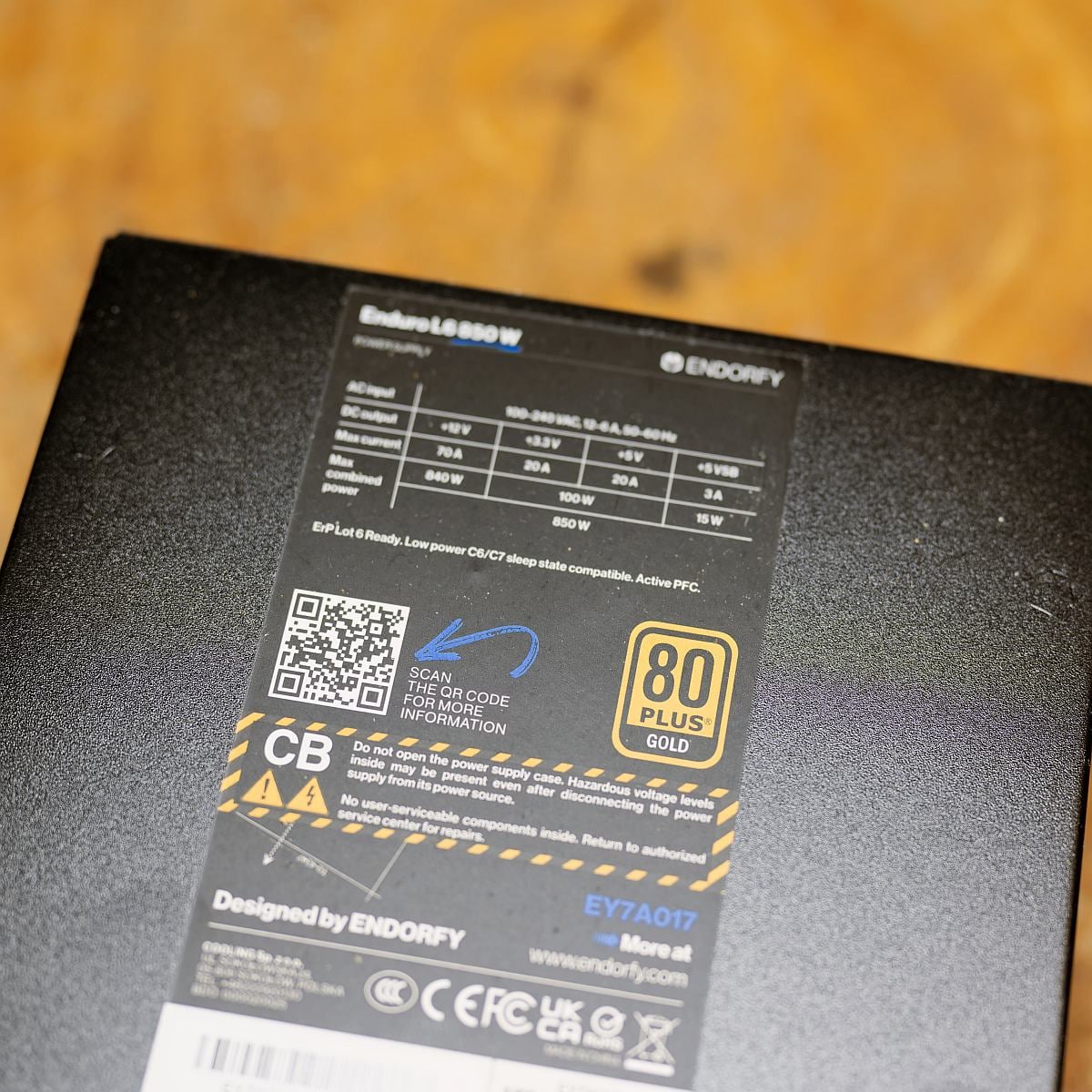
This short 140mm depth gives it broad compatibility with smaller ATX or Micro-ATX chassis, where cable management space behind the PSU shroud is tight. However, bear in mind that you will also need to find somewhere to route all these cables, as it’s all or nothing here.
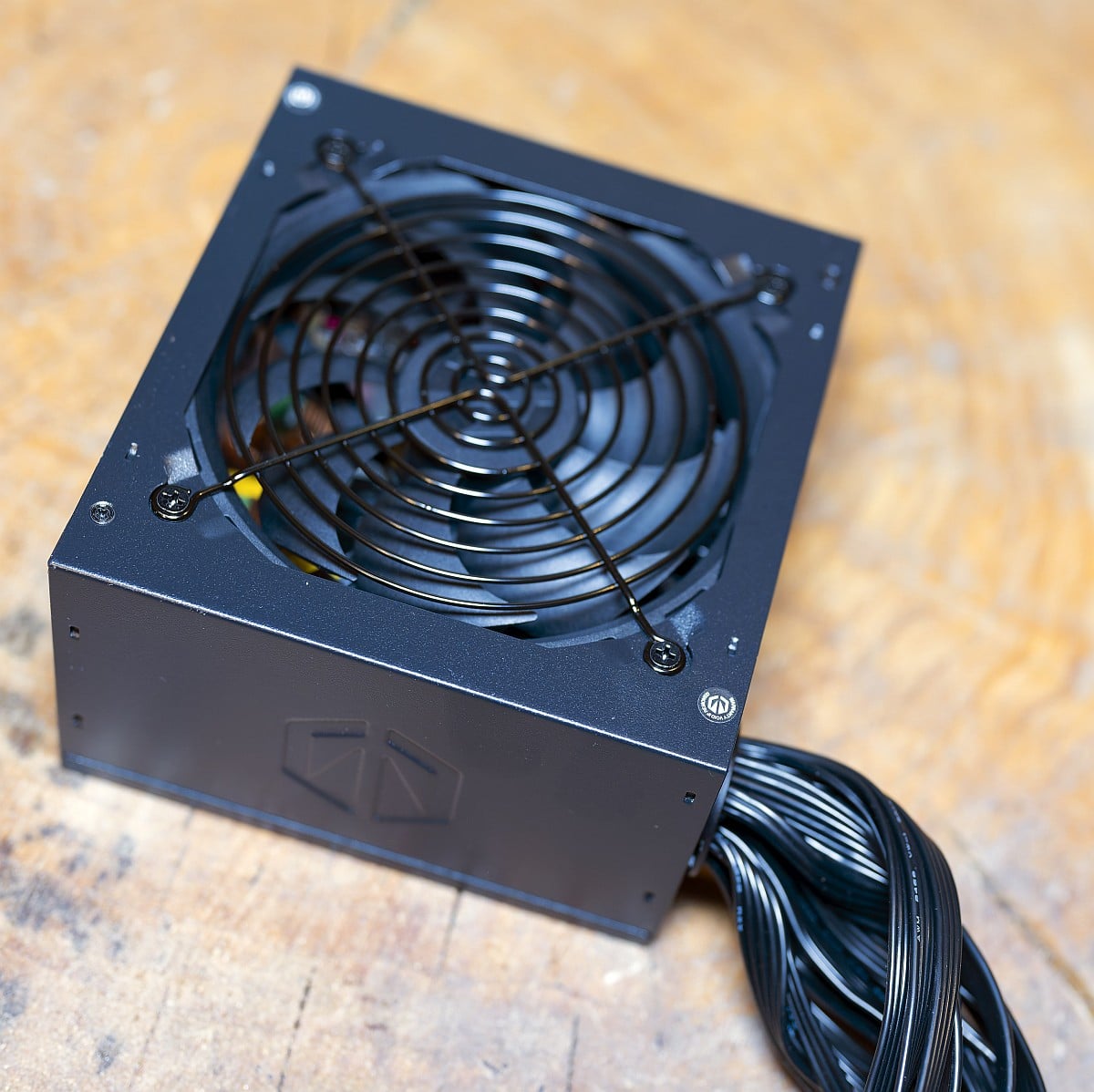
Visually, the unit adopts an all-black aesthetic, with the Endorfy logo embossed into its sides. There’s also a typical grille sporting a concentric-circle pattern above the fan.
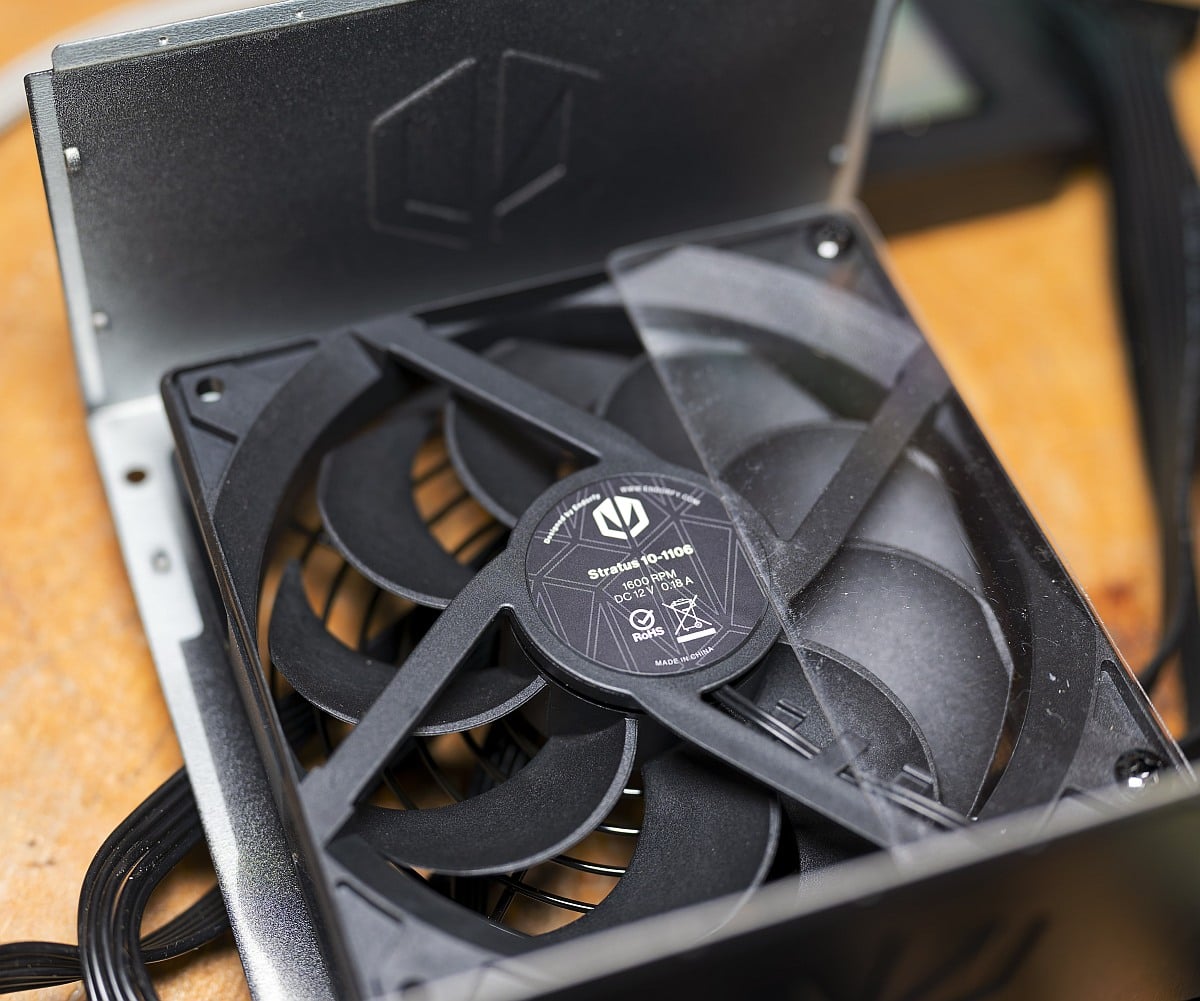
Beneath that grille sits a 120mm Endorfy Stratus 10-1106 fan, which features a fluid dynamic bearing. Although this unit lacks a semi-passive zero-rpm mode, the fan is tuned to run at a low ~600rpm baseline during low-to-medium load scenarios.
Internals
Primary side
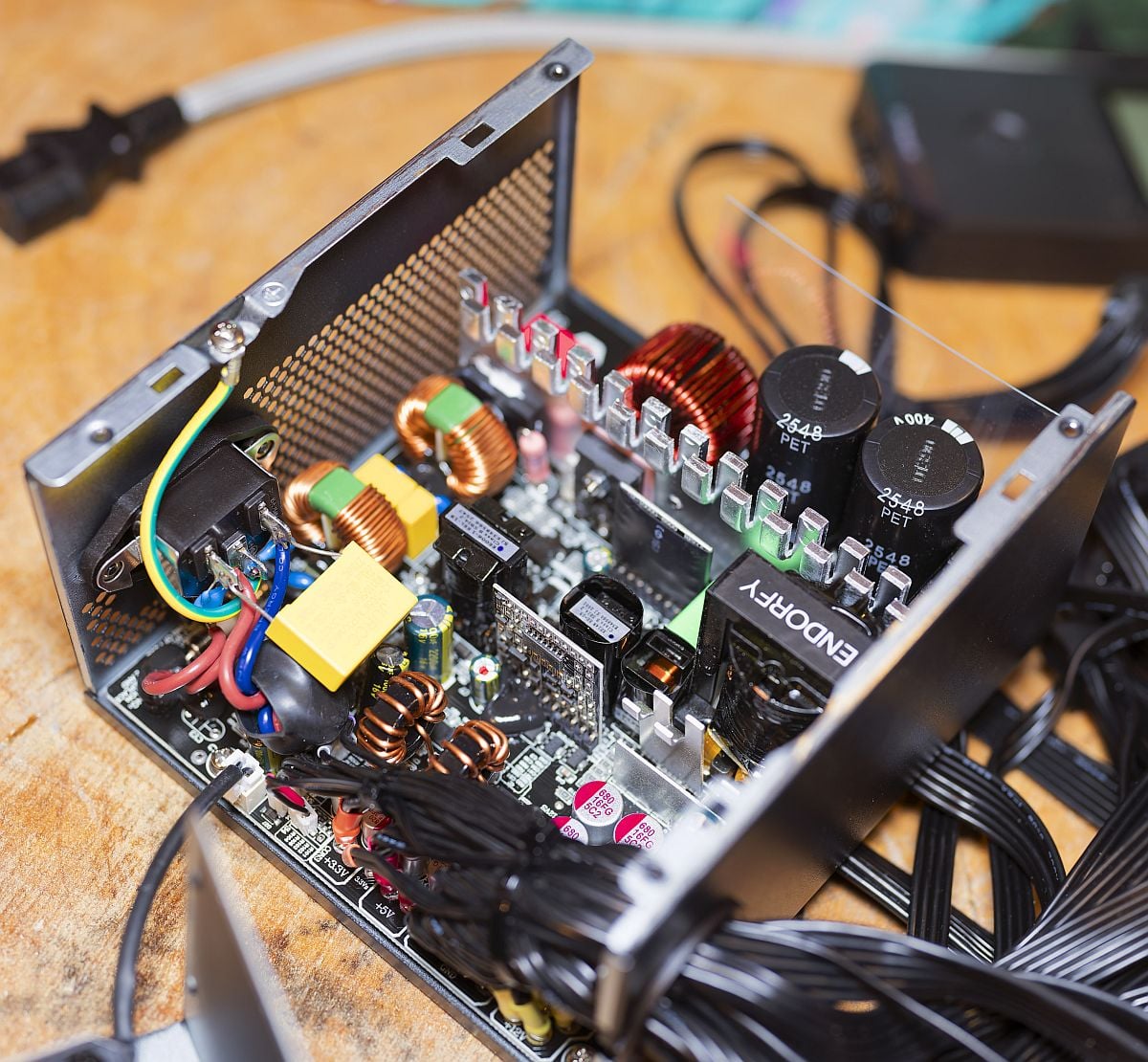
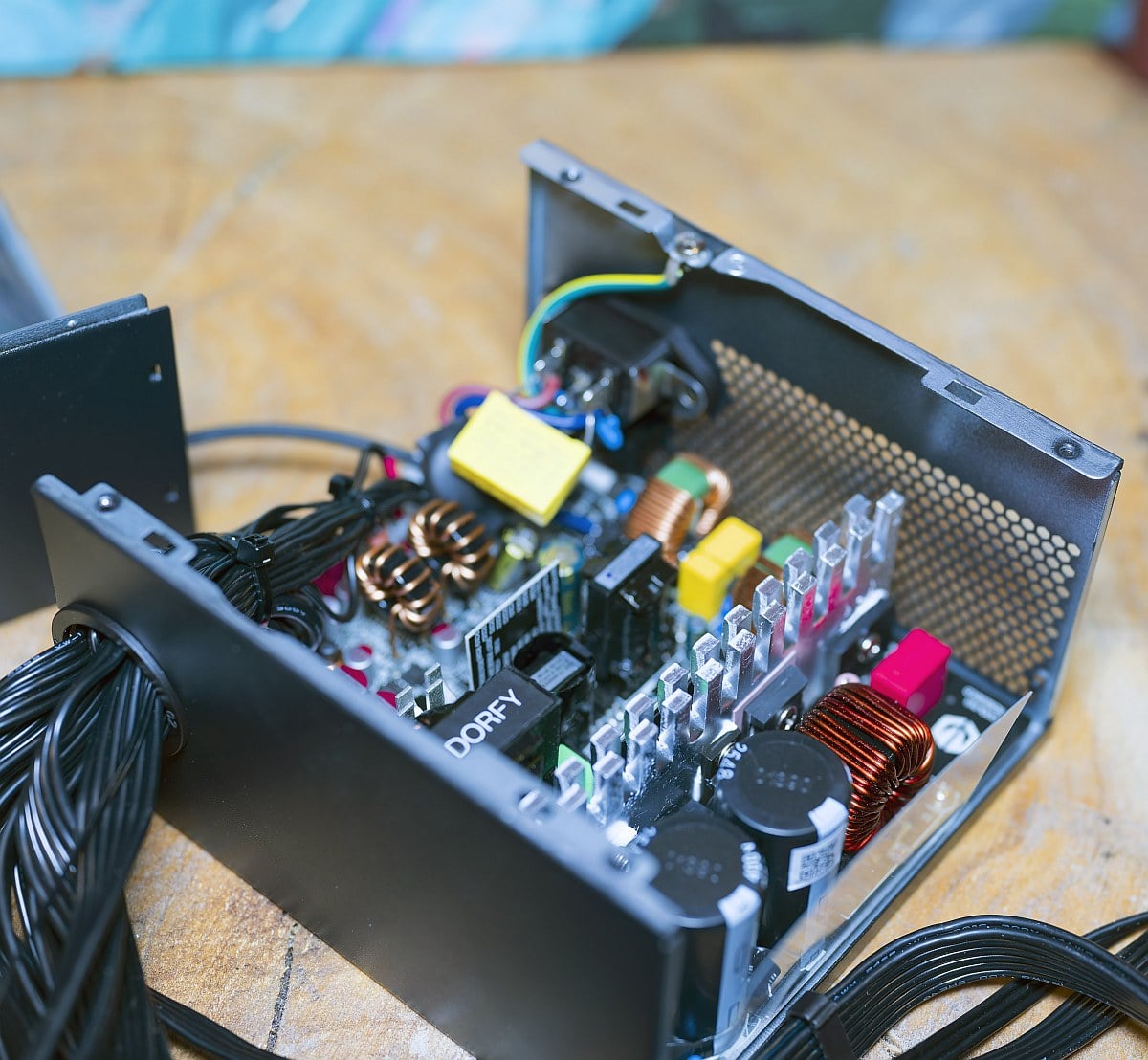
Under the hood, you can find a double-sided PCB design from OEM PSU maker Jiumeng. The primary side features an APFC topology paired with a half-bridge and LLC resonant converter setup. The APFC controller is a Champion CM6500UNX with two Way-On WMJ36N65F2 MOSFETs (650V, 20A). Meanwhile, the bulk caps comprise two Toshin (400V, 390uF, 2,000h @ 105°C, LW) units. The resonant controller is a Champion CM6901X with two NCE Power NCE65TF130F (650V, 18A) main switchers.
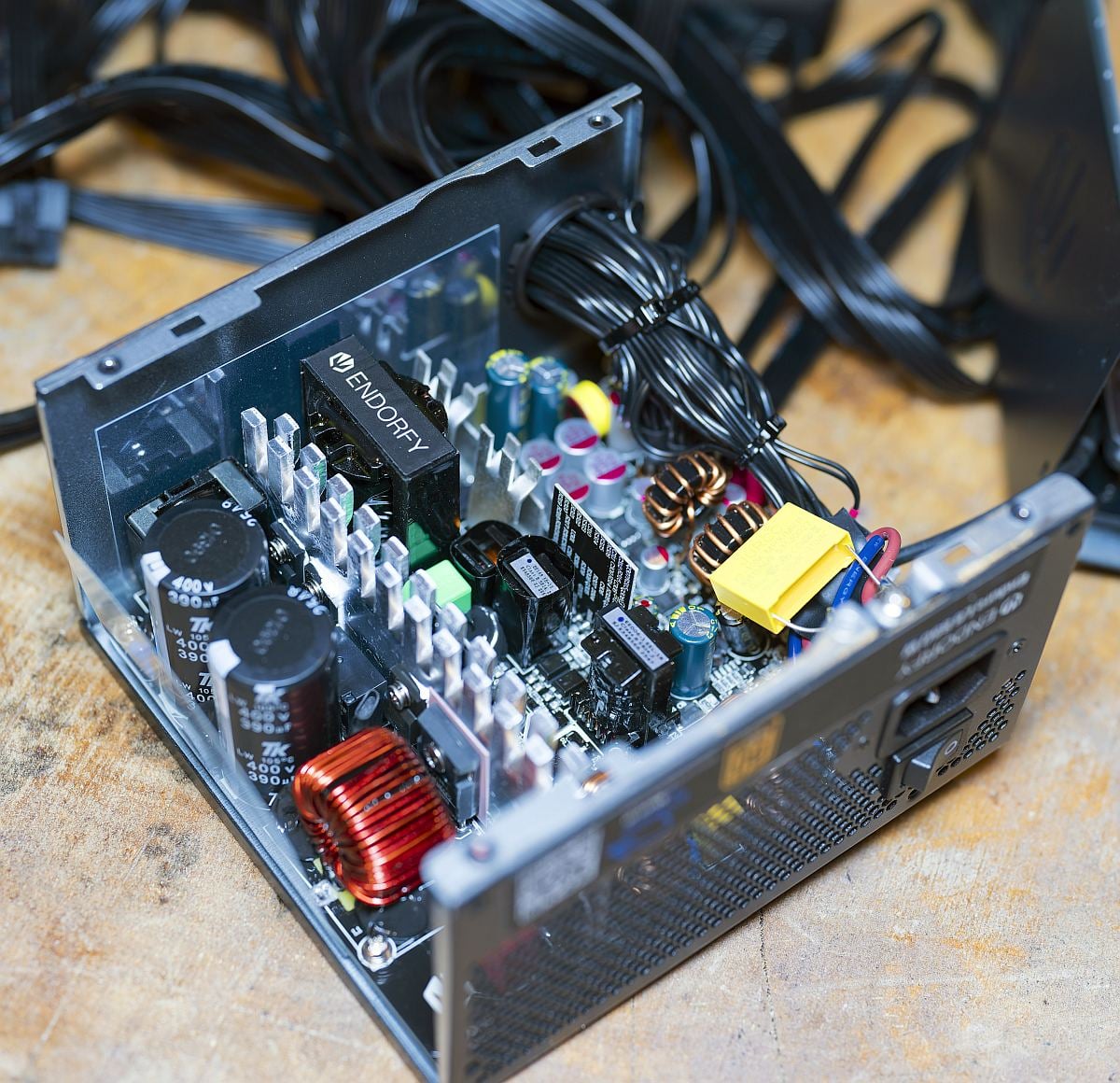
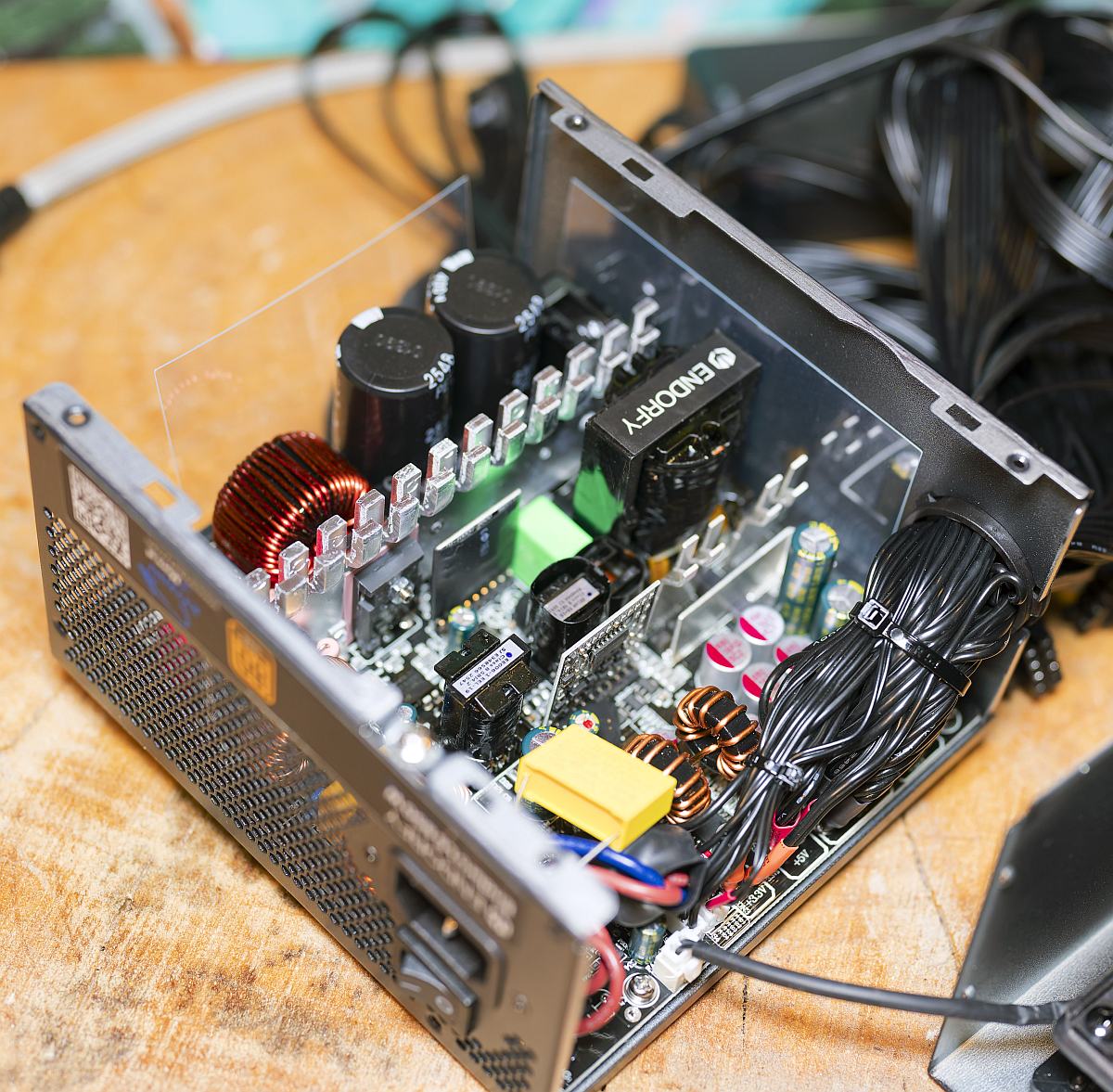
Secondary side
The secondary side uses synchronous rectification for the main +12V rail, alongside DC-DC converters for the +5V and +3.3V minor rails. Here you’ll find five Teapo Electrolytic caps and nine Teapo polymer caps, as well as the six SLM150N06G MOSFETs for the +12V rail. The minor rails use four Rectron RMN3N5R0DF MOSFETs, managed by a uPI uP3861P PWM controller.
Performance and efficiency
How we test
My first basic test is performed with a Thermaltake Dr Power III power-supply tester. It doesn’t draw more than a couple of watts from the PSU, but it helps determine whether it’s operational. A self-check indicates whether voltages are running at the proper levels.
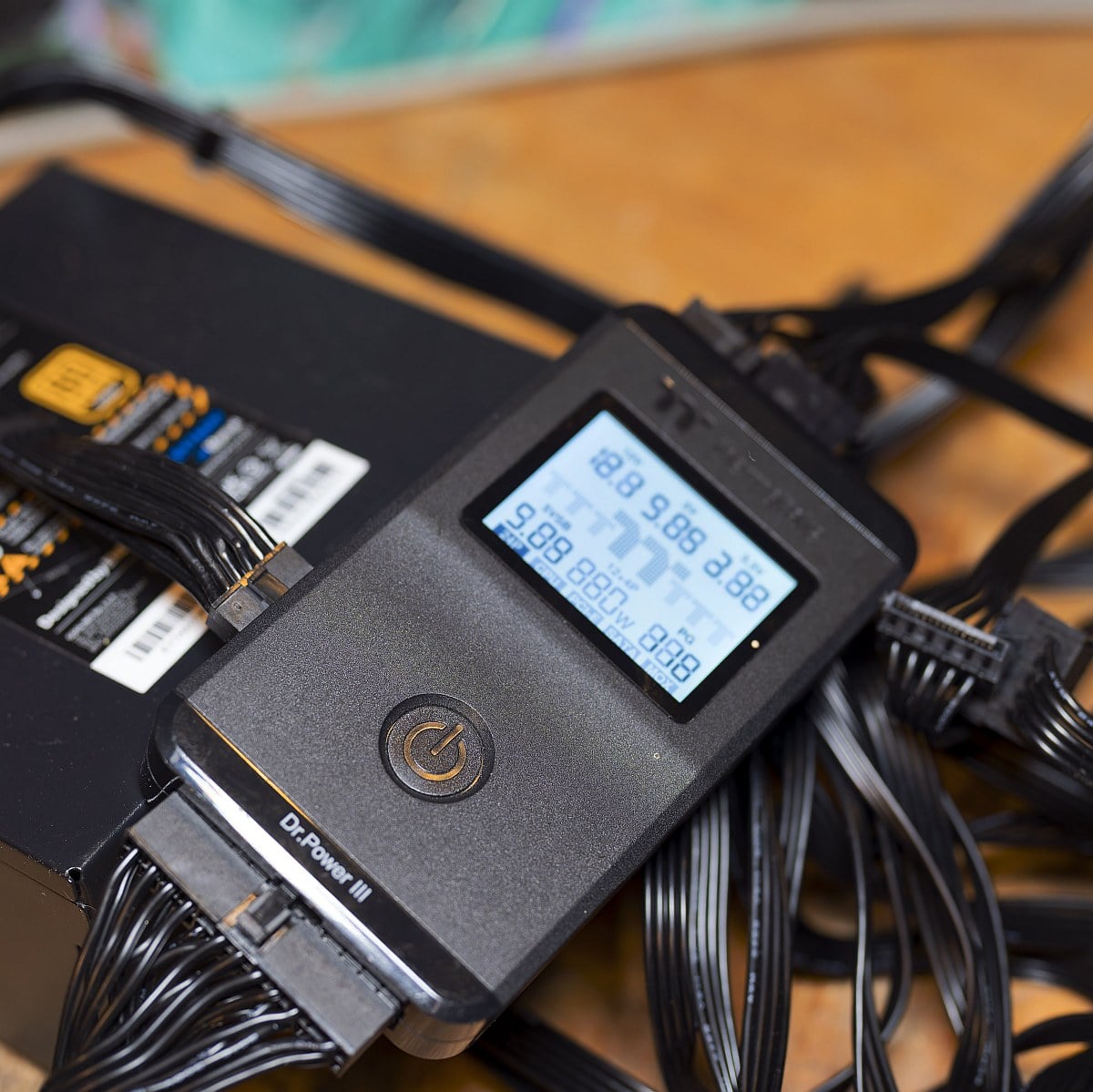
As you can see, there are no issues with the Endorfy Enduro L6 850W unit. The following professional setup was used for the remainder of my testing:
- Voltcraft VC-870 digital multimeter
- GW INSTEK GDS 3154 oscilloscope
- Fluke 97 Scope meter (voltage and ripple)
- Voltcraft SL-451 decibel meter (noise)
- ACUVIM-IIRF (measures active power input from the socket)
- PCE Instruments PCE-DT 50 tachometer (measures rotational speed of the fan)
Let’s kick off with a brief summary. The Endorfy Enduro L6 850W delivers very good efficiency, keeping power waste and heat generation in check. Under typical loads, this PSU consistently maintains high efficiency, especially considering its low price. This high efficiency can translate into lower electricity bills for users running their systems extensively, as well as a reduced environmental impact, at least compared to a cheaper, less efficient PSU.
Testing was performed under controlled laboratory conditions with a 230V mains input to evaluate real-world power delivery, efficiency curves, noise profile, and rail regulation. I’ve also compared these results against the be quiet! Pure Power 13 M 850W as a near competitor, albeit one that doesn’t have modular cables.
12V regulation
| Wattage | Endorfy Enduro L6 850W | be quiet! Pure Power 13 M 850W |
| ~85W (10%) | 12.02V | 12.18V |
| ~212W (25%) | 12.01V | 12.16V |
| ~425W (50%) | 11.96V | 12.14V |
| ~637W (75%) | 11.92V | 12.11V |
| 850W (100%) | 11.88V | 12.08V |
Voltage regulation on the main +12V rail is tight across the entire load spectrum. The be quiet! unit always stays above the 12V line here, while the Endorfy drops slightly 11.88V at full load. Both units are solid here, though, with minimal variation.
Wide-load efficiency
| Wattage | Endorfy Enduro L6 850W | be quiet! Pure Power 13 M 850W |
| ~85W (10%) | 88.38% | 88.64% |
| ~212W (25%) | 92.27% | 92.71% |
| ~425W (50%) | 92.97% | 93.39% |
| ~637W (75%) | 91.91% | 92.52% |
| 850W (100%) | 90.42% | 92.34% |
Although it’s officially stickered as an 80 Plus Gold unit, the Enduro L6 850W punches above its weight class, earning a Cybenetics Platinum rating at 230V input. In our tests, it maintains ~93% peak efficiency at half load, and remains above 90% even under maximum output. The be quiet! unit, which also has 80 Plus Gold certification, is slightly more efficient here, especially at 850W, but there’s otherwise not a lot in it.
Low-load efficiency
| Wattage | Endorfy Enduro L6 850W | be quiet! Pure Power 13 M 850W |
| 40W | 82.35% | 81.34% |
| 60W | 86.42% | 86.67% |
| 80W | 88.71% | Not checked |
Examining low-load efficiency is equally important if, as in most cases, your PC spends much of its time idle. Whether your system is running basic tasks or pushing full CPU and GPU performance, you want your PSU to operate economically, minimising heat output and potentially extending the lifespan of your computer’s components.
As you can see, the Endorfy Enduro L6 850W results are practically indistinguishable from the more expensive competitor here, and efficiency stays above 82% at even a 40% loads.
12V ripple suppression
| Wattage | Endorfy Enduro L6 850W | be quiet! Pure Power 13 M 850W |
| ~85W (10%) | 29.9mV | 27.4mV |
| ~212W (25%) | 31.1mV | 26.5mV |
| ~425W (50%) | 32.5mV | 23.2mV |
| ~637W (75%) | 36.2mV | 24.3mV |
| 850W (100%) | 41.7mV | 26.8mV |
Ripple suppression on the Endorfy’s +12V rail is well controlled, coming in at 41.7 mV under 100% full load. That’s far below the maximum allowable 120mV standard set by ATX design guides. The be quiet! PSU performs better here, but they’re both solid results.
Noise
| Wattage | Endorfy Enduro L6 850W | be quiet! Pure Power 13 M 850W |
| ~85W (10%) | 30.0dBA (~620rpm) | 30.0dBA (0rpm) |
| ~212W (25%) | 30.2dBA (~640rpm) | 30.0dBA (0rpm) |
| ~425W (50%) | 30.5dBA (~680rpm) | 31.2dBA (750rpm) |
| ~637W (75%) | 36.7dBA (~1,250rpm) | 31.2dBA (750rpm) |
| 850W (100%) | 38.9dBA (~1,550rpm) | 31.5dBA (810rpm) |
Acoustic output isn’t bad for this low-cost PSU. Despite lacking a semi-passive zero rpm mode, the 120 m Stratus FDB fan spins at a gentle ~620–680rpm until it gets to 50% load, at which it generates a negligible noise level of around 30dBA (you couldn’t hear it above the background noise level in my lab).
Under maximum 850W loads, however, the fan speed tops out at around 1,550rpm, with a noise output of 38.9 dBA. The be quiet! Pure Power 13 M 850W is much quieter at these levels.
Conclusion
The Endorfy Enduro L6 850W might not have modular cables or a zero-rpm mode, but it’s a solid PSU for the money. Combining excellent efficiency with quiet fan acoustics at low-to-mid loads, as well as ATX 3.1 compliance and a native 12V-2×6 graphics cable, it hits all the key technical requirements for modern gaming builds.
Add in its generous seven-year warranty, and you’re looking at a decent package that will stand the test of time. If you’re aiming to save as much money as possible on a PSU for your next PC build, but without skimping on quality, the Endorfy Enduro L6 850W is well worth considering.
However, it’s also worth bearing in mind that spending a little bit more on a PSU with modular cables can make it much easier to assemble a tidy build, as you only use the wires you need. Also, while, the Endorfy Enduro L6 is basically inaudible at low loads, you can get a unit that’s quieter when running flat out for not much more money.
If you’re happy to sacrifice cable modularity, though, and tolerate a bit more fan noise at high loads, this is a solid, efficient PSU for a very reasonable price.