

Everyone wants better operating temperatures in their gaming PC, but is there a more optimal way to position our hardware in service of this goal? According to YouTuber TrashBench, the answer in unequivocally: yes. Following a quick experiment, the tech tweaker has shown we could be reducing our graphics card thermals by almost 20°C, providing we’re brave enough to break from convention.
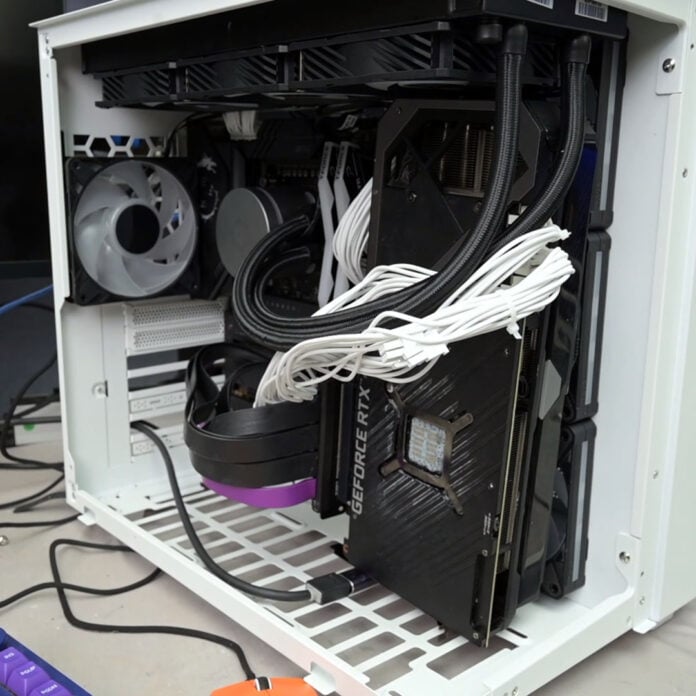
Rather than explore how different fan orientations affect case airflow, TrashBench wanted to investigate if shifting the position of components would lead to a greater change in temperatures. To explore this line of thought, the YouTuber built a dual-chamber test bench featuring an Intel Core i9-14900K (cooled via an AIO water cooler) and an Nvidia GeForce RTX 3080, alongside three intake fans and a single exhaust.
Keeping all fans at fixed RPMs, baseline operating temperatures were captured while the system ran Time Spy and a 12-thread 7-Zip benchmark simultaneously over 10 minutes. Running in a standard layout, with a horizontal graphics card and push-pull case airflow, the average CPU temperature sat at 65.2°C, while the GPU was a touch toastier at 70.9°C.
The next experiment involved running the RTX 3080 at the bottom of the case, which required removal of some mesh to avoid contact between fans, maintaining connection to the motherboard through a PCIe riser cable. Doing so did practically nothing to improve GPU cooling (-0.1°C) but did see the CPU and VRM temperatures improve by -4.2°C and -7.0°C, respectively.
However, upon moving the graphics card directly in front of the intake fans saw the biggest and most promising change in temperatures. Relative to stock, the CPU climbed by a mere +1.1°C, but the GPU core temperature fell by a whopping -16.7°C, with the hotspot falling even further to the tune of -19.3°C. VRAM also benefited from this switch, running -14.0°C cooler, with VRM temps surprisingly falling by -7.8°C too.
In the interest of fullness, TrashBench also experimented with placing the GPU in front of the triple-fan intake. This placement did respectively improve GPU core and VRM temperatures by -7.1°C and -4.6°C versus stock, but saw the CPU climb by +3.4°C. Meanwhile, swapping the AIO water cooler from exhaust to intake, creating positive air pressure inside the case, helped cool the processor by an extra -6.2°C but saw a dramatic rise in GPU temps to the tune of +16.0°C.
Combining the GPU placement in front of the side intake, with the AIO running as an additional intake, provided the best all-round improvement to temperatures compared to stock. The GPU core was down -10.5°C, VRAM fell by -7.8°C, and the hotspot was -14.0°C cooler. Meanwhile, CPU and VRAM temperatures respectively reduced by -3.3°C and -3.1°C.
As TrashBench points out, this experiment by no means encompasses the umpteen variables in play that dictate case temperatures, including fans, the components themselves, and more. However, this tinkering does suggest chassis design is in need of a shakeup to achieve optimal thermals for our hardware, much as it’s not pretty nor feasible for many in its current form. I’d certainly welcome a shakeup for aesthetics, but all the more so if there’s extra performance for the taking.