
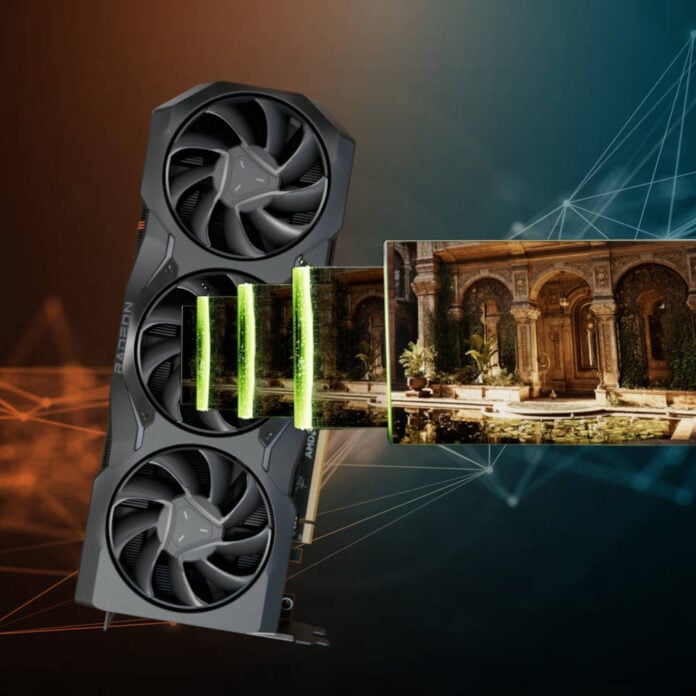
Modders have already managed to run multi-frame generation on AMD Radeon GPUs, with varying levels of success. While the mode does work, boosting the perceived smoothness of games, it only runs in certain titles and requires some file tinkering.
We’re not just talking about new Radeon GPUs either, as the workaround also works on older GPUs. The trick relies on enabling multi-frame generation (MFG) using DLSS Enabler. This tool simulates DLSS upscaling and DLSS frame generation on DirectX 12-compatible GPUs and DLSS 2/3-ready games. In other words, it can technically inject a form of multi-frame gen into games using any GPU.
Like OptiScaler, this mod injects DLSS components through FSR’s pipeline to trick the game engine into generating more frames than AMD Radeon GPUs currently support. As a reminder, MFG is officially only available for Nvidia RTX 50 Series users and some Intel Panther Lake iGPUs, as AMD has yet to release its own in-house MFG tech.
YouTuber Ancient Gameplays took it for a spin in Cyberpunk 2077 to test its capabilities, showing that the mod does indeed work, though not without some limitations. The frame rate did multiply as promised, the smoothness improved, and ambient occlusion was noticeably enhanced. However, there were also visible motion artifacts.
While this was to be expected, there is another sizable issue with this mod, which is stability. Ancient Gameplays had to launch the game multiple times before it finally booted, as there seems to be some issue during the launch process. The 3x MFG option was also bugged when paired with ray tracing, causing unpleasant stuttering. Likewise, the game’s adaptive frame generation option didn’t work correctly on the Radeon GPU, causing huge variations in performance, jumping between fast motion and a sluggish, stuttery experience.
If you manage to remain patient through all of this, you could finally experience MFG ahead of other Radeon owners. Of course, this mod mode is only recommended for hardware enthusiasts with plenty of patience, but we can’t help but be impressed by such an accomplishment. Its main benefit is to show that all these upscaling-related technologies can be implemented on older hardware, albeit with limitations – it’s just a case of whether AMD, Nvidia, and Intel want to do it.