


RAM costs may not hit the stratospheric heights predicted for 2027 after all, as market analyst firm TrendForce says it’s lowered its forecast for contract price increases next year. “Buyers are turning cautious,” warns TrendForce, adding that “demand may weaken next year.”
Don’t get out the champagne just yet, though. It looks as though DDR5 prices are still going up next year, but perhaps not by as much as originally thought. Either way, there appears to be uncertainty brewing, with indications that the DRAM market may be starting to cool off. In particular, TrendForce says that DDR4 spot prices are now actually going down, as shown in the graph below.
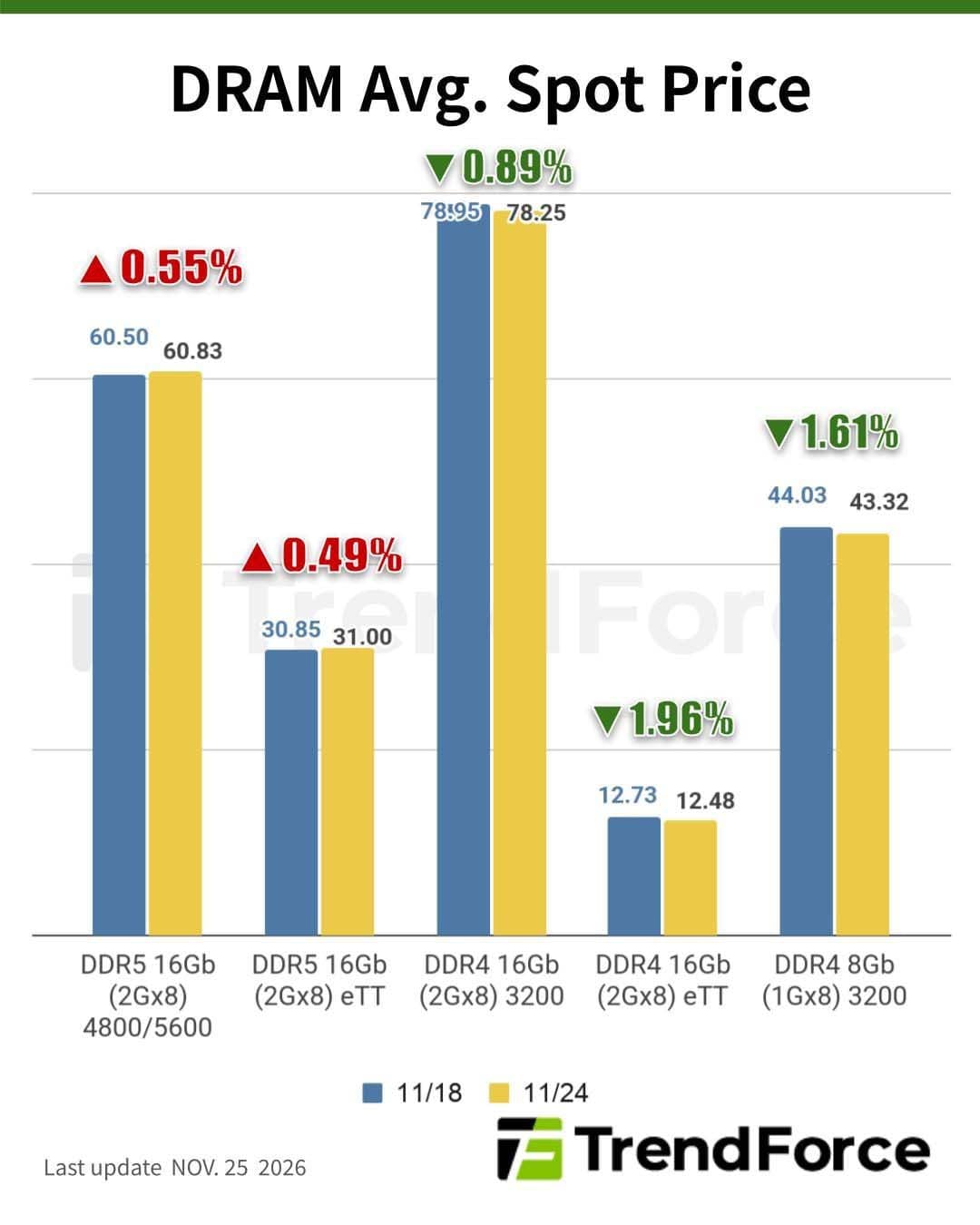
“DDR4 and DDR3 have been more heavily impacted by the weakening consumer application segments, keeping their prices under continuous downward pressure,” said the firm in a post on X. TrendForce cites a number of factors in its decision to lower its predictions. “US data centre policy and geopolitics add uncertainty,” claims the market research firm, while saying that Chinese CSPs (cloud service providers) “have cut some server DRAM demand.”
Meanwhile, extremely high prices in the consumer market have unsurprisingly deadened demand, meaning retailers and distributors are buying RAM in lower quantities. “Consumer demand is weak,” says TrendForce, “and buyers are focused on reducing inventory first.”
While the big memory makers, such as SK Hynix, Micron, and Samsung, have shifted a lot of their production capacity to HBM, drastically reducing the supply of traditional DRAM chips for consumer devices, TrendForce notes that Winbond and Nanya are now “filling the consumer DRAM gap.”
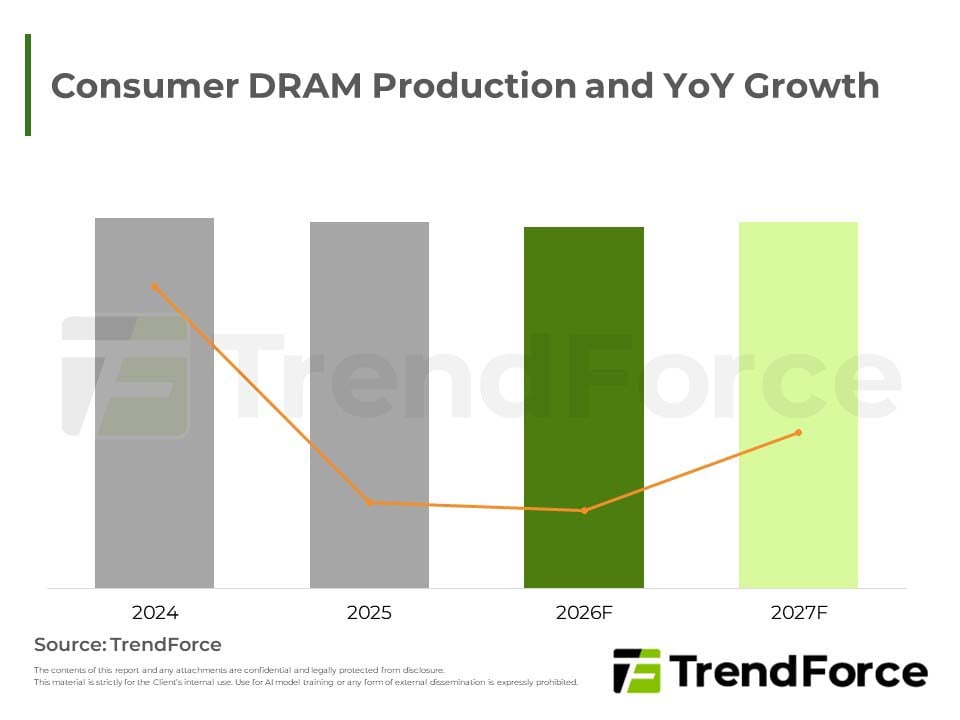
The firm forecasts a sharp increase in consumer DRAM production and year-on-year growth in 2027. The figures still sits below 2024 levels, but they’re considerably higher than the last couple of years.
While production may be increasing, though, consumer demand is currently low, as prices are so high, and existing inventory needs to be shifted. “Consumer DRAM demand momentum next year may be weaker than expected,” says TrendForce.
Whatever happens, it looks like we’re still in for a bit of a slog in the desktop PC market before memory is properly affordable, and it may never come down to the lows of 2024 and early 2025 again.
For more information on the current situation, read our analysis on why PC RAM prices aren’t going to crash any time soon, as well as our interview with memory consultant Ben Miles, who explains some of the workings behind the scenes.