

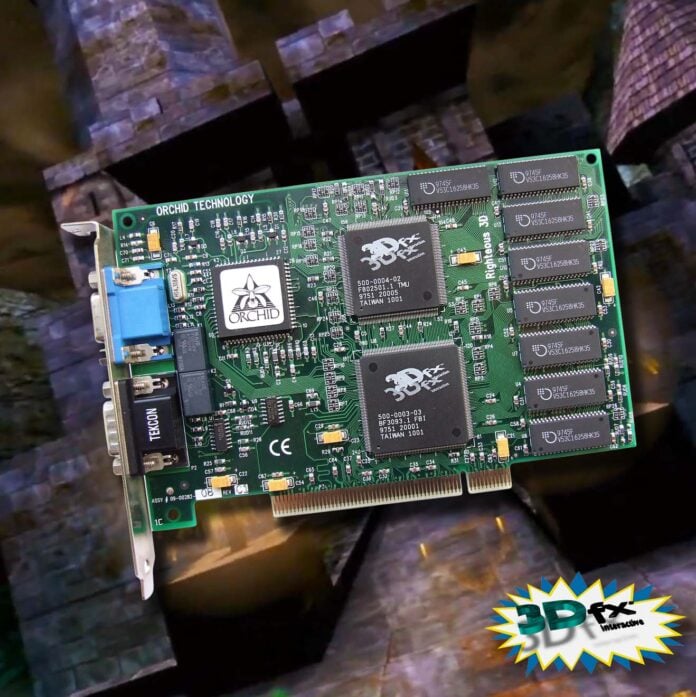
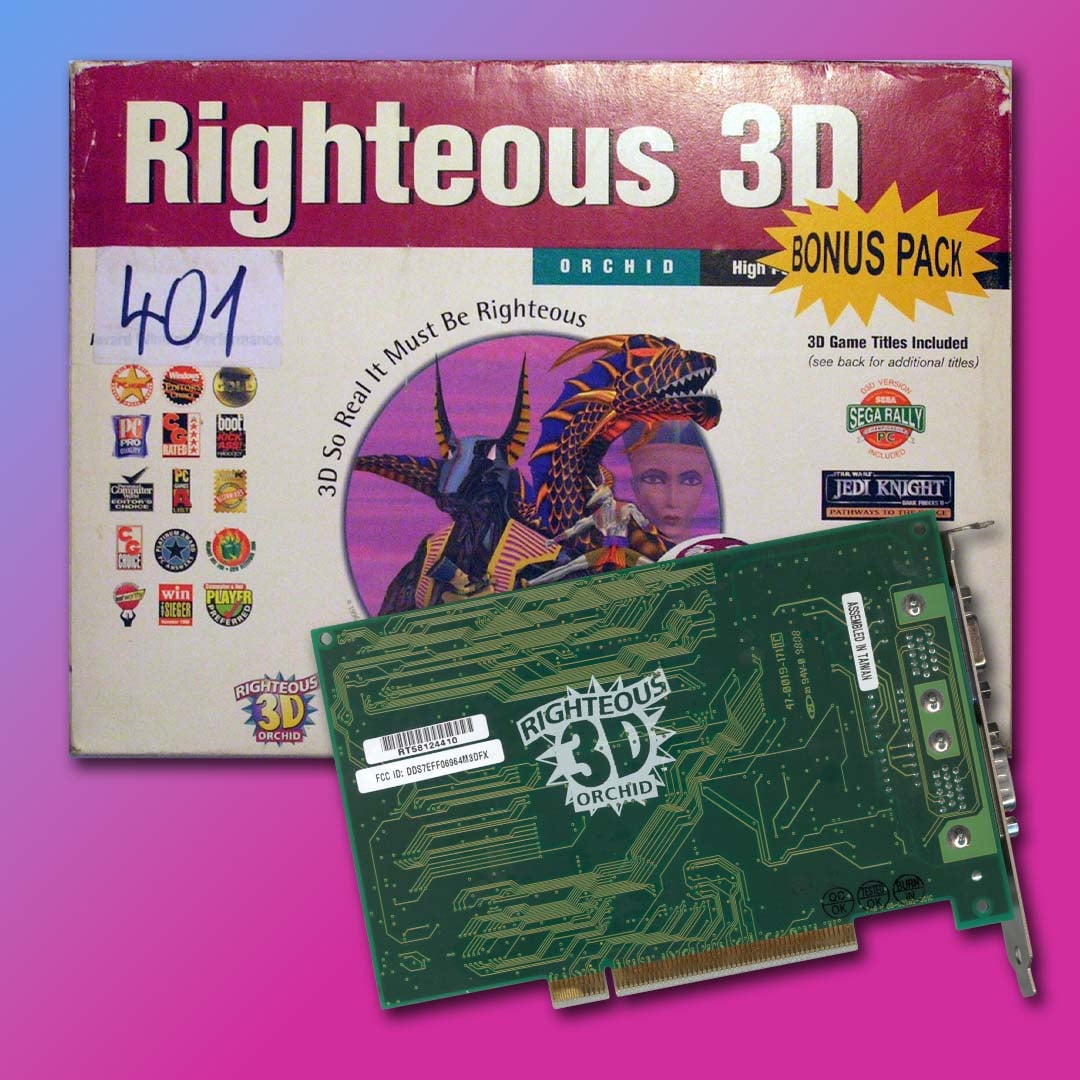
30 years ago, on 7 October 1996, PC gaming changed forever. On that day, the Orchid Righteous 3D was unleashed into the wild, the first card bearing 3dfx’s Voodoo Graphics chipset, having been announced 11 months earlier at Comdex. What followed was a rewriting of the 3D gaming rulebook, as the PC became the games machine to beat. With graphics that made the PlayStation and N64 look positively stone age, you just couldn’t believe what you were seeing when you fired up one of 3dfx’s demos for the first time – the future of gaming was here, and it was on PC.
I loved my Guillemot Maxi Gamer 3D that I bought with my student loan in 1997 – to this day, I consider it the best PC upgrade I’ve ever bought in terms of the difference it made. How on earth did something as cool as the Voodoo Graphics chipset get made in the mid 90s? As the fabled 3D accelerator passes its 30th birthday, I caught up with 3dfx cofounder Ross Smith to talk about its development behind the scenes.
We were for games
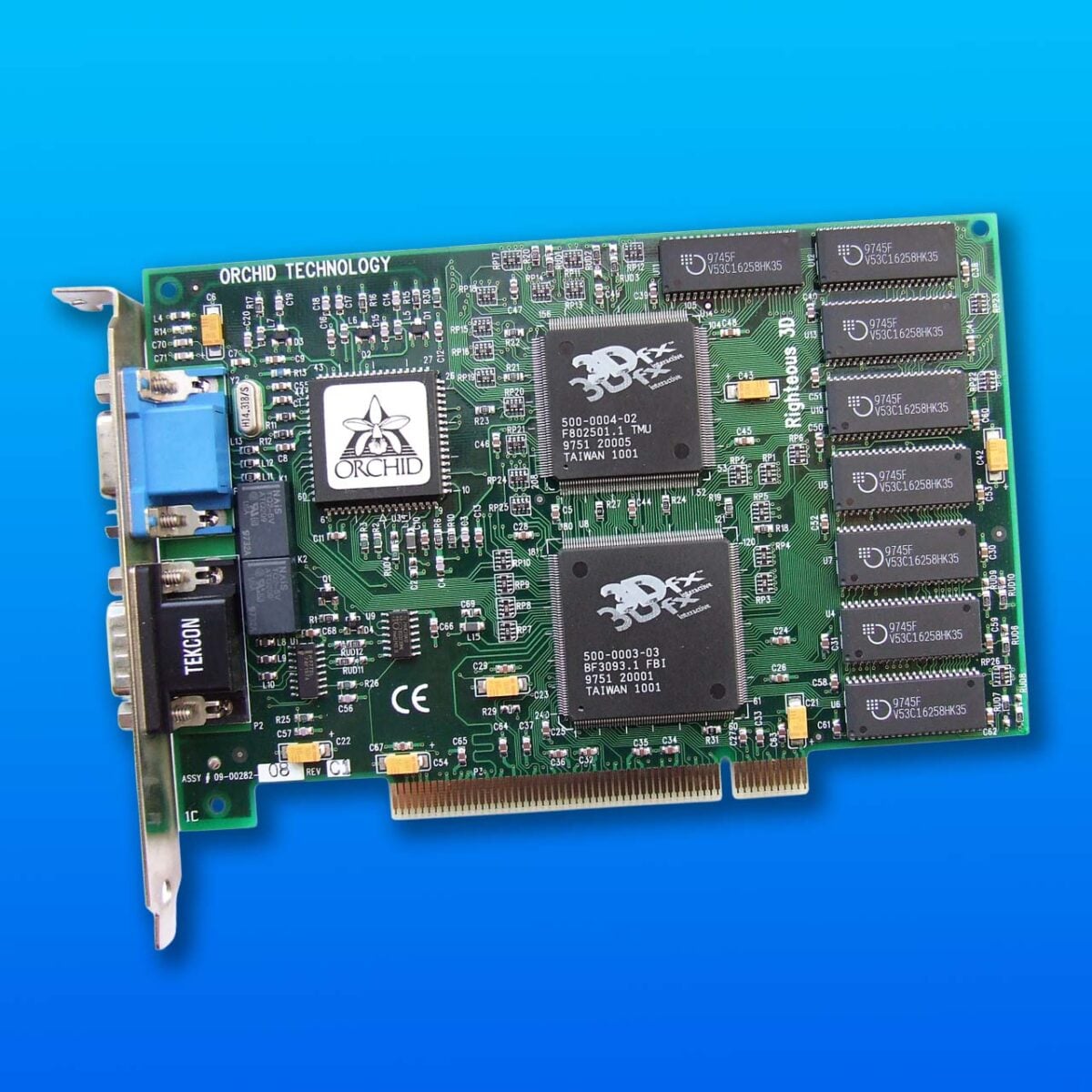
“Diamond Multimedia laughed at us,” recalls Smith, who cofounded 3dfx with Scott Sellers and Gary Tariolli in 1994. “They said, ‘Are you crazy? This thing doesn’t have a VGA – no one’s going to put this in a PC – you can’t have a relay that’s going to click over when you play a game.'” The first Voodoo cards didn’t function as traditional graphics cards – you needed to have a standard 2D VGA card as well, and the two cards hooked up round the back with an analogue VGA pass-through cable.
“When you invoked a game that used Voodoo Graphics, it would switch,” explains Smith, and on early cards you could actually hear the click. “Your monitor would then connect to the Voodoo Graphics board, and you’d be playing games. That wasn’t a bug, but like an undesirable feature – it became a big deal because people knew that when you heard that click, it was time to play a game.”
Why didn’t 3dfx make a card that did both 2D and 3D in one? “We maintained the discipline of not trying to be a general-purpose graphics chip,” says Smith. “We were for games – that was it.” However, he also confesses that there was another reason why 3dfx didn’t build a standard 2D VGA setup into its card.
Diamond Multimedia laughed at us. They said, ‘Are you crazy?’
“We didn’t know how to do VGA,” admits Smith, “so we’d have to go buy one and then we’d have to integrate it.” That wouldn’t just add cost in terms of buying in hardware, but also when it comes to software support for all the many Windows packages that people would expect to be able to run on the card.
“No one pays for compatibility with WordPerfect or Excel,” explains Smith. “They expect it, and if you don’t have it, then your OEM, whether it’s Compaq, Gateway, HP or whatever, you’re going to get a bunch of grief over that, because you can’t run WordPerfect, and no one’s going to pay a penny for that.
“So we said, ‘let’s focus on games,’ and we did something revolutionary there – we didn’t have a VGA. That was partly down to our lack of design experience, and partly down to my concern about profitability and compatibility. Being compatible with a million apps is really hard – being compatible with 200 games is much easier.”
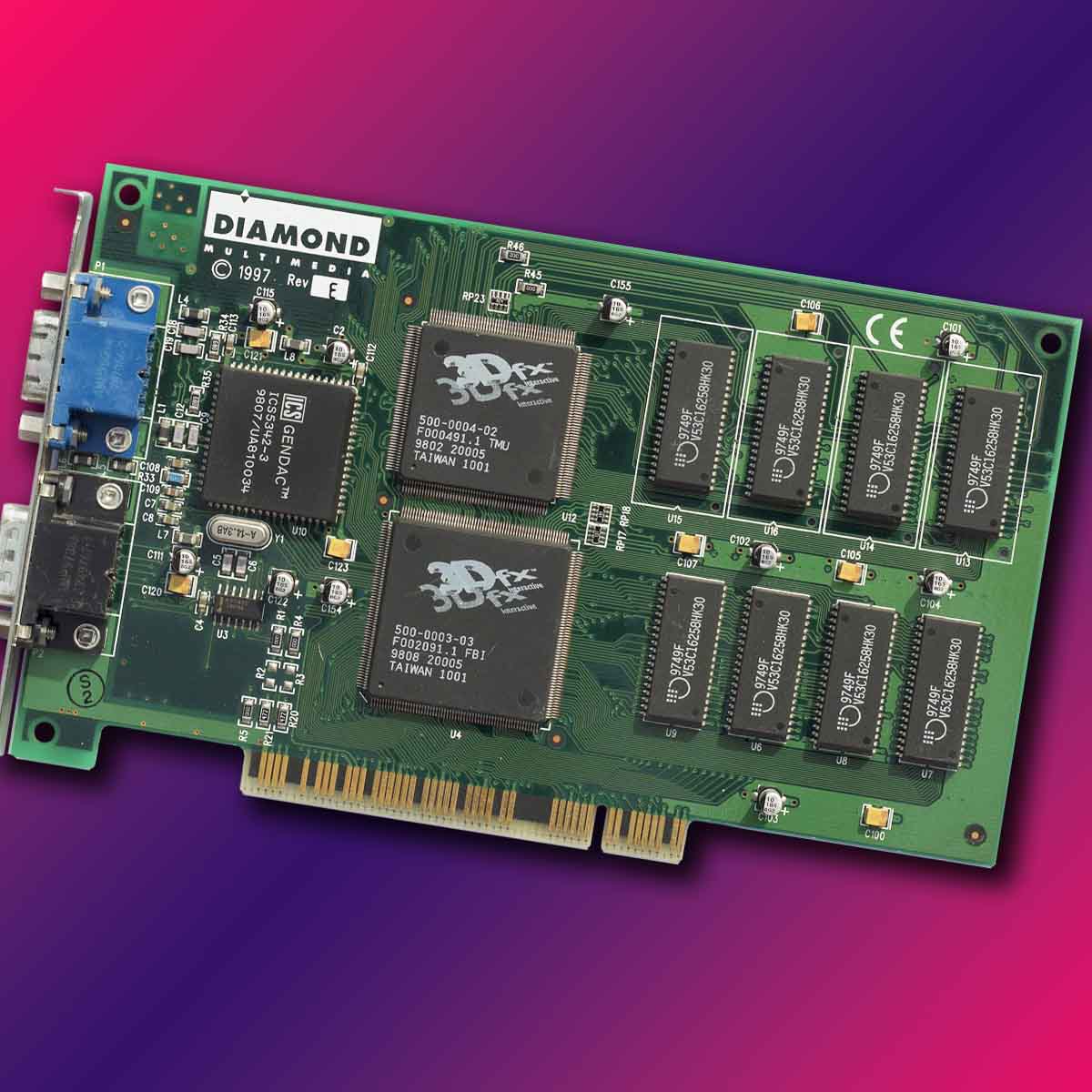
Of course, Diamond Multimedia wasn’t laughing for long. The company went on to make the Diamond Monster 3D – one of the most popular Voodoo Graphics cards. “Diamond saw that Orchid was on board, so that success kind of breeds success,” explains Smith, “and we got a bunch of guys. We got Guillemot in Europe, and we got companies in Japan and Korea.”
But we’ve got ahead of ourselves here, let’s hop in our Glide-accelerated time machine and hurtle back to the late ’80s, when cases were beige, 500MB seemed like an unfathomably large amount of storage space, and a 33MHz CPU was, really, really fast.
Where it all started
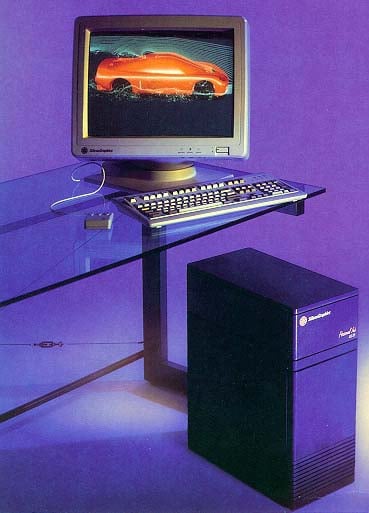
The genesis of 3dfx started twinkling in the late 1980s at Silicon Graphics (SGI), where Smith, Sellers, and Tarolli were all employed. Smith had previously worked at MIPS Computer Systems, which had been bought by SGI. “I met these clever engineers,” he says, “and we all had the same vision that the PC was going to become a really important platform for 3D graphics.” That was easier said than done, though. “It was a fairly novel idea in the late 80s,” admits Smith, “and we couldn’t convince SGI management of that.”
Committed to their ambitions, the trio spun off a company from SGI called Pellucid to do it. “We had real 3D graphics products in the marketplace in the late ’80s, early ’90s,” claims Smith about Pellucid. That’s a feat given the tech available at the time, but there was little in the way of supporting infrastructure. “We were way too early to market,” he says. “There were no apps, our focus was on CAD, not on games, and we kind of ran out of money.”
The CEO of the company told me, ‘If you ever bring up 3D graphics again, I’m going to cut your hands off.’
Pellucid was then bought up by Media Vision, a company that Smith describes as one “that made sound cards, and wanted to expand into classic VGA graphics, chips, and adaptors for the mainstream PC market.” Smith rolls his eyes and says, “They tried to adapt us.” It didn’t work. “We were 3D guys,” explains Smith, and he says the team had some success getting some new tech into Media Vision’s graphics product stack while selling sound cards.
“We introduced the first OpenGL toolkit for Windows, probably in 1991 or ’90,” he recalls, “then we also introduced some compelling 2D high-performance graphics controllers.”
He says it all came to a head for him during a meeting of executive staff. “I brought up the fact that I’d done this deal with Kubota to do advanced 3D graphics, and the CEO of the company told me, ‘If you ever bring up 3D graphics again, I’m going to cut your hands off.'” Smith quit to become a consultant, but just before he left, he had a fortuitous meeting.
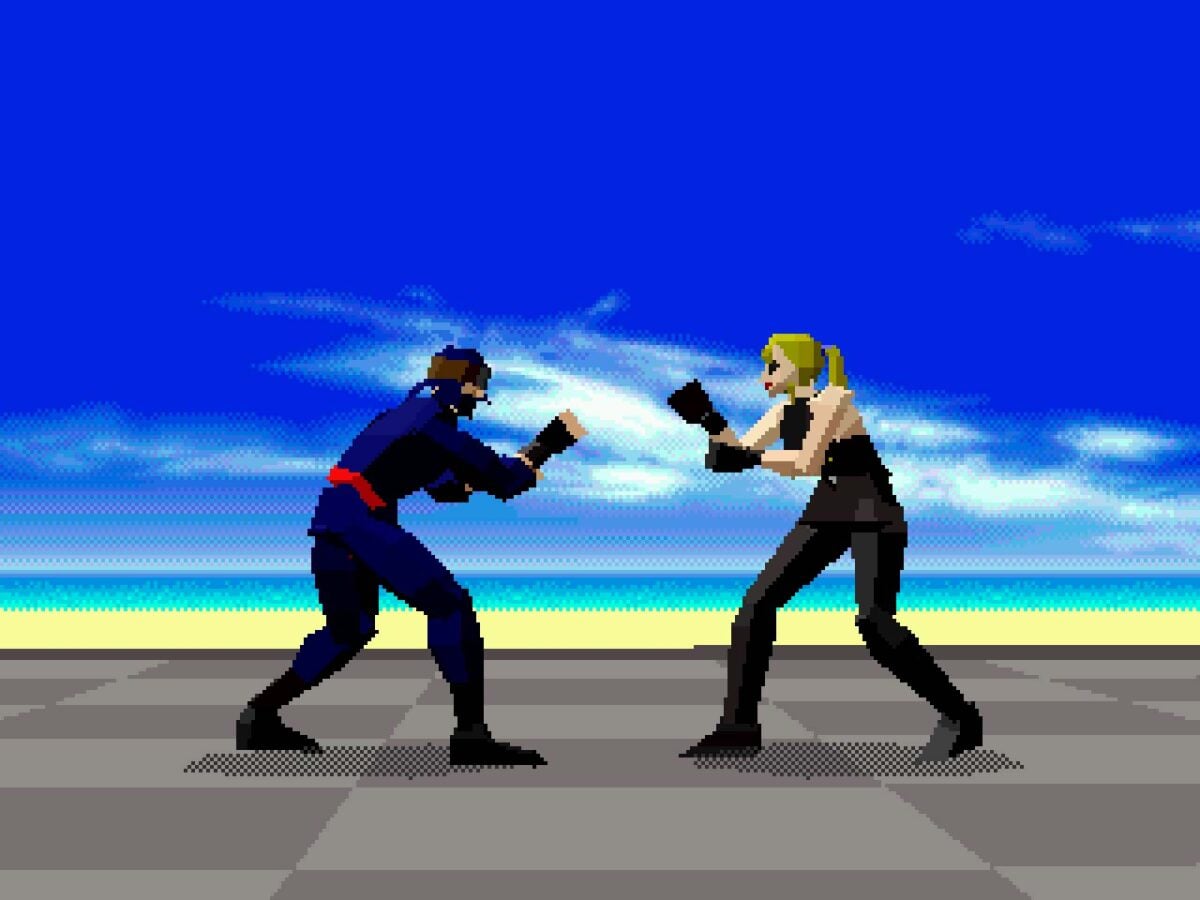
“A guy dropped by the office, who was from a videogame company called American Laser Games – they made arcade games and amusements. And this guy said, ‘You know, 3D’s coming to the game business, could you guys build us a chip?’ Because he was responding to what Sega had done with Lockheed Martin on Virtual Fighter and Daytona.”
They were terrible. It was like, holy cow, this is abysmal. They weren’t perspective correct. There was popping everywhere.
He invited Smith and Herb Kuta (a cofounder of SGI), to the AMOA expo in Anaheim to have a look at how 3D graphics was shaping up in games. “We’re looking at these games, and they had 3D graphics in them,” says Smith, but he was far from impressed.
“They were terrible. It was like, holy cow, this is abysmal. They weren’t perspective-correct. There was popping everywhere. I mean, the games were good. The graphics were terrible.
And Herb and I said, ‘You know, we can do a lot better than this.’ So we came back, and while my CEO was trying to cut my hands off, we dragged in Gary and Scott and started thinking – could we build a graphics chip?”
From CAD to games
With an enormous amount of 3D expertise under their belts, the team certainly knew their stuff, but making CAD hardware is a whole world away from the smoke and mirrors of 3D in games.
“For games, you need good texture mapping performance, rasterisation, and really high memory bandwidth,” explains Smith. “For CAD, you need precision, floating point, line drawing, stippled lines; you need all this other crap.” Making a gaming graphics chip was going to be a whole different ballgame, and Smith says a large amount of the team’s success here was down to Gary Tarolli’s mathematical wizardry.
For games, you need good texture mapping performance, rasterisation, and really high memory bandwidth.
“Gary’s a mathematician, a physicist, and he understood the math shortcuts we could take – he was a software architect, and that’s really what you need to build a successful semiconductor company. He’s a software guy who understood what we could do to only focus on the gaming part of the market.”
An architecture was developed that could do it, with Scott Sellers key to developing the silicon design, while Smith worked on a business plan. “The whole scheme of the plan was to use this graphics chip and boards that we built to connect the arcade market to the home market,” says Smith.
Raising capital
At this point, Smith and Scott were in Palo Alto, where Smith was still working out of his apartment, and Gary Tarolli lived in Boston, with occasional commutes so the trio could meet. The last piece of the puzzle was Gordon ‘Gordie’ Campbell, who at that time had a venture capital firm called Techfarm.
“He interviewed me to work with a guy I worked with at MIPS, who was building an ECL version of the Power PC chip,” explains Smith. “It had very high performance, and we were going to sell it to Apple because I was consulting with them, and Gordie could tell I wasn’t enthused about doing that. He said, ‘Well, clearly this is not what you want to do. What do you want to do?’
“And I said, ‘What do you know about 3D graphics?’ I gave the whole spiel, and he said, ‘Well, get your team down here, and let’s talk about it.’ I’d been a VP of sales and marketing and business, but I’d never run a company. So, the three of us, and a lady who’s not with us any more, Alma Ribbs, decided, ‘Let’s bring Gordie in to run the company and go raise the money.’ So we anointed Gordie as chairman and CEO, and raised our first amount of venture.”
The infant 3dfx collective made $5 million in its first round, which was small but enough to get started, and Smith says they eventually raised $40-50 million before getting to market.
Core hardware
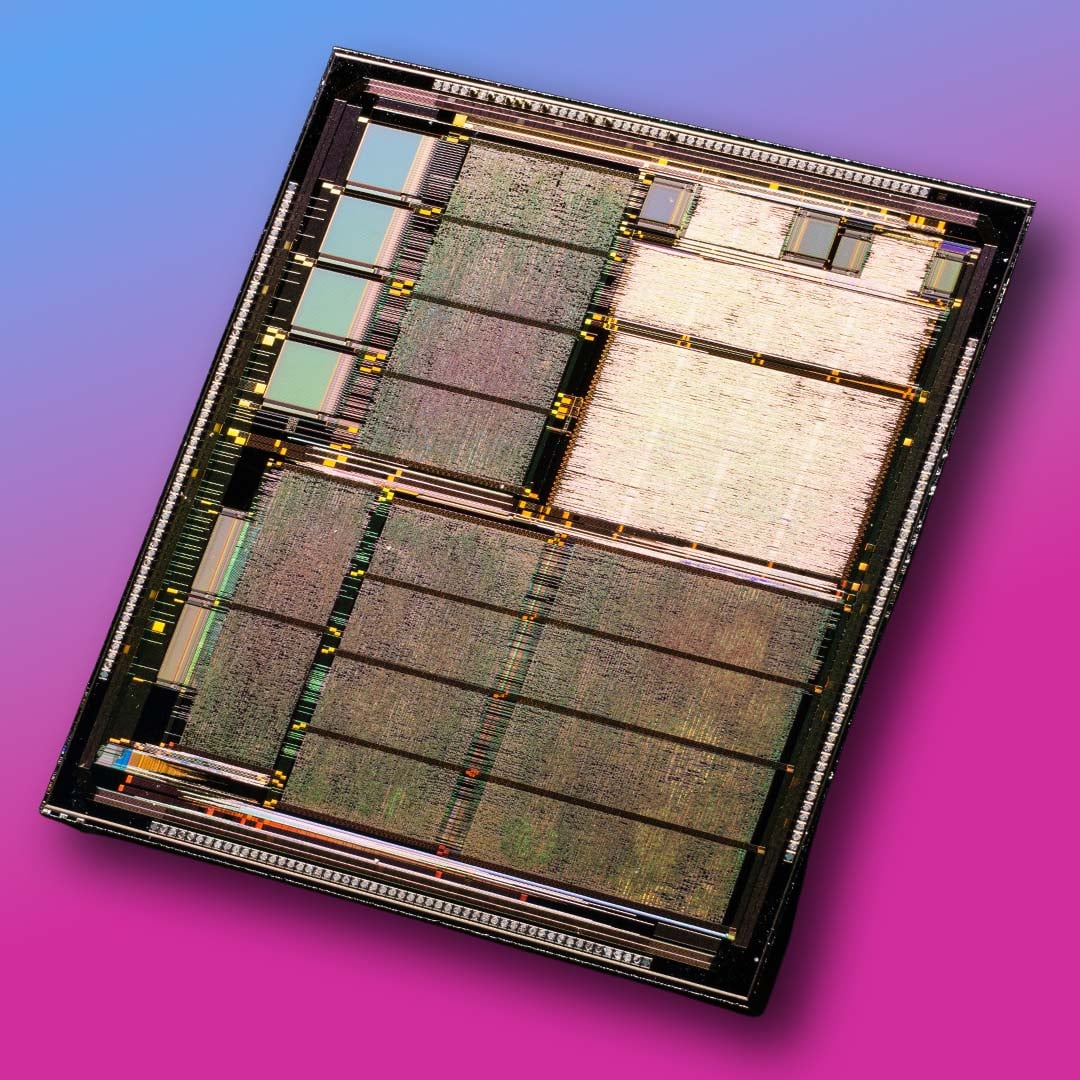
A 3dfx Voodoo Graphics board is a very different beast from today’s graphics cards, and not just because there isn’t a single heatsink in sight, let alone a fan. There’s not even a power connector – it gets all the 15W it needs straight from a PCI slot.
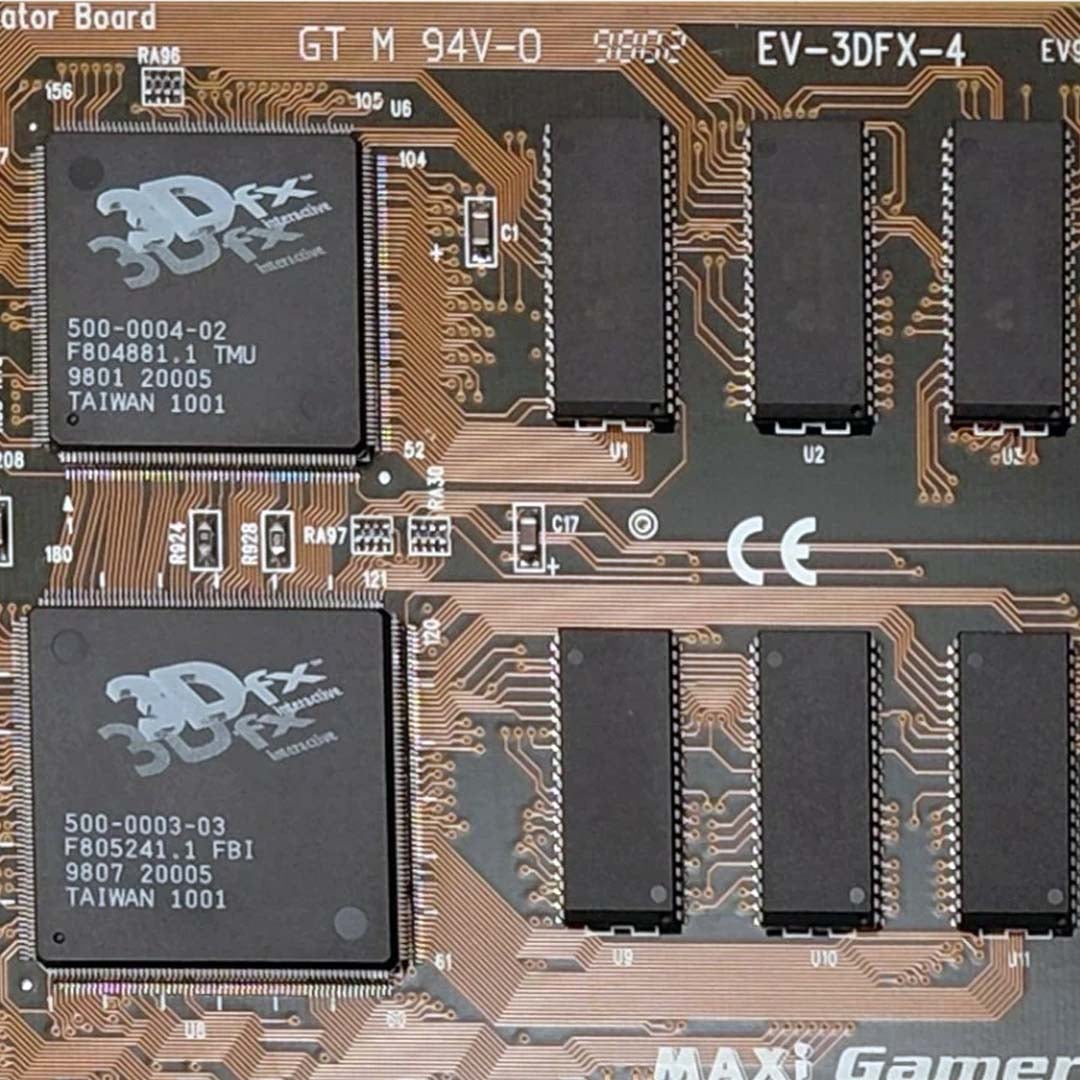
Instead of having just one chip, there are two. One acts as the frame buffer interface (with FBI in its model name), which is basically the rasterisation engine. It talks to the CPU to get all the polygon data, works out which of them will be visible on screen, and then goes about drawing and filling them with basic colours.
Once the FBI is done with a frame, it passes it to the texture mapping unit (TMU), which adds the crucial detail of textures, complete with alpha blending for transparency effects, as well as mipmapping and even trilinear filtering. The result then goes through a DAC (digital-to-analog converter), which feeds the frames out of its 15-pin VGA output.
Each chip has access to 2MB of EDO memory, making for 4MB in total. “Because of our work in 2D graphics, we were really good at doing efficient memory designs,” explains Smith. “Scott Sellers was able to extract amazing efficiency out of a reduced number of memory chips, so we could really keep our memory footprint low, and Gary designed specific and actually patented algorithms so that meant, even though we weren’t doing 24-bit colour, it looked like it.”
Even this modest amount of onboard RAM was a problem for the fledgling 3dfx team, though.
Lightning strikes
“The memory was the most expensive thing on the board,” claims Smith. “It was more expensive than our ASICS.” In those early days, Smith says the first 3dfx Voodoo Graphics cards were forecast to cost around $1,000, simply down to the extreme cost of memory at the time.
“Then this magical thing happened,” says Smith. “The price of memory fell through the floor. Now our boards, instead of retailing for $999, they were going to retail for $249, or $279.” The difference is huge, and Smith notes the difference it made to 3dfx’s target audience.
The memory was the most expensive thing on the board. It was more expensive than our ASICS.
“They really weren’t for 12-year-olds; our buyers were guys that had PCs, so they’re typically 18 to 40. If you were going to go buy a $1,000 gadget, you had to talk to your other half, right? But if you were going to buy a $249 gadget, you could probably just go buy it.”
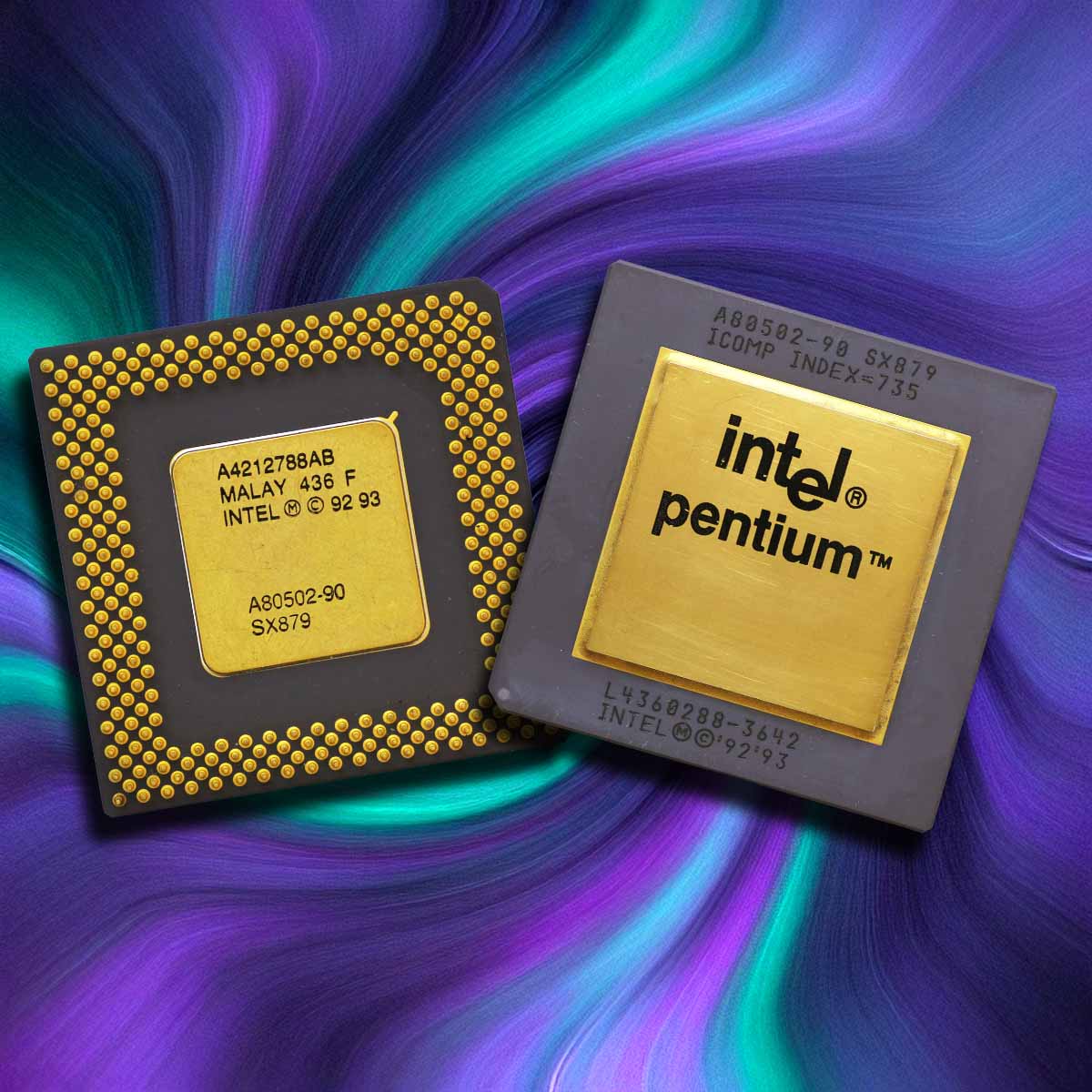
In the meantime, Microsoft’s Windows 95 was out, and Intel’s Pentium CPU was quickly becoming dominant and more affordable, bringing support for high-speed 32-bit PCI slots as standard with it. “That meant we didn’t have to put a geometry engine in our chip,” notes Smith, as the Pentium “had the geometry processing power we needed for good 3D graphics.
“That meant we could save a bunch of money. Everyone else put in a geometry engine, or tried to put a geometry engine in their chip, which was very expensive silicon. And they made it compatible with CAD, which made it even more expensive. So we skipped all that. We just had a rasterisation chip and a texture mapping chip, and that was the essence of our chipset – we had the highest-performance, lowest-cost solution in the marketplace.”
Emulators then chips
Of course, getting hardware out of the door is only one part of the equation. If 3dfx wanted Voodoo to be a success, it needed game support in a big way. At this time, Direct3D didn’t exist, and OpenGL was a graphics workstation tool for CAD. Instead, 3dfx decided to create its own low-level graphics library, which it called Glide. It even worked in DOS, meaning you didn’t need to worry about Windows overheads.
Smith explains that “we did that because we talked to Microsoft and we talked to Intel, and they said, ‘we want to kill DOS. We don’t want to support DOS.’ And we said, ‘DOS is really important in the PC game market – you don’t support DOS, you’re not in the market.’ So we had to do Glide ourselves – it was really low level, but all the game developers loved it.”
At this time, 3dfx hadn’t physically produced any cards. “We put together an emulator using the Silicon Graphics RealityEngine,” says Smith, “and we bought several of those, and we gave them to game developers, so they could actually run their games on our emulator and see how they were going to perform.”
I ask him what the devs thought of it. “They loved it,” he replies. “I mean, that’s how we won everyone over. They would use the emulator to prerender their games, and see how they’re going to look. The interface was really easy to use and gave them a bunch of control.” Smith describes this active approach toward game developers as quite novel among hardware makers at the time.
“Basically, doing outreach to game developers and treating them like the key ingredient they were to our success,” he says, “because most other companies, like S3 or others, saw game developers kind of as a necessary evil, not as the lifeblood of a company that’s focused on gaming. So we flipped the whole thing around.”
This paved the way in later years for schemes such as Nvidia’s The Way It’s Meant To Be Played developer programme, but Smith says it was a new idea at the time. “I was able to hire some really good people that understood the importance of that, and we created really the first silicon company’s game developer outreach in the industry, and then we were really focused on that.”
The quality and performance were better than the emulator, so we were in shock. It was like, ‘holy cow, it worked!’
Then the first chips came back. “I remember it being a holiday of some sort, and I remember it’s just Gary, Scott and me feeding the engineers and bringing them coffee in the lab, trying to get the thing to come up. We had a bunch of games and demos ready to run when we got silicon back – the first thing that we had was a fighting game and Microsoft Flight Simulator running in real time on the thing.
“And the quality and performance were better than the emulator, so we were in shock. It was like, ‘holy cow, it worked!’ And then it was like, ‘okay, well now let’s go commercialise this thing.'”
3dfx started by making its own boards for the arcade market, with the objective of later selling its chips to board partners for the home market.
Killer demos
Once you’d seen a 3dfx Voodoo card in action, you were hooked – the graphics were simply phenomenal for the time. In particular, I recall an astonishing demo called Valley of Ra, a fighting game scene with real-time reflections and a shiny metal character. Later, when Unreal launched, if you ran the game in Glide mode on a Voodoo card you got shiny reflective floor surfaces, which looked amazing too. This is long before real-time ray tracing, of course. I ask Smith what was going on.
“Valley of Ra was written by Phil Carmack and Gary McTaggart,” he tells me. “It’s really good texture mapping – just a texture mapping hack, basically. It’s called reflection mapping, right? So it’s not a real reflection. It’s not global illumination, a real spectrum, it’s a hack. But the whole Voodoo Graphics thing was a hack.
“Reflection mapping was a trick that had been done on SGI machines before as well. You have to do some calculations to make it look correct, but it’s not a real reflection. It’s just another trick, but game developers are full of tricks.”
There’s a story behind the development of this particular demo as well. “Scott, Gary, and I were going to Japan to meet with the masters of video games, and they really were at the time – that’s where we learned that, if you’re not running at 60Hz, nobody will even talk to you.
When we showed Valley of Ra in Japan at 60Hz, it was like, ‘Where do we sign?’
“It might have been Taito who said, ‘We need to see a fighting game before we adopt your stuff,’ so we came back to the guys and said, ‘We need a fighting game demo.’ We mapped it out and said, ‘We need to show them things we’ve never seen before. It’s got to be 60Hz. It’s got to be beautiful,’ so that reflection mapping was part of that.
It was an instant hit. “When we showed that in Japan at 60Hz, it was like, ‘Where do we sign?’ says Smith. “Valley of Ra was instrumental in getting all the fighting game income, both on the consumer and arcade side, because no one had ever seen that.”
There were plenty of other demos, including the stunning Grand Bleu, which took you through an ocean scene with fish, dolphins, sharks, and turtles. “It had beautiful water rendering and caustics,” says Smith, “all these things that are really hard in graphics. That was amazing, and that got us a bunch of design wins.”
Remarkably, Smith also tells me about a developer in Austria at Reality 2 who was running early shaders on a Voodoo card, well before the days of DirectX 8 and dedicated pixel and vertex pipes.
“I didn’t even know what a shader was until I saw his demo,” says Smith, “and he was doing smoke and ripples on water. And it was like, ‘holy cow, what is this?’ and he goes, ‘it’s called shader.’ We didn’t even know what people could do until we saw them.”
The Quake effect
The big killer app, of course, was Quake, ID’s ground-breaking first-person shooter, with the ability to look and shoot up and down, as well as just left and right, with awesome weapons, brilliant monster designs and a killer Nine Inch Nails soundtrack. It was very brown, but it was also incredible.
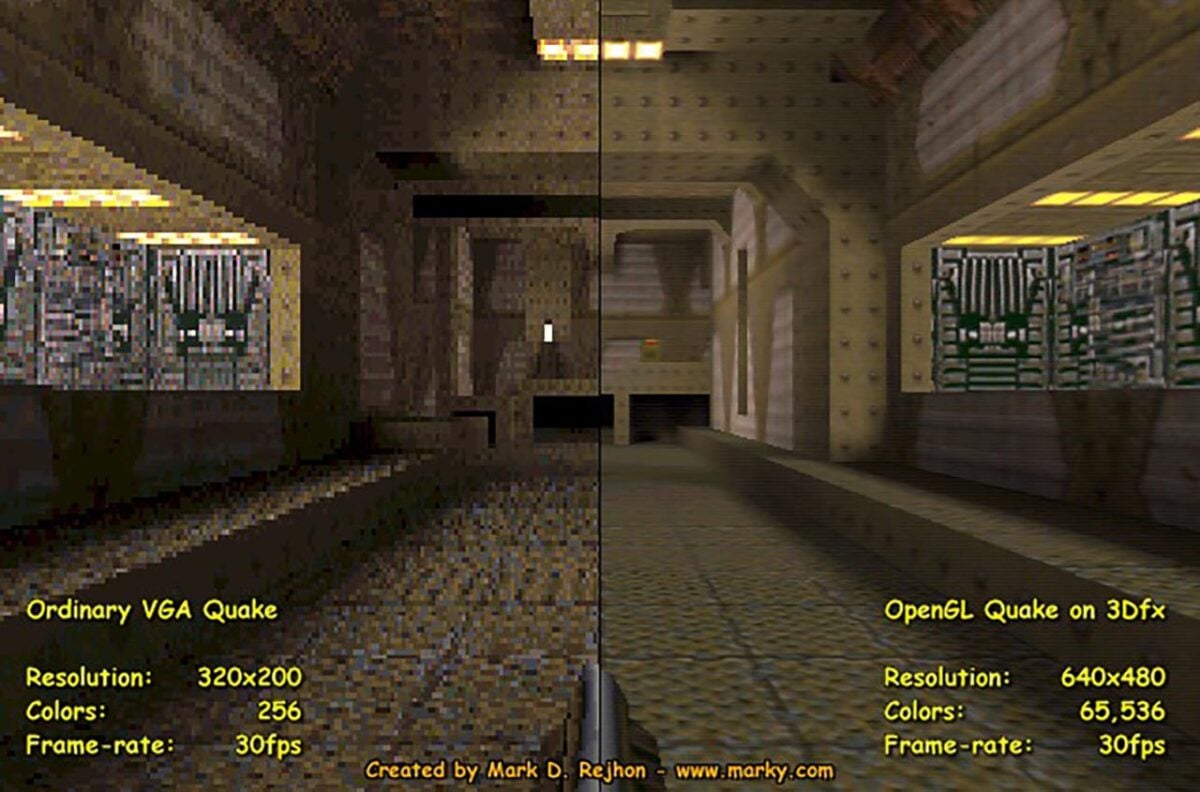
The game originally released in June 1996, and a patch called GLQuake turned up at the start of 1997 to enable you to run it with glorious Voodoo graphics. John Carmack had developed an OpenGL version of the game so it could run on 3D cards, and 3dfx responded with a cutdown version of the API called miniGL that could run it.
“We did miniGL for a couple of reasons,” explains Smith. “We were getting several developers, and John [Carmack] was one of them, who wanted to have OpenGL compatibility, and adding that on top of Glide was easy because of its heritage. By doing that, we picked up a number of games, including Quake. I think it was probably on our roadmap, and maybe Quake was the catalyst for that.
“But I would certainly give ID, John, and Quake a great deal of credit for our overall success – we probably sold millions of boards because of that game, and it was magnificent. That’s the last game I’ve gone all the way to the end on, and I was exhausted after doing that. It was well crafted, beautiful, dark. The physics were so good, and some of those monsters who were really hard to kill. I remember playing that game at like 4am.”
I would give ID, John, and Quake a great deal of credit for our overall success – we probably sold millions of boards because of that game.
As a teenager who’d played Quake on a Pentium 90 since release at this time, I can confirm that the difference that GLQuake made to the game was incredible. Previously, you were running it in software on a Pentium CPU, with 256 colours at 320×200, and it looked seriously rough and chunky. We still loved it, because the underlying game was so good, but GLQuake completely transformed the action.
Suddenly, there were no rough edges, but instead sharp lines, smooth-looking textures. Running at 640×480, it more than quadrupled the pixel count, gave you 16-bit colour, and made everything look unimaginably better.
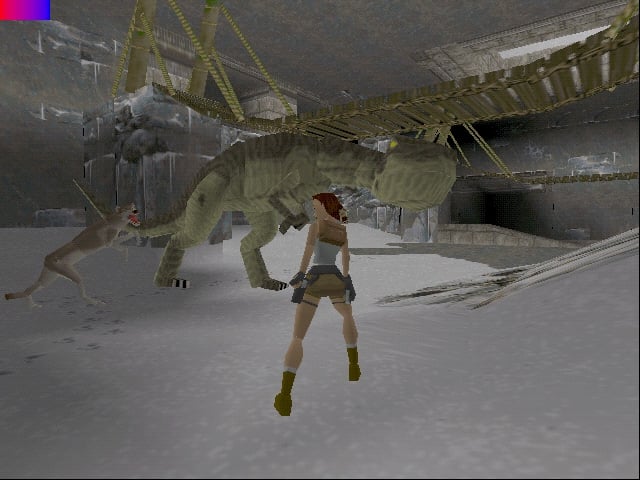
Many other games followed suit, including Tomb Raider, which Smith describes as one of his favourites from the time. “It was beautiful exploring all the different environments it had – it wasn’t killing things all the time.” He also points out that Dance Dance Revolution was first run on a Voodoo card.
Personal favourites of mine included hurtling through 3D indoor sci-fi spacecraft shooter Forsaken, gawping at the gorgeous sunsets in Ultimate Race Pro, and living the Star Wars dream in Jedi Knight II. One game that also stands out for me is the PC version of Wipeout 2097 (Wipeout XL in the US), a sci-fi racer from Psygnosis that had been popular on PlayStation. The PC version required a 3D card, and it looked so much better than the console version, with super-smooth graphics.
Competitors
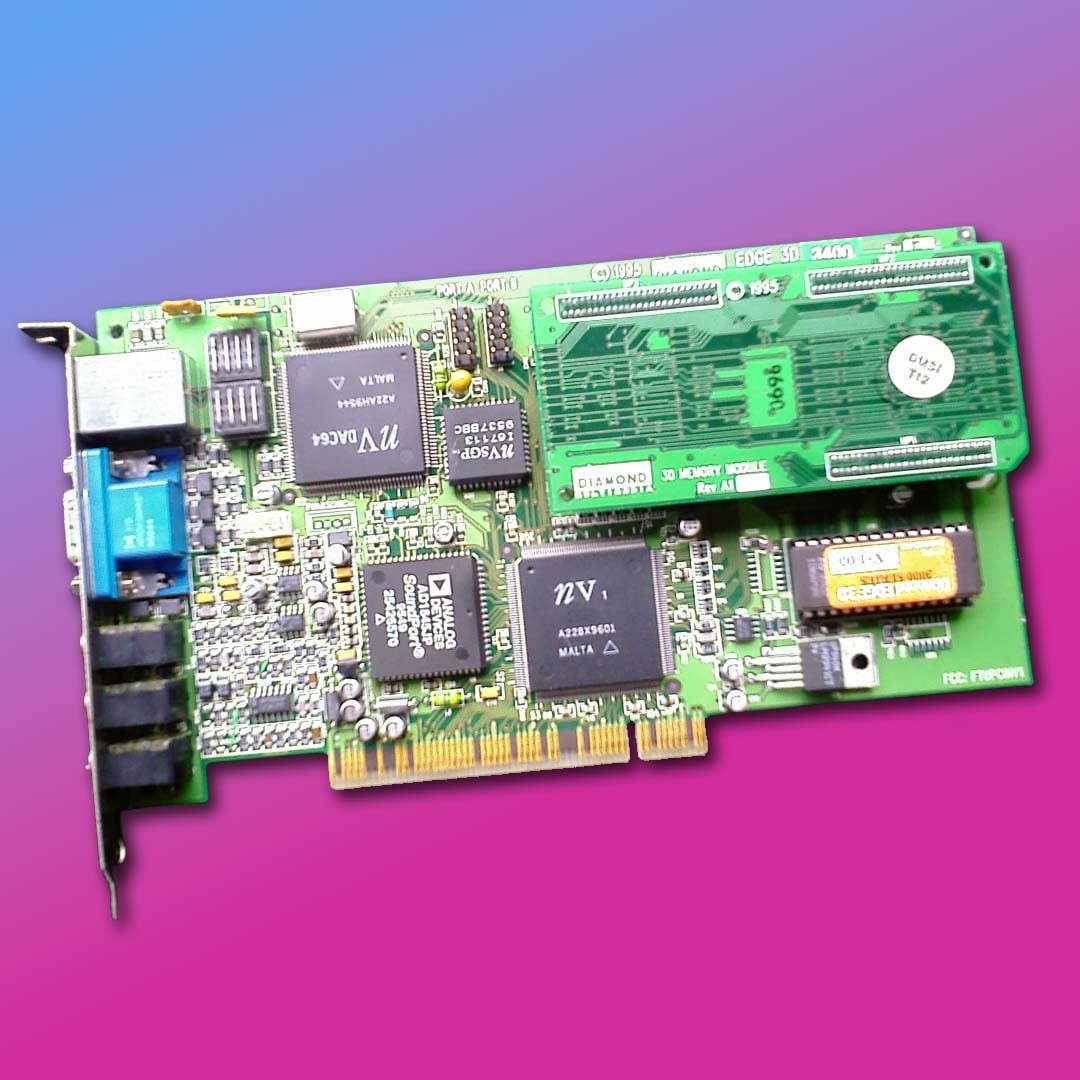
It’s also worth noting that 3dfx wasn’t the only company making 3D cards for gaming at the time, but it was certainly the one that captured the public’s imagination. One little-known firm was called Nvidia, which had released the NV1 even earlier in May 1995.
“There were like 20 different 3D graphics companies, but no one was laser-focused on games,” claims Smith. “Nvidia was the closest to that, but their first chip, the NV1, was an abomination.” He describes Jensen as a “wizard” and says he was very gracious when Smith went back to him in later years to get Nvidia GPUs for his new firm, Quantum 3D.
Nvidia’s first chip, the NV1, was an abomination.
In the 90s, though, 3dfx had the upper hand. “We went down the path of staying with OpenGL, the graphics pipeline that Gary was instrumental in developing, and Herb Kuta as well,” explains Smith. “Nvidia went a different path and did something called forward texture mapping, which didn’t work. They had a bunch of anomalies in the rendering that made it funky, and it was hard to develop for.”
Other competitors at the time included S3, Matrox, and ATi, and in the UK I recall VideoLogic’s rival PowerVR tech had a fair bit of traction. I remember the main reason why I went for a Voodoo card was simple, though – it would run on a Pentium 90, while the VideoLogic Apocalypse 3DX needed an MMX CPU. I ask Smith what the secret was.
“PowerVR uses a technique called retained graphics mode,” says Smith, “where you submit a display list and the card renders it. There are some benefits to that. What Voodoo Graphics used was called immediate mode. Basically, the CPU submits data to the graphics chip as it comes along. So, on the one hand, you do need a certain minimum level of performance, but on the other hand, it gives you much more control over what you submit to the graphics card to maintain frame rate.
“That all came from the SGI heritage. The Indigo workstation, built in SGI, had a very similar architecture to Voodoo Graphics. It didn’t have a geometry engine. It used a microprocessor in the system for geometry, just like Voodoo Graphics. That level of control gave the game developers much more flexibility to deploy a game that would be adequate on a lesser CPU.
“That wasn’t necessarily by design – it was intrinsic to the architecture. PowerVR is a very clever architecture. It has some real interesting benefits, and it went on to quite good success, especially in the mobile space. But it had some real flaws when it came to doing that kind of rendering.
The Voodoo name
The hardware might have been amazing, but a good brand name also goes a long way when it comes to capturing the public’s imagination. From Pentium to GeForce, some PC brands became household names, and 3dfx needed something similar for its ground-breaking 3D graphics chipset.
“We were struggling to name it,” says Smith. “The first name of it was called the SST – Sellers, Smith, and Tarolli, or Smith, Sellers, Tarolli,” and SST1 made it out the door as the chipset’s model number, but not the end brand name. I said, and Alma Ribbs [director of marketing] backed me up on this, ‘We need a real name for this thing. It’s got to be different. It’s got to be cool.’ And we had all these names – fast names, like the Panther, the Jaguar or the Shark or whatever.”
Meanwhile, Smith says Gary Tarolli “wanted to call it NoCAD because we were not going to do CAD.” None of them were quite right, but then Ribbs and Smith inadvertently stumbled on the answer, while roaming the streets of New Orleans while attending a tech tradeshow.
Alma and I are walking around New Orleans, and there’s a shop on Bourbon Street, which is Marie Laveau’s House of Voodoo.
Smith suggests this might have been Siggraph, which was in New Orleans in 1996, but 3dfx originally announced the Voodoo name in 1995, so I assume it must have been a different event. “Alma and I are walking around New Orleans,” says Smith, “and there’s a shop on Bourbon Street, which is Marie Laveau’s House of Voodoo. Marie Laveau was a famous witch doctor and practitioner of Voodoo in New Orleans in the 19th century. This place sold all kinds of voodoo stuff. Alma and I saw that and we said, ‘It’s a Voodoo. It’s Voodoo Graphics.'”

The rest of the team weren’t initially sold on the idea. “We brought that back to the team – Scott, Gary, and Gordie, and they said, ‘No way. It’s way too dark.’ Alma and I had to fight for that, man. We fought, and finally we won. They understood that what we were doing was Voodoo, right? That really was the essence of the name, and that became the core identity for the products that we built. It changed everything.
“There’s really a lot of power in the name. We could have just given up on it and called it the Kingfisher or whatever, but calling it Voodoo Graphics made it readily identifiable in so many people’s minds. I just remember Scott, because Scott’s kind of a corporate guy – he’s a Princeton grad, and he really struggled with it. But Voodoo is what it was, and that was the right name for it. Sometimes all those cogs line up, and you get something magical, and that was a great name.”
We all know what happened to 3dfx in the end, of course. It was a big, bright flame that burned out a few years later, with Nvidia hoovering up most of its assets. PC gaming could have been very different without the 3dfx Voodoo graphics chipset, though. Since then, graphics tech has given us hardware transform and lighting, programmable shaders, ray tracing, and now AI with upscaling and frame gen.
I don’t want to play down these achievements, because they’ve all had a tremendous impact on the 3D graphics pipeline. However, for me, none of them have quite made the same difference as my first 3dfx Voodoo Graphics card – the jump from CPU software rendering to 3D hardware acceleration was incredible, and there hasn’t been anything quite like it since. For that, 3dfx Voodoo Graphics, we thank you.
If you’ve enjoyed this look back at the first 3dfx Voodoo chipset, take a look at our guide to the greatest GPUs ever, which naturally includes the Voodoo, as well as our feature on 10 graphics cards that changed PC gaming forever, which goes even further back.