
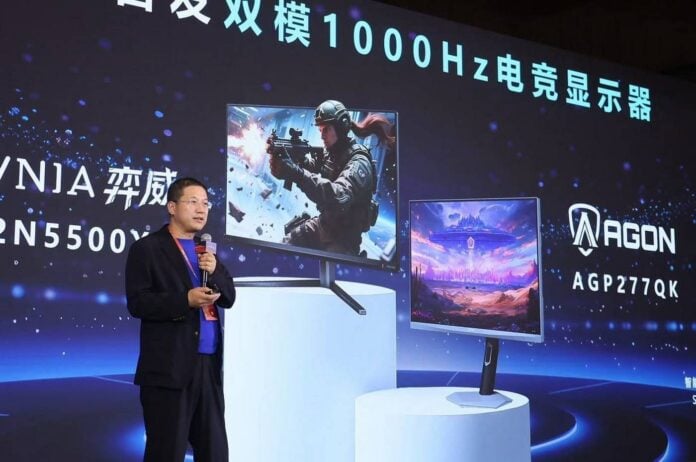
Philips, AOC, and TCL have teamed up to end image blur with the help of new panels capable of reaching up to 1,000Hz. The news was shared by Philips’ Instagram account, where the brand showed its upcoming Evnia 27M2N5500XD, a monitor with the potential of becoming the next esports dream display.
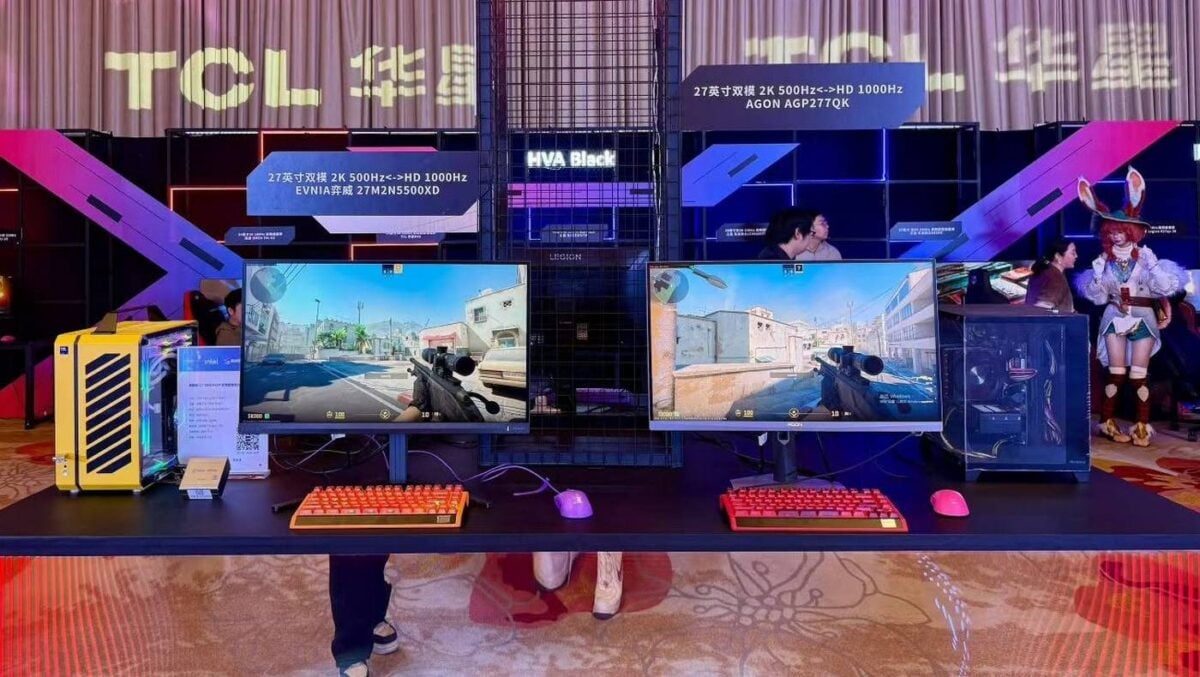
The Philips Evnia 27M2N5500XD was presented alongside the AOC Agon AGP277QK, which also shares identical specs, mainly differing in its external design. Both are based on 27in IPS panels supporting dual-refresh modes, offering a native 500Hz at QHD (2560×1440) resolution and a whopping 1,000Hz at HD (1280×720) resolution. This makes them the fastest gaming monitors yet, surpassing 720Hz solutions by a comfortable margin.
Why is an extra 280Hz not considered massive? Well, jumping from 720Hz to 1,000Hz, translating to 38%, is smaller than the jump we experienced when moving from 144Hz to 240Hz (66%). Furthermore, we are reaching speed levels where each jump provides less visual difference compared to its predecessor. An important consideration since you trade a lot of image detail (resolution) to unlock it in this instance. That said, this doesn’t mean they are useless; if you are into competitive gaming, these could offer you a real advantage, just not enough to supplant a lack of skill.
If the reduced resolution isn’t a deal-breaker for you, well, you can expect outstanding motion clarity and very low input lag. At 1,000Hz, each frame stays on display for just 1ms, making transitions super-fast and sharp. In fact, the panel pixel response times may be the limiting factor here, as a sub-1ms will be needed to ensure each transition is finished in time to avoid frame-to-frame overlapping.
According to IT Home, the Evnia 27M2N5500XD is rated for 1ms GtG, meaning that the maximum transition is higher, and could result in smearing or ghosting. But to measure this impact, we will have to wait for reviews. Unless LCDs find a way to boost their pixel response, OLED panels may become the only way to get a true +1,000Hz experience. But hey, I am ready to be surprised.
Speed aside, the Evnia 27M2N5500XD is advertised to boast a DeltaE below 2 colour accuracy and a 2,000:1 static contrast, which is higher than typical IPS panels. There is even a mention of VESA DisplayHDR 400 certification, though I wouldn’t hold my breath for it.
While it would fall short of an equivalently fast OLED, this new monitor should give TN-based solutions a hard time, both in clarity and colour reproduction. Who knows, maybe even pricing. You can expect to see the first 1,000Hz displays sometime next year.