
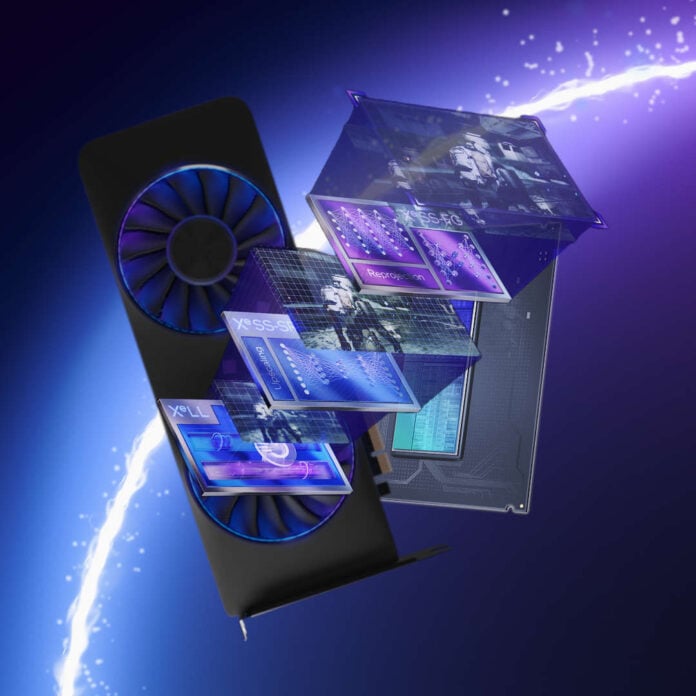
Intel has released driver version 32.0.101.8509, adding XeSS 3 Multi-Frame Generation (MFG) to more products featuring Arc graphics. This includes everything from dedicated Alchemist GPUs to integrated Core Ultra iGPUs.
This WHQL-certified driver brings XeSS 3 MFG to Intel Arc A-Series (Alchemist) and Arc B-Series (Battlemage) discrete GPUs, as well as Core Ultra 100 Series (Meteor Lake) and Core Ultra 200 Series (Lunar Lake / Arrow Lake H) processors. Though desktop Arrow Lake-S CPUs aren’t specifically mentioned in this release, support should come any time now since they share the same generation of GPU architecture as their mobile H counterparts.
This is excellent news for integrated graphics, which generally lack the raw performance to push high frame rates in modern games. XeSS 3 MFG lets you choose between x1, x2, x3, and x4 frame generation, resulting in up to 3 generated frames for each rendered one. Thus, with the help of MFG, products powered by iGPUs will finally push decent frame rates, delivering the smoother gameplay generally exclusive to dedicated GPUs. While these generated frames may lack the quality of rendered ones, they offer a tempting alternative when low graphics options and resolutions aren’t sufficient.
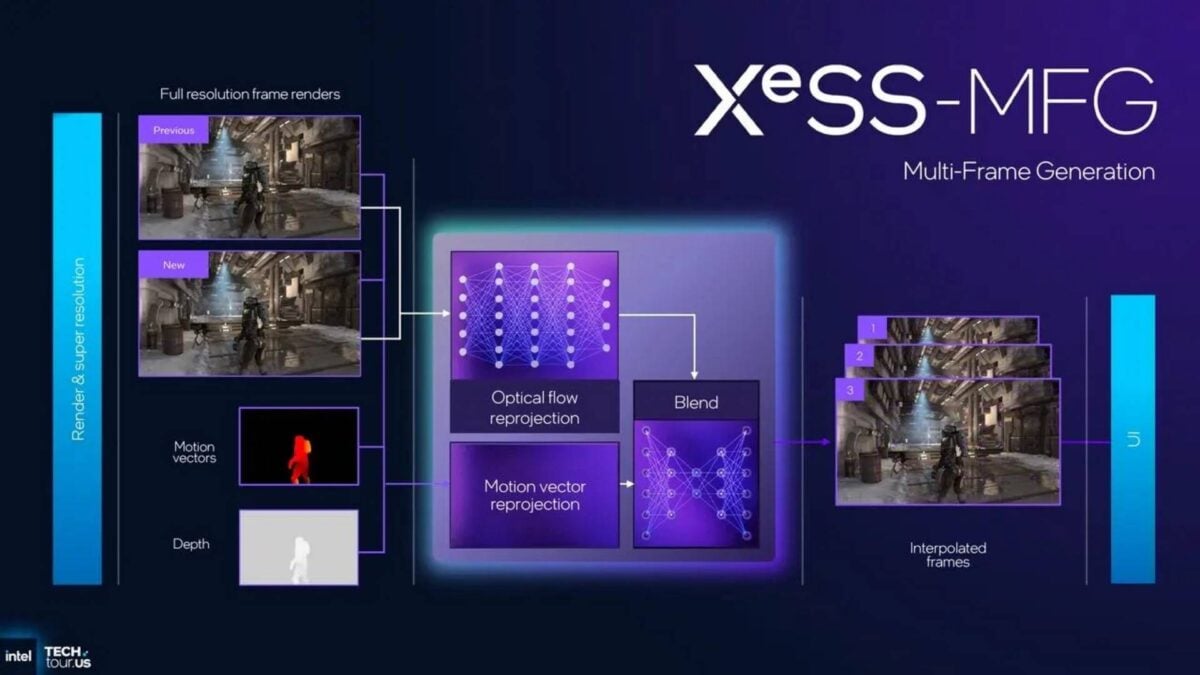
With this expansion, Intel indicates that no Arc product will be left behind, putting AMD in a tight spot due to its lack of a competing solution. As a reminder, AMD has yet to launch any MFG technology, let alone for its Ryzen integrated graphics. While mods are seen as a stopgap, Intel’s official support gives it a wider reach and, most importantly, a user-friendly enablement.
Aside from laptops’ iGPUs, the other segment that will greatly benefit from XeSS 3 MFG is handhelds powered by Lunar Lake chips, such as the MSI Claw 8 AI+. These power-constrained devices will now boost their perceived smoothness by a noticeable margin, assuming the cost of running MFG isn’t too high. Understandably, XeSS 3 MFG will be stackable on top of regular XeSS Super Resolution upscaling and XeLL (Xe Low Latency) to further boost performance while reducing latency. The latter is indispensable when using any form of frame generation.
As usual, be it Intel’s or Nvidia’s, the final result of MFG hinges on the detail and quality of the base (rendered) image and the base frame rate. The higher quality/resolution frames and a higher base fps count you input into MFG’s algorithms, the greater the output will be. As a rule of thumb, above 60fps is recommended for an optimal experience.
Lastly, users should be able to leverage Intel’s driver override feature to enable MFG on XeSS 2 games, thus expanding the game support list. If you want to give it a try, the Arc Graphics Driver 32.0.101.8509 is available via Intel’s website (1.3GB) here.