
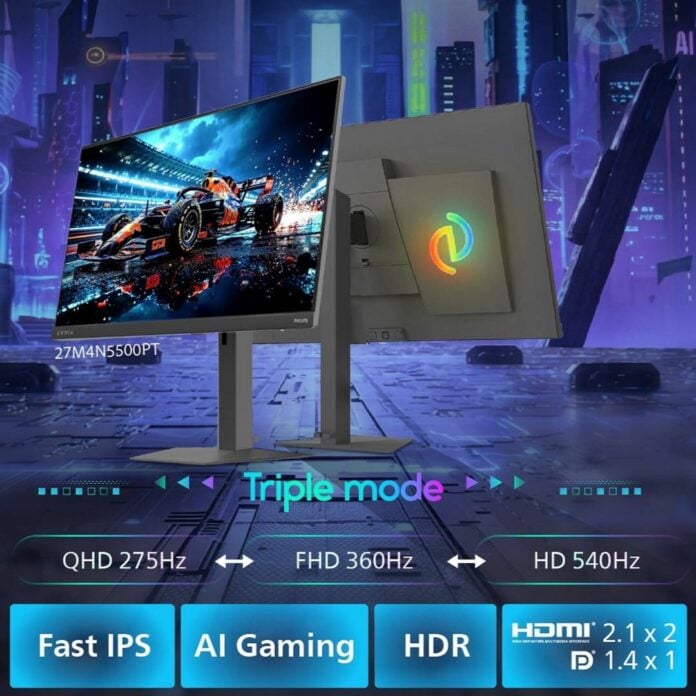
Philips has announced a new range of triple-mode gaming monitors, offering a choice of 275Hz, 360Hz, and 540Hz refresh rates, depending on the resolution. The Philips Evnia M4 series is designed to offer a one-stop shop for all your gaming needs, allowing you to switch the refresh rate and resolution to fit whichever genre of game you want to play.
The first models in the M4 range are the Evnia 27M4N3500PT and 27M4N5500PT, both of which are powered by triple-mode Fast IPS panels. These come hot on the heels of the recently announced MSI MPG OLED 322URDX36, which is also a triple-mode monitor, but MSI’s screen uses QD-OLED panel technology instead of the IPS LCD panels used by Philips here.
This choice of modes is designed to offer greater flexibility to players who enjoy vastly different game styles, allowing you to increase motion smoothness or graphical fidelity, depending on your preferences, and the pace of your game. For example, you can play AAA story-driven games at 275Hz using these screens’ native QHD (2560×1440) modes, which provide the best image quality and sharpness, on top of HDR support.
Then, when your friends invite you to a Battlefield or Call of Duty match, you can easily switch to the second 360Hz mode, which drops the resolution to FHD (1920×1080). Lastly, when the time comes to play competitive esports titles, you can push the panel to its limit and experience smooth 540Hz motion at 1280×720, which comes with the added benefit of lower latency/input lag.
Unlike dual-mode screens, this third (middle) preset fills the gap between high-quality graphics and peak performance, bringing flexibility to players. To take advantage of this feature, you only need to press a button, and the system will automatically adjust to the monitor’s new specs.
That said, the middle 1920×1080 resolution doesn’t divide into 2560×1440 with whole numbers, so there will be some downscaling involved – it won’t be like using a native 1080p screen. This is different from 4K/1080p dual-mode monitors, for example, where the 1080p mode is basically the native resolution, as it uses integer scaling. For more detail about this, it’s worth reading our guide to how dual-mode monitors work.
While Philips hasn’t shared many details about these new displays, we do know that both of them have 27in panels and are equipped with HDMI 2.1 and DisplayPort 1.4 video inputs. There’s a fully-adjustable stand, including height, tilt, swivel, and pivot movements, and Philips says a peak brightness of up to 350nits is on offer. You will also find the usual gaming enhancement features, such as shadow boost, smart crosshair, and motion blur reduction.
There’s no word on pricing yet, and Philips only plans to launch the Evnia 27M4N3500PT and 27M4N5500PT in the Asia-Pacific (APAC) region. However, given they’re based on IPS rather than QD-OLED tech, we’d expect them to be a fair bit cheaper than the MSI MPG OLED 322URDX36.