

A recent benchmark of an AMD engineering sample may have provided us with our first glimpse of the Steam Deck 2’s core hardware in action. While these test results clearly aren’t indicative of final performance, they do give us some idea as to what we may be able to expect from the handheld’s specifications.
A recent results page on OpenBenchmarking, a website that hosts scores from the Phoronix Test Suite, showcases an AMD 100-000001930-12_Y processor in action, running on a GBR-FF6-SKT motherboard. The CPU has six cores of an unknown architecture, and 12 threads, running alongside 24GB of LPDDR5-9600 memory.
| Steam Deck 2* | Steam Deck OLED | |
|---|---|---|
| APU | AMD Gainsborough | AMD Sephiroth |
| Cores / threads | 6 / 12 | 4 / 8 |
| RAM | 24GB LPDDR5-9600 | 16GB LPDDR5-6400 |
The ‘GBR’ acronym present in the motherboard’s name suggests this processor is from AMD’s upcoming Gainsborough family. This name holds importance to the Steam Deck, as it’s the surname of Final Fantasy VII character Aerith, whose moniker served as the codename for Valve’s Steam Deck LCD chip. The firm continued this naming convention with its Steam Deck OLED, switching to Sephiroth.
Should Valve adopt this Gainsborough APU for the Steam Deck 2, the future handheld would enjoy a 50% uplift in core and thread counts relative to the existing model. This would be in addition to the same increase in RAM capacity and speed, benefitting both its CPU and GPU with a larger unified pool. You can see the benchmark results in the screenshot below.
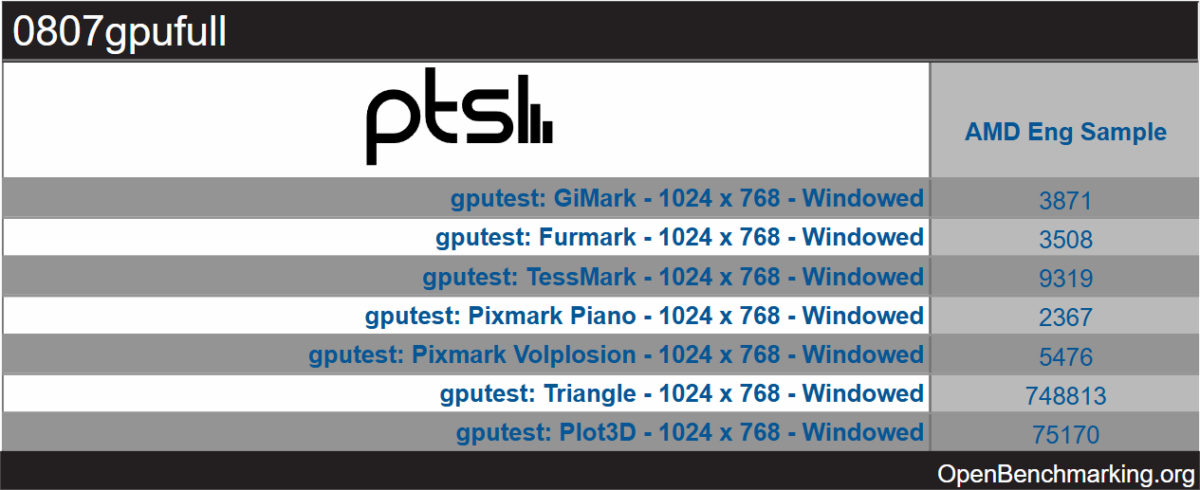
Sadly, the benchmarks do little to provide detail on what CPU architecture is in play, with no significant information pertaining to the Gainsborough GPU either. The test resolution of 1024×768 also makes any performance comparisons to the existing Steam Deck impossible, as that system runs at 1280×800.
Regardless, there are GPU results that we can line up next to those of a Steam Deck OLED (thanks, Videocardz), albeit with the caveat that these tests were conducted at different resolutions, so they aren’t immediately comparable. This potential Steam Deck 2 chip enjoys a gain of 32% in Pilot3D, for example, with a score of 75,170 compared to 56,807.
There’s also an 82% boost in Pixmark Volplosion, with the new chip scoring 5,476, compared to 3,007. However, we’re looking at a smaller gain of just 6% in FurMark, where the score goes from 3,323 to 3,508. Bear in mind that these are very early results with settings that aren’t really comparable, though, and these figures may well change as drivers improve.
Valve has said it wants Steam Deck 2 performance to provide a “delineated improvement”, rejecting existing Ryzen Z series models with a Zen 5 and RDNA 3.5 combo. As such, we could be looking at Zen 6(c) cores, hopefully running alongside RDNA 4 graphics or better.
Check out our Steam Frame review for more chatter on Valve’s latest hardware.