
Microsoft has shared its plans for next-gen Windows PCs, and in the process revealed the names of upcoming AMD and Intel processor series, plus the product categories these chips will cover in its lineup. Called Hybrid Intelligence, this roadmap includes four device tiers, ranging from budget 8GB laptops to supercomputers powered by Nvidia’s GB300 platform.
A leaked slide from the event shows two unreleased CPU families. The first is AMD’s Ryzen AI 500 lineup, which is possibly based on the Zen 6 architecture. The second is Intel’s Core Ultra 4 range of CPUs, based on the Nova Lake architecture. There is even a mention of Intel’s upcoming Crescent Island GPU (officially branded as the Intel GPU D-Series). Interestingly enough, Microsoft seems to have split its product tiers based on their total system memory rather than raw processing power.
The lowest stack, called Tier 0, includes budget laptops packing 8GB of memory, powered by AMD Ryzen 100 and 200-series CPUs, Intel Core Series 3 and 4 chips, and Qualcomm Snapdragon C/X/X Plus SoCs. In terms of AI power, Microsoft says these systems are for local context and actions – basic tasks that don’t require a lot of compute and memory.
Speaking of which, Microsoft has also recently announced that it has improved Windows 11 multi-tasking performance on 8GB devices, claiming up to a 40% speed increase. That said, don’t expect these machines to run anything more demanding than web browsing and media consumption.
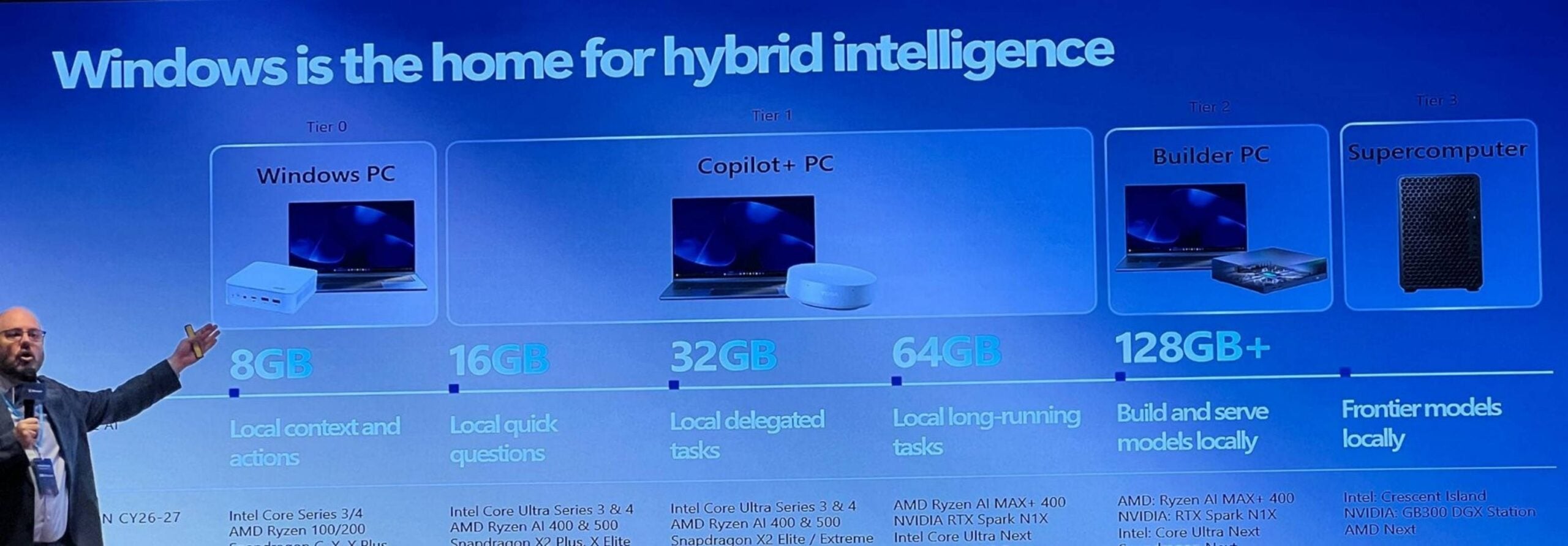
Tier 1 products show that Microsoft has not yet abandoned its AI ambitions for Windows, and include three sub-categories based on available memory, all Copilot+ certified. The 16GB and 32GB models will be paired with Intel’s Core Ultra Series 3/4 chips, AMD’s Ryzen AI 400/500 CPUs, and Qualcomm’s Snapdragon X2 Plus/X Elite/Extreme processors, targeting local questions and task delegation.
Meanwhile, the 64GB devices in this tier swap the processor portion for AMD’s Ryzen AI Max+ 400 and Nvidia’s RTX Spark N1X, in addition to an unnamed Intel Core Ultra Next chip. These 64GB devices seem to be the starting point at which it makes sense to process AI tasks locally.
Tier 2 and Tier 3 are designed for advanced AI users building and running large models locally, packing 128GB or more memory. Specifically for Tier 3, Microsoft lists Intel’s upcoming Crescent Island (D-Series) GPUs, which are based on the Xe3P architecture. Most notably, these combine up to 480GB of LPDDR5X memory – enough to handle models with up to 300 billion parameters on a single card, 1.5TB/s of bandwidth, and 1.3-petaflop of FP8 compute power.
By splitting tiers based on memory capacity, Microsoft is aiming to offer scalable AI capabilities, tailored for different needs, from basic action triggers to advanced LLM development. What is sure is that the company has not yet abandoned its AI ambitions for Windows.