
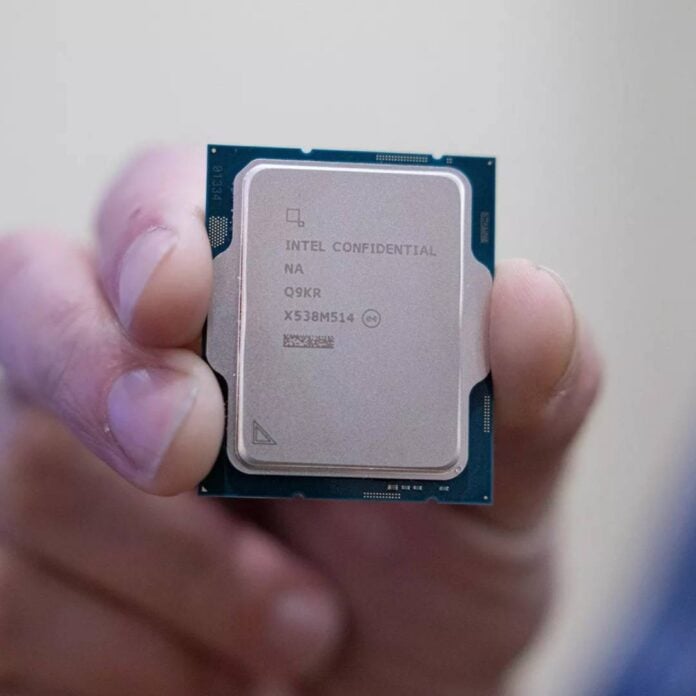
Intel is reportedly cooking up a multiplier-unlocked CPU with 12 P-Cores and bLLC (big last level cache) tech, but no E-cores on its compute tile. According to leaker Jaykihn on X, this chip will feature the same Coyote P-Cores that power the company’s forthcoming Nova Lake CPUs.
Unlike the rest of Intel’s Razor Lake family, which is expected to use TSMC’s N2P node, this unnamed CPU with 12 P-Cores will reportedly be manufactured using the same 18A-P process as next-gen Nova Lake chips. To be specific, according to this leak, the CPU has a 12+0+4 configuration, where the 12 (performance) P-Cores live inside a dedicated compute tile, while the four (low-power efficiency) LPE-Cores share space on the SoC tile with the memory controller, iGPU, and other blocks.
Jaykihn indicates that Intel’s standard E-Cores for efficiency are completely absent from the compute die, meaning they’re not simply disabled, adding that all 12 P-Cores are located on a single tile. In a follow-up post, Jaykihn claims that this processor will be a replacement for a locked 8+0+4 bLLC part that was previously rumoured.
On top of its 12 P-Cores, Jaykihn says this CPU is an unlocked variant with bLLC L3 cache, similar to AMD’s Ryzen X3D processors, but without Hyper-Threading. While the exact amount of cache was not disclosed, earlier Nova Lake rumours suggested that Intel could pack 108-144MB of L3 cache per compute tile.
Jaykihn claims this CPU will join the rest of Intel’s Razor Lake lineup, which includes a 4+8 design featuring Coyote Cove P-Cores and an 8+16 variant powered by newer Griffin Cove P-Cores. The leaker also adds that previously rumoured 125W 6+12+4 bLLC model is no longer launching with Nova Lake, but is instead delayed to release alongside Razor Lake. That said, another leaker, OneRaichu on X, claims that this 12 P-Core processor is in fact part of a Nova Lake Refresh and not Razor Lake.
Either way, if this core configuration is accurate, that’s great news for gamers. It should cost less money than Intel’s top-end CPUs with loads of cores, while also offering great gaming performance thanks to the extra bLLC cache.
Razor Lake-S is expected to launch sometime in 2028, supporting the same LGA1954 socket as Nova Lake-S. Until then, plans may change, so take all the above with a grain of salt.