

Nvidia has recently released its latest DLSS 4.5 Transformer model to GeForce users, showing a noticeable quality improvement compared to DLSS 4. We’ve been suitably impressed, while other enthusiasts have experimented in different ways, testing what would happen if the resolution was dropped right down to basics.
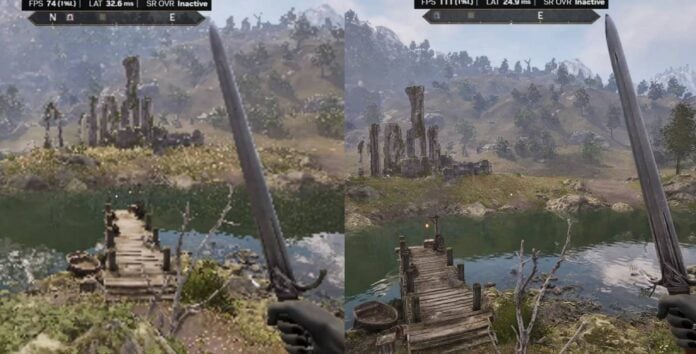
zWORMz Gaming on YouTube and @cremieuxrecueil on X did exactly that and shared their findings. Turns out, DLSS 4.5 is so good at upscaling that even extremely low resolutions are viable inputs for its algorithm. @cremieuxrecueil tested the new tech in Oblivion, where it wonderfully upscaled a pixelated 240p render into a perfectly usable image. If someone told me this was native 1080p, I would have believed them. zWORMz chose Red Dead Redemption 2, where the upscaled image looks even more impressive than in Oblivion.
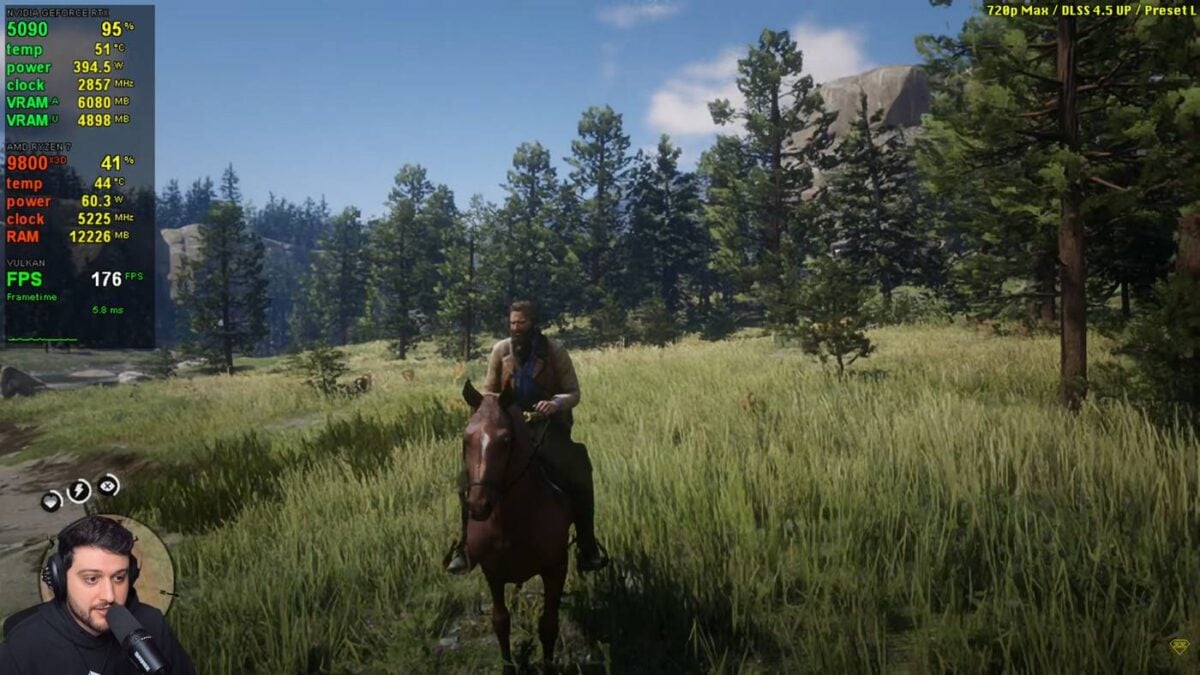
Red Dead provided a lot of detail to reconstruct, making the potential for errors greater. But somehow, DLSS 4.5 did a fantastic job, transforming a 240p/360p native image into one resembling 720p/1080p. Yes, it’s not perfect by any means; there are still some artefacts around the character’s outline and when moving at a fast pace, but considering how little data the upscaler had to work with, the result is nothing short of impressive. Even the strongest critics of upscaling should be convinced by its effectiveness.

Just look at the pictures above or the video below (from 25:40) to see how DLSS 4.5 Performance and Ultra Performance modes are drastically clearer and sharper. Native 360p with TAA looks closer to an oil painting than a 3D game, and without TAA is even worse, resembling pixel art or those hilarious potato graphics. I was most impressed by how it was able to recreate trees and foliage details from so little, but having access to all sorts of data from the game engine works wonders.
For those unfamiliar, DLSS reconstructs each image by combining a low-resolution native render with motion vectors, depth data, and multiple previous frames, which then go through a trained neural network to rebuild lost detail. Instead of a simple upscaling pass, it performs temporal reconstruction to produce cleaner and more stable images, beating native rendering with TAA.
And the best part, all of this is available on GPUs as old as the RTX 20 Series from 2018. That said, it is important to note that DLSS 4.5 has a higher performance impact on older generations, making it better suited for modern RTX 50 Series. For instance, Hardware Unboxed found that DLSS 4.5 delivers fewer fps than native rendering when using RTX 20 and 30 Series in some titles. However, if you own a modern GPU, our testing found that RTX 40 and 50 Series are only affected by a ~3% reduction in performance.
To put it simply, DLSS 4.5 is an impressive piece of tech, provided its usefulness isn’t limited by its performance impact. Even at this relatively early stage, it shows that in a couple of generations, we may no longer be able to distinguish between a native and an upscaled 360p image.