


I look forward to unpacking the latest hardware and software trends of Steam users every month, but I can’t help but parse the latest data from the Hardware Survey and declare it dubious at best. It’s unclear how exactly such clearly erroneous results have received the greenlight from Valve, but there are several red flags that point to the results needing another look.
First of all, there are several sweeping changes in hierarchy and market share across the survey’s many categories. The most seismic is the apparent rise of Simplified Chinese as the platform’s dominant language, increasing by a whopping 30.74% while English falls by 14.74%. If we take this shift at face value, we’re either staring down a massive influx of Chinese Steam users or Valve is underreporting statistics from other regions.
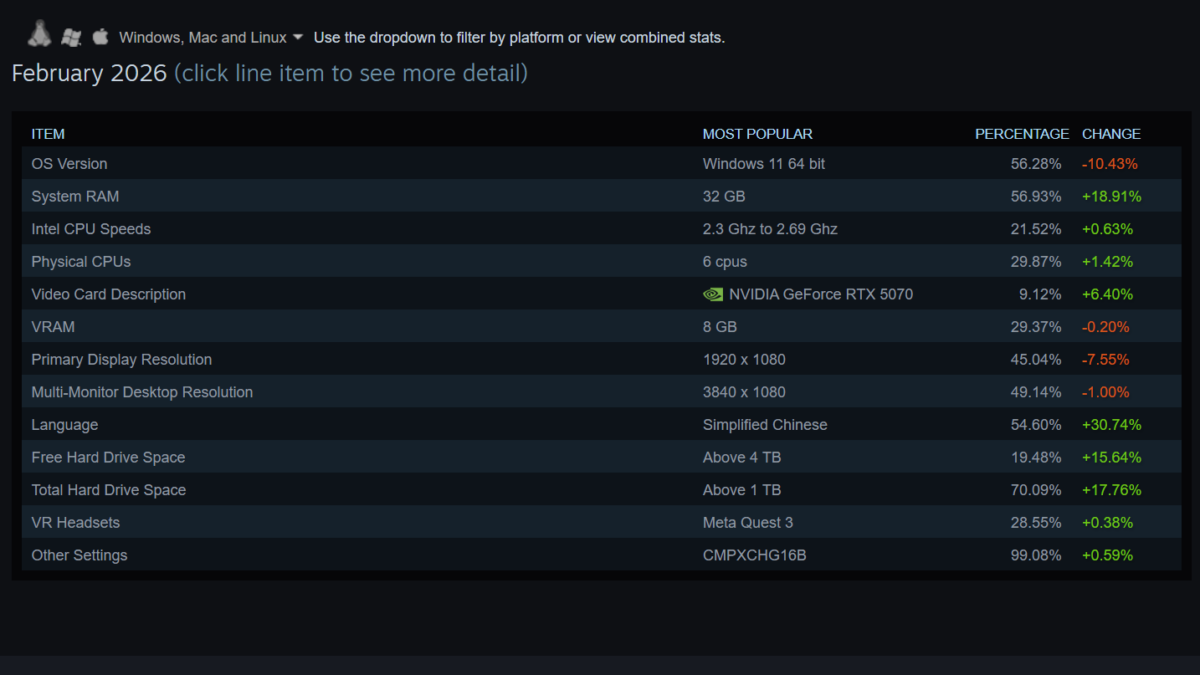
Continuing to examine the red flags, total hard drive space and RAM capacities have similarly ballooned, by 18% and 19%, respectively. Given that RAM and SSD prices haven’t been in a consumer-friendly place for some time, I highly doubt Steam users have so quickly built up their memory and storage to such levels.
Then there’s the 10% drop in Windows 11 market share. While Microsoft’s operating system grows increasingly unpopular following several problematic updates, it’s difficult to believe that a massive 12% of the user base has run back to Windows 10. This goes against the steady decline we’ve seen in recent months, with Linux emerging as a big competitor.
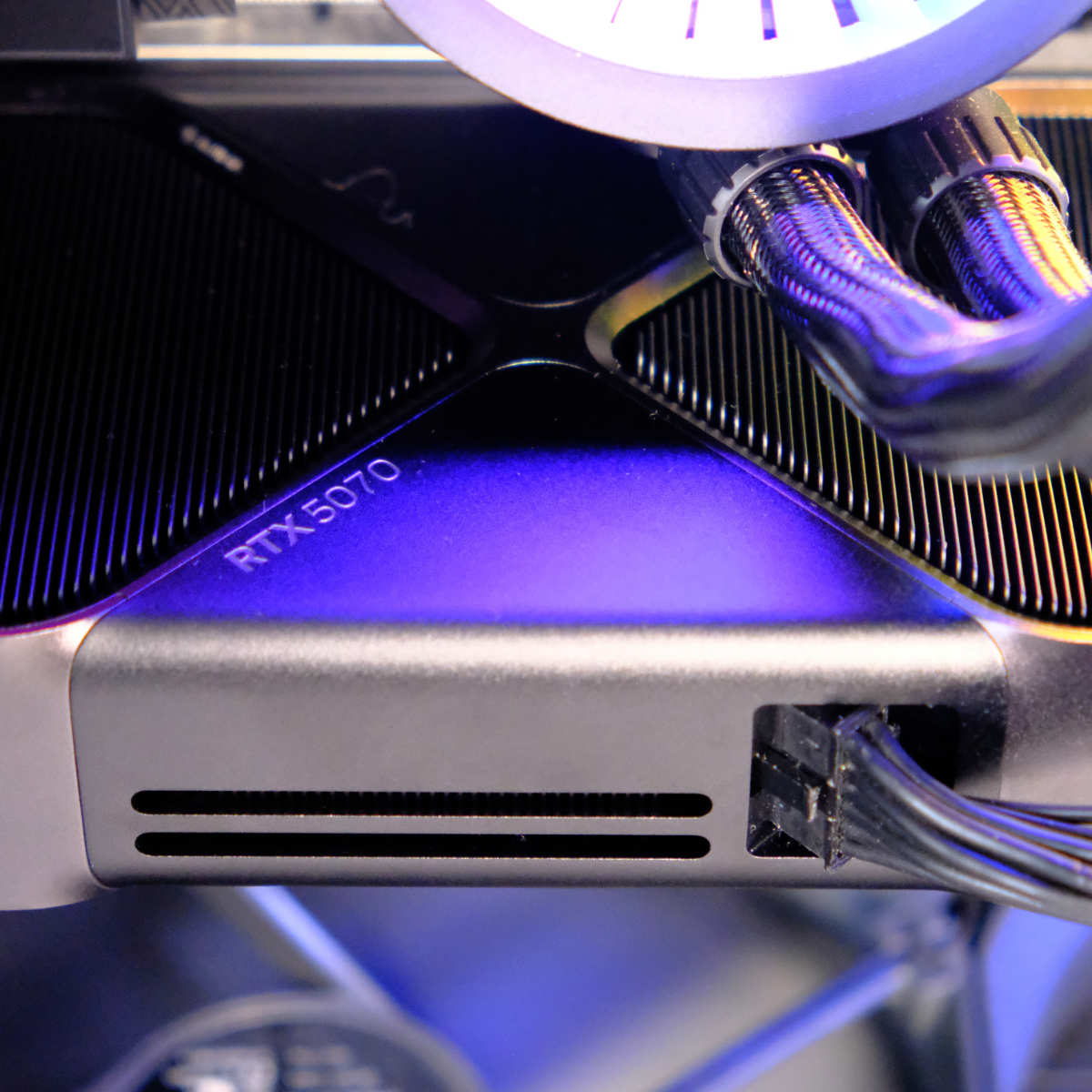
The meteoric rise of Nvidia’s GeForce RTX 5070 is also questionable. While this GPU was growing in popularity in the January 2025 Steam Survey, that increase amounted to a modest 0.45% growth in market share, which is nothing compared to the enormous 6.55% swing we’re currently seeing.
These strange results follow a Steam Client Beta update, which in part addresses misreporting on the Hardware Survey. More specifically, the patch “fixed an issue where VRAM on some graphics cards was not reported correctly.” I’m relatively confident in saying that Valve needs to do more work here if it wants to improve accuracy across the board.
Ideally, I’d appreciate Valve sharing the size of each sample from which the Steam Hardware Survey draws. To go one step further, breaking down the respondents by region would also help create greater understanding of each month’s results.
This isn’t the first time we’ve seen Valve publish skewed or incorrect results for a Steam Hardware Survey, and I’m sure it won’t be the last.
If you’re hungry for some hardware analysis, check out our best GPU guide for recommendations on your next graphics card upgrade. Make sure you have Club386 as part of your Google Preferred Sources too, if you’re keen to see our coverage more frequently in search and elsewhere.