

Nvidia has just unveiled DLSS 5 during its GTC 2026 press conference, describing it as “the company’s most significant breakthrough in computer graphics since the debut of real-time ray tracing.” However, this new iteration of the software suite has drawn a palpably negative reception from large swathes of the Internet. I agree and sympathise with almost all the critiques and concerns people are raising following this surprisingly discomfiting first impression, but there’s some clearly impressive tech here that could prove beneficial in the right hands.
What is DLSS 5?
DLSS 5 differs from prior versions through the introduction of real-time neural rendering. This application of deep learning uses a game’s colour and motion vectors to improve lighting and material quality on a per-pixel basis. The model also understands asset qualities, providing precise subsurface scattering based on environmental lighting conditions, in addition to calculating light interactions with hair, fabric, and other materials.
Developers have controls to fine-tune how DLSS 5 interacts with a game’s visuals.
In the back end, developers have access to controls, including colour grading, masking, and more to fine-tune how DLSS 5 interacts with a game’s visuals. While DLSS 5 will integrate into game engines via the same Nvidia Streamline framework as the current version, the tech does have a unique limitation – you can only use it at resolutions up to 4K. This isn’t a major issue considering the rarity of displays that boast panels beyond that pixel count, but it’s a hard cap nonetheless.
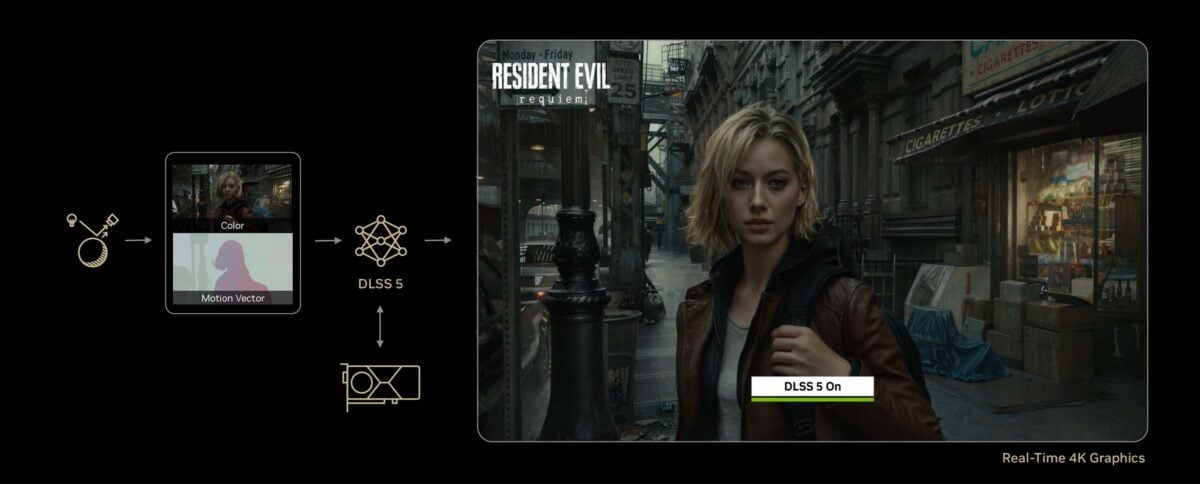
Nvidia demoed DLSS 5 to press at GTC 2026 using two GeForce RTX 5090 Founders Edition cards, rendering the game on one and the DLSS model on the other. However, this doesn’t mark the return of SLI, as the company intends to have everything running on a single card come the software’s Autumn 2026 release window.
Questions remain about the viability of DLSS 5 on lower-end graphics cards, particularly those with relatively small pools of VRAM. We’ve seen DLSS Frame Generation inadvertently cause performance regressions on account of paltry frame buffers crumbling under pressure, so I’m relatively confident we’ll see the same again here.
DLSS 5 in action
Given the strength of the last several versions of Nvidia’s software suite, with DLSS 4.5 being largely excellent, I was ready for DLSS 5 to be yet another software slam dunk for the green team. Instead, the demos I’ve seen thus far showcase glimmers of graphical excellence laced with an overwhelmingly uncomfortable uncanny valley sheen.
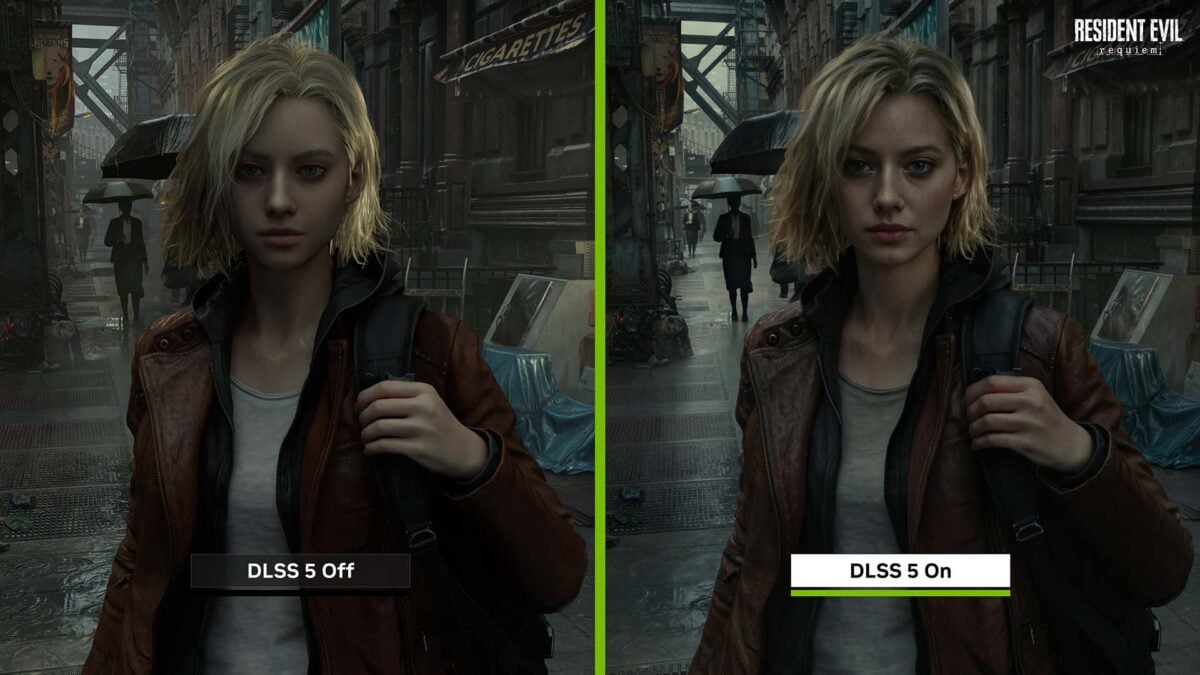
Grace’s eyes and lips are now bigger to the point of yassification.
When I first saw the before-and-after screenshots from Resident Evil Requiem above, my immediate impressions of DLSS 5 were wholly negative. Despite claims that the tech doesn’t change the geometry of assets, it’s clear something is off in that respect, especially when you examine Grace’s eyes and lips, which are now inarguably bigger to the point of yassification.
Other examples of the tech aren’t as egregiously distracting but still have an uncanny quality. I don’t have much love for the stock visual presentation of Starfield, but DLSS 5’s take on NPC faces only creates a new flavour of strange.
All that said, there are clear improvements on show here, particularly in Bethesda’s RPG. Environmental lighting stands out as the biggest winner in this regard, but I’m curious to know if Bethesda could have achieved a similar effect via standard path/ray tracing.
Coming full circle back to Grace, another close-up of her face doesn’t showcase the same distracting makeover. I’d argue there’s still an element of yassification at play, but improvements to subsurface scattering are readily apparent side by side, with her washed out clay-like skin.
It’s important to stress that developers have control over the output of DLSS 5. There’s every chance that the more disconcerting effects of this tech are the result of humans finding their feet with the machine learning application. Conversely, we could see more granular controls materialise closer to release. I just hope we’re not staring down a potential homogenisation of art, regardless of which way the scales tip.
Many publishers in addition to Bethesda and Capcom are showcasing the tech in their games, with 15+ titles pledging support for DLSS 5. At the very least, we should have a swathe of examples with which to test the tech and see how it affects visuals.
Closing thoughts
I don’t doubt that Nvidia expected a more positive initial reaction to DLSS 5, and perhaps the final release will perform more favourably than this tease. If anything, I’d be glad for this reception to occur now than upon launch, as there’s still time for some course correction before Autumn 2026.
I’m willing to hold out on my final judgement until I have DLSS 5 running locally. Seeing the software in small snippets and screenshots is one thing, but what will matter most is how it performs in tandem with player inputs. For the moment, though, I’m not convinced I’d entertain using the tech on my own time, much as I’ll happily continue using DLSS 4.5 in the meantime.