

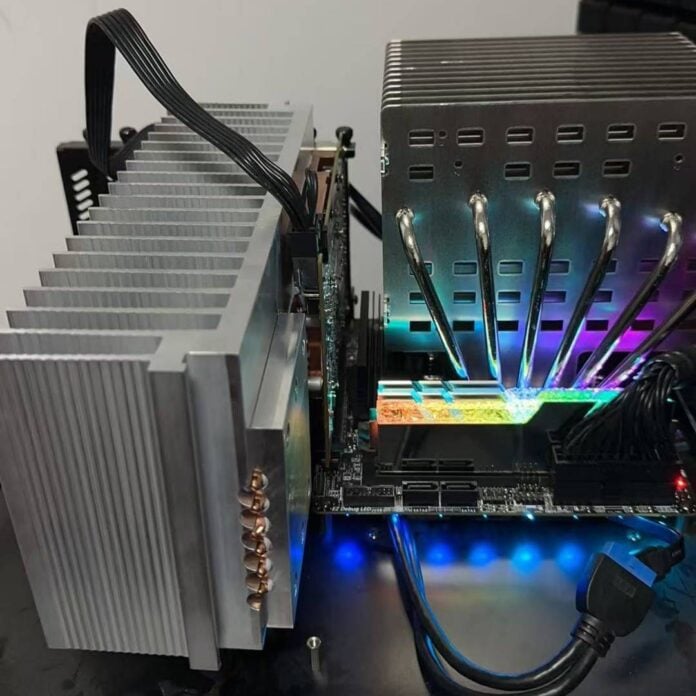
A modder has built an enormous passive-cooling system that can apparently handle an Nvidia GeForce RTX 4060 graphics card without a fan. The design basically replaces the original cooler with a chunky block of aluminium, removing all the fans. Weighing a hefty 2.5kg, this custom cooler takes up more than twice the size of a standard RTX 4060 card.
The mod was shared in the comment section of a video on bilibili.com by a user called NexFrame, who provided views of several different angles of the mod. These show that the user went with a custom extruded aluminium fin stack, complemented by a set of six heatpipes that help distribute heat more efficiently towards the far edge of the cooler. To avoid hindering natural heat convection, the fins were kept at a much greater distance apart than in traditional coolers that rely on concentrated fan airflow.
As a result, the cooler ended up being large and bulky, taking up more than 220mm in length and three slots in width, from the looks of it. The aluminium block dwarfs the card’s PCB, and even the motherboard, making the Noctua NH-P1 CPU cooler next to it look comparatively small.
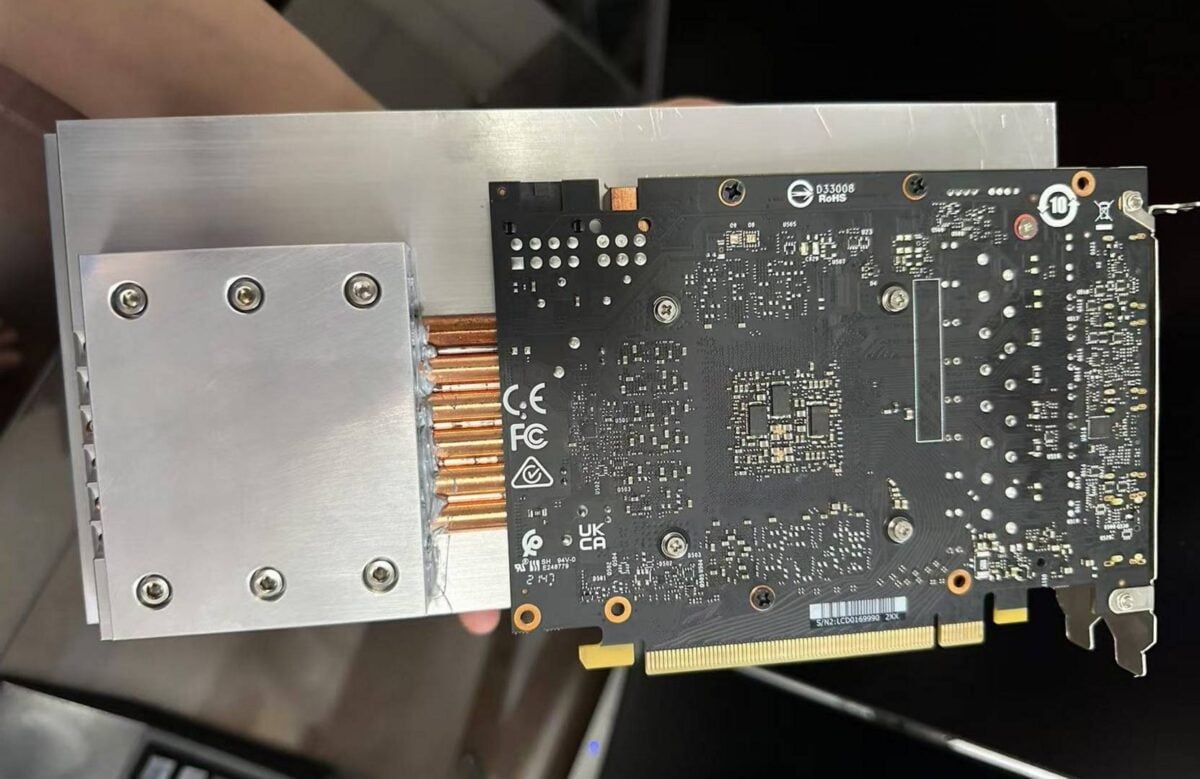
While this is still smaller than some actively-cooled cards, it’s important to keep in mind that we are talking about a 115W TGP (total graphics power) card here. When it comes to passive cooling, bulky coolers are inevitable, unfortunately. On top of this, just over 100W is as far as you would want to go with a DIY cooler anyway, as any more would be exponentially harder to cool. There is a reason we don’t see many fanless graphics cards these days, since the power draw of even mid-range GPUs, such as the RTX 5060 Ti, sits at around 180W. Needless to say, a fully passive RTX 5090 is practically a dream.
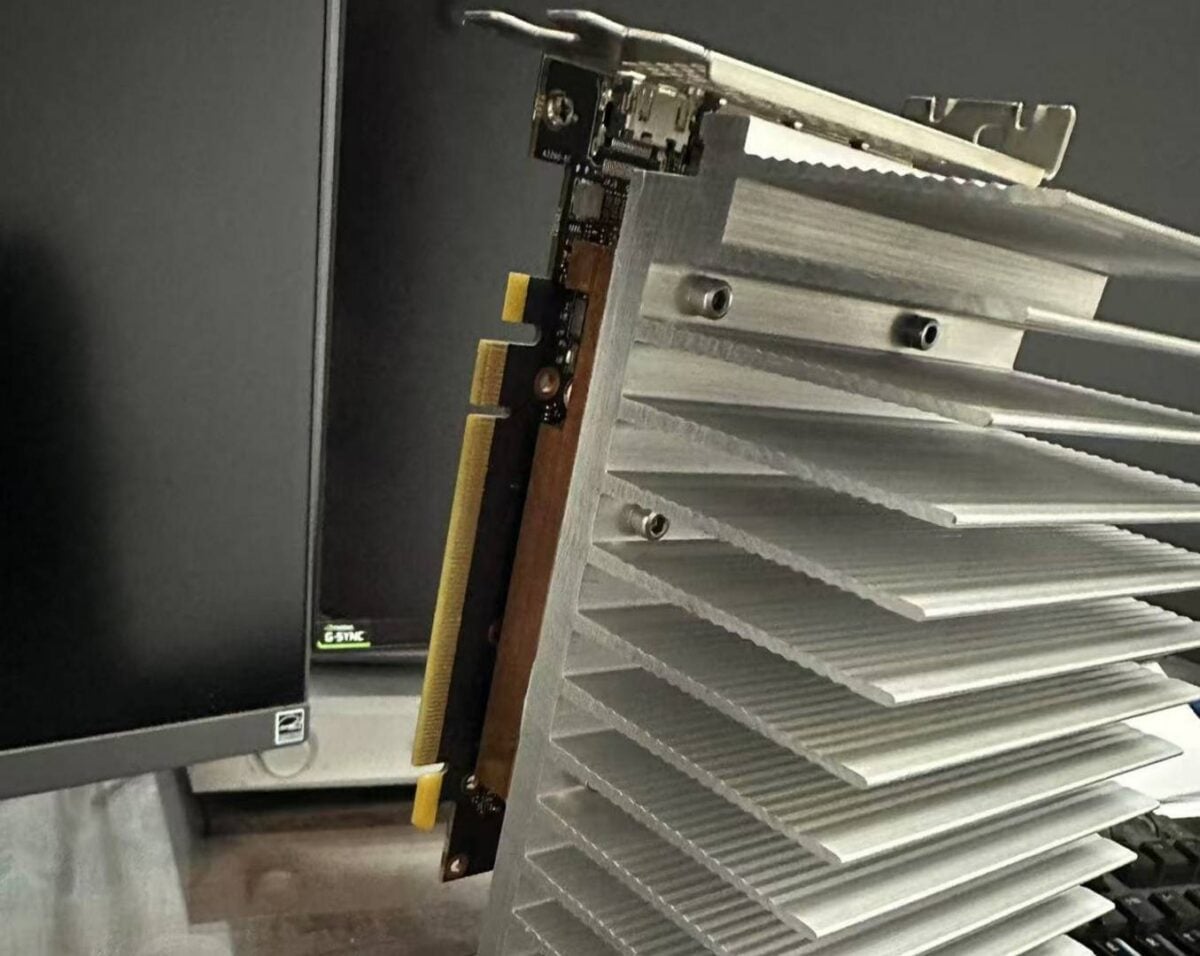
Unfortunately, the modder didn’t share any information regarding temperatures, especially those for the GDDR7 memory chips, as they can overheat if they’re not properly contacting the heatsink. In fact, there is no indication if this mod even works, although the lit-up RAM LEDs suggest the system can at least power on. Nevertheless, this is a cool proof of concept.