
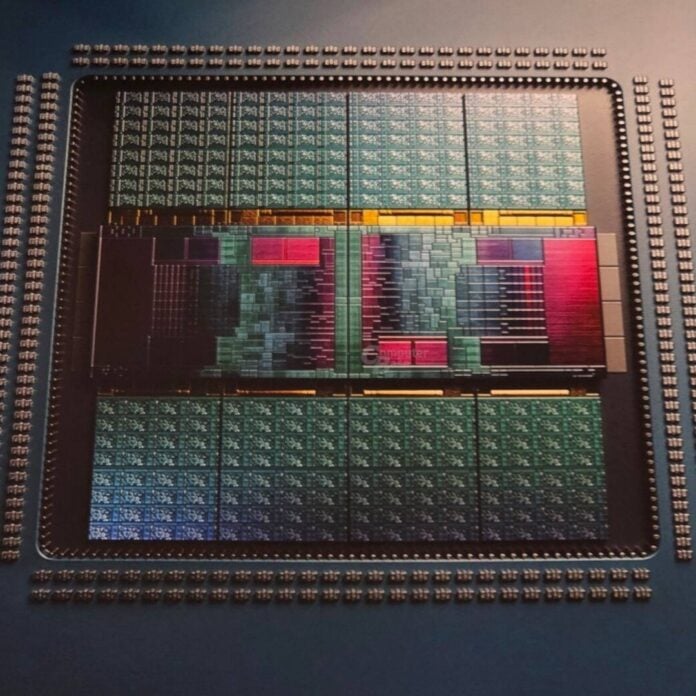
AMD has revealed a few bits of information ahead of the official Zen 6 launch, starting with a rendering of the internal structure of its upcoming Epyc Venice CPUs. These show the flagship 256-core design split between different chiplets, alongside the I/O dies and other supporting parts.
The CPU’s internal structure was spotted and pictured by ComputerBase on advertising banners at San Francisco’s Moscone Centre, where AMD intends to hold its Advancing AI 2026 keynote. The images show the internal structure of what looks like the flagship 256-core Epyc CPU, split between eight CCDs (core complex dies).
Each CCD comprises two 16-core CCXs (core complexes), for a total of 32 cores per physical chiplet, manufactured using TSMC’s 2nm node. These CCDs are positioned on either side of two large I/O dies, which connect everything together using AMD’s Infinity Fabric links, while also containing the memory controller, some PCIe lanes, and other I/O features.
Former AMD Corporate Fellow Patrick Moorhead, who now runs Moor Insights & Strategy, also shared some photos of the CPU on social media, which you can see in the X post below.
Set to power AMD’s Helios integrated rack-scale systems and other AI data centres/hyper scalers, these CPUs are advertised as offering a 1.7x gen-to-gen performance uplift alongside 1.6TB/s of memory bandwidth, not to forget double the CPU-to-GPU bandwidth thanks to the PCIe 6.0 connection. These chips are also expected to be offered with 3D-V-Cache, but it’s unclear if such variants will be available with 256 cores.
Although AMD hasn’t yet disclosed detailed performance figures and platform specifications, these pictures indicate that Zen 6 will bring a significant increase in core density, while continuing AMD’s modular chiplet-based design. With 256 cores and 512 threads, next-gen Epyc CPUs will offer 33% more cores than Zen 5 designs, along with frequencies exceeding 5GHz, likely making them the fastest chips on AMD’s roster.
Desktop users are also expected to get a slice of the cake, as rumours claim AMD is planning to make 24-core CPUs on consumer AM5 platforms. If correct, Zen 6’s 50% boost in core count would mark a huge upgrade for consumers. Furthermore, these chips’ clock speeds are said to boost much higher than Epyc’s 5GHz, reaching up to 7GHz on some models. To put it simply, everyone should be excited for Zen 6.