
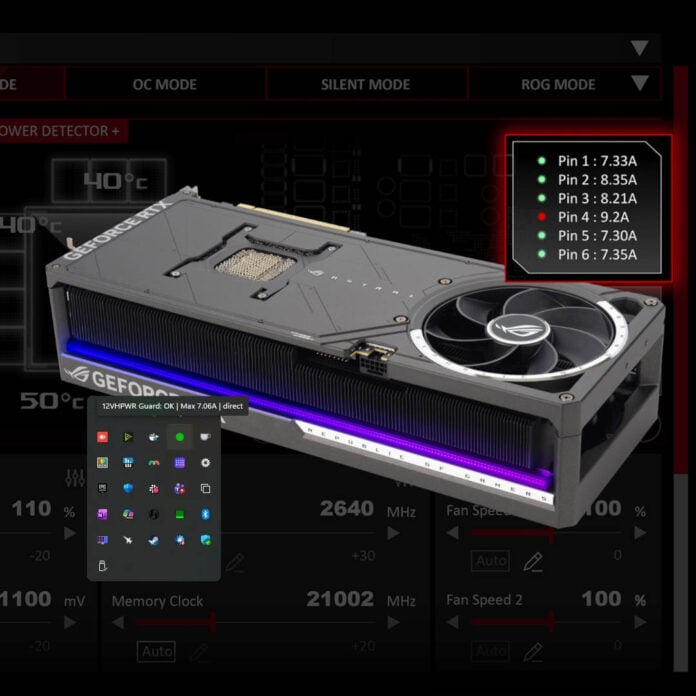
An Nvidia RTX 5090 user had had enough of worrying about the safety of their card and developed a piece of software to detect current imbalances on the potentially troublesome 12V-2×6 cable. Called 12VHPWR Guard, the tool automatically shuts down the PC to prevent the connector or cable from melting due to overheating.
The tool sits in the Windows tray and pulls all 12V-2×6’s pin current measurements every half a second. If one of the six pins remains above 9.5A for 15 seconds straight, it forces the PC to shut down. To do so, 12VHPWR Guard requires per-pin sensing on the hardware side, which is mainly available on premium cards such as Asus’ ROG Astral series.
Its developer said that 12VHPWR Guard directly reads the ITE IT8915FN monitoring chip installed on supported ROG Astral cards over the GPU’s I2C bus through NVAPI, with HWiNFO shared memory available as a fallback. The developer also notes that all I2C access is read-only, and that the tool uses only about 1% of one core and 35MB of RAM. They also claim that 12VHPWR Guard was validated against HWiNFO at idle and under ~500W gaming load and found that per-pin readings agreed within 0.02A.
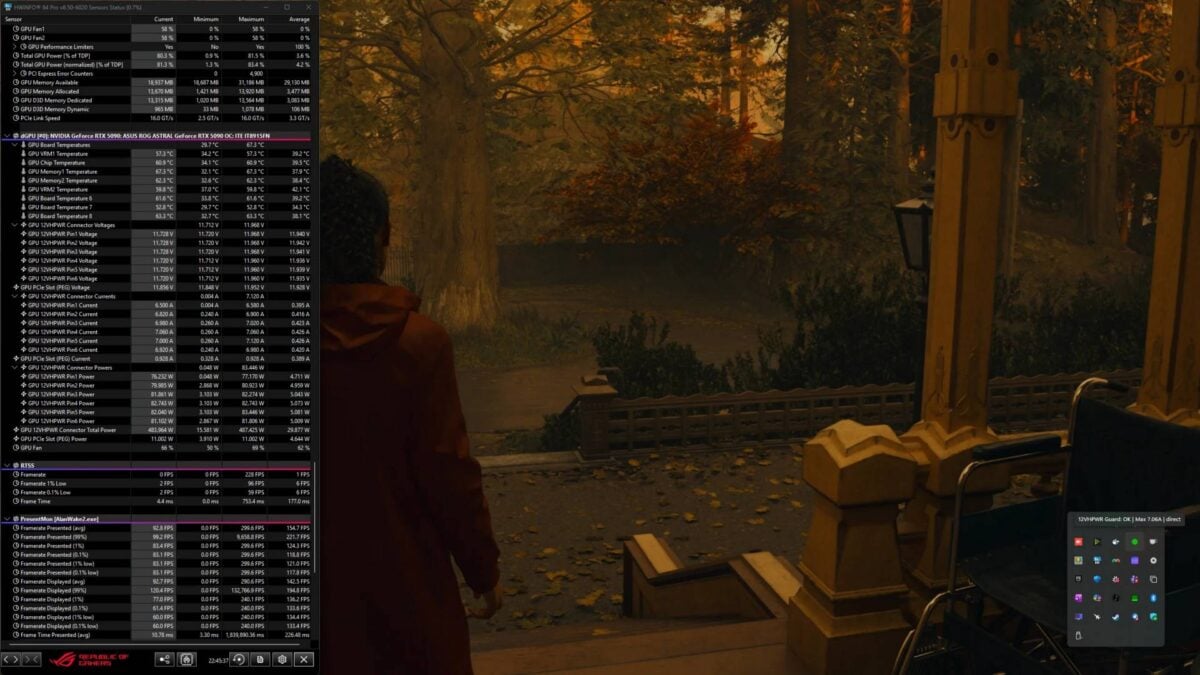
While Asus already offers per-pin current monitoring through its GPU Tweak III software, with a warning in case of power imbalance, it doesn’t act on that information to shut down the machine. This means that if the user is not in front of the PC when the alarm shows, the situation could degenerate into a melted cable or burned graphics card.
At the moment, the tool is only confirmed to work with Asus’s Astral cards, i.e. ROG Astral RTX 5080 OC and ROG Astral RTX 5090 OC. The ROG Matrix Platinum RTX 5090 should also be compatible since it features the same per-pin monitoring as the Astral series.
Currently, the tool only runs on Windows and requires Python 3.10. Users can also configure the current threshold and shutdown timer if the defaults seem too conservative. The developer said that the selected parameters were on purpose, accounting for potential transient spikes and normal load swings.
In future iterations, the developer wants to allow 12VHPWR Guard to drop the power limit through the management API instead of shutting down the system. This has the benefit of being faster than waiting for Windows to close all open apps, while saving active tasks. At that point, system shutdown will become a last resort if a pin stays too hot anyway. If this interests you, you can download or check the project’s progress on GitHub.