
Intel is seemingly planning to release its first Nova Lake-S desktop CPUs in early 2027, with the flagship multi-die variants coming later, according to a presentation slide leaked on social media. Shared by tech leaker @wxnod on X, the slide also appears to confirm many previous Nova Lake rumours, including the X3D-style massive bLLC cache.
According to the leaked slide (machine translated), Intel plans to commence mass production of its next-gen Nova Lake-S desktop processor in Q4 2026, followed by market availability in Q1 2027. That said, the slide indicates that Intel will only release the smaller monolithic (single-die) chips to start, carrying up to 28 cores split between Performance (P), Efficient (E), and Low Power Efficient (LP-E) core variants. The much-awaited dual-die flagship, which packs up to 52 cores, is listed as coming later in the year.
The slide also references the upcoming Razor Lake and Hammer Lake series as coming in Q4 2027 or later, but stops short of revealing any juicy information. While this leak seems to have originated from some kind of partner presentation, rather than an official Intel briefing, it looks legitimate and appears to corroborate many previous leaks.
For instance, it confirms that Nova Lake-S will feature a Big Last Level Cache (bLLC), giving next-gen Intel CPUs up to 288MB of cache to compete with AMD’s 3D V-Cache chips. This is a sharp increase compared to the current flagship, which carries 40MB of L2 plus 36MB of L3 cache, pushing the new CPU ahead of AMD’s monster Ryzen 9 9950X3D2 and its 208MB total cache (L2+L3). Like AMD’s 3D V-Cache, Intel’s bLLC is expected to dramatically boost frame rates, with the leaked slide claiming a leap in gaming performance.
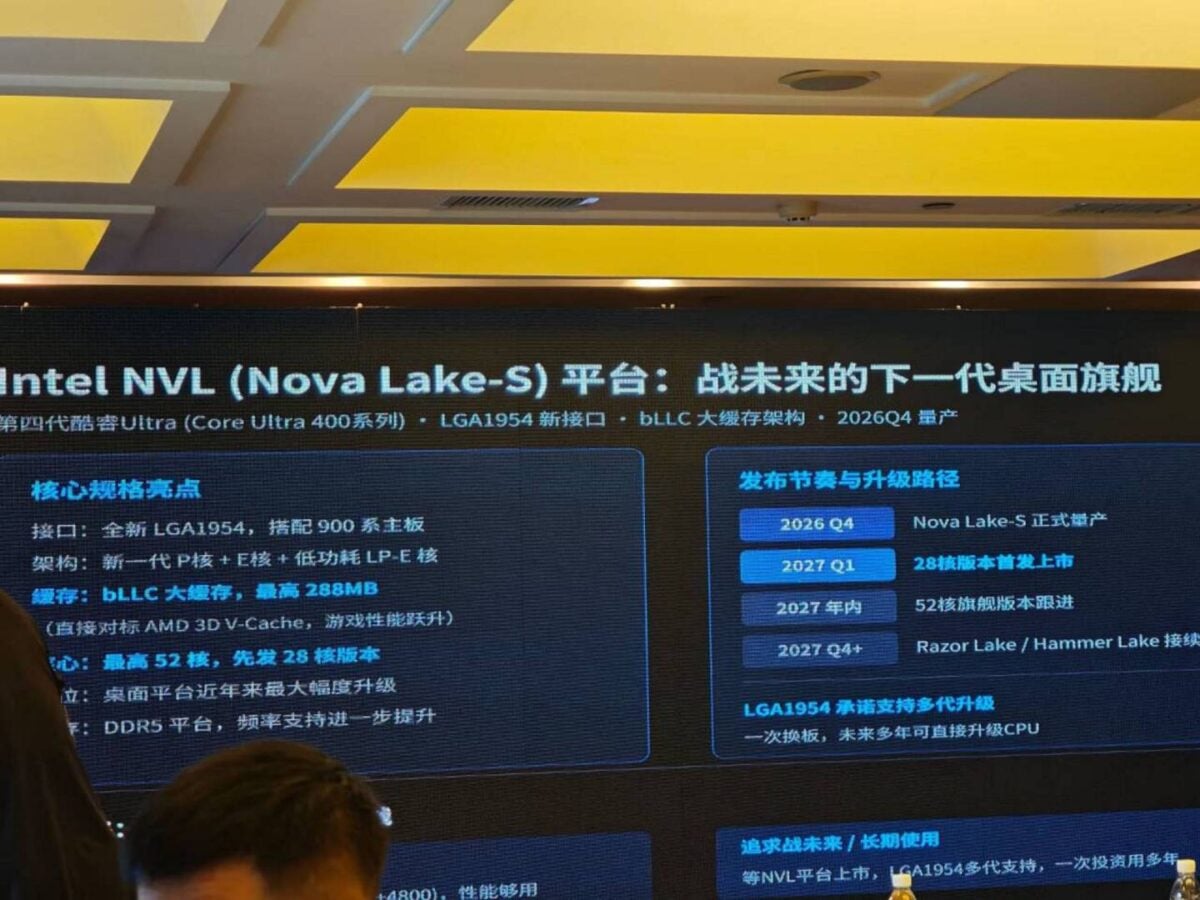
On the platform side, the leak lists Intel’s new LGA1954 socket and 900-series chipset, while also saying the new socket will “support multiple generations of upgrades” [machine translation]. This backs up a hint from Intel’s Robert Hallock, who in an earlier interview said “I do” when we asked him whether he saw a future where Intel sockets support more CPU generations. Previous rumours have also suggested that LGA1954 could get four generations of CPUs, akin to AMD’s AM4, which would be a stark and welcome change.
The slide also confirmed support for DDR5 memory, including compatibility with faster memory modules down the line. On the opposite side, the leaked slide appears to contradict previous rumours regarding a change in CPU naming, referencing Nova Lake-S processors as having three-digit Core Ultra 400-series names, instead of the rumoured four-digit Core Ultra 4000 numbering scheme. Lastly, there was no mention of AVX-512 support, which is expected to make a return on consumer Intel hardware after five years of absence.
Overall, a wealth of leaks and rumours now appear to agree that Intel’s next-gen chips will mark the biggest leap in performance in recent consumer CPUs, perhaps even surpassing AMD’s upcoming Zen 6 chips. We can’t wait to see both firms’ next-gen chips in action.