

AMD has shared a bunch of AI performance results for its new Gorgon Halo Ryzen AI Max+ Pro 495 CPU, showcasing the chip’s massive 192GB memory pool. With 50% more memory than a single Nvidia RTX Spark (or AMD Strix Halo) chip available, the company says machines powered by this CPU can now run 300-billion-parameter AI models.
With only days remaining until Nvidia launches its RTX Spark AI chip at Microsoft’s October 7 event, AMD’s announcement is timed for disruption. The new Ryzen AI Max+ Pro 400 series, which is largely a refresh of the Strix Halo Ryzen AI Max+ Pro 300 series, but with the ability to address more RAM and a 100MHz higher clock speed, is AMD’s answer to Nvidia’s RTX Spark.
That said, since the latter has yet to show its full might, AMD instead opted for an Intel Core Ultra X9 388H as a comparison to showcase its new flagship Gorgon Halo processor. This is somewhat of an unfair comparison considering the Core Ultra’s consumer market segment, not to mention its smaller 64GB maximum memory allocation.
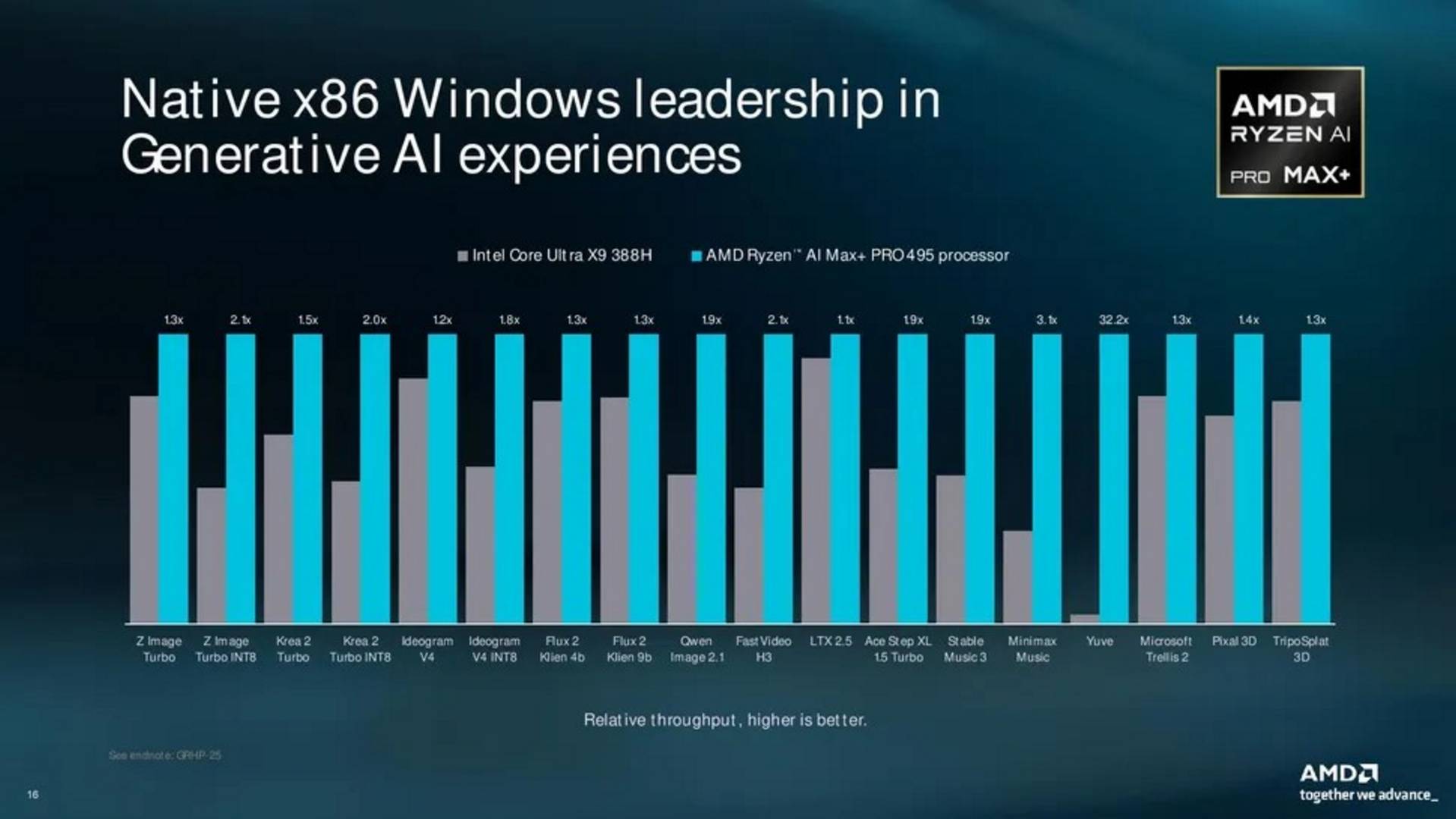
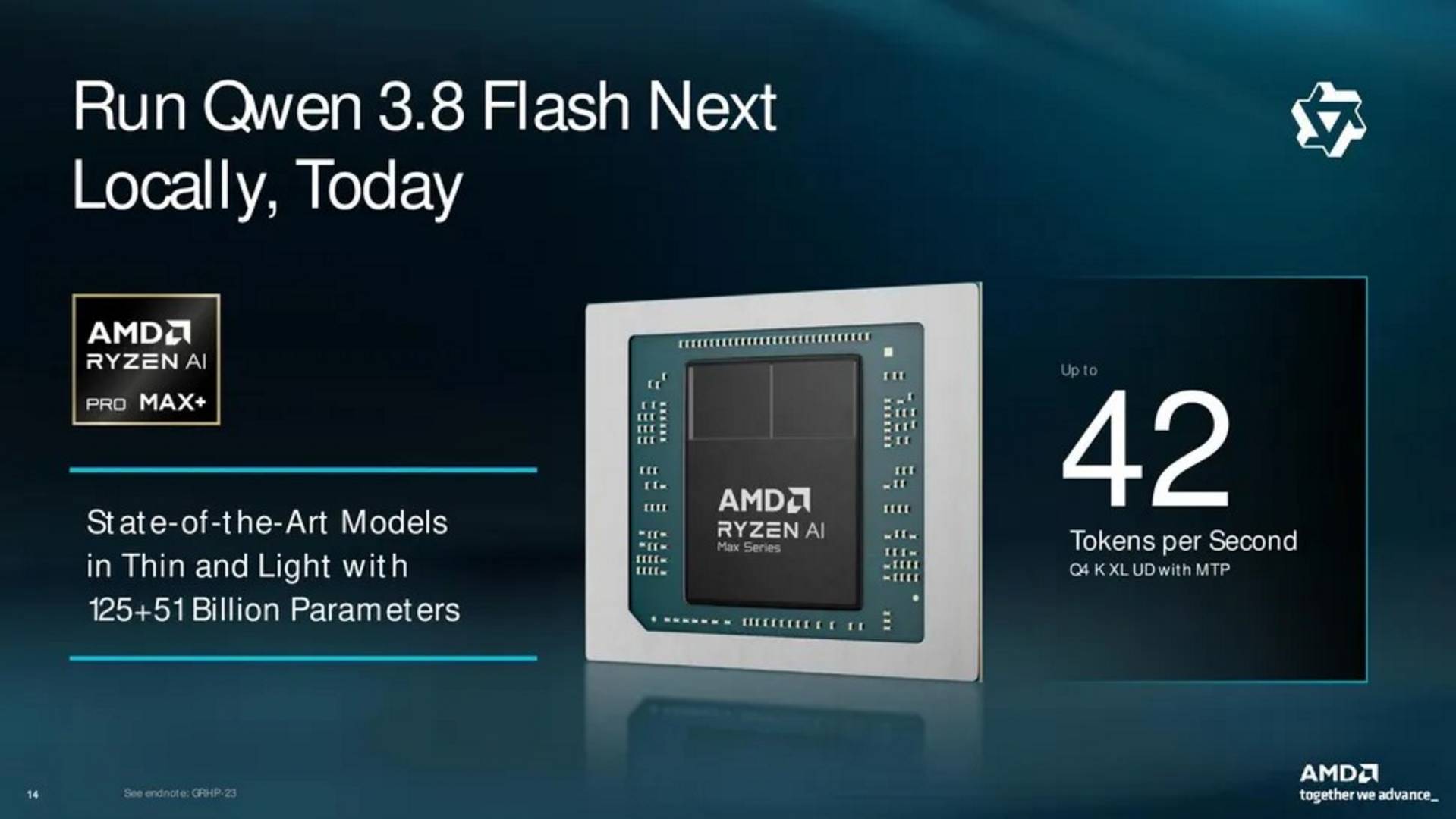
Nevertheless, AMD claimed that its flagship Ryzen AI Max+ Pro 495 was between 1.1x and 32.2x faster than the Intel chip in AI, claiming up to 20 tokens per second in GLM 5.3 Flash with 320 billion parameters, which is regarded as one of the best open-weight models. Note, however, that while GLM 5.3 Flash has 320 billion total parameters, only 18 billion are activated for each token. AMD also claimed up to 42 tokens per second in Qwen 3.8 Flash, which is a 125 billion parameter model with 5 billion parameters active per token.
Besides holding larger models, having this much memory can also be useful for running multiple models at the same time. For example, you could run a small and fast model for easy tasks, and a larger model that can take over if a task is too complex.
While 192GB of memory is an advantage over the RTX Spark’s 128GB for a single chip, it’s not the be-all and end-all when it comes to AI. A chip’s compute speed and memory bandwidth also play a role. For example, higher GPU compute (FLOPS/TOPS) performance ensures an AI system understands larger prompts instantly, reducing initial pause before an answer. It also accelerates image generation by cutting down the time required to render a picture. That said, once the chatbot starts typing, text generation speed becomes bound by memory bandwidth.
Speaking of which, on top of offering 50% more memory, the Ryzen AI Max+ Pro 495 also boasts a slight boost in memory bandwidth, bringing it to 273GB/s, up 6.5% from Strix Halo’s 256GB/s. Other than this, it’s pretty much a refresh of AMD’s last-gen Ryzen AI Max+ Pro 395, packing the same 16 Zen 5 CPU cores plus 40 RDNA 3.5 GPU compute units (CUs), with a 100MHz increase to CPU and GPU boost frequencies.
As a result, Gorgon Halo will mainly shine when working on large AI models, with AMD claiming support for up to 300-billion-parameter models. Whether this will allow it to beat Nvidia’s RTX Spark remains to be seen. According to Tom’s Hardware, last-gen Strix Halo was able to deliver 56 tokens per second in GPT-OSS 120B with 4-bit quantisation, against 64 tokens per second for Nvidia’s DGX Spark. Considering that the latter has a very similar design to the upcoming RTX Spark, the new Gorgon Halo Ryzen AI Max+ Pro 495 may fall short in some AI tasks.
Price-wise, Gorgon Halo-powered devices such as the Minisforum MS-S1 Max-P495 will cost $7,399. That’s a steep but unsurprising price considering the amount of memory on board. For those interested in a portable version, be it for AI or traditional workloads, AMD partners will also release Ryzen AI Max+ Pro 400-equipped laptops, such as the HP ZBook Ultra G3a at $7,449.