
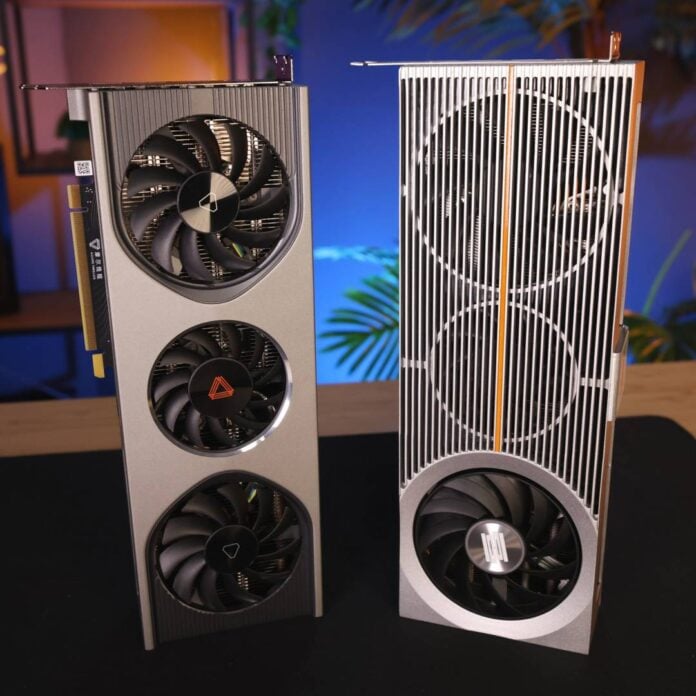
China’s second in-house GPU, the Lisuan LX 7G100, has been benchmarked by tech site PCGH, showing poor performance compared to AMD, Nvidia, and Intel GPUs. It’s considered to be China’s fastest gaming graphics card to date, but the LX 7G100 still lags behind in many metrics, including idle power draw.
Made by Lisuan Tech, a Shanghai-based company founded in 2021 by former S3 Graphics employees, the LX 7G100 was released in June this year. Despite being very recent, though, its performance is unfortunately from a decade ago. According to PCGH tests, the LX 7G100 can barely beat a nine-year-old AMD Radeon RX 580, despite boasting a 2GHz boost frequency, 12GB memory capacity, and a smaller 6nm manufacturing node.
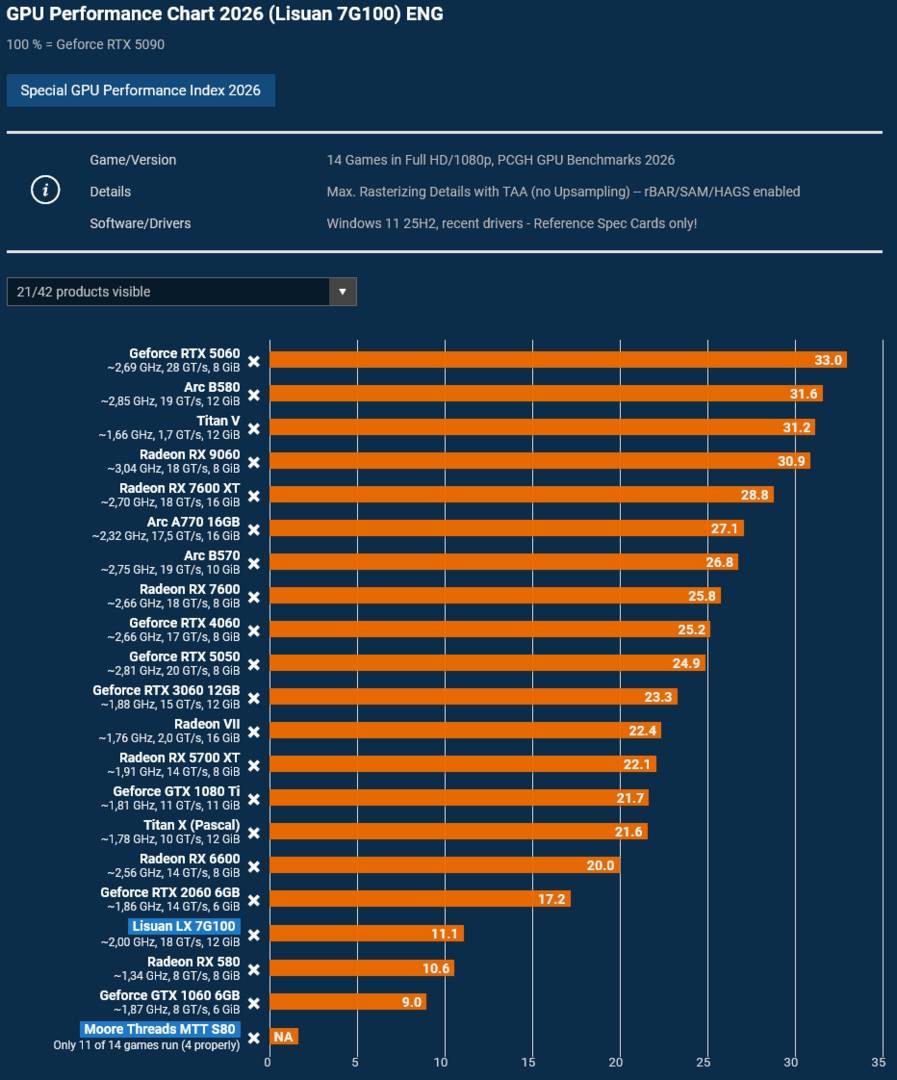
When averaged using PCGH’s 14-game test suite, the LX 7G100 sat just 5% ahead of the RX 580, while trailing Nvidia’s GeForce RTX 2060 by 65%. Even Nvidia’s entry-level RTX 5050 left it in the dust, offering more than double the frame rate. Needless to say, this is far from the anticipated RTX 4060 performance target. In real-world performance, it doesn’t stand a chance even against the last-gen Intel Arc A770.
On top of being slow, the LX 7G100 lacks any ray tracing or matrix (AI) units, which blocks exclusively ray-traced games (such as Doom: The Dark Ages) from working. The GPU is also prone to driver-related bugs and crashes. To give you an idea, of the 20 games in PCGH’s test lineup, only 14 worked, of which two suffered from graphic glitches and instability. At least it supports DirectX 12 and Vulkan.
Power consumption is also an area for improvement, especially idle power, where the LX 7G100 gobbles about 59W, doing practically nothing. For comparison, Nvidia’s RTX 2060 takes just 10W, while AMD’s RX 6600 sips 6W. It can’t even compete on price in the Western world, with the Founders Edition costing PCGH €500 including customs duties, and normal cards costing around €350.
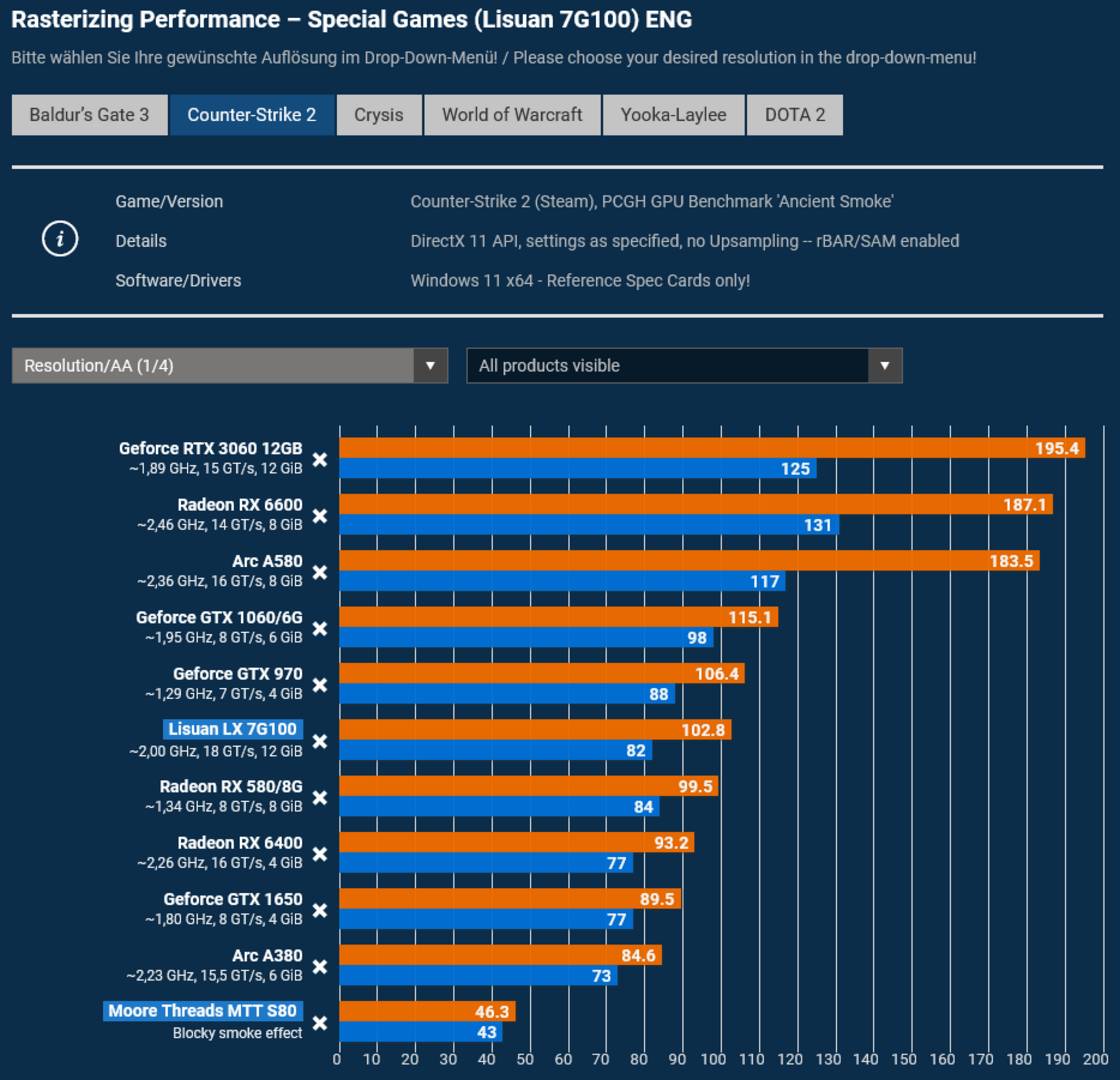
That said, when compared to China’s other in-house GPU, the Moore Threads MTT S80, it look brighter. Here, the new LX 7G100 pulls ahead in many tests, leading by 20% in Dota 2, 37% in Baldur’s Gate 3, and a whopping 122% in Counter-Strike 2, though it loses in World of Warcraft and Crysis.
Considering its fresh release, the LX 7G100 isn’t a total catastrophe. It’s at least able to play some games at reasonable frame rates, and it shows that someone else can make a GPU in an industry that sorely needs competition. This one isn’t going to be a threat to Nvidia or AMD, though.