
AMD has announced new optimisations to its FSR frame generation tech, saying frame-pacing consistency has been improved. The company says these changes are coming to Radeon RX 9000-series GPUs, but didn’t indicate if or when older graphics generations will receive this treatment.
For those unfamiliar, frame pacing measures the consistency of the delay between each frame, be it rendered or generated. In an ideal scenario, the timing between each frame should be identical (evenly distributed frames) to deliver the smoothest experience. If one frame is delayed more than the others (perhaps one frame staying on screen for 3ms, and the next for 18ms), the user perceives this as a hitch or stutter.
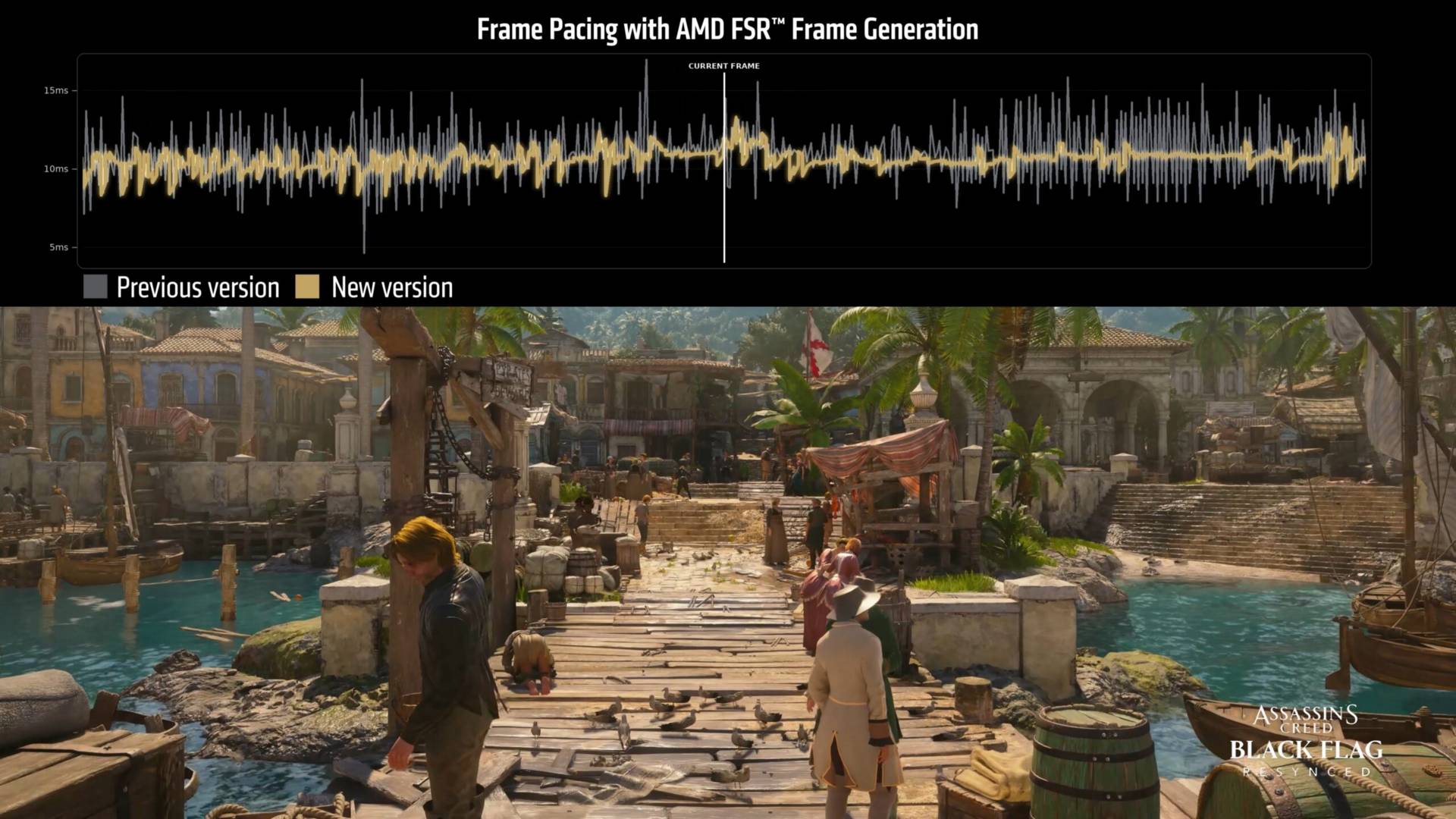
Unfortunately, since its launch, FSR frame generation has suffered from this issue. For instance, Hardware Unboxed discovered that while FSR frames were generated at an even pace, their delivery to the display was inconsistent. This resulted in a jittery motion, an issue that wasn’t present when using Nvidia’s DLSS frame generation tech. Considering that frame gen is a tool meant to improve motion smoothness in games, failing to do so is a deal breaker.
With its latest update, AMD claims to have improved FSR frame generation output. “We’re not just making FSR smarter, we’re making it smoother,” says the company. “We’re rolling out new frame pacing improvements for FSR frame generation on AMD Radeon RX 9000 Series graphics cards, delivering more consistent frame pacing for a smoother, more responsive gaming experience in supported titles.”
While the company stopped short of clarifying what exact changes have been made, any improvement is welcome. Also, AMD didn’t clarify if older generations of GPU can expect a similar fix.
The underlying technology powering AMD’s FSR frame generation differs fundamentally between Radeon RX 9000 and Radeon RX 7000 series cards. The former can use an AI-driven pipeline, while the latter falls back on an analytical version based on FSR 3. In the meantime, Radeon RX 9000 owners should experience smoother gameplay when enabling FSR frame generation.