
AMD has seemingly fixed its FSR Frame Generation frame pacing problems, though not all games are covered. The fix is included in the latest Radeon Adrenalin drivers v26.10.1 and is automatically applied to games supporting this feature.
Since its launch in 2023, FSR Frame Generation has been known to be less smooth than its Nvidia counterpart. Forward to December 2025, Digital Foundry on YouTube demonstrated that this AMD technology had frame pacing issues causing generated frames to be displayed at an uneven rate, resulting in jittery motion. While hope remained that this could be fixed at some point, AMD never did so, at least publicly. Even the ML-based FSR 4 Frame Generation version bundled with the Redstone package suffered from the same problem, yielding a great fps boost on paper, but an uneven frame pacing output, especially when the point of view moved.
At first, this inconsistency was believed to result from the way AMD implements frame pacing, which didn’t use flip metering, unlike Nvidia’s DLSS technology. The latter ensures precise frame pacing of generated frames, resulting in smooth gameplay. In August, Hardware Unboxed on YouTube again demonstrated the inconsistent frame pacing of FSR Frame Generation, showing in video how the generated and rendered frames were displayed at inconsistent intervals. Even though the GPU generated each frame at a steady interval, the delivery to the monitor broke down somewhere, causing uneven pacing, which was perceived by the user as stuttery or jittery motion.
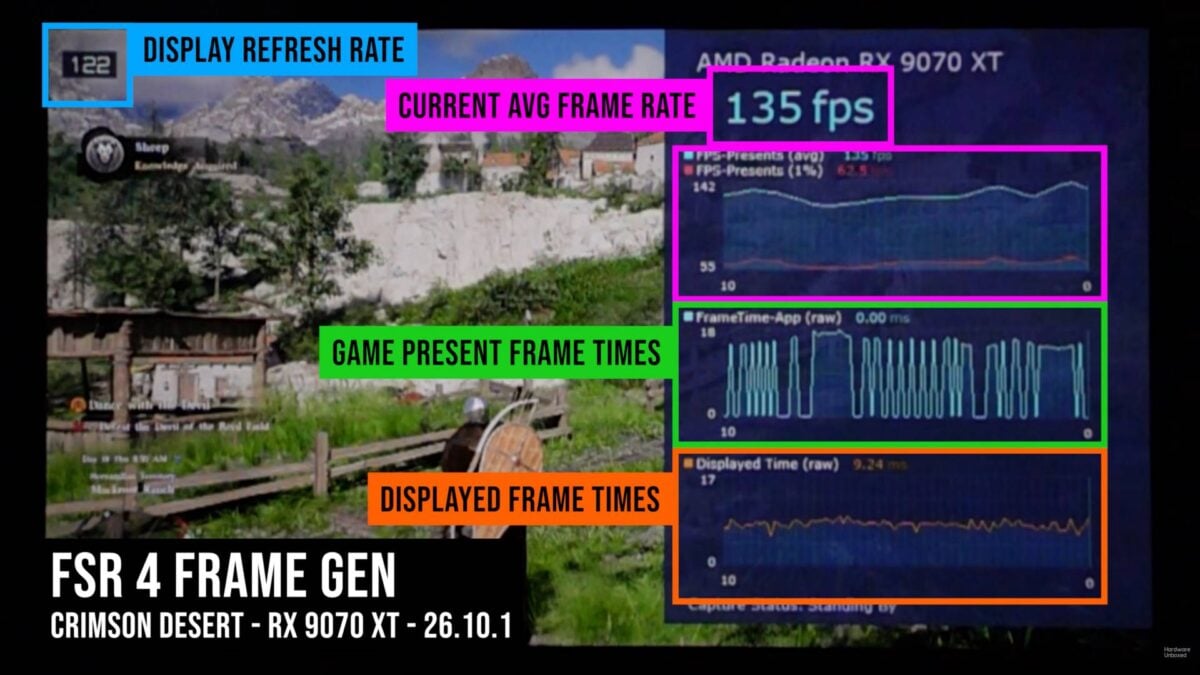
In a recent announcement, AMD claimed to have optimised its FSR frame generation tech, saying frame pacing consistency has been improved on Radeon RX 9000 series GPUs. Following this, Hardware Unboxed installed the latest 26.10.1 driver and put it to the test on an RX 9070 XT GPU. Turns out, AMD did indeed fix FSR Frame Generation pacing, but only in some games and some FSR implementations.
For example, Crimson Desert felt smooth with no double-tap jittery output. The same went for Resident Evil Requiem, which previously suffered from erratic frame delivery, as well as The Witcher 3 Remastered, Alan Wake 2, and Lego Batman LOTDK. Assassin’s Creed Black Flag Resynced also saw an improvement, but pacing was not considered flawless. All of this is more visible in Hardware Unboxed’s video below.
However, not all games were fixed, unfortunately. For example, God of War Ragnarok still exhibited erratic frame pacing outputs, as well as Hogwarts Legacy and Borderlands 4 to some extent. The common point between all these games seems to be the level of FSR Frame Generation implementation. Games that have a native FSR 4 Frame Generation implementation seem to be fixed, but those still running on FSR 3.1.5 or earlier remain broken.
Thankfully, there is a solution for some of these games, specifically those with separate FSR Frame Generation DLL files. On these, upgrading the FSR 3.x.x DLL files with an FSR 4 file fixed the pacing issues. Though some outliers remain, such as Cyberpunk 2077. In this specific instance, the game appears to repeat the rendered frame twice instead of injecting the generated frame. Interestingly enough, in this title, FSR 3 Frame Generation delivered a better and smoother experience than FSR 4 Frame Generation. Hardware Unboxed also found that FSR 3 Frame Generation frame pacing was better on last-gen RDNA 3 Radeon RX 7900 XTX GPU.
Though work is still needed to bring FSR Frame Generation to the level of its competition, this is a welcome step toward a final fix. Despite its latency impact, frame generation and multi-frame generation remain a handy tool for gamers, capable of genuinely improving the perceived smoothness of games when properly implemented. It’s also a great tool to take advantage of modern high-refresh monitors.