
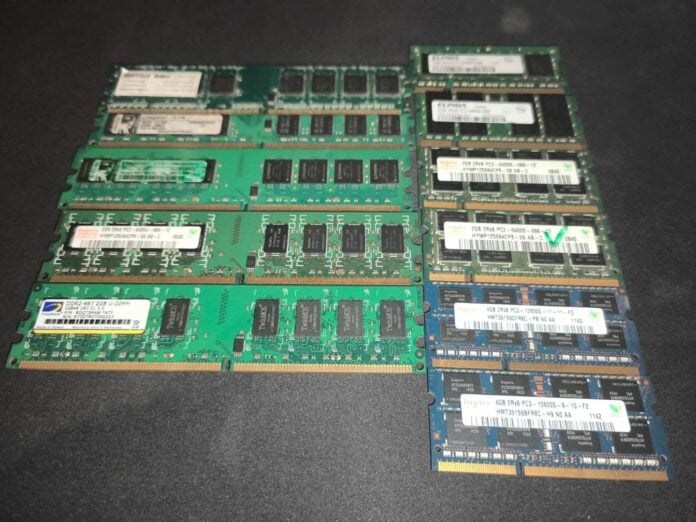
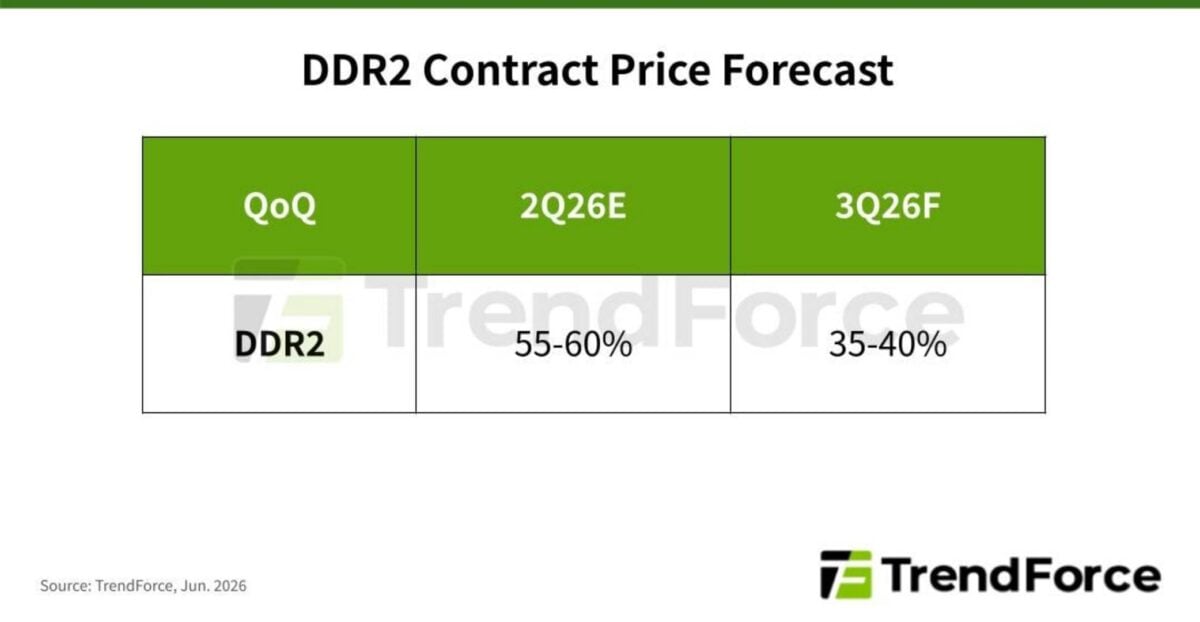
Even legacy memory is now becoming a victim of the RAM crisis, including ancient DDR2 products. Market analyst TrendForce’s latest research has revealed that the tightening of mature-node DRAM supply is forcing companies to adopt older memory products to secure enough capacity. As a result, DDR3 and DDR2 products have seen a continuous rise in cost, with DDR2 contract prices increasing by 55-60% in Q2 2026, and forecast to go up by another 40% in Q3 2026.
To no one’s surprise, the big three memory manufacturers, Samsung, SK Hynix, and Micron, continue prioritising high-margin advanced-node production to support the insatiable demand from the AI industry for HBM and server DRAM. Consequently, wafer allocations for DDR4 and other mature nodes have been reduced, forcing some buyers to seek older DDR3 and DDR2 memory from less prominent memory producers. Among these, we find Nanya and Winbond, two Taiwanese manufacturers specialising in legacy products such as DDR4, DDR3, DDR2, and other NAND flash types, such as those used in embedded applications or automotive.
The report indicates that the rising contract prices have prompted some manufacturers to downgrade their memory specifications in order to control system costs. In other words, products using DDR4 are being refitted with DDR3, and those using DDR3 are being redesigned to use DDR2.
As if this weren’t enough, it appears that Winbond is gradually reducing DDR2 production and reallocating capacity toward higher-margin products such as DDR3, DDR4, and LPDDR4, further tightening DDR2 supply. Fortunately, ESMT, another semiconductor company specialising in memory, is planning to increase its DDR2 production at PSMC, a foundry that manufactures chips designed by other companies.
Despite this, as with HBM and DDR5, this sudden shift in demand is exceeding the output of the aforementioned Taiwanese manufacturers, causing prices to rise. TrendForce’s latest report shows that the tension on consumer DRAM is no longer limited to bleeding-edge technology, spreading to products that were nearly abandoned by the industry.