
The global DRAM module market has reached $21.2 billion in revenue in 2025, according to TrendForce, driven by AI server demand and constrained chip supplies. This represents a 59% year-on-year (YoY) increase and, astoundingly, Kingston’s revenue commands a huge 62% of this burgeoning market.
According to the latest TrendForce report, rising prices and concentrated shipments from DRAM module makers in the second half of 2025 are driving this massive growth, which marks a significant acceleration compared to 2024’s 7%. The report outlines how the top five global DRAM module makers account for 77% of total market revenue in 2025, of which Kingston maintains a dominant share.
Furthermore, Kingston’s inventory buildup throughout 2024 and 2025, plus the jump seen in H2 2025, has helped it drive a yearly revenue growth of 48% in 2025.
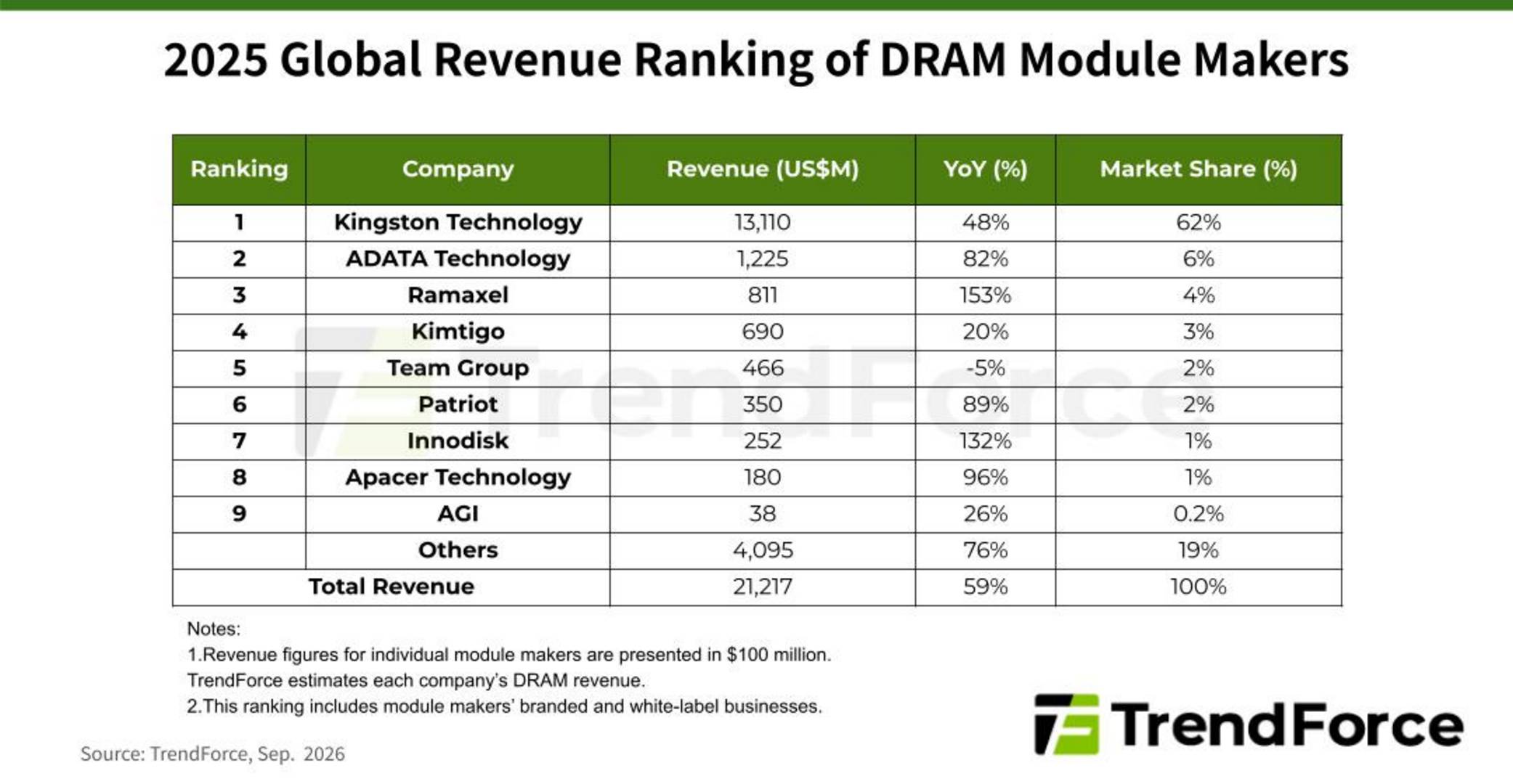
Once we get past Kingston’s dominance, we find Adata ranking second with a 6% market share and 82% YoY growth, followed by Ramaxel in third position with 4% market share and a whopping 153% YoY growth. Adata’s low-cost inventory – accumulated during the previous market cycle and Ramaxel’s partnerships with PC OEMs and cloud providers, are presented as major factors in their growth. The only company to mark a decline is TeamGroup, which ranked fifth, with a 2% market share and -5% YoY growth.
It’s certainly been a transformative time for the memory business compared to the last few years. Following the 2023 downturn, where the memory market suffered a severe 28% revenue decline, due to post-pandemic oversupply and reduced consumer demand, memory manufacturers (Samsung, SK Hynix, and Micron) aggressively cut production while shifting wafer allocations towards high-margin HBM and server-grade DDR5 memory.
However, in mid-2024, when US tariffs hit at the same time as DDR4 memory started entering its end-of-life (EOL) phase, demand suddenly grew as PC makers and retailers tried to secure capacity in anticipation.
This drove a rebound, pushing YoY DRAM revenue up by 7%, reaching $13.3 billion in 2024. That said, while this overall growth was in single digits, DRAM spot prices jumped 43% over the year. This recovery continued through 2025, marking a massive 120% spot price increase over 2024. .
As shipment volumes and prices for modules have increased, most module makers have experienced a market upswing recently, TrendForce reports, encouraging them to adjust their portfolios towards higher-margin industrial and enterprise products. The gains were so big, in fact, that Micron, which is one of the big three memory players, announced it was exiting the consumer market entirely to focus on servers and data centres.
When it comes to the DRAM module market, Kingston clearly reigns supreme. While we don’t have any concrete revenue figures as the company is privately owned, Forbes estimates that its total annual revenue for 2025 was $14.4 billion. It looks as though 2026 will be a fantastic year for all these companies, to the chagrin of consumers who have to deal with absurd hardware prices at the moment.