
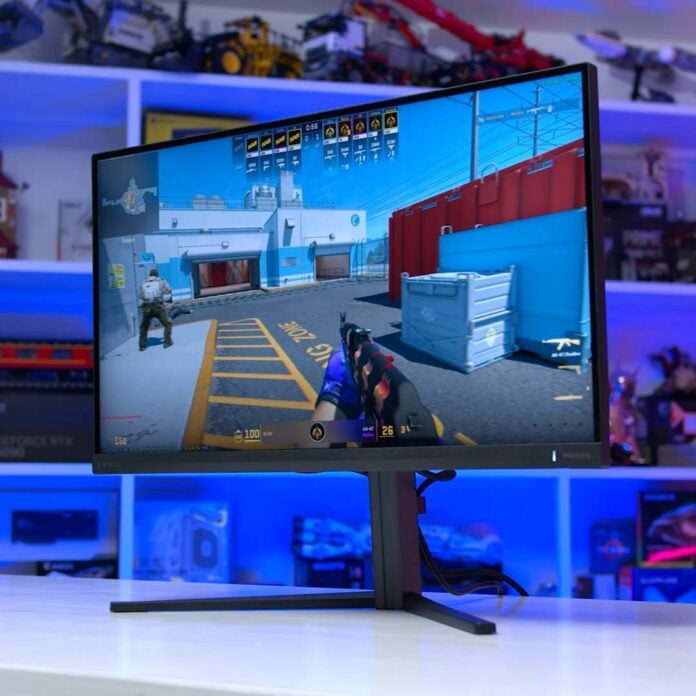
After years of anticipation, the first 1,000Hz gaming monitor has reached reviewers, but its performance has failed to live up to expectations. According to tests conducted by Monitors Unboxed on YouTube, the 1,000Hz Philips Evnia 27M2N5500XD’s motion performance was bad, being surpassed by even 360Hz LCDs and 240Hz OLEDs.
The Evnia 27M2N5500XD is a 27in 1440p 500Hz dual-mode monitor that can switch to a 720p 1,000Hz configuration, pushing IPS LCDs to new speed levels. That said, while its refresh rate is technically faster than a 720Hz OLED in a similar configuration, looking at the full picture shows a glaring bottleneck. It turns out this monitor’s pixel response times are too slow for a 1,000Hz refresh rate.
While you usually get smoother motion and reduced input delay from a high refresh rate, pixel response times are equally important. If pixels don’t finish switching (change colour) before the next refresh cycle, the image will blur and show ghosting, which can look worse than a slower refresh rate. As a result, a monitor should ideally have a good mix of refresh rate and response time to deliver an optimal experience. This is partly why OLEDs are ideal for gaming – their pixel response is very fast, clocking in below 0.3ms in real-world tests.
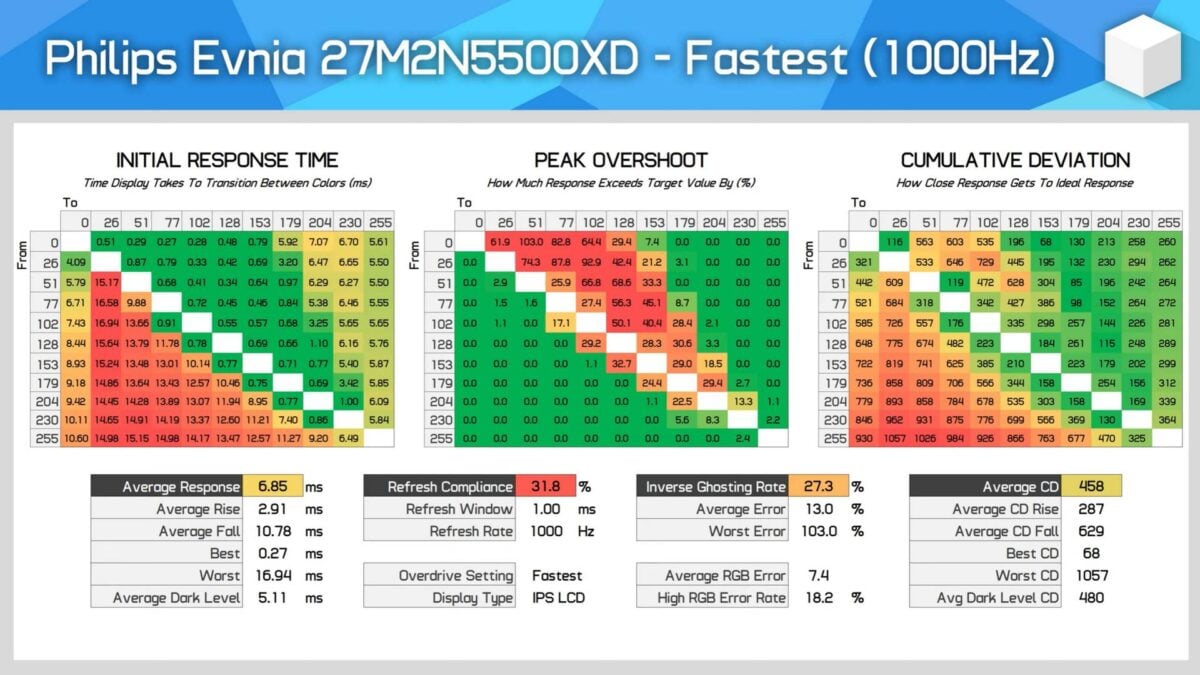
To measure this optimal pixel response time, Monitors Unboxed uses the refresh rate compliance metric, which is a way of measuring how well a monitor’s pixel response times keep up with its refresh rate. For example, a 500Hz monitor draws a new frame every 2ms, so to achieve perfect motion clarity, most pixel transitions should complete within that time. If these transitions take longer, pixels stop mid-task before the image clears, causing ghosting and smearing.
To calculate refresh rate compliance, you simply divide the number of measured transitions that complete within the refresh window by the total measured transitions and multiply that figure by 100, which gives you a percentage. This means that a 1,000Hz monitor needs pixels complete their transition in 1ms or less.
Now, while manufacturers often advertise 1ms response times for their IPS-based monitors, they often refer to the grey-to-grey pixel response time, which doesn’t show the whole performance picture. This means that when measuring the full black-to-black transitions, these monitors often fall short, exceeding 4ms, and sometimes even 10ms.
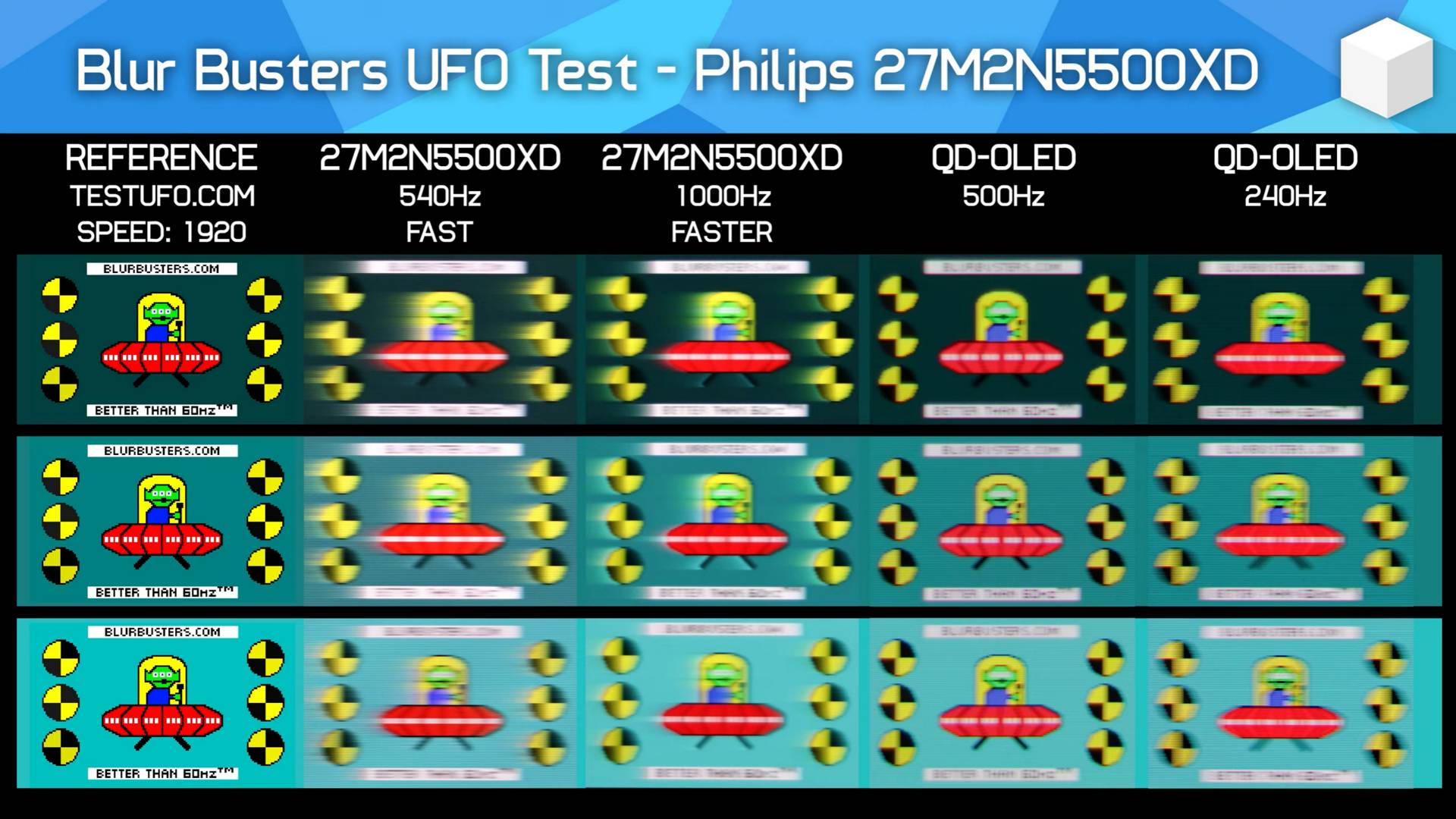
This is what Monitors Unboxed found with this 1,000Hz screen, as the average response time hit 6.85ms, which is way above the 1ms needed for full compliance. As a result, this monitor only reaches 31.8% refresh rate compliance, which is far from the +80% one would consider acceptable. These slow transitions are shown clearly using the Blur Busters UFO test, where this IPS panel struggles with fast-moving images, resulting in a blurry mess. Even 360Hz IPS panels and 240Hz QD-OLED screens offer a clearer image.
All this indicates that the specific panel here simply isn’t fast enough to cope with a 1,000Hz refresh rate. Unless a new IPS technology evolution comes to shake things up, it seems that OLED screens may offer the only way to achieve a true +1,000Hz experience.