DLSS 4.5 just launched at CES 2026, improving the upscaling quality of GeForce RTX GPUs everywhere from today. The suite will also make some tweaks to the Multi Frame Generation formula, but those changes are coming later down the line.
DLSS 4.5 Super Resolution
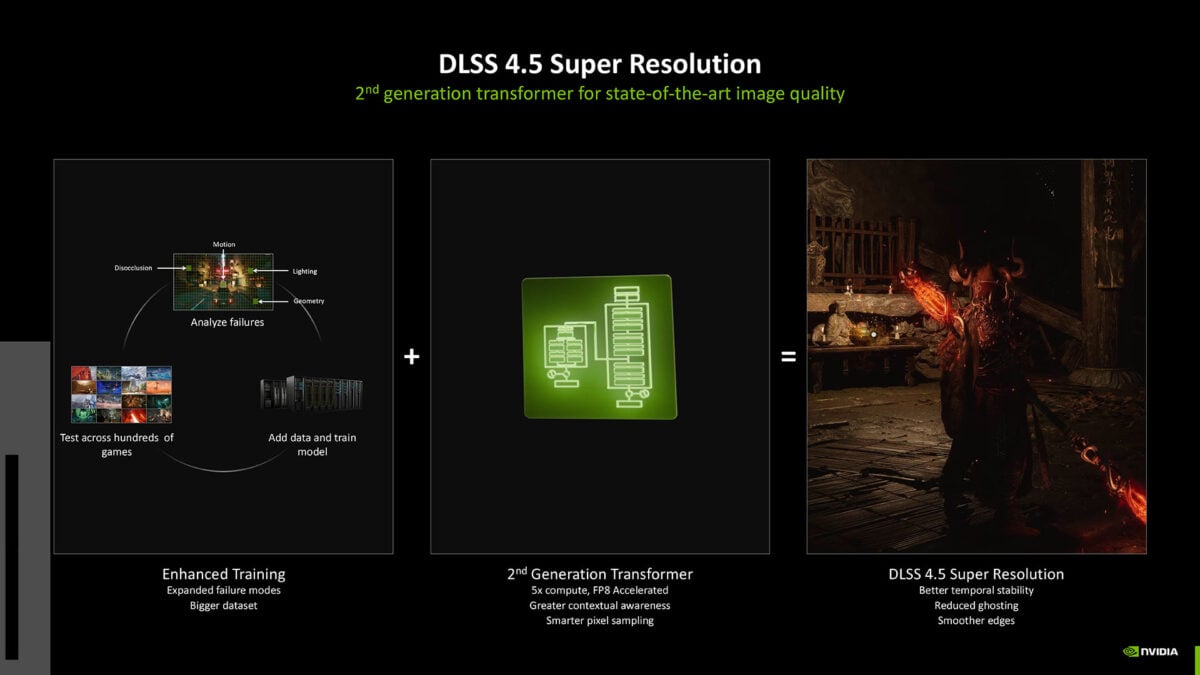
Building on the foundations laid down by its first-generation ‘Transformer’ upscaling model that debuted alongside the GeForce RTX 50 series, Nvidia has crafted an improved second-generation version. In short, this iteration boasts numerous under-the-hood improvements that should provide higher image fidelity than prior efforts.
This boost in image quality comes courtesy of a wider breadth of training materials. Nvidia tells us that the AI model has trained with a much larger dataset in tandem with expanded failure analysis, though the brand didn’t provide statistics to illustrate this increase in scope.
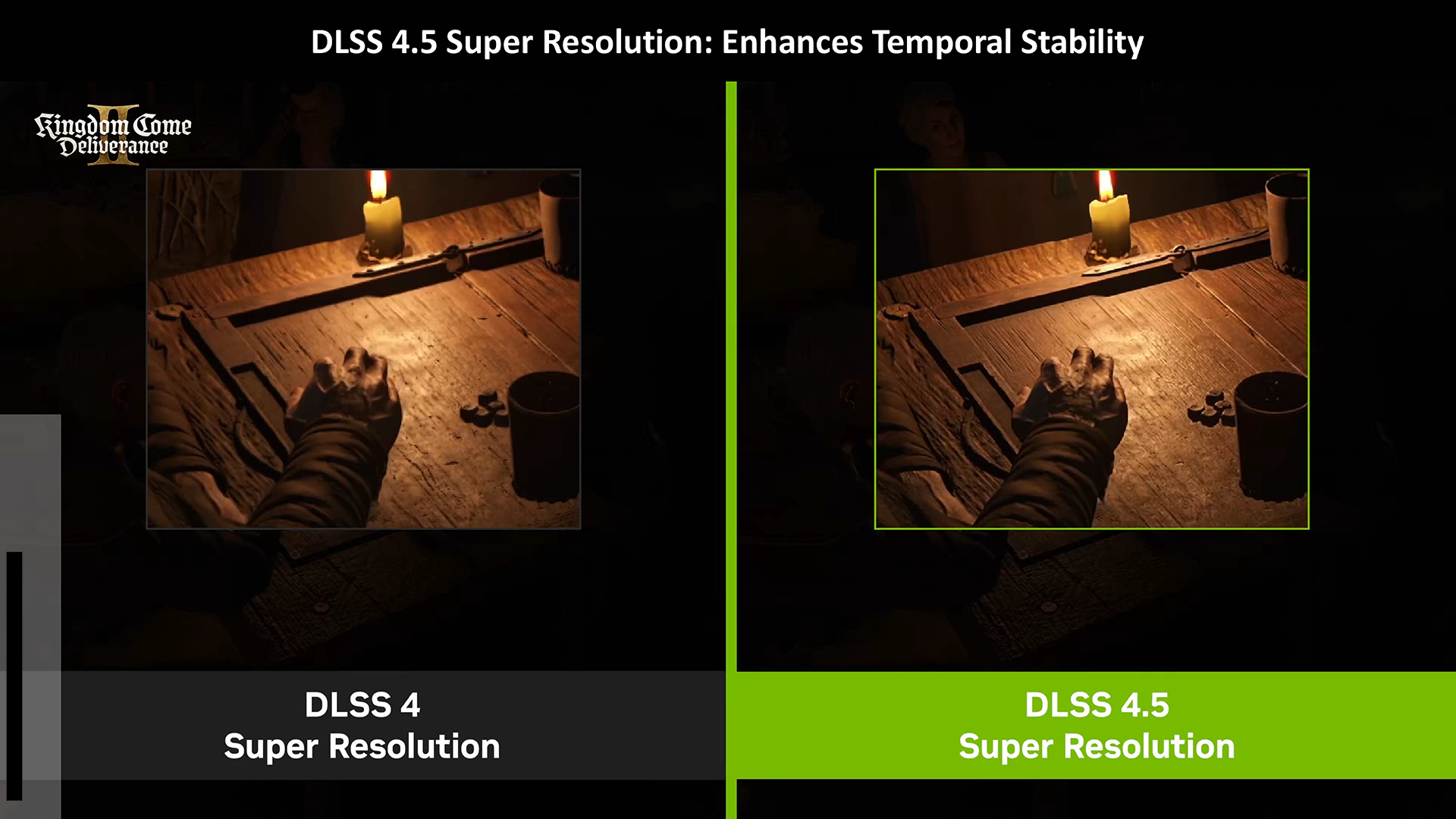
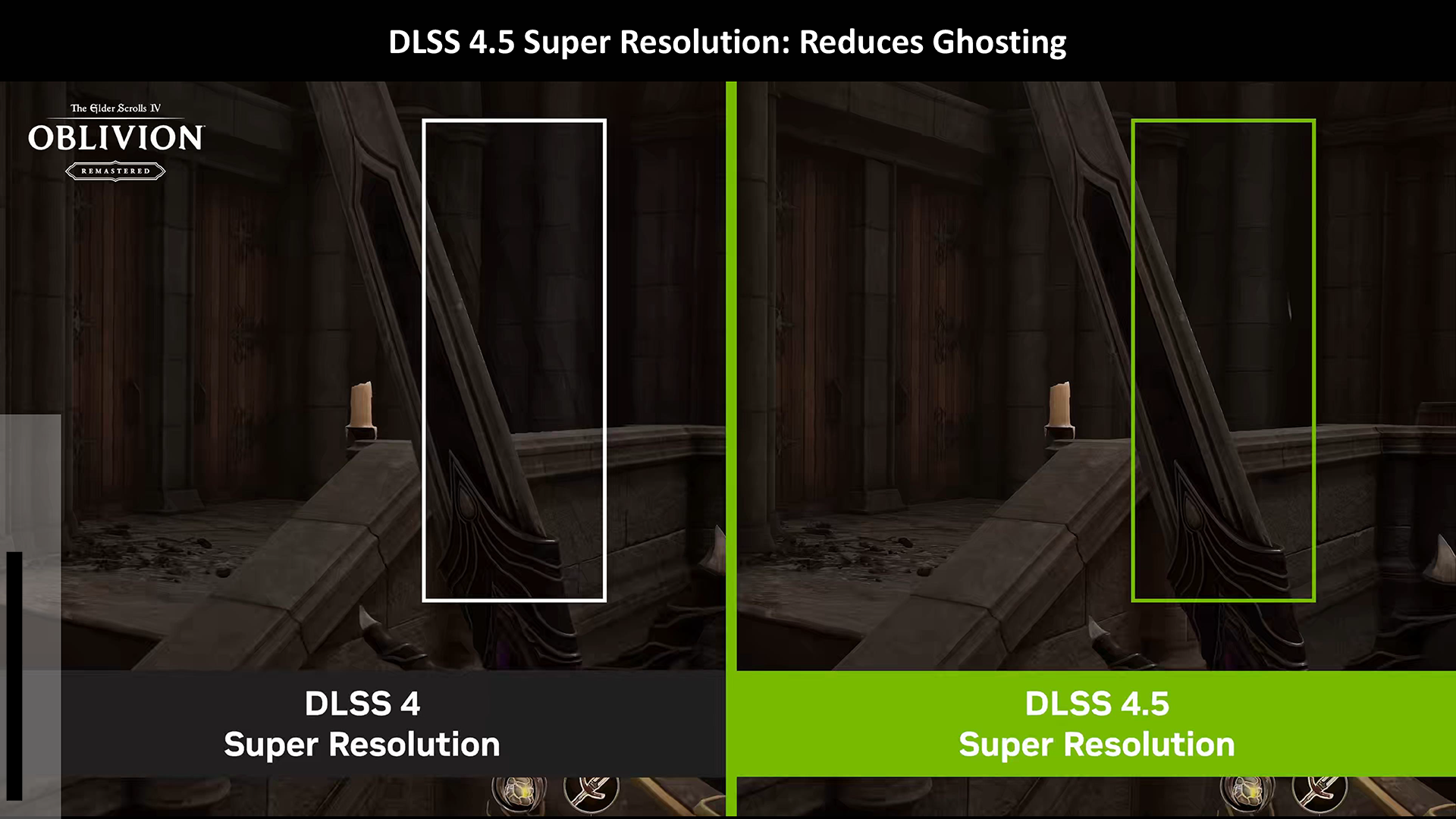
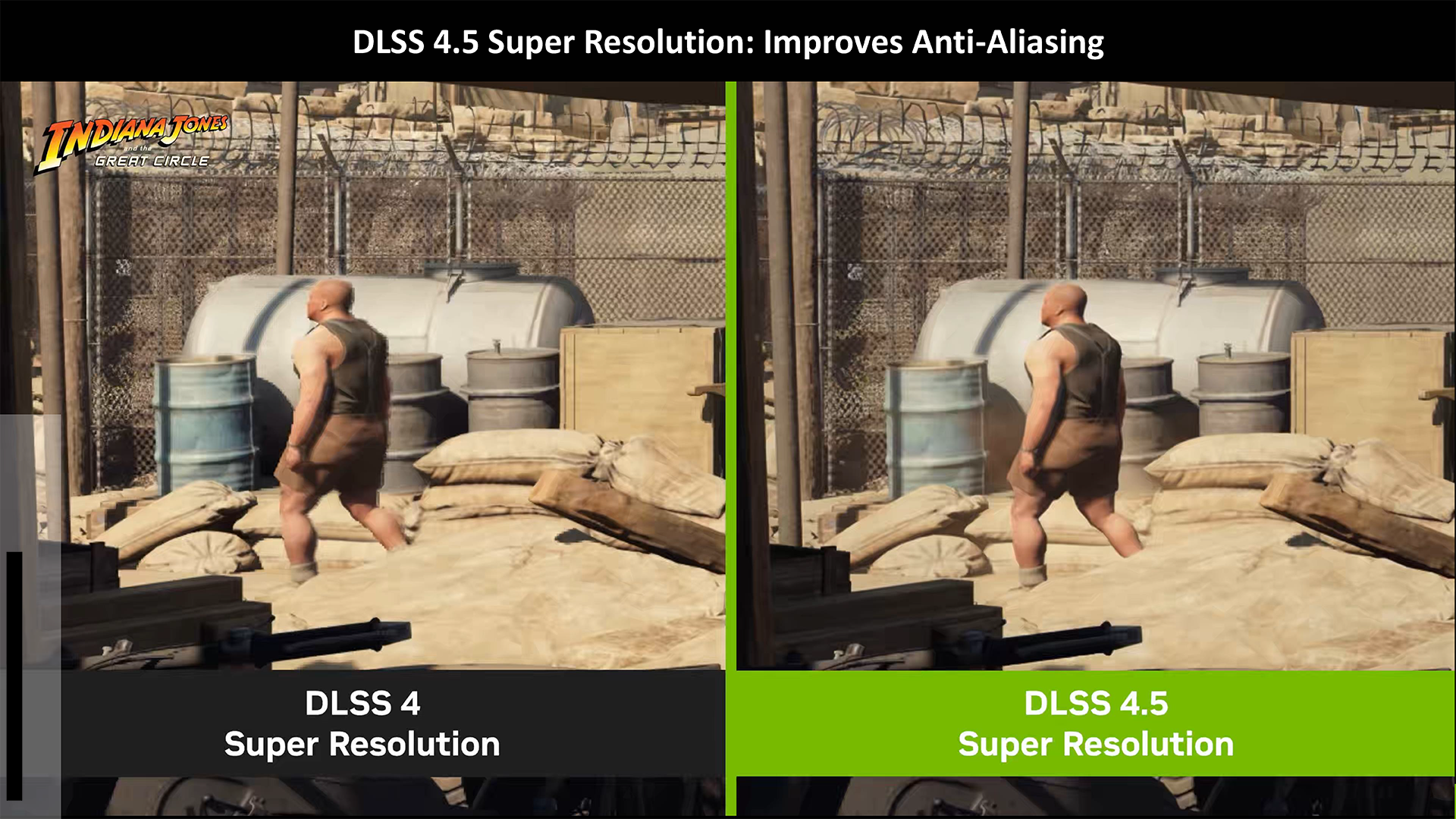
This more robust training regime provides DLSS 4.5 Super Resolution greater contextual awareness of game assets frame-to-frame, and can more smartly sample pixels for upscaling. In turn, you can expect better temporal stability, less ghosting, and improved anti-aliasing in real-world usage.
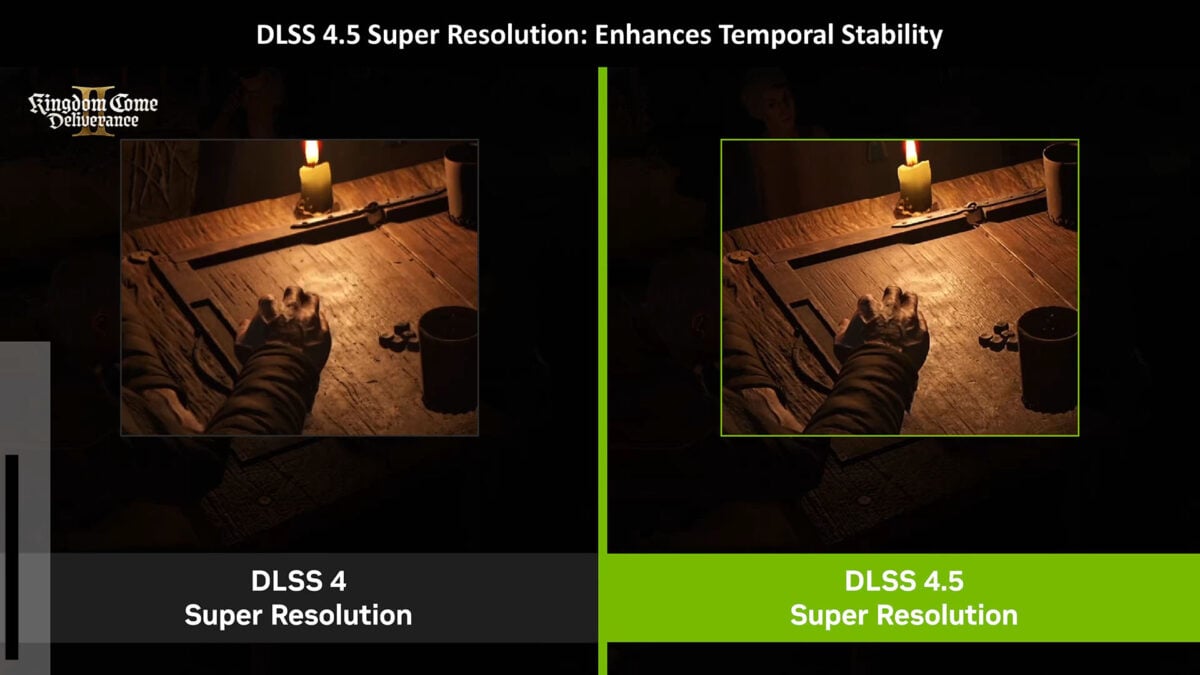
Nvidia has provided a few examples of DLSS 4.5 Super Resolution in action, highlighting the new version’s aforementioned improvements, complete with comparisons to DLSS 4. As you can see from the Kingdom Come: Deliverance II screenshots, the new model’s superior temporal stability nets a sharper image with greater retention of finer details like in the table’s woodgrain.
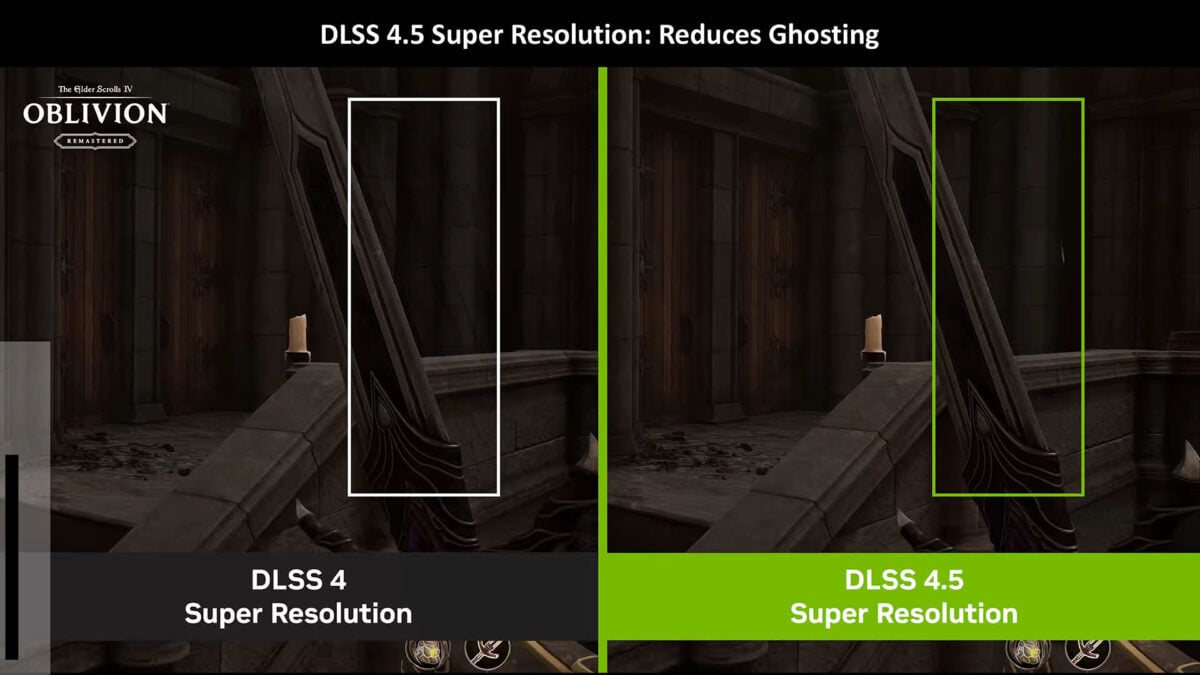
Next we have a side-by-side of The Elder Scrolls IV: Oblivion Remastered. In this scene, camera panning results in noticeable ghosting as DLSS 4 can’t adequately resolve the differences between the similarly-coloured sword and surrounding stonework. Meanwhile, DLSS 4.5 Super Resolution doesn’t exhibit this same problem, providing a much cleaner image in motion.
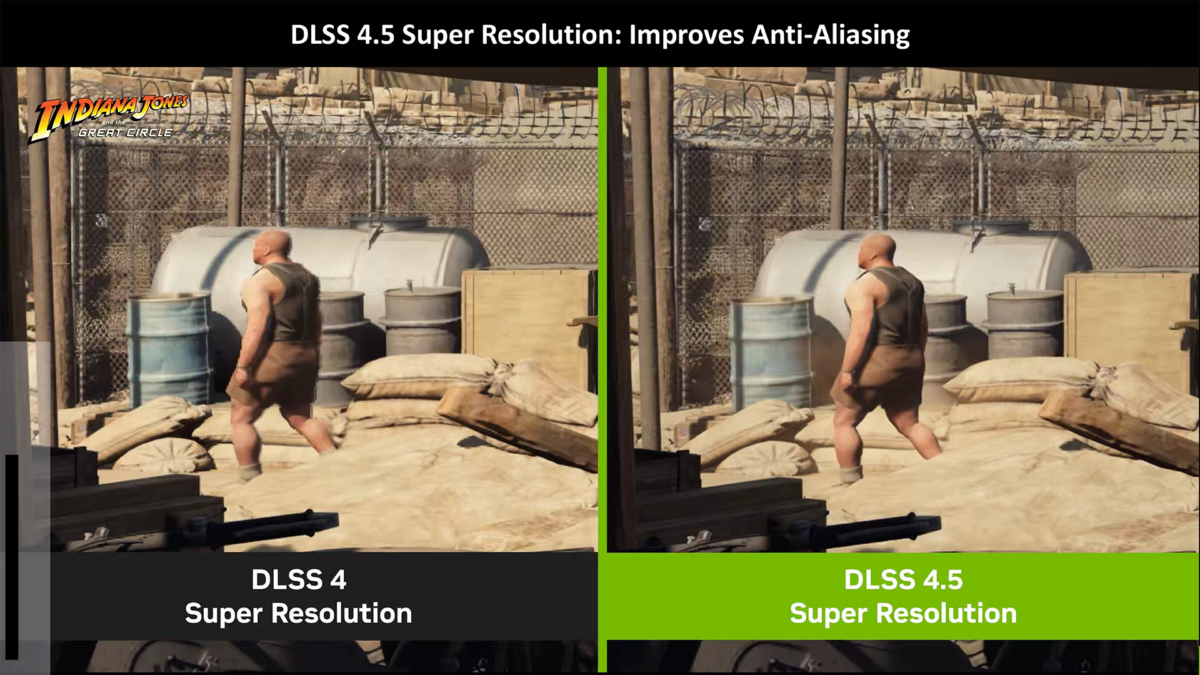
Finally, Indiana Jones and the Great Circle sees DLSS 4.5 Super Resolution offer appreciably better anti-aliasing. This is most noticeable along the edges of the NPC, as well as in the overall definition of the chain link fence. By contrast, DLSS 4 looks distractingly fuzzy.
Foundationally, DLSS 4.5 Super Resolution still uses FP8. This means GeForce RTX 50 and 40 series graphics cards will be able to run the second-generation Transformer model with the least overhead, thanks to their native hardware support for the instruction set. Older GPUs can still use the upscaler, but doing so will incur a higher performance cost relative to the older Convolutional Neural Network (CNN) model.
At the time of writing, there are no native implementations of Nvidia DLSS 4.5 Super Resolution, but you can still inject the new model into compatible games right now. All you’ll need is the latest versions of the Nvidia App as well as GeForce Game Ready driver and you can begin overriding to your heart’s content in 400+ games.
DLSS 4.5 Multi Frame Generation

Nvidia also plans to increase the amount of frames that Multi Frame Generation can generate from 4x to 6x. In theory, this would allow you to boost a 60fps source into a 360fps output but the usual caveats of latency and frame pacing still apply.
However, DLSS 4.5 Frame Generation should offer better performance on the latter front, netting smoother-feeling frame rates. That’s not forgetting the improved image quality that the feature will benefit from by working in tandem with the new Super Resolution model.
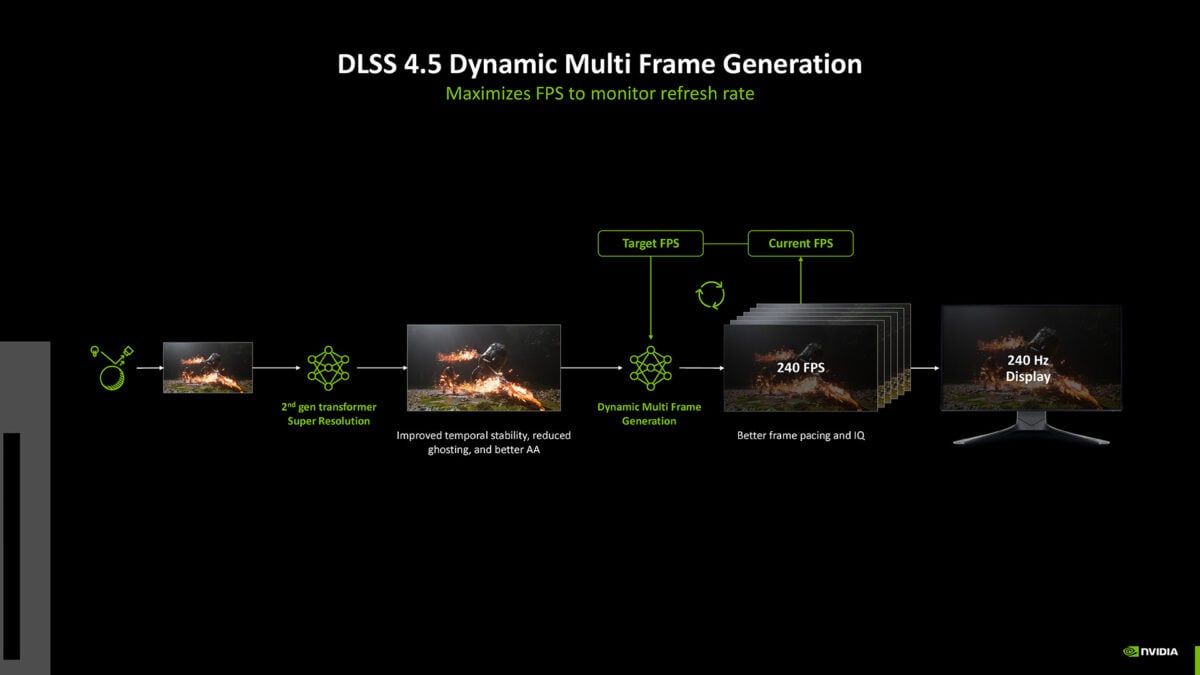
More excitingly, from my perspective, is the promise of ‘Dynamic Multi Frame Generation’. Instead of generating a set number of frames at all times, this mode will generate however many frames are necessary (up to 6x) to hit a target frame rate of your choosing.
This dynamic mode of operation for DLSS Multi Frame Generation feels like how the feature should have always been. I’m extremely curious to see it in action, but we’ll need to wait until Spring 2026 to try it out. Curiously, Nvidia didn’t provide any meaningful reasoning as to why it wasn’t launching the feature alongside DLSS 4.5 Super Resolution.
Conclusion
Through DLSS 4.5, Nvidia is further cementing the class-leading position of its software suite. That’s a win for the company’s brand perception but, more importantly, this is a tangible benefit that current and prospective GeForce RTX owners can immediately appreciate.
However, I’m curious to see how the company can similarly improve its DLSS Ray Reconstruction feature. That’s not forgetting Nvidia Reflex 2 either, which has been conspicuously absent since its announcement at CES 2025 with no update on availability.

The shadow of the long-rumoured GeForce RTX 50 Super series unavoidably hangs over Nvidia’s CES announcements, but their absence from these proceedings was entirely predictable considering the ongoing DRAM crisis. Perhaps Computex will bear fruit in this regard.
Outside of DLSS 4.5, Nvidia also announced G-Sync Pulsar. You can read all the details you need on that monitor tech by following the link.
For more CES 2026 announcements, make sure you’re following Club386 on Google News and have the site set up as a Google Preferred Source. Just click both buttons below and you’re golden.