
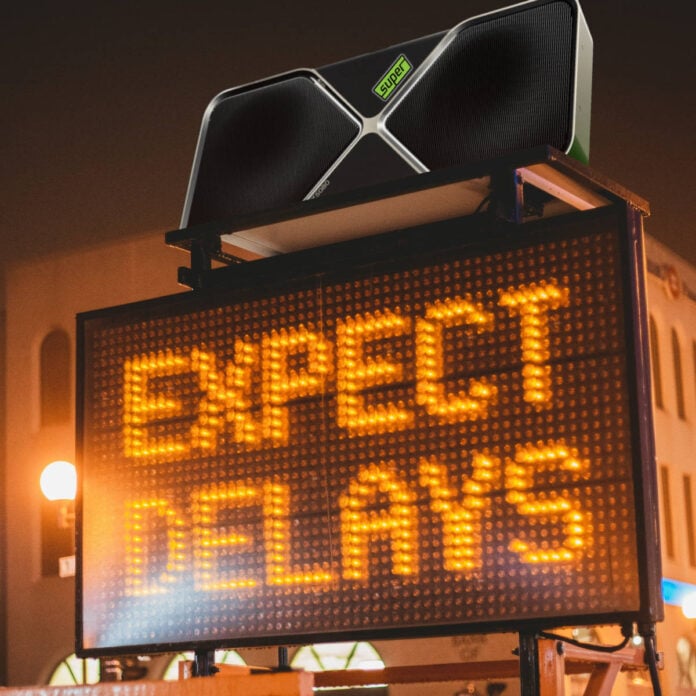
Nvidia has reportedly delayed its RTX 50 Super series due to memory shortages, causing a cascading effect that impacts next-gen RTX 60 GPUs. According to tech news site The Information, and shared on Reddit, Nvidia has postponed the launch of its Super series to prioritise its higher-margin AI accelerators.
Originally, the GeForce RTX 50 Super lineup was expected to offer more memory than current RTX 50 GPUs and appear during CES 2026, followed by a release sometime in Q2 2026. Unfortunately, due to an increase in demand for DRAM from AI datacentres, pushing up prices, it looks as though Nvidia has delayed the launch of the RTX 50 Series to an unknown date.
“The company this year had scheduled the release of an incremental update, code-named Kicker, to last year’s RTX 50 line of GPUs, and it had completed the new design,” says The Information after talking to two sources with “direct knowledge of the matter.” However, these plans were apparently scuppered by memory costs. “In December, Nvidia managers changed plans,” says the site, “telling employees and suppliers the company was delaying Kicker, without offering a new timeline. Nvidia managers said one reason was due to the global memory shortages, which have pushed up prices, and the need to prioritize memory production for the company’s AI chip business.”
As a reminder, the RTX 50 Super series was expected to use 3GB GDDR7 memory chips, as found on professional cards such as the RTX Pro 6000. This would enable Nvidia to add 50% more memory to its existing lineup without having to change the bus width, and swap the 2GB chips for 3GB models.
Furthermore, while Nvidia’s big H100 and H200 AI GPUs don’t use GDDR7, their HBM silicon shares the same manufacturing lines as other memory types. So, having the choice, both memory manufacturers and Nvidia seemingly prefer to focus on higher-margin server/datacentre products, instead of gaming GeForce cards.
| Rumoured specs | RTX 5070 Super | RTX 5070 Ti Super | RTX 5080 Super |
|---|---|---|---|
| CUDA cores | 6,400 (+256) | 8,960 (+0) | 10,752 (+0) |
| Mem. capacity | 18GB (+6GB) | 24GB (+8GB) | 24GB (+8GB) |
| Mem. clock | 28Gb/s (+0Gb/s) | 28Gb/s (+0Gb/s) | 32Gb/s (+2Gb/s) |
| Board power | 275W (+25W) | 350W (+50W) | 415W (+55W) |
Unsurprisingly, this delay is also reportedly having an impact on Nvidia’s next-gen RTX 60 Series release. Codenamed Rubin, these GPUs were previously expected to enter mass production in late 2027, likely followed by an announcement/launch in January 2028 at CES. However, according to The Information, this is no longer the case.
“The delay will also push back the release of Nvidia’s next-generation gaming GPU,” says the site. “Likely called the RTX 60 series, it was originally scheduled to begin mass production at the end of 2027, according to one of the people.”
This reported delay could be a reflection of Nvidia’s inability to secure enough memory capacity from major manufacturers (Samsung, Micron, and SK Hynix), forcing it to postpone its plans. Regardless of the reason, it looks as though gamers will be waiting for longer this time before seeing new hardware, extending the RTX 50 Series lifespan by another year or more.
For a long time, Nvidia generally released new GPUs on a yearly basis, until GeForce 10 (2016), when its two-year cadence was introduced. Now, it seems even that strategy is no longer cutting it, as we enter a new era of slow progress.