
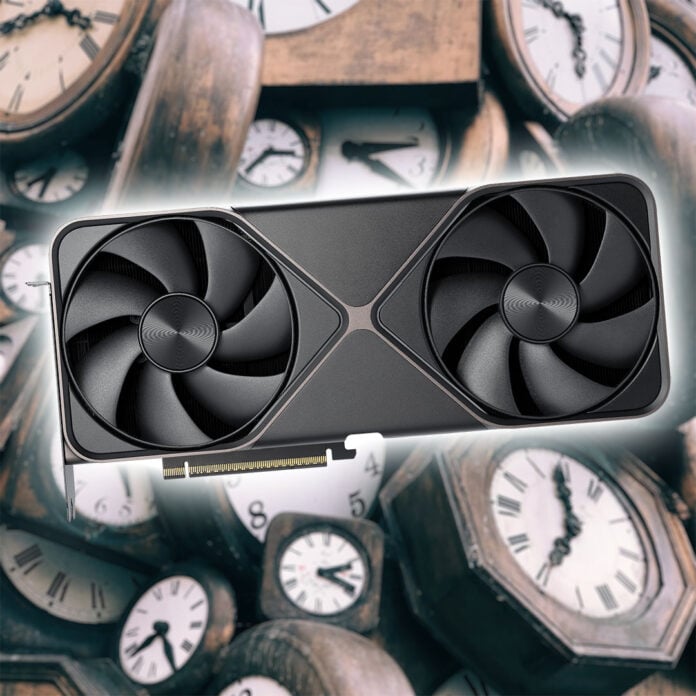
Nvidia has unveiled its Rubin architecture at CES 2026, prompting rumourmongers to share when we should expect the GeForce RTX 60 series. Unfortunately, you’ll likely want to exercise a great deal of patience before you enjoy these particular GPU spoils.
According to storied Nvidia leaker kopite7kimi, we shouldn’t expect the GeForce RTX 60 series before 2H 2027. This would mean the earliest launch date for the cards would be June 1, 2027, making for a wait of at least 853 days.
That’s another 11 days on top of the 842 that accounted the wait between the GeForce RTX 4090 and RTX 5090. That period of time was already longer than usual, with the prior two generations taking 729-756 days to arrive. It even beats the 847 day wait between the GeForce GTX 10 series and the advent of RTX.
| Timeline | Duration | Start/End dates |
|---|---|---|
| RTX 50 to 60 | ≥853 days* | 30/01/25 – 2H 2027* |
| RTX 40 to 50 | 842 days | 12/10/22 – 30/01/25 |
| RTX 30 to 40 | 756 days | 17/09/20 – 12/10/22 |
| RTX 20 to 30 | 729 days | 20/09/18 – 17/09/20 |
| GTX 10 to 20 | 847 days | 27/05/16 – 20/09/18 |
A June 01, 2027 release date could coincide nicely with Computex of that year. However, I believe we’ll sooner see the GeForce RTX 60 series materialise closer to Q4 2027 given Nvidia’s prior three launches and other market factors.
First, there’s the ongoing memory crisis. This situation directly affects the cost of manufacturing of current and upcoming consumer graphics cards, as all require VRAM. In the wake of growing chip costs, reports claim that Nvidia will produce 40% fewer GeForce GPUs in 2026, likely focussing on more profitable enterprise offerings foremostly and having knock-on effects for future products.
Many, including myself, believe that this is at least in part as to why there’s been no GeForce RTX 50 Super series launch at CES 2026. It’s unclear whether market conditions have completely killed the refresh, or merely delayed it. Should Nvidia still intend to bring them to market, then it makes sense to provide the improved SKUs sufficient breathing room to sell before announcing true successors.
There’s also market share to consider. Analysts claim that Nvidia controls around 90% of the graphics card market, with AMD and Intel commanding 8% and 1%, respectively. While this generation has seen genuine rivalry between the companies, there’s no denying that Team Green can afford to wait and release on its own terms. Its hold on the space is just that strong, as are its enterprise profits.
2027H2
— kopite7kimi (@kopite7kimi) January 7, 2026
Regardless of when the GeForce RTX 60 series arrives, these cards may not deliver the generational gains of yore. Ask Jensen Huang, as we did at CES, and the future is less about raw computational power and more on deep-learning prowess. That GeForce RTX 6090 will undoubtedly be a rendering monster, but we may need to adjust our bars of measurement.
In the meantime, GeForce RTX owners of all generations can reap the benefits of DLSS 4.5 and its superior upscaling performance. There’s also DLSS Adaptive Frame Generation, along with a bump to 6x mode, which GeForce RTX 50 series can look forward to. For all the details on the suite, check out my write-up here.
CES 2026 is still going strong, and we’re reporting live from the show floor. Follow Club386 on Google News for all the latest developments, and consider adding the site to your Google Preferred Sources too so that you don’t miss a thing. Click both buttons below and you’re all good.