
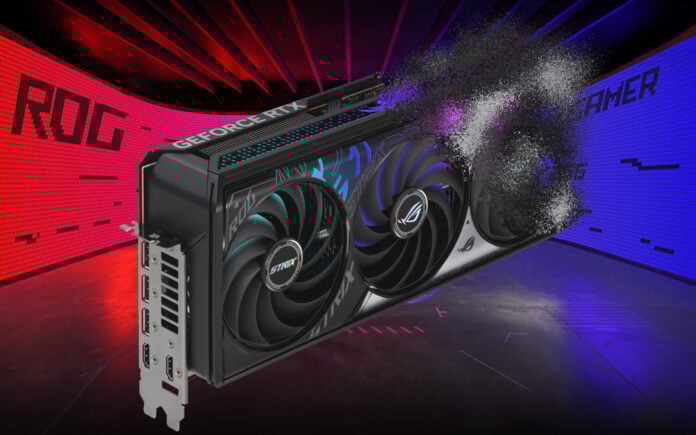
Update (16/01/26): Asus has reached out to Hardware Unboxed to clarify both its, and by extension Nvidia’s, position relating to the status of GeForce RTX 5070 Ti and RTX 5060 Ti 16GB. The cards are neither discontinued, nor described as end-of-life (EOL), and sales will of both will continue for the foreseeable.
Fluctuations in supply, caused by memory shortages are apparently temporarily affecting production and restocks across retailers. This will lead to reduced availability of the cards, but Asus is attempting to “stabilise supply as conditions improve.”
So, while the GeForce RTX 5070 Ti and RTX 5060 Ti 16GB haven’t official gone to the great graphics card garden in the sky, don’t expect to see many of them populating store shelves any time soon. There’s a fine line between EOL and rare, and it’s difficult not to describe both SKUs as treading that line.
The original report, as written, follows below.
Original (15/01/26): Nvidia mid-range 16GB GPUs are quietly being retired in favour of cheaper-to-produce 8GB models, according to a new report. As the GPU market enters a turbulent phase with pricing spiralling upwards, Nvidia is seemingly killing off models that require more VRAM.
Asus explicitly told tech YouTube channel Hardware Unboxed that the RTX 5070 Ti is currently facing a shortage, forcing Asus to place this model in end-of-life (EOL) status. As a result, Asus will shift production capacity to other GPUs, so there won’t be any restocks when in-store inventories of RTX 5070 Ti are consumed.
But that’s not all, this situation extends beyond the 5070 Ti as the RTX 5060 Ti 16GB is also reportedly being placed into EOL status, with Asus indicating that no further production is planned. This means that Nvidia’s most affordable 16GB cards could effectively disappear from the market. While Nvidia hasn’t publicly announced EOL status for these GPUs, a lack of supply will quickly make the situation clear. And besides, EOL or not, if there is no stock, the official status doesn’t mean anything.
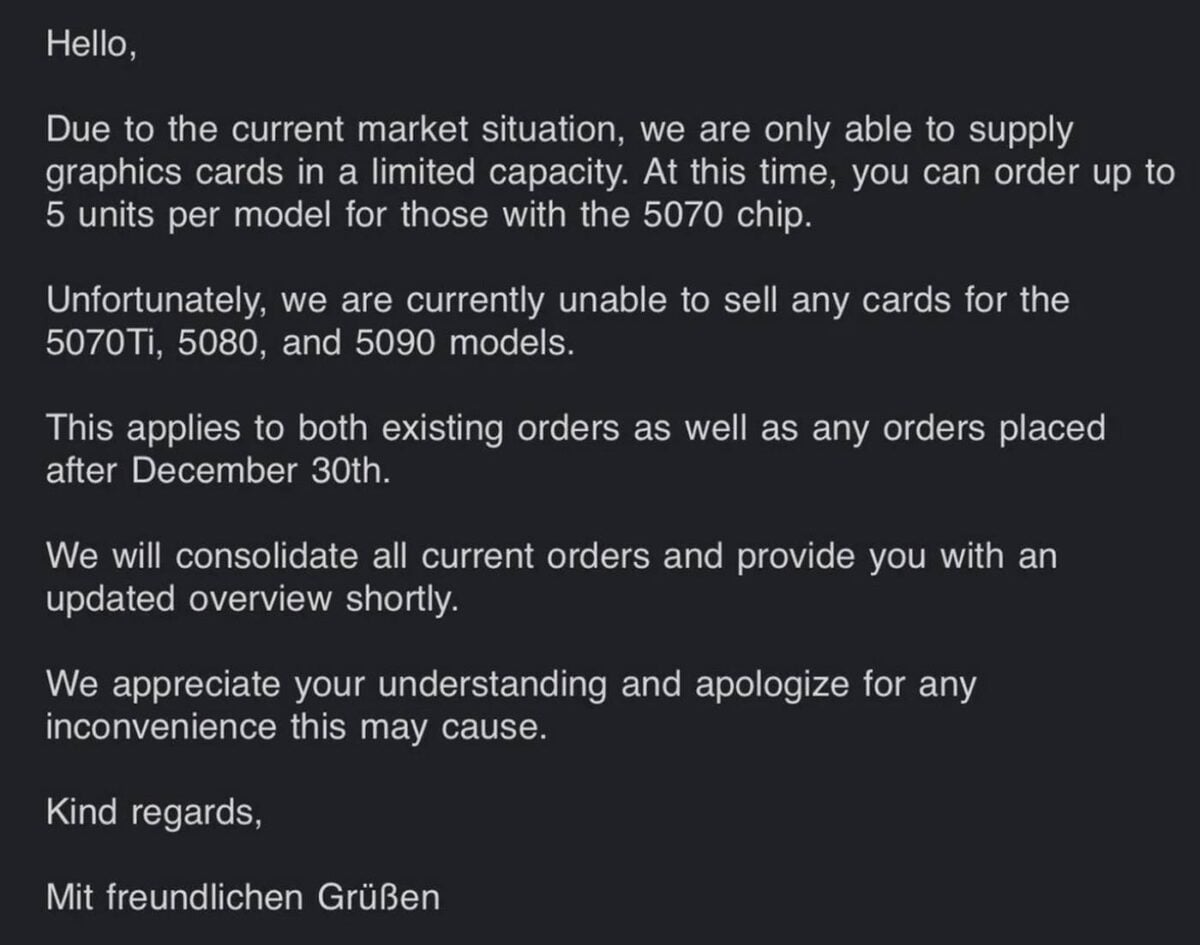
This is the first time a graphics card partner has directly confirmed the card’s discontinuation, validating earlier reports from Board Channels. This also explains a recent communication shared by a European retailer (shown below), and shared on Reddit, in which a supplier indicates its inability to source high-VRAM GPU models.
At present, the only GeForce models available in meaningful quantities seem to be 8GB models, particularly the RTX 5060 and RTX 5060 Ti 8GB, which are said to be receiving priority GPU allocation. As for the RTX 5070, which has 12GB of VRAM, supply is getting scarce and prices are rising.
As we mentioned before, the driving force behind these decisions is the rising prices of memory products, such as the GDDR7 chips needed by most of Nvidia’s RTX 50 series cards. Both the RTX 5070 Ti and RTX 5060 Ti 16GB require twice as many memory chips as the 8GB models, making them less economically viable. This also explains the uncertain status of the rumoured RTX 50 Super series, which were expected to feature even higher memory capacities.
With a good chunk of Nvidia’s mid-range GPU offerings out of action, AMD would have a golden opportunity to capture some market share with its 16GB RDNA 4 offerings. Unlike the RTX 50 Series, Radeon 9000 cards use GDDR6 memory, which seems to be less vulnerable to VRAM price shocks. That said, even AMD GPUs have been seeing price increases lately.
If 16GB graphics card prices continue their hike to the top, many users will have no choice but to settle for models with less VRAM. That’s a troubling prospect considering how modern games have started pushing beyond the 8GB frame buffer limit. The situation also raises concerns about the longevity of these cards, which may become obsolete much sooner rather than later.