
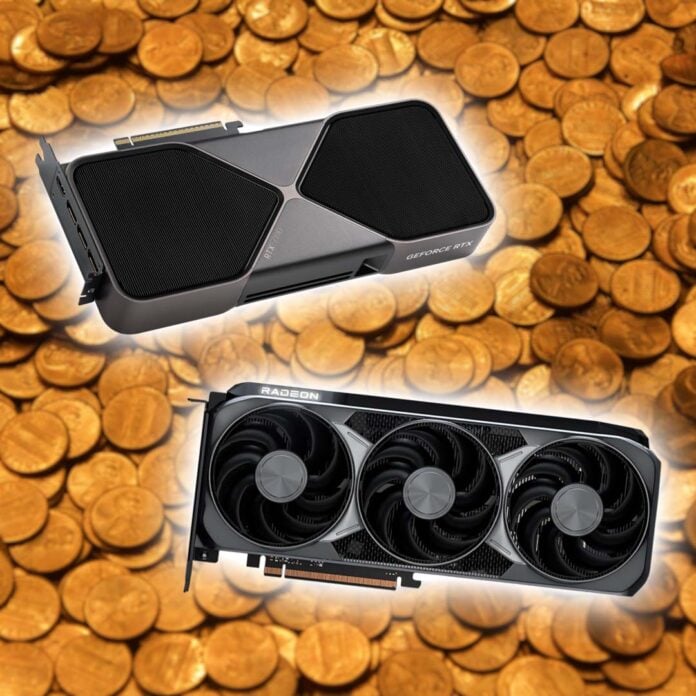
Taiwanese graphics card manufacturers are allegedly facing higher costs for GPU and VRAM bundles from both AMD and Nvidia, as the two GPU makers contend with the ongoing memory crisis. While the specifics of these cost increases are unknown, insiders expect graphics card to rise within a few weeks as a result.
According to tech site Benchlife, Nvidia notified add-in-board (AIB) partners of its intent to raise the cost for memory packages on January 16, 2026. This affects the GDDR7 modules broadly used across Nvidia’s GeForce RTX 50 series, from the GeForce RTX 5060 upwards, as well as the GDDR6 chips found in the GeForce RTX 5050.
Curiously, Nvidia is apparently managing to maintain lower memory package pricing than AMD, despite the latter’s best efforts to keep GPU prices close to MSRP. This is despite Radeon RX 9000 series cards using older, less expensive GDDR6 VRAM. This is perhaps indicative of Nvidia’s superior buying power in economies of scale, but that’s just a best guess in a supply chain with countless factors to consider.
Despite apparently raising the cost of their GPU and VRAM bundles, reports claim that neither AMD nor Nvidia are raising the official MSRPs of their products. While this sounds good in theory, it’s a token gesture in practice. AIB partners can still raise the prices of their cards to distributors, who will in turn increase their own prices to consumers, resulting in more expensive graphics cards on store shelves.
As profit margins squeeze under these pressures, GPU models with less financial headroom suffer the most. We’ve already seen claims that AMD is deprioritising Radeon RX 9070 production, while Nvidia’s GeForce RTX 5070 Ti is increasingly hard to find at MSRP.
Reporting from Commercial Times suggests that MSI has already increased the price of its GeForce RTX 50 series stock, but both Asus and Gigabyte will follow suit in the near-future. The outlet also states that the higher cost to distributors ranges between 10-15%, but we’ll need to wait at least a few weeks to see whether this will mirror retail pricing.
As the memory crisis shows no sign of ending anytime soon, I don’t expect the price of any consumer hardware to do anything but trend upward. Outside of memory-dependent parts, these market circumstances are also creating problems for CPU cooler and PSU prices. That’s not forgetting a reportedly massive drop in motherboard sales, which may see more DDR4 boards flood the market.
With all this in mind, if you’re considering an upgrade, my advice is to pull that purchase trigger as soon as you can. Just don’t forget that there are still plenty of great DDR4 CPU upgrades out there, if you’re rocking an older system and would prefer to weather the storm.
For the latest on the memory crisis, make sure you’ve got Club386 as a Google Preferred Source. You can also follow the site on Google News. If you haven’t done so already, just click the buttons below.