

Running at its stock TDP, AMD’s Ryzen 7 9850X3D is as impressive as gaming processors come, but what happens if you trim back its power budget? This question hasn’t left my mind since I reviewed AMD’s new champion, with my preliminary findings suggesting the chip would become far more efficient after this simple tweak, and with minimal performance loss.
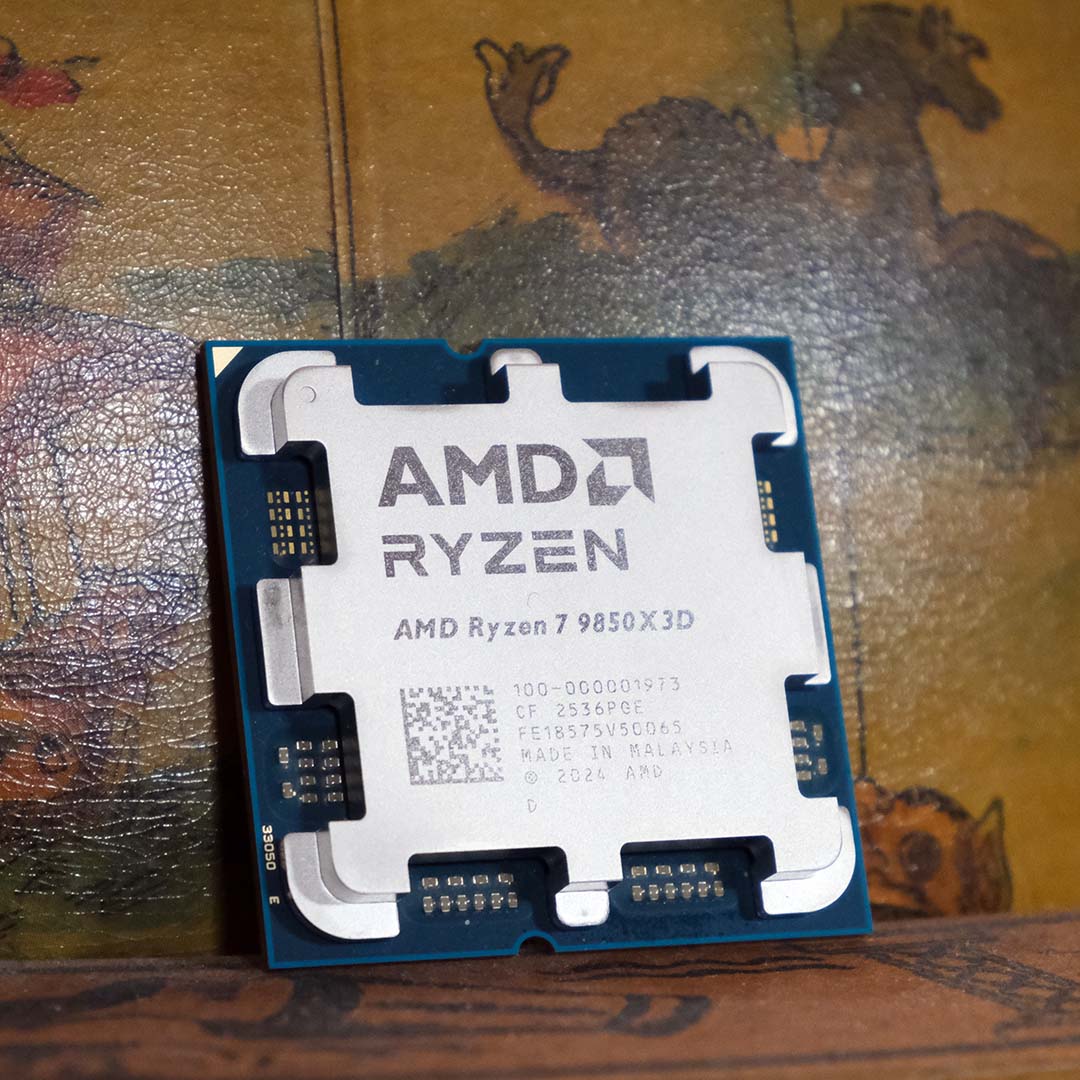
Acting on this curiosity, I’ve benchmarked an AMD Ryzen 7 9850X3D at 65W via AMD Ryzen Master’s Eco Mode. That’s a massive 46% reduction from the CPU’s default 120W TDP. However, the scale of impact from this reduced power budget isn’t nearly as large, particularly in terms of single-core performance.
Apart from this difference in TDP, I tested the processor using the same hardware and software versions you’ll see in my Ryzen 7 9850X3D review. In short, we’re calling on the services of the Club386 test bench, albeit with graphics card duties falling to a GeForce RTX 5090 Founders Edition, so the chip has maximum headroom to show off its capabilities.
Apps
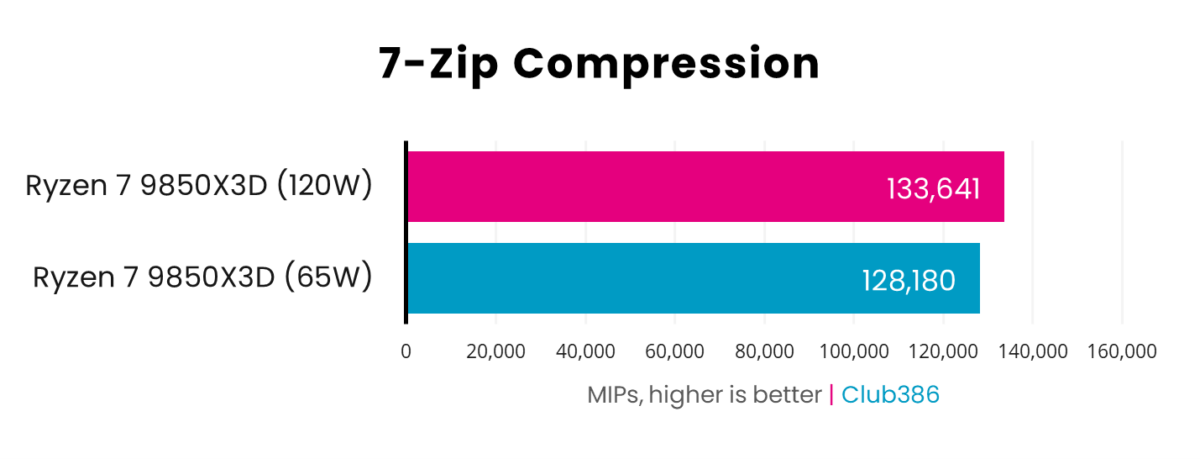
Right off the bat, 7-Zip Compression demonstrates the Ryzen 7 9850X3D still runs really fast, even with far less power at its disposal. Starting with 133,641 million instructions per second (MIPS) at 120W, dropping to 65W only sees output drop by 4.08% to 128,180MIPS. I’ll be noting performance differences with two decimal points henceforth, as some of the differences moving forward are just that small.
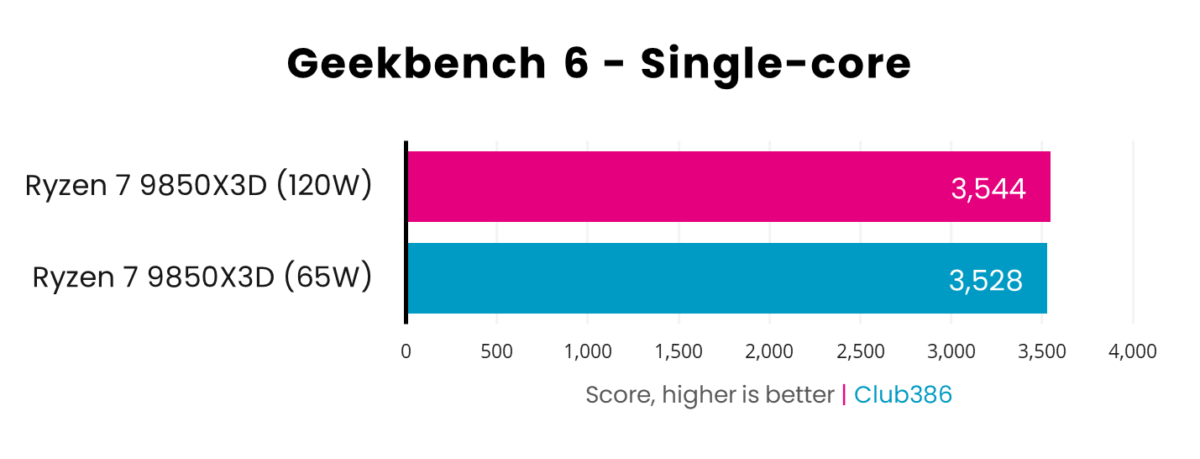
Yup, there’s just 16 points separating the two TDPs in Geekbench’s Single-core benchmark. Going from 120W to 65W only decreases performance by 0.45%, practically in margin-of-error territory. Single-threaded performance is the most important metric for the Ryzen 7 9850X3D’s gaming performance, so take this result as a pseudo foretelling of frame rate differences to come.
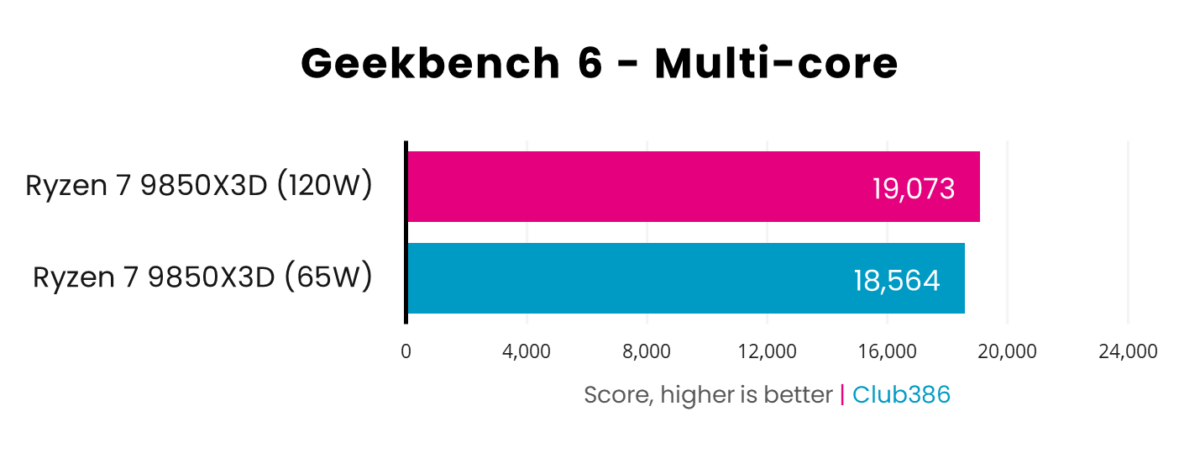
Multi-core scores in Geekbench 6 take a bigger dip at 65W. Relative to its 120W score, the Ryzen 7 9850X3D is down 2.67%. While more substantial, that’s still a minor dip considering the 46% reduction in TDP.
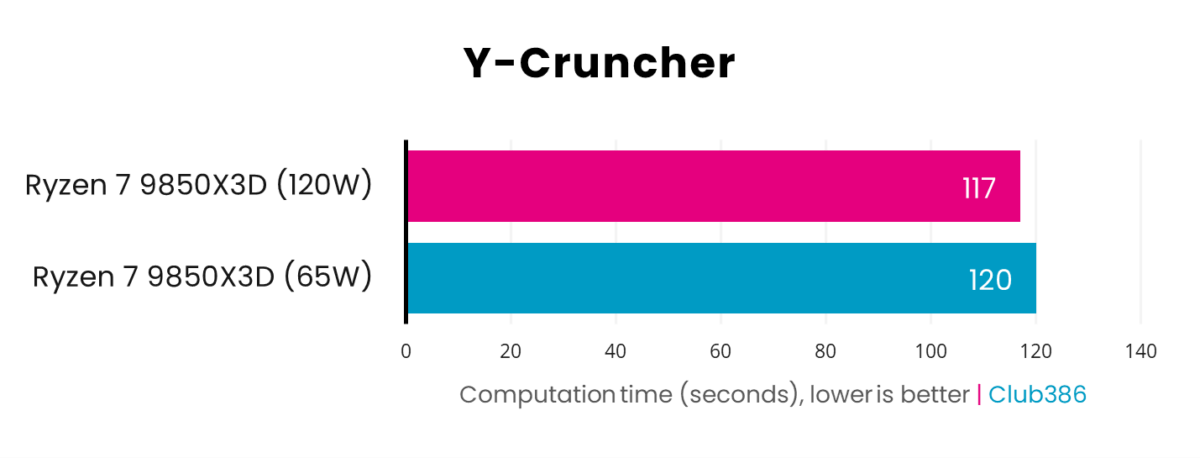
With less power available, computing Pi to 5b digits takes the Ryzen 7 9850X3D an additional three seconds. I wish my mathematics skills held up as well when my energy levels were similarly low.
Content creation
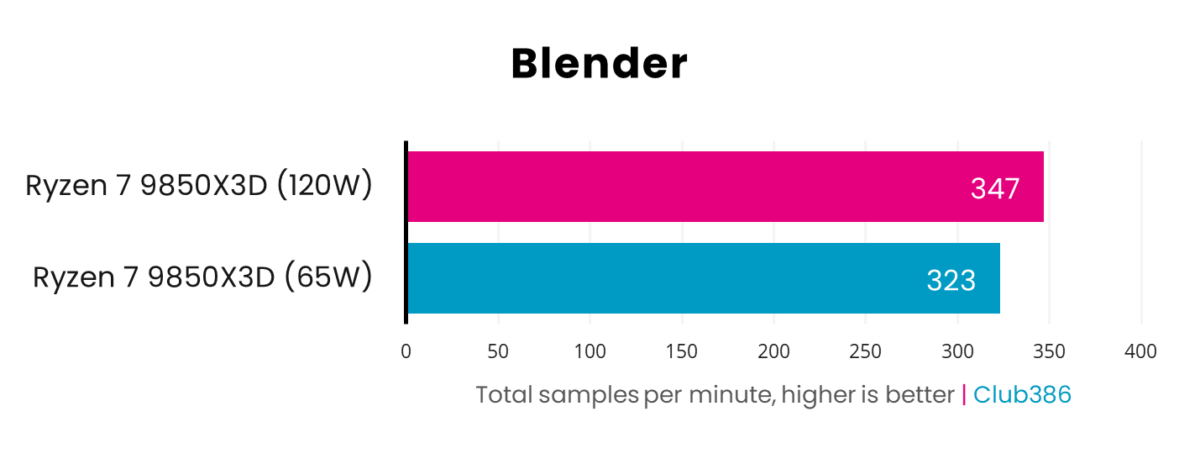
Blender sees the Ryzen 7 9850X3D take one of its biggest tumbles at 65W, as total samples per minute fall by 6.92%. That’s no surprise considering this is a multi-threaded application that pushes all this CPU’s cores hard, but it’s yet another reasonable reduction considering the power limit in play.
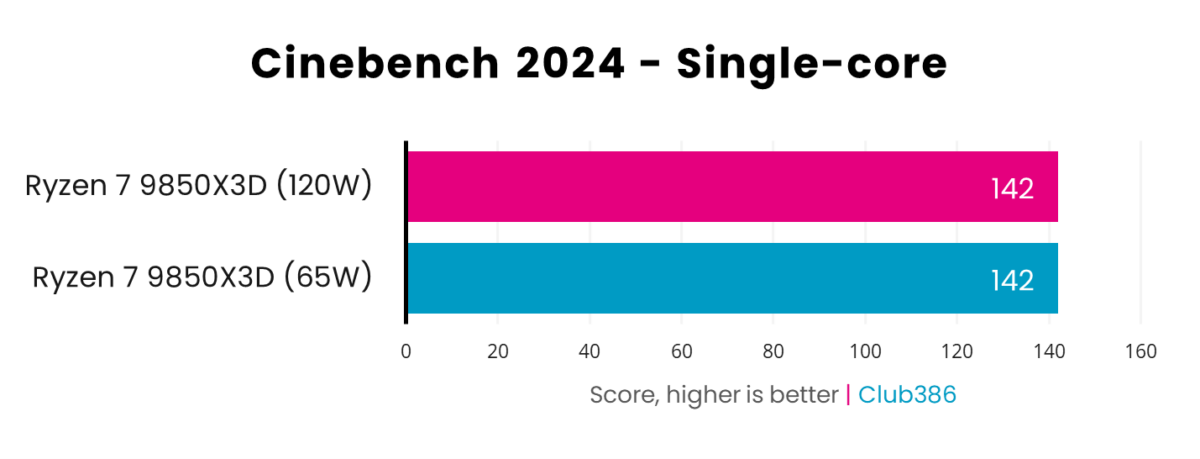
At 65W, the Ryzen 7 9850X3D doesn’t flinch during Cinebench 2024’s single-core benchmark, mirroring its 120W score of 142 points. As with Geekbench, reducing power has no bearing on the processor’s ability to boost all the way up to 5.6GHz on one core.
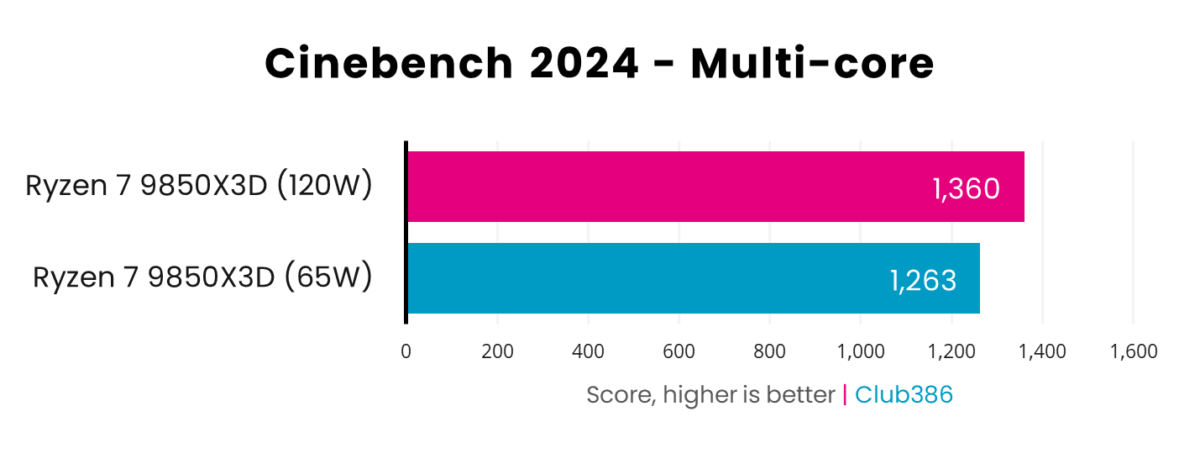
Another multi-core test sees another notable decrease in the Ryzen 7 9850X3D’s performance at 65W. I use the term notable to mean relatively speaking compared to single-core performance, as this drop is only a 7.13% fall in points from 1,360 to 1,263.
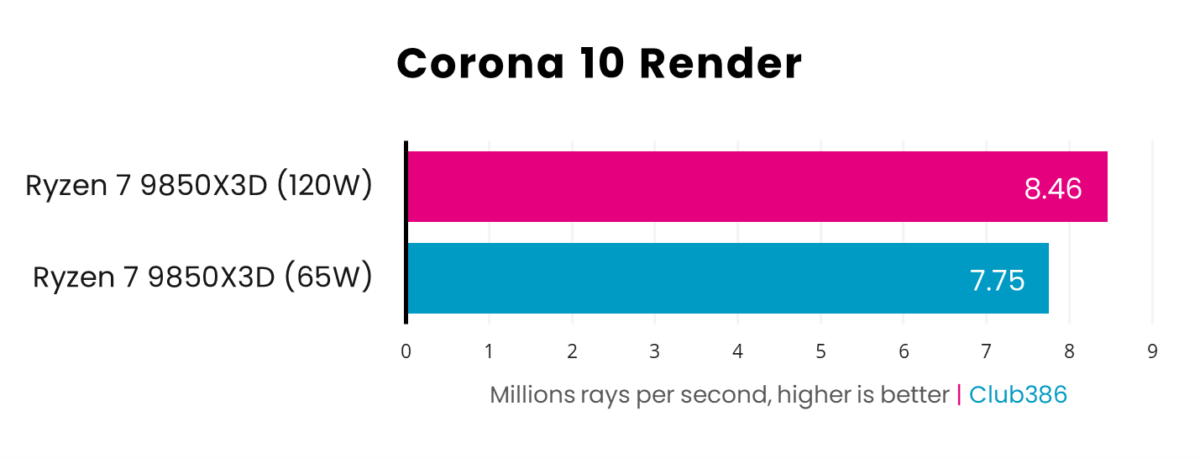
Corona 10 Render sees the largest decrease in performance across our entire testing suite, as the Ryzen 7 9850X3D ray rate falls by 8.39%. Without getting too ahead of myself, if this is the worst we can expect from swapping to 65W, then colour me excited.
Memory
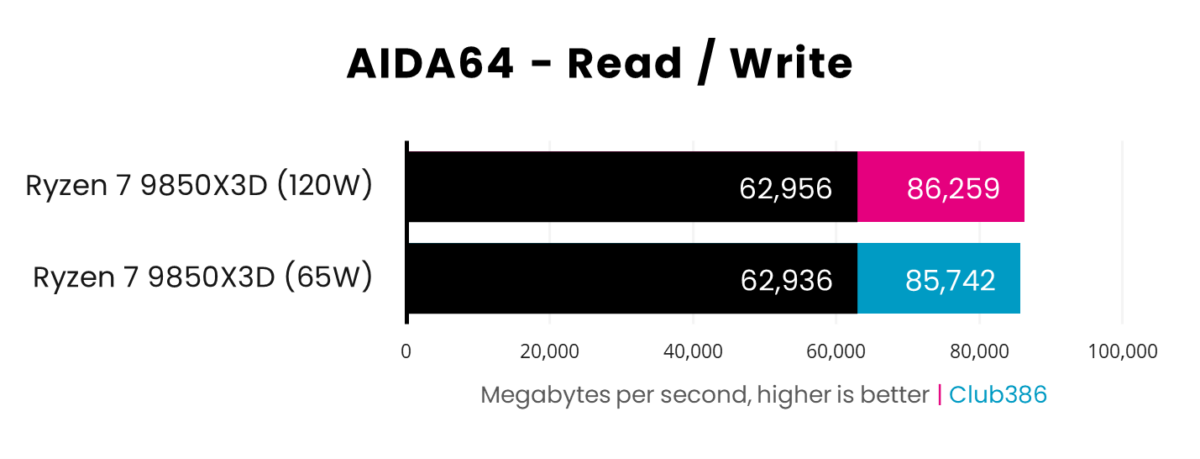
Power limits have a negligible bearing on the Ryzen 7 9850X3D’s memory bandwidth. Write throughput decreases by a mere 0.60%, while reads drop by a mere 0.03%.
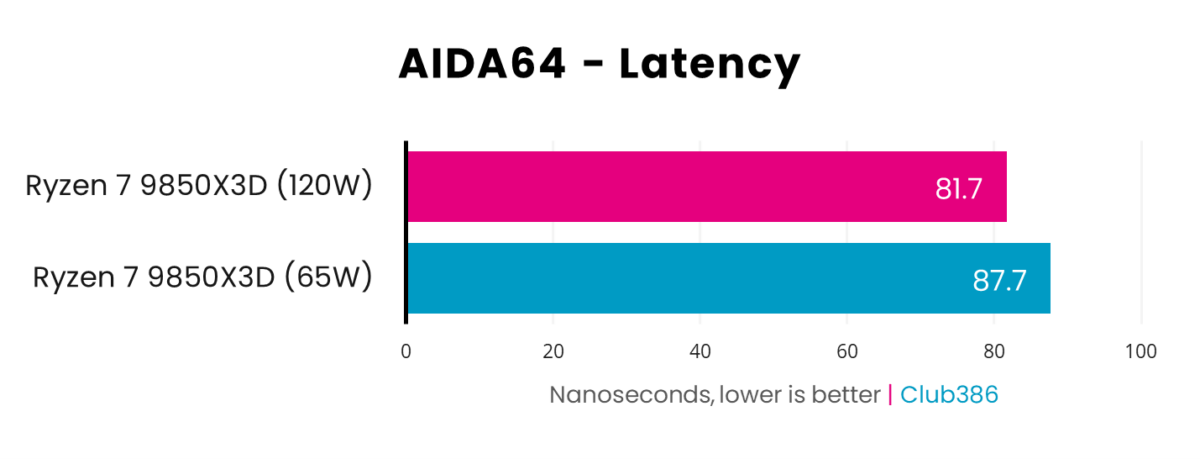
Conversely, latency suffers under the constraints of 65W. Reducing power leads to a 7.34% increase in responsiveness, but the Ryzen 7 9850X3D is still operating fairly speedily at 87.7ns in this case.
Gaming
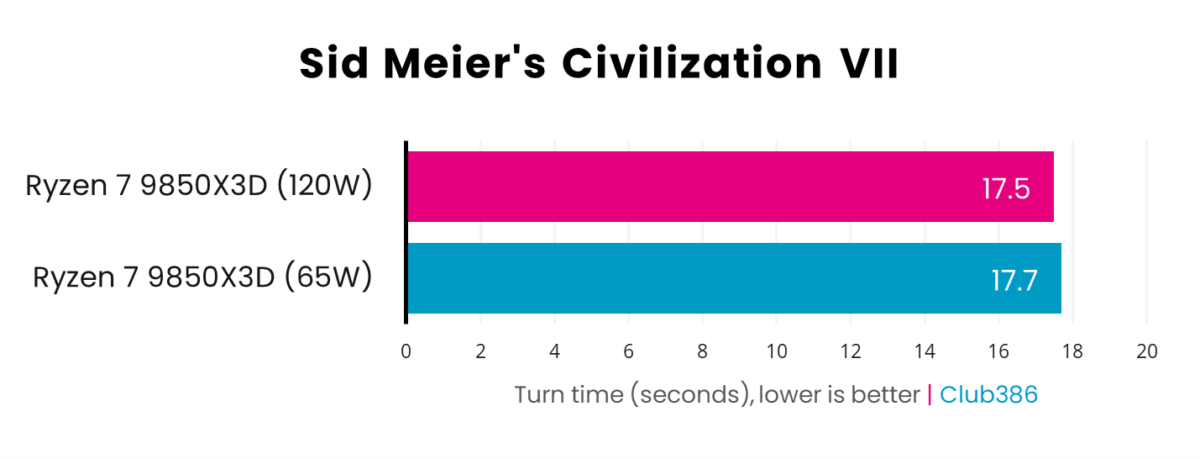
Computing the moves of allied and rival civilisations alike, the Ryzen 7 9850X3D remains stalwart in Sid Meier’s latest 4X game. With a 65W TDP, average turn times increase by 1.14%, or 200ms. That’s another 20 seconds per 100 turns, which I challenge anyone to notice.
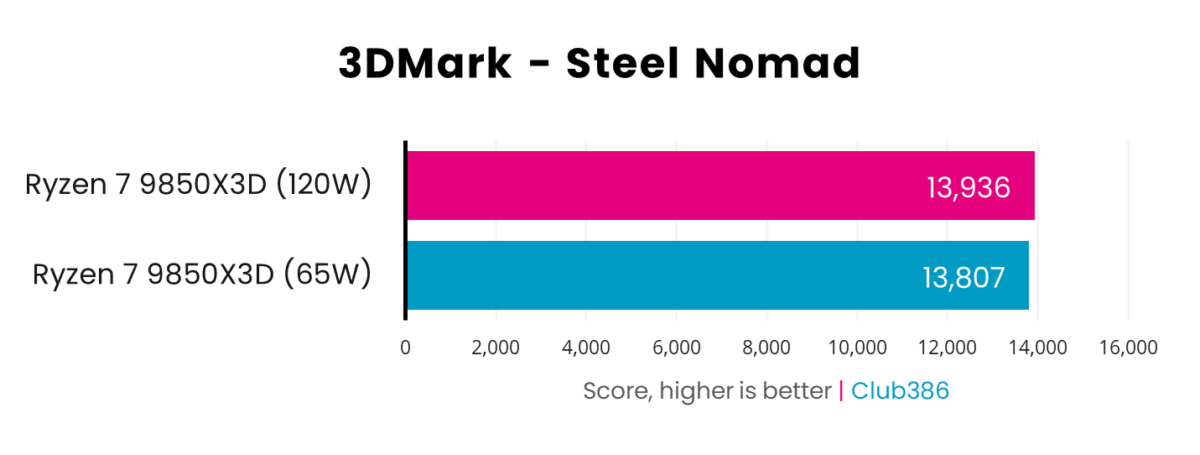
The 4K raster scene of 3DMark Steel Nomad creates a firm bottleneck on the graphics card, even when you’re using a GeForce RTX 5090. As such, the Ryzen 7 9850X3D’s 120W score of 13,936 points only falls to 13,807pts, a decrease of 0.93%, at 65W.
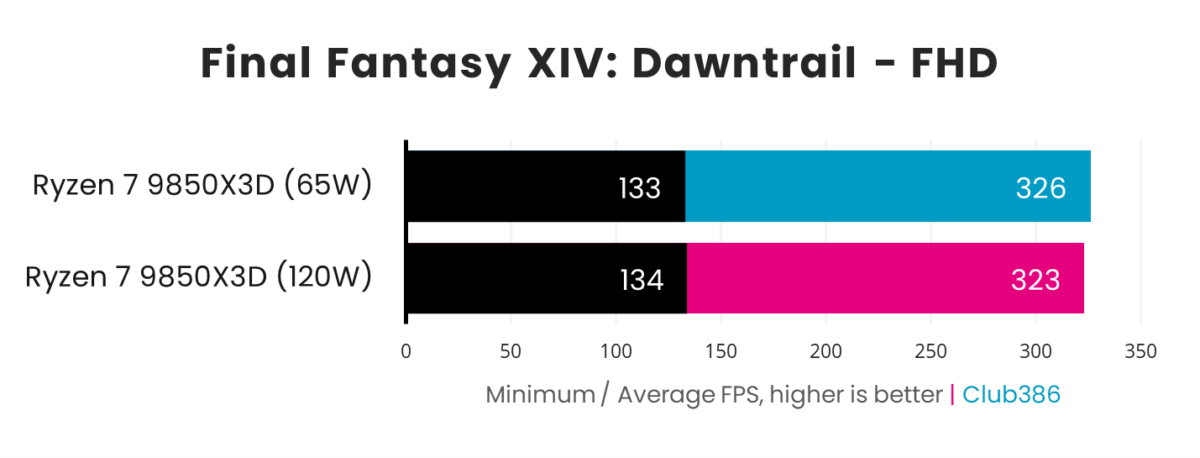
You can trim down the Ryzen 7 9850X3D TDP and not worry about it affecting your frame rate in Final Fantasy XIV: Dawntrail. More precisely, I saw average frame rates increase by 3fps (+0.93%), and minimums fall by 1fps (-0.75%). This isn’t an indication that the lower wattage improves performance, though, as we’re in margin-of-error territory when frame rates are this high – performance is basically the same.
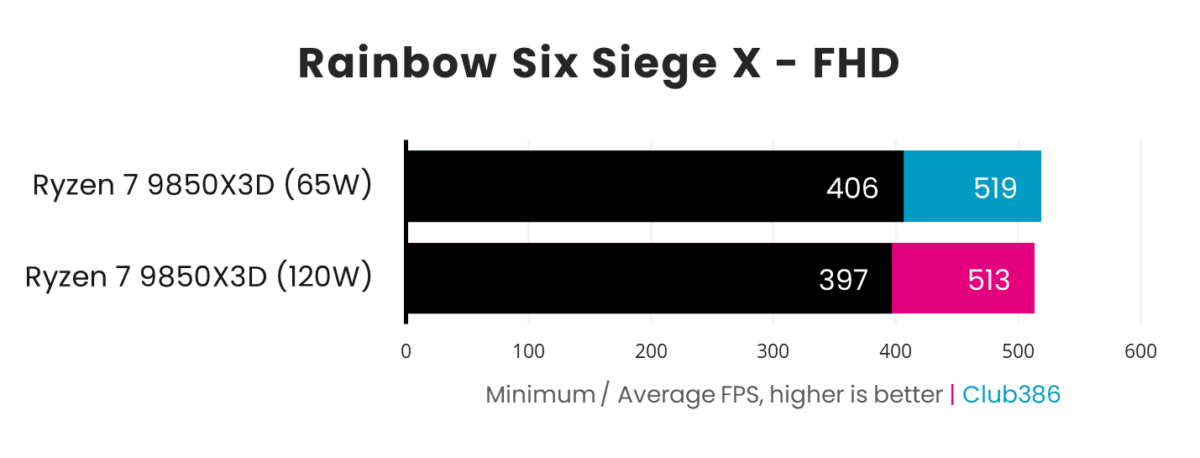
Running Rainbow Six Siege X at 65W provides a slight complication, as frame rates rise perplexingly rise by 2.27% / 1.17% at 65W compared to 120W. In terms of percentile improvements, we’re again in margin-of-error territory here – the performance difference is basically negligible.
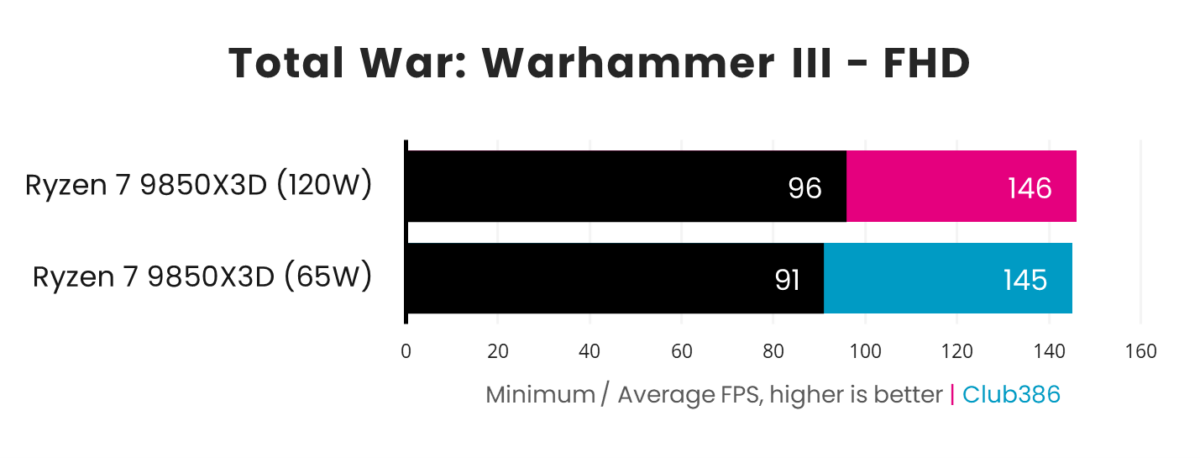
Total War: Warhammer III’s average frame rates only decline by a minute 0.68% at 65W, with minimums falling more substantially at 5.21%. That’s not a bad trade for reduced head and power draw in my eyes.
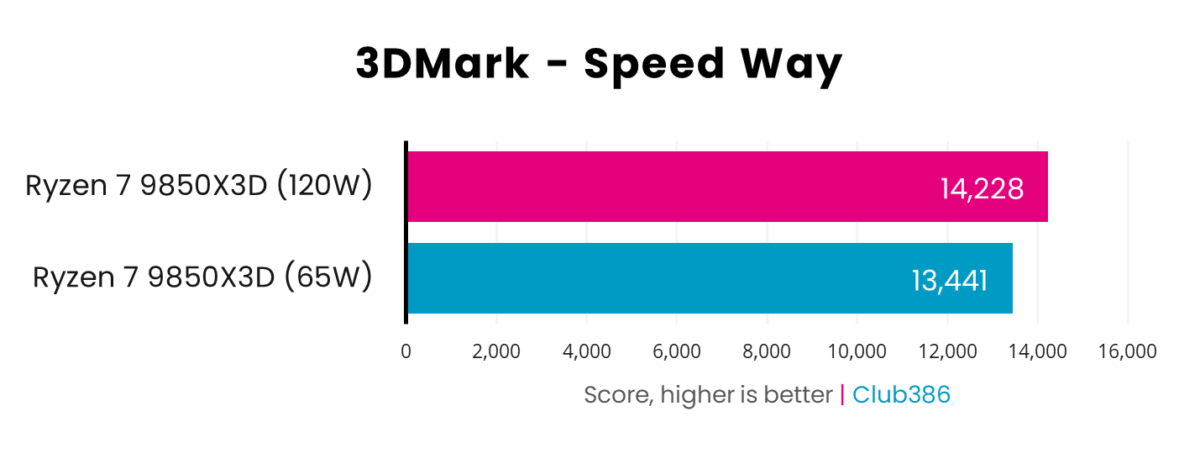
Ray tracing requires a solid amount of processing and graphical grunt, as the 3DMark Speed Way results indicate. We’re looking at a 5.53% decrease from swapping to 65W. However, this synthetic test is more illustrative of a worst-case scenario than the real-world impact on games.
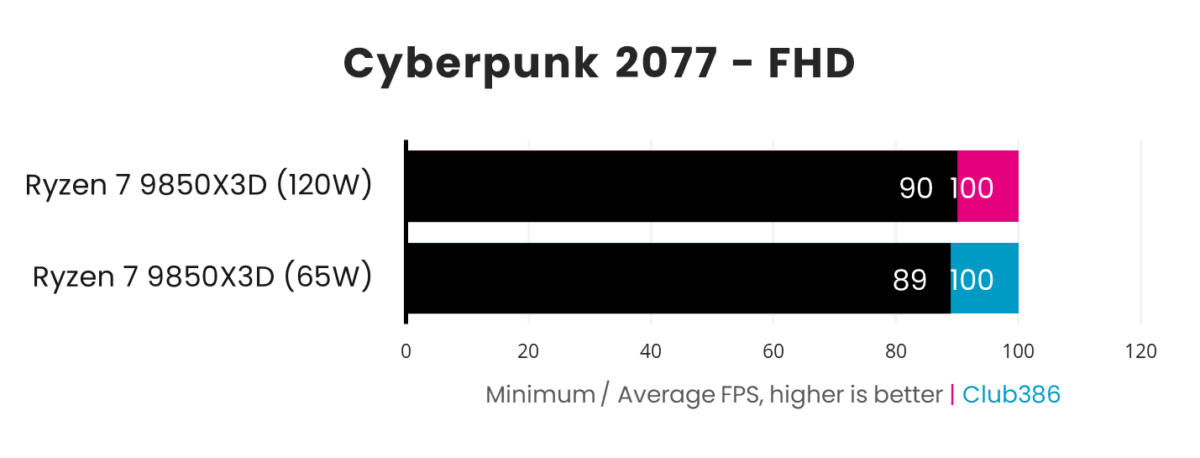
The beauty of path tracing places much more pressure on your GPU than the CPU, and few examples are as demanding as Cyberpunk 2077. As such, swapping to 65W on the Ryzen 7 9850X3D only comes at the cost of a single frame when running at 1920×1080 with the RT Overdrive selected.
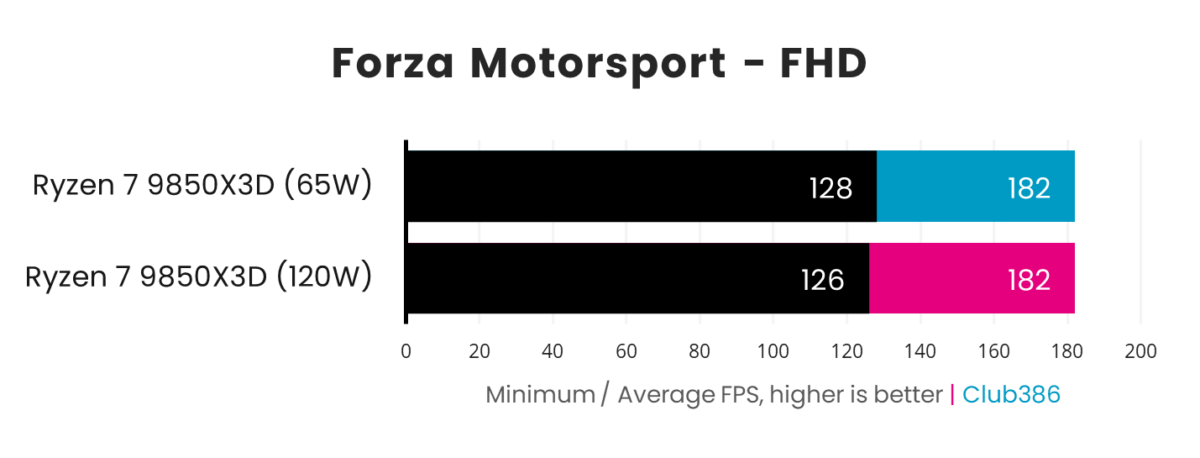
In our final race, Forza Motorsport sees 65W results mirror 120W in terms of average frame rates. Minimum FPS is up 1.59% on the lower wattage, but that’s well within the margin of error.
Vitals
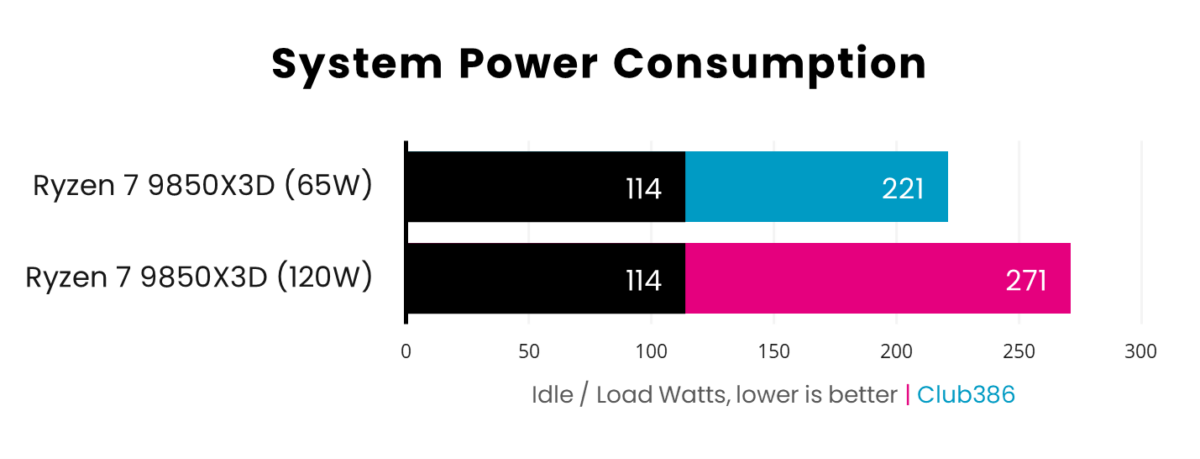
Trimming TDP back to 65W from 120W doesn’t net a 55W reduction in real-world power consumption, but it’s not far off. In a Cinebench 2024 all-core workload, the Ryzen 7 9850X3D sipped 50 fewer watts at the lower limit, making for an 18.45% reduction in peak wattage from the wall, with no change in idle rates.
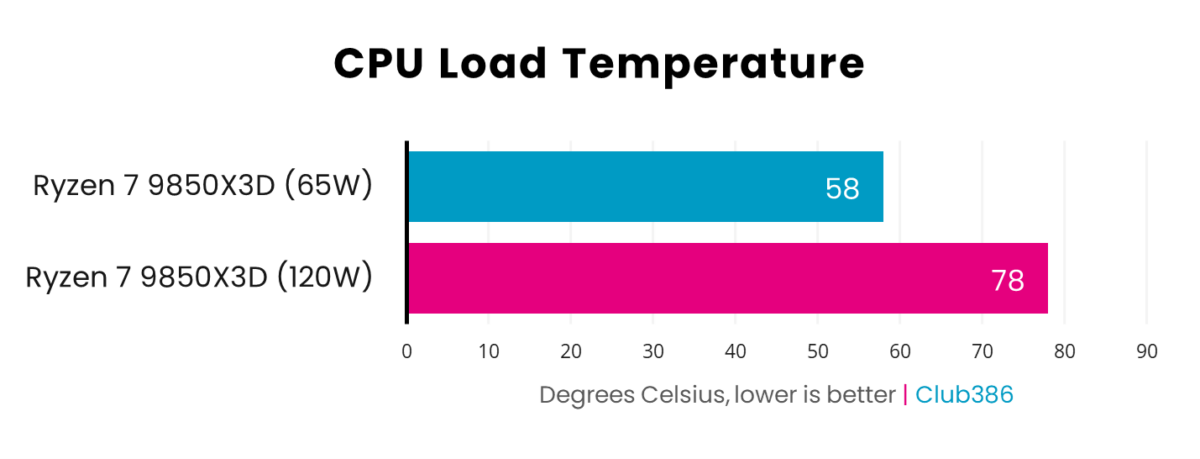
TDP stands for thermal design power, of course, and temperatures are where you see a big impact with this change. You shave a massive 30°C off the 9850X3D’s peak operating temperature by moving from 120W to 65W. That’s a welcome reduction of 25.64%, and will make the processor far easier to cool with a decent air cooler, or even in a small case.
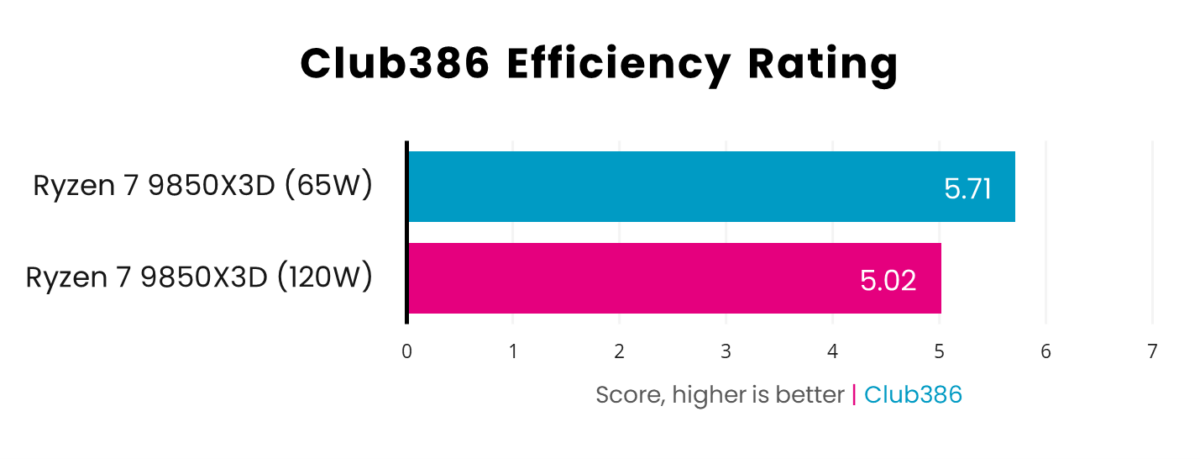
Taking the 65W and 120W Cinebench 2024 multi-core scores and dividing them by system power consumption, we arrive at our Club386 Efficiency Rating. Unsurprisingly, considering performance fell by 7.13% and wattage was down 18.45%, the Ryzen 7 9850X3D almost jumps up by a whole point.
Conclusion
Were I putting together a system with an AMD Ryzen 7 9850X3D at its heart, I’d seriously consider capping its TDP to 65W without much hesitation. There’s practically no difference in single-threaded gaming performance versus stock wattage, and the decrease in multi-threaded performance in content creation software isn’t that severe either, especially when you consider the substantial drop in power draw and operating temperature.
As I mentioned briefly earlier in this piece, the 65W Eco Mode would particularly benefit smaller builds. Following this experiment, I’m keen to reduce the wattage available to the 9800X3D inside my mini-ITX build I put together at the tail-end of last year. I expect temperatures will drop almost as sharply, making the rig quieter and less of a pseudo heater for my room.
If you’re after absolute performance, stick with the 120W mode, but there’s no denying the Ryzen 7 9850X3D is an impressively powerful gaming CPU even at 65W.